Photo Jottings - Page 45 of 127 - Photography equipment expertise

Here’s a brief look at the Sony Carl Zeiss Vario-Sonnar T* DT 16-80mm F/3.5-4.5 zoom lens.  Scroll down for the main review.

Lens
SAL-1680Z  Carl Zeiss Vario-Sonnar T* DT 16-80mm F/3.5-4.5 zoom lens
Box contents
Front and rear caps, hood, nice carrying case and users manual.
Cost
$998 retail
Build quality
Good
Additional information
Performs much the same as the less expensive Sony 16-105mm.  For APS-C cameras.
Specifications below
Optical configuration
14 elements in 10 groups
Angle of view
83°-20°
Aperture
7 blades, circular
Full frame and APS-C
APS-C.  Not for full frame, but will work.  Nearly full coverage at 80mm, infinity focus, but APS-C size capt. crops the images using the A900.
Depth of field and focus scales?
Focus distance window
Minimum focus, image plane to subject
14″  (350mm)
Minimum focus, end of lens barrel to subject
6.5″  (165mm)
Hard stop at infinity focus?
Yes
Length changes when focusing?
No
Focus ring turns in AF?
No
Filter size
62mm
Filter ring rotates?
No
Distance encoder?
Yes
Max magnification
0.24x
Min. F/stop
F/22-29
Sony teleconverter compatible?
No
Length changes when zooming?
Yes
Dimensions WxL  (my measurements)
2.8″ x 3.3″   72mm x 83mm
Maximum  extended length (my measurements)
5.0″  (127mm)
Weight bare (my scale)
15.5oz  (440g)  16.5oz (468g) with caps

Let’s check out some shots of the lens
.

Aug08/cz80box.jpg
Box and lens.
Aug08/cz80ft.jpg
Front element.
Aug08/cz80sd.jpg
Side, drawn in.
Aug08/cz80sdex.jpg
Fully extended.
Aug08/cz80bk.jpg
Backside.
october08/cz1680lensdatamtf.jpg
MTF data, Sony screen grab.
october08/cz1680lensdata2.jpg
X-ray view, Sony screen grab.
The Sony A700 was used for this review.  For a better understanding of my review methods and terminology, go here.
This lens is a DT APS-C type, meaning it’s not meant for a full frame or film camera, but it will work, and crop the images accordingly on the A900.  This lens is also similar to the Sony 16-105mm, so if you want to compare them, go here.  Also check out the 16-50mm F/2.8 for better low light performance, at a lower price.
For $1000 you get a well built lens, hood, nice carrying case and a fancy lens cap with not only the alpha symbol, but with the blue “Zeiss” logo too!  Notice the “ZA” on the front of the lens, it’s also on the box and manual.  It stands for Zeiss Alpha mount manufacturing.  Sony claims the lens has two aspheric elements, see image above.  It’s made in Japan.
The lens has a matte black type finish that is slightly different from the rest of the Sony lineup, it’s rougher and duller.  The rubber ribbed grip area is ever-so slightly different than the regular Sony lenses and the hood has an anti-reflective finish, again, different from the regular hoods from Sony.  Size and weight wise, it’s about the same as the 18-250mm and 16-105mm.  It has a distance window with FT/M and white zoom indexing numbers at 16, 24, 35, 50 and 80.  Build quality is good, with a nicely tooled metal mount, but zoom and focus action could be a little easier and more precise in my opinion.
Filter size is 62mm, which is the same as the Sony 18-200mm, 18-250mm, 24-105mm, 16-105mm and 70-300mm G SSM.
Filter use.   Normal filters cause a tiny bit of additional vignetting at 16mm, F/3.5, nothing really to worry about.

Zooming.  A little sticky sometimes, otherwise average.  There’s no lock but you shouldn’t need one as the zoom is damped somewhat tight.  The distance marks match up in the EXIF data.

Manual focusing is ok, but you only have about 1/8 turn from close to infinity focus, so hopefully you have good hand-eye coordination.  There is a little play in the focus ring, and the action is stiff, it may loosen with use.  Auto-focusing is pretty quick and accurate, I had no troubles with the A700.

Sony Carl Zeiss 16-80mm F/3.5-4.5 aperture/focal length guide below.
Maximum aperture
          F/3.5
       F/4
        F/4.5
Range
16mm – 18mm
20mm – 30mm
35mm – 80mm


Check out the Distortion below.


Aug08/cz1680brl.jpg
Barrel distortion at 16mm (24mm equivalent)
Aug08/cz1680pin.jpg
Pincushion at 80mm (120mm equivalent)
Distortion on the Sony 16-80mm lens is moderate to strong at 16mm, flat at 24mm-35mm, then mild to moderate pincushion starting around 50mm, but it’s not too bad, even at 80mm.  This is average performance for Sony wide zooms.
Color is no different from the rest of the Sony lineup.
Coma.  Very light wide open at 16mm.  I see some odd light streaks in the extreme corners.  See crops below.
Lens flare/ghosting is average, or slightly above average depending on focal range, sun intensity and background.  Look for a couple of small red/green blobs when the low sun is in the image at the 16mm end.  At the long end, there’s almost nothing.  Everything looks good with the sun centered in the image, at both ends.  At wide angle, 16mm, the hood works pretty well to control ghosting but use your hand for best control when the sun is not in the image.  Replacing the hood will cost you a whopping $50, and labeled by me as a Sony massive profit generator.
Lateral color fringing.  Control here is average.  Moderate amounts of red/purple along the image periphery in high contrast areas.  This lens has better control than the Sony 16-105mm F/3.5-5.6.
Bokeh looks good with the aperture wide open, but becomes a little busy stopped down.  See crops below.
Light fall-off below.
      16mm F/3.5
     16mm F/5 .6
october08/cz1680vigw35.jpg
october08/cz1680vigw56.jpg
     80mm F/4.5
     80mm F/5 .6
october08/cz1680vigtel45.jpg
october08/cz1680vigtel56.JPG


Light fall-off or corner darkening is moderate at 16mm wide open, but one stop down and it isn’t noticeable in real shots.  At the long end, there’s nothing to worry about.  See real shot below.


Random shots below.


    16mm @ F/3.5 Light fall-off
  16mm @ F/5.6 color blobs
october08/02czlf.JPG october08/cz1680sunfl.jpg
    16mm @ F/3.5 bokeh
  16mm @ F/5 bokeh
october08/cz1680bokw35.jpg october08/cz1680bokw50.jpg
    80mm @ F/4.5 bokeh
  80mm @ F/5.6 bokeh
october08/cz1680boktel45.jpg october08/cz1680boktel56.jpg
    16mm @ F/3.5 coma
  16mm @ F/5 coma
october08/cz1680cmaw35.jpg october08/cz1680cmaw5.jpg
The top left shot shows light fall-off in a real picture, it’s noticeable, but you wouldn’t need to shoot at F/3.5 in broad daylight, stop down to F/5.6 and there’s no problem.  The top right shot is ghosting with the sun low in the sky, this is pretty light and would clean up easy in post processing.
Bokeh examples in the middle row.  The wide-open shots look fairly good, but stopped down it starts to become busy.  Better than average bokeh for this zoom range.
The bottom row shows coma.  The light streaks are something new for Sony lenses I’ve tested, and I’m not sure what the cause is. The Sony 18-200mm F/3.5-6.3 also has some of this.  Coma is controlled quite well, even wide open at all lengths, and is above average, and better than the Sony 16-105mm.  The light streaks can be seen in the corners in a screen sized shot between F/3.5-5 near 16mm.
How sharp are the 16mm corners?

    16mm @ F/3.5
  16mm @ F/5.6
october08/cz1680cnw35xx.jpg october08/cz1680cnw56xx.jpg
    16mm @ F/8
  16mm @ F/11
october08/cz1680cnw80xx.jpg october08/cz1680cnw11xx.jpg


80mm corners next.


    80mm @ F/4.5
  80mm @ F/5.6
october08/cz1680cntel45.jpg october08/cz1680cntel56.jpg
    80mm @ F/8
  80mm @ F/11
october08/cz1680cntel80.jpg october08/cz1680cntel11.jpg

The 16mm corners look slightly soft at F/3.5, but a stop down or so and they’re sharp.  There isn’t much difference in sharpness at F/8, and beyond that there’s softening of the corners (and whole frame) at F/11.  The corners towards the telephoto end show no real sharpening as you stop down.  The biggest gains are what you see above.  This is impressive performance and better than average for this type of lens.
Next we’ll check out the 16mm center sharpness.

    16mm @ F/3.5
  16mm @ F/5.6
october08/cz1680ctrw35.jpg october08/cz1680ctrw56.jpg
    16mm @ F/8
  16mm @ F/11
october08/cz1680ctrw80.jpg october08/cz1680ctrw11.jpg


80mm centers next.

    80mm @ F/4.5
  80mm @ F/5.6
october08/cz1680ctrtel45.jpg october08/cz1680ctrtel56.jpg
    80mm @ F/8
  80mm @ F/11
october08/cz1680ctrtel80.jpg october08/cz1680ctrtel11.jpg
You can plainly see by looking at the crops that the centers are pretty sharp all the way around, at both ends.  Wide-open apertures are slightly soft, but you see it only at or near 100% viewing sizes.  One stop down and the centers hit maximum sharpness.  F/11 softens ever so slightly, more noticeable at 80mm, but is still completely usable.

The Macro test next.

Below, check out the sample and click the picture to see a cropped portion of the full image, (292kb file).  The sample shot was taken with the Sony A 700 12.2MP camera.  The subject is a standard US stamp, 1″x 3/4″ or 25.4mm x 19mm.  Also, note the macro shot was taken as close to the subject as focusing allowed; In this case, 6 1/2″ or 166mm, measured from the front of the lens barrel to the subject.

Close macro. 100% crop, click for full size- -292kb.
Very apparent here is the nice sharp image that covers the stamp.  The shot was taken at F/8, but it’s about the same at F/5.6.  The Sony 16-105mm F/3.5-5.6 has an even sharper macro shot than the Carl Zeiss 16-80mm, see the comparison review here.

Now for the conclusion.

The Sony Carl Zeiss Vario-Sonnar T* 16-80mm DT F/3.5-4.5 ZA is a fairly expensive ($1000) lens, but turned in a solid performance all the way around and is worth the price if you like very sharp images with this focal length.  At F/5.6, this lens is near perfect, especially as you zoom out, and would make a great permanent lens on your APS-C camera.  Consider the less expensive and faster Sony 16-50mm F/2.8 SSM, it turned in a solid performance similar to the Carl Zeiss 16-80mm.  Both lenses have a very practical focal range, and are about the same size.

Look below for the difference in 16mm and 18mm.

The desk scene shows the somewhat subtle 2mm wide advantage, but in a small room it can make a big difference, especially when trying to photograph a bunch of people.

18mma.jpg
18mm or 27mm equivalent
18mma.jpg
16mm or 24mm equivalent
Full review of the Sony Carl Zeiss 50mm F/1.4 SSM Planar T* lens. 

summer2013/s50zbox.jpg
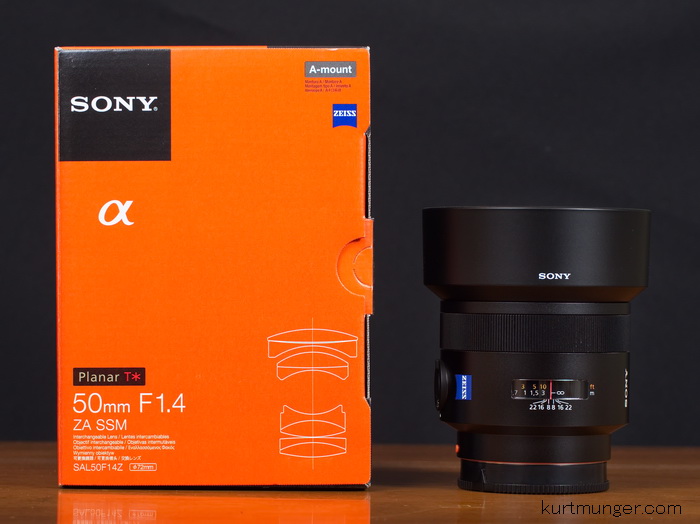
Box and contents
The Sony A77 and A900 were used for this review.  For a better understanding of terms and methods used in this review, go here.
The usual center, mid-section and corner crops are located at the very bottom of the page.
Introduction.
The full frame coverage Sony Carl Zeiss 50/1.4 Planar T* SSM lens was introduced in late 2012, and became widely available in mid-to-late 2013; it’s an all new design using 8 elements in 5 groups, with SSM.  Sony and Minolta users have been patiently waiting for an upgraded fast 50mm lens for quite some time.  The Minolta designed Sony 50/1.4 lens goes back to 1985, and received a few upgrades in coatings, aperture and outer design through the years, but the actual optical design (7 elements in 6 groups) I think goes back even farther to 1979 with the manual focus Minolta 50/1.4 MD Rokkor-X.  The Sony 50/1.4 was a good lens back in the day, but at wide apertures it is soft, and not up to 21st century standards in my opinion, even the Sigma 50/1.4 HSM is superior at wide apertures.
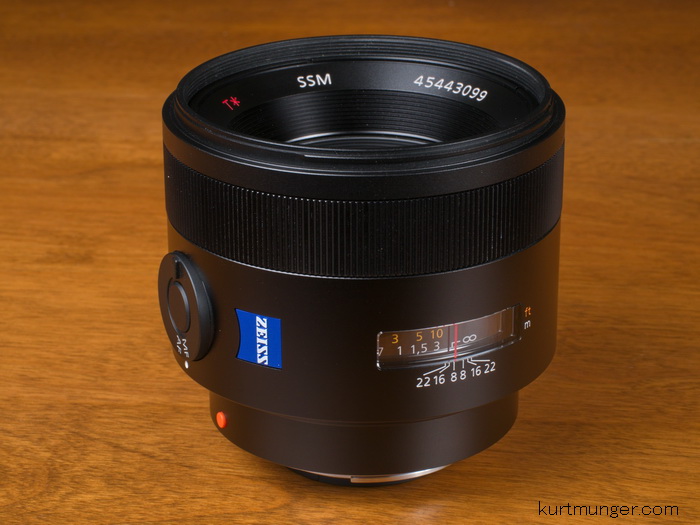
Found on the outside of the lens is an AF/MF switch, and focus hold button, which can be changed to DOF on certain camera bodies.  Also, normal on prime lenses from Sony is a focus distance scale under a clear plastic window with depth of field hash marks.  The Sony CZ 50mm F/1.4 has an aluminum body, and of course the distinctly smooth CZ metal mount.  Build quality is very good, with a nice fit and finish, and it feels solid in the hand, it’s very similar in size and weight to the CZ 85/1.4.  Sony says the lens is ‘dust and drip’ resistant, but the question here is how many ‘drips’ is it going to take to void the warranty?  I hear Sony is good about reasonable repairs under warranty, so maybe I’m a bit over cautious.  The lens body has an appealing black paint finish, similar to other Sony Carl Zeiss prime lenses.  Filter size is 72mm, which is used on many of Sony’s primes, like the 85/1.4, 24/2, 20/2.8 etc, see full list in the summery.
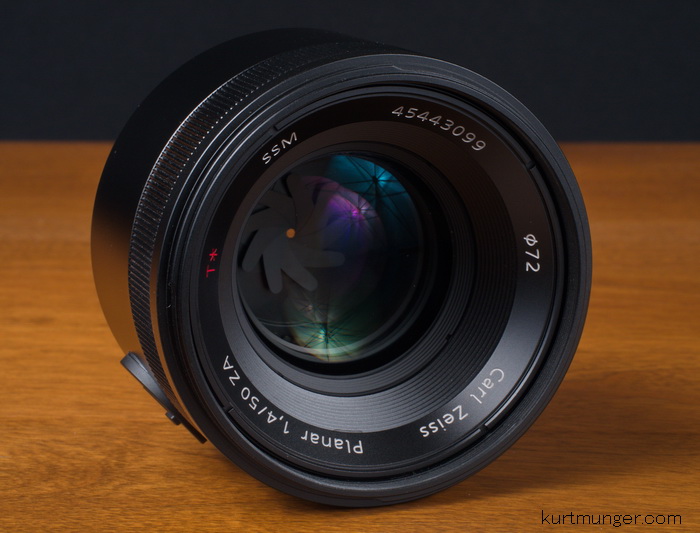
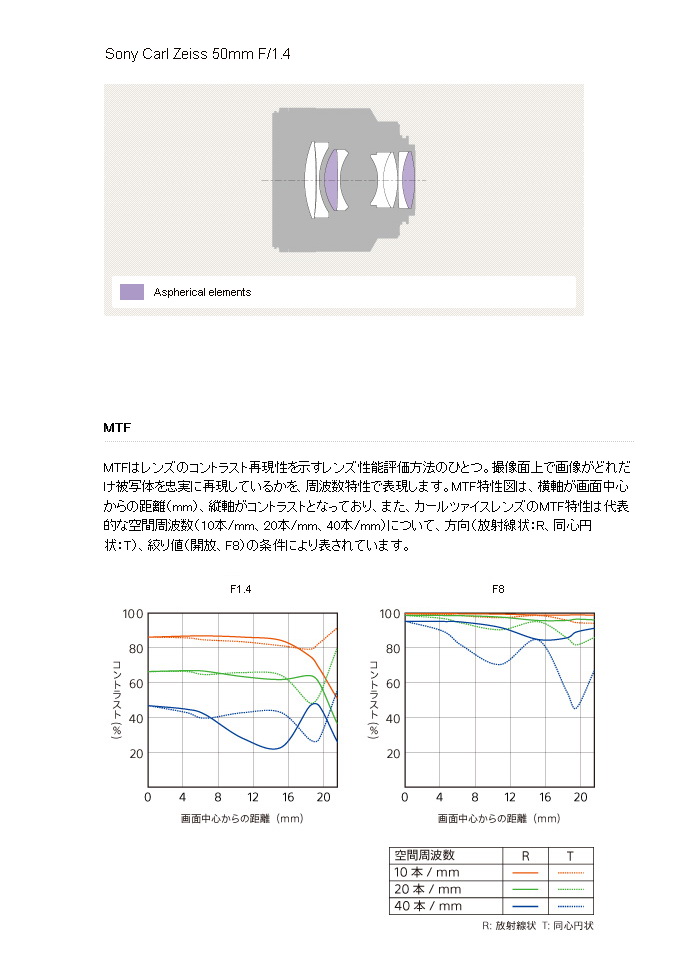
Sony claims the use of 2 aspherical, and 1 ED glass element in the design of the lens, although that is slightly ambiguous when reading Sony’s description of the lens on their website.  In keeping with the newer mirrorless lens designs, Sony has installed the aperture blades in the reverse, meaning the tips of the blades are showing through the front element, it’s usually the other way around.  The lens says ‘made in Japan’.
In the box is the lens, front and rear caps, a cheap plastic solid hood* (ALC-SH126), inspection card signed by the world famous H. Hirano(?), and owner’s manual.   *Note, for $1500, this lens should have a good metal hood with black flannel inside, not what looks like a Vivitar replacement hood with spray painted black undercoating on the inside.
Focusing.  The manual focusing ring is damped a tiny bit too much in my opinion, and is hard to turn with one finger, but It doesn’t “wander” when jiggling the camera.  Focus ring travel is 1/4 of a turn form close-up to infinity, which is a good amount of travel, and allows precise focusing, but will depend on your focusing ability and eye sight.
AF; This lens uses a focusing motor inside the body, called SSM or Super sonic wave motor.”  SSM is almost silent, and pretty fast, and it’s better than Sony’s cheap SAM system.  With SSM, you can over-ride the AF system by simply turning the manual focus ring after the AF locks.
When using F/1.4-2 at closer focusing distances I had to adjust the AF system for a persistent slight mis-focus, thankfully, it was resolved with a -6 micro adjustment with the A900, however, you may, or may not have to adjust your copy.  Longer focusing distances were perfect, even at F/1.4.
2594-kurtmunger-banner.gif
Requisite product shots.

summer2013/s50zsd.jpg
Side shot showing AF/MF switch, focus hold button, and bold ‘Zeiss’ logo.
summer2013/s50bk.jpg
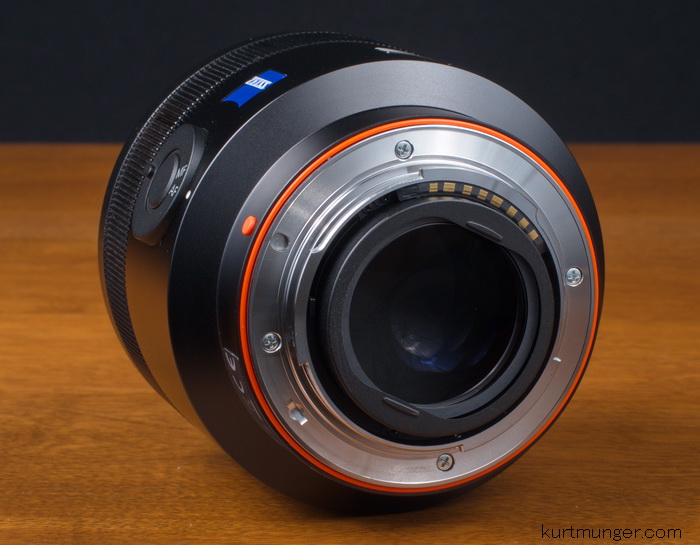
Back side showing very smooth machined Zeiss metal mount.
summer2013/s50zft.jpg
Deep set front element.
summer2013/s50zmtf.jpg
Sony X-ray view and incomplete MTF chart
General information and specifications.

Lens
Box contents
Front cap, rear cap, cheap plastic hood, and users manual.
Cost
Approximately $1499
Build quality
Very good.
Additional information
Became available in mid-2013.  A good alternative to this expensive lens is theSigma 50mm F/1.4 HSM, or the the Sony 50/1.4 that’s been around since 1985.
Specifications below
Optical configuration
8 elements in 5 groups
Angle of view
47˚ full frame,  32˚ APS-C
Aperture
9 blades, curved
Full frame and APS-C
Made for full frame, but works fine on APS-C cameras.
Depth of field and focus scales?
Depth of field hash marks, and focus distance scale in window.
Minimum focus, image plane to subject
17.4″  (442mm)
Minimum focus, end of lens barrel to subject
12.6″  (320mm)
Hard stop at infinity focus?
No.
Length changes when focusing?
No.
Focus ring turns in AF?
No.
Filter size
72mm.
Filter ring rotates?
No
Distance encoder?
Yes
Max magnification
0.14x or 1:7.1
Min. F/stop
F/22
Sony teleconverter compatible?
No
Length changes when zooming?
N/A
Dimensions WxL  (my measurements)
2.8″ x 3.2″   71mm x 81mm.
Maximum  extended length (my measurements)
3.2″  (81mm)
Weight bare (my scale)
18.2oz  (516g) bare.
Optical qualities summary.
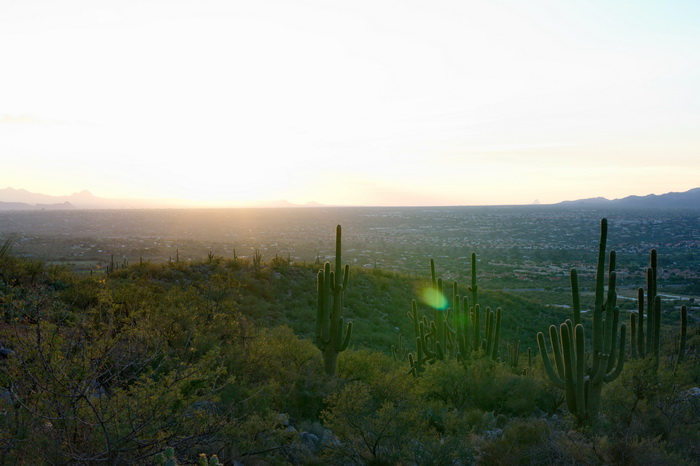
Lens flare/ghosting.  Above average control.  I see some small green blobs when the sun is directly inside the image in bright situations, but almost none otherwise.
Light fall-off.  Somewhat heavy on full frame wide open, and low on APS-C.  See samples below.
Color fringing (CA).  Lateral color fringing control is above average and hardly noticeable.  You see some axial color fringing also when the aperture is wide open, but it clears up mostly by F/2.8-4, see crops in the full frame section.
Bokeh.  Smooth, see examples below.
Color.  The same as other Sony lenses.
Close up filter.  N/A
Coma.  A tiny amount noticeable in the far corners at F/1.4; samples in FF section.
Regular filters cause no additional light fall-off problems using APS-C or full frame cameras.
Filter size.  72mm.  Other Sony lenses to use this size are the: 20/2.8, CZ 24/2, CZ 85/1.4, 135 STF, and the 16-50mm F/2.8.
Distortion.  Barrel type; minor on APS-C, moderate on Full frame.
summer2013/s50zdis.jpg
Very mild barrel distortion on APS-C.


Distortion is mild using an APS-C camera.

Light fall-off samples, (APS-C).
           F/1.4
              F/2
summer2013/s50zvig14.jpg
summer2013/s50zvig20.jpg

Light fall-off is very light and not a problem, even at F/1.4 with a filter attached.


Bokeh samples.

           F/1.4
             F/2
summer2013/s50zbok14.jpg
summer2013/s50zbok20.jpg
           F/2.8
             F/4
summer2013/s50zbok28.jpg
summer2013/s50zbok40.jpg


Bokeh in the center area looks smooth at all apertures, however, I see some spherochromatism at F/1.4-2.8, which causes that particular aperture bokeh to appear less smooth than at other apertures.  Spherochromatism shows itself as colored tinges around blurred highlights, such as when the foreground is blurred, you’ll get red outlined highlights, with the background blurred, you’ll get green outlined highlights, this goes away as you stop down, and is mostly noticeable on fast lenses when used wide open.  Bokeh along the sides of the frame is harsh at wide apertures, but that’s typical for this type of lens.  Distance to in-focus subject; about 7′ (2.1m) with the background about 16′ (5m) away.  The A900 was used for these images, I put them here as this is the normal place for Bokeh samples, and I’m too lazy to add anther crop table in the full frame section.


Color fringing.

           F/1.4
             F/2
summer2013/s50zgf14.jpg summer2013/s50zgf20.jpg
           F/2.8
             F/4
summer2013/s50zgf28.jpg
summer2013/s50zgf40.jpg


Axial color fringing occurs all over the image, but goes away as you stop down the aperture.  The stadium lights show some magenta fringes, but it goes away around F/4.  This is not a big deal as you can remove this issue in photoshop lightroom newer versions under ‘Chromatic aberrations’ and then ‘defringe’.


Maximum reproduction size.

Check out the cropped image of the stamp.  The sample shot was taken with the Sony A77 24MP camera.  The subject is a standard US stamp, 0.87″x 1.0″ or 22mm x 25mm.  Also, note the macro shot was taken as close to the subject as focusing allowed; in this case 12.6″ (320mm), measured from the front of the lens barrel to the subject.  
 
This lens has an approximate reproduction size of 0.14x (1:7.1) which is about average for this type of lens, and it turned in a sharp image of the stamp.  The stamp shot is displayed full size, but cropped.  As a side note; the “1996” on the bottom left of the stamp measures a mere 1mm wide.  
As close as you can get, F/7.1. Click for larger image.

_______________________________________________________________________


Full frame results using the Sony A900 below. 

Check out the differences when using a film or full frame camera below.  I’m only pointing out the noticeable issues as compared to the APS-C bodies, so if I don’t show it here, the results are not significantly different enough to warrant posting an additional set of images in this section.


Light fall-off

            F/1.4
              F/2
summer2013/s50zvig14ff.jpg
summer2013/s50zvig20ff.jpg
            F/2.8
              F/4
summer2013/s50zvig28ff.jpg
summer2013/s50zvig40ff.jpg


There is definitely more light fall-off using a full frame camera, with noticeably dark corners and mid-sections at F/1.4, but it clears up nicely by closing the aperture one or two stops.  Using a regular “thick” type filter produces little to no additional light fall-off.


Flare and ghosting.
summer2013/s50zgst2.jpg


Ghosting is kept to a minimum, with only some green blobs visible, and contrast holds up well when the sun is directly inside the image.  This is as bad as I could make it look in a real picture, even over-exposed as this one is.  If I waved the lens around in the sun at high noon you may see a little more ghosting.

Lateral color fringing.
summer2013/s50zcfsff.jpg


Technically, there is a hint of color fringing, (magenta) along the tree trunk sides, but in real use, there is none visible. This 100% crop was taken at the last 700 pixels from the left side.


Coma samples.

           F/1.4
             F/2
summer2013/s50zcoma14.jpg summer2013/s50zcoma20.jpg
           F/2.8
             F/4
summer2013/s50zcoma28.jpg
summer2013/s50zcoma40.jpg


Coma sometimes shows up in the corners of fast (F/1.4-2.8) wide to medium length lenses, and takes the forms of birds, bats, or jets!  The CZ 50/1.4 SSM has fairly mild coma at F/1.4-2, and almost nothing stopped down farther.  This performace is much better than the original Sony 50/1.4 lens.  For really bad coma see this review.  Crop is of a small Christmas tree at the very corner of the image, about 25′ (7.6m) away.

Full frame distortion.
summer2013/s50zffdis.jpg
Mild to moderate barrel distortion on full frame.


I see some moderate barrel distortion with full frame coverage, (although the curve looks simple); it’s almost completely repairable in post processing.

Conclusion. 

The Sony Carl Zeiss 50/1.4 SSM is very well built, with fast and accurate SSM focusing, excellent resolution even with the aperture wide open, and way above average control of lateral color fringing and Coma.  A couple of minor negatives as compared to the Sigma is the Zeiss has more light fall-off and more axial color fringing at wide apertures like F/1.4-2, and of course the price of the Zeiss is over three times that of the Sigma.  However, the Zeiss equals or excels in all other areas, so it’s worth a little more right?   But how much more, especially when you look at the current price of full frame offerings from Canon, and Nikon; and by ‘current’ I mean recently designed 50mm, F/1.4, (or this faster one for about the same price).  One might successfully argue that the Sony CZ 50/1.4 is built better, and possibly has better performance at very wide apertures, unfortunately, I don’t have any other 50/1.4 lenses to make any direct comparisons, but I can make some educated guesses between the lenses I’ve reviewed, so here goes……


Sony 50/1.4.  Lagging way behind both lenses below in resolution at F/1.4-4, and coma at F/1.4-2.8.  Probably close in all around performance at F/5.6 on down.


Sigma 50/1.4 HSM.  Resolution about the same as Zeiss at all apertures.  Coma stronger at F/1.4-2 than Zeiss.  Flare and ghosting control not as good, build quality good, but not like the Zeiss.  No focus hold button.


Carl Zeiss 50/1.4 SSM.  Build quality the best by far. Coma control the best.  Bokeh smoother than Sigma, about the same as the Sony.  Flare and ghosting control better than Sigma, about the same as Sony, focusing slightly faster and more accurate than Sigma, about the same as the Sony, (your results may vary depending on camera used).  Light fall-off stronger than Sigma, and axial color fringing stronger at F/1.4-2.


Which one is best for…?


Landscapers that won’t be using any aperture below F/5.6: the old Sony 50/1.4 is just fine, plus, it’s smaller and much less expensive than the Zeiss.  Stopped down resolution differences are probably not noticeable unless flipping back and forth between images at 100%.   The Sigma is generally less expensive than a new Sony, so if you don’t mind the extra bulk and weight, I’d go with the Sigma 50/1.4 HSM.


Low light hand held street shooting: the Sigma will be adequate, but watch the focusing, depth of field is slim at F/1.4, so focusing is crucial, and the Sigma AF system is not always as reliable and accurate as Sony; meaning one sample may be right on, another will be way off.  People that don’t want to gamble with potential quality issues from Sigma should spring for the Zeiss.


Budget conscious people looking for resolution only; the Sigma is by far is the best choice, assuming you get a copy similar to the one I reviewed.


APS-C users; I’d go for the 35/1.8, it’s the same basic coverage, and works very well.  Based on optical performance, it’s a much better bargain that the Zeiss.  Also, contrary to popular belief, using the Zeiss on an APS-C camera actually degrades the performance as the full frame sides are actually slightly sharper than at the mid-sections where the APS-C sides would be.


Is it really worth $1500?  When you compare it with the Sigma, probably not, but when compared to the older Sony 50/1.4 it is a very welcome upgrade, and if you’re using a full frame Sony camera, it’s the only high quality choice you have.


2594-kurtmunger-banner.gif


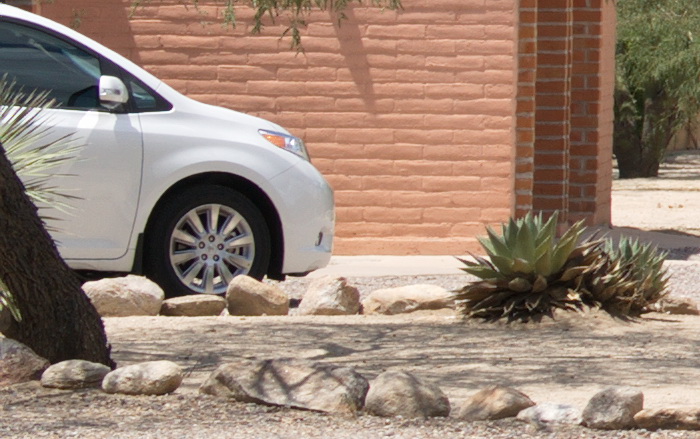
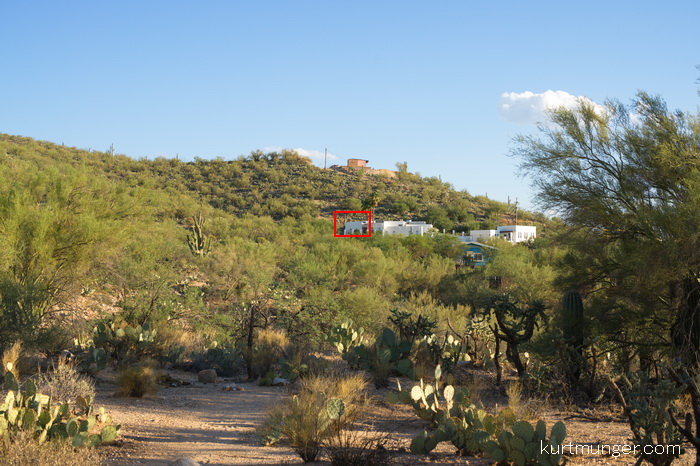
Full image showing crop area.

summer2013/s50zover.jpg


Sample crops from the centers, mid-sections and corners.

          Center
          Mid-section
             Corner
F/1.4
summer2013/s50zctr14.jpg
summer2013/s50zmid14.jpg
summer2013/s50zcornerr14.jpg
F/2
summer2013/s50zctr20.jpg
summer2013/s50zmid20.jpg
summer2013/s50zcornerr20.jpg
F/2.8
summer2013/s50zctr28.jpg
summer2013/s50zmid28.jpg
summer2013/s50zcornerr28.jpg
F/4
summer2013/s50zctr40.jpg
summer2013/s50zmid40.jpg
summer2013/s50zcornerr40.jpg
F/5.6
summer2013/s50zctr56.jpg
summer2013/s50zmid56.jpg
summer2013/s50zcornerr56.jpg
F/8
summer2013/s50zctr80.jpg
summer2013/s50zmid80.jpg summer2013/s50zcornerr80.jpg
F/11
summer2013/s50zctr11.jpg summer2013/s50zmid11.jpg
summer2013/s50zcornerr11.jpg


At F/1.4, the centers are very sharp, but there is some axial color fringing and a little veiling haze; thankfully, both are gone by F/2.8, where the centers are tack sharp with great contrast.  The mid-sections are a little soft when compared to the very sharp centers, but they sharpen up well at F/2.8, and are almost as sharp as the centers at F/5.6.  The corners are also somewhat soft (relatively speaking), but look good at F/2.8, and great at F/5.6.  In fact, the corners are a tad bit sharper than the mid-sections if you look closely, and that matches up with the MTF graph in the product shot section. 

At F/8, the crops are all about the same in sharpness, which is spectacular!

One expects the centers of all lenses to be very sharp now days, even at F/1.4, but the side, and corner performance of this lens is stunning!

The mid-sections were taken from the same place as the APS-C extreme corners would be.  Exposure differences are from light fall-off.  Distance to subject is around 303′ (92m).

That’s it for the review.  Please check out the Sony Carl Zeiss 50/1.4 SSM at B&H Photo to help support my site, thanks!

Sony CLM-V55 clip-on monitor

Did you ever wish you could have a better, and bigger main LCD on your camera, one that makes it easier to focus and compose on?  The Sony CLM-V55 is one such product.  This screen is great for old folks that can’t see too well anymore, or anybody else that has problems seeing the standard 2.5″ or 3″ camera LCDs.  Even if your current camera screen is VGA quality, like most Sony DSLR, SLT and NEX cameras screens are now, the Sony 5.0″ portable monitor is a big step up.


MAY2011/sonyv55box.jpg


Inside the box is the monitor, folding hood, accessory shoe for Sony, and shoe adapter for other brands,  gray carrying pouch,  18″ (450mm) HDMI cable and owner’s manual.   Funny, the pouch has an orange tag stitched at the seam with “Sony” printed on it, a rip-off of the “levi’s” tag.

You don’t need to have a Sony camera to use this item, any camera or camcorder that supports HDMI output will work.

This is a quick review of the Sony CLM-V55 monitor, covering box contents, use on still cameras, with, and without live view.
When you open the box and take out the monitor, it looks a little small and disappointing, but after you use it for a while, then go back to the small camera screen, you really miss it.  The screen quality is very good, with excellent contrast and colors, although the camera screen seems a little more colorful for some reason.  However, the CLM-V55 screen can be adjusted for brightness, contrast, color tone and color temp, plus other stuff.  There is also a “pixel-by-pixel” magnification feature which uses the whole screen, but if you’re using it to focus with, live view focus check (on some Sony cameras) does the same thing.
The entire screen (aspect ratio 15:9) is not used unless pixel magnification is selected, all other use has very narrow black bands at the top and bottom, or along the sides depending on the display selection.
Viewing angle is very wide, if you have the shade on, the screen looks the same from all viewable angles.
The screen is light-weight and small enough when folded up to fit in a back pocket comfortably, but don’t sit on it!  You really don’t notice the weight when mounted on a mid-size to large camera.
Thoughts from my somewhat limited use on still cameras; for cameras without live view and video, like the A700/900 etc—still worth a hard look.  If you have trouble seeing everything in the camera screen, or your camera screen doesn’t tilt, this LCD would solve those problems.  For live view cameras with tilt screens; it would be a nice accessory as you can see the focus point much easier, and shooting and watching video is more enjoyable.
The Sony CLM-V55 is pretty expensive, especially if you buy a battery for it, (there is no battery included).  You can get a cheap laptop for the price of those items, but a laptop is not very handy, and cheap laptops have awful screens.  If you don’t use a tripod much or shoot video, it doesn’t make much sense to get this.  But….if you do use a tripod often for indoor photography, or shoot a lot of videos, this monitor is very addictive.


SonyStyle.com website for this item here.


MAY2011/sonyv55monbk.jpg


This is the back of the monitor showing the battery compartment and sun shade (hood) extended, this device just snaps on the monitor and folds up when you don’t need it.  A battery is not included, but takes the same one (NP-FM500H) as most intermediate and pro Sony DSLRs.  It also takes some big video camera batteries, like the NP-QM71D or NP-QM91D.  Note; the battery level for the CLM-V55 is not indicated on the LCD, the little light by the power button turns green when the batter has power, and red when it’s low.  It’s supposed to turn white in AC mode, but I couldn’t confirm that because I don’t have the AC adapter.

The speaker (monaural) is on the back under all the holes.  It also has a 3.5 stereo mini jack for head phones, and the monitor has a sound level adjustment.

The monitor has a standard 1/4″-20 tripod socket, with the other hole being a plug receptacle to stop rotation.  There is no need to mount the LCD to the camera’s hotshoe, it uses no power or signal, the hotshoe is just providing a place to mount the screen.  You can put it on a tripod beside the camera if you want.  There’s a bracket made by Sony for mounting the screen and camera together using the camera’s tripod socket.


Mounted on A580.

MAY2011/sonyv55mondown.jpg


Mounted on the Sony proprietary hotshoe and plugged in with included HDMI cable.  You can only view one screen at a time, if you turn on the CLM-V55 monitor, the camera screen turns off automatically.  There may be a way to keep both screens on, depending on camera HDMI control.

On the Sony A900/700, when you turn off the CLM-V55 power, both screens are blank, you need to unplug the HDMI cable to get the camera screen to power up.  Again, there could be a work-around, but I’m not aware of any at this time.


MAY2011/sonyv55monup2.jpg


The big screen shows the exact same thing as the small screen, including focus areas, grid lines, digital leveler, camera settings, help menu etc.  You can tell the difference in screen size very easily in this photo.


MAY2011/sonyv55monbkft.jpg


This is the front view, showing the battery mounted in place.  The LCD swings around to the front if you want, and back and forth 90°.


MAY2011/sonyv55peak.jpg


This is the “peaking” screen, it turns black and white in this mode, with the “peak” in-focus areas in color.  Even the normal display data is rendered as as “peak.”  This feature isn’t very handy in my opinion, it shows areas that are supposed to be in focus, but really aren’t.  There seems to be a broad focusing range for being “peak” and you’ll wind up with an out of focus shot if you strictly go by this feature.  I’d rather just check the screen.  In this shot, the window blinds are showing “peak” but everything in the image is sharp, not just the blinds.  I was focusing on the curio cabinet.


That’s it for this review, if you’d like to support the site, check out the Sony CLM-V55 clip-on monitor by using the link, thanks!

Sony CZ 16-35mm F/2.8 and Sony 35mm F/1.4

Comparison at 35mm.  People have written to me and asked about how the new Sony Carl Zeiss zooms compare to the older AF prime lenses, such as the Minolta AF 35mm F/1.4, or in our case here, the updated but still old Sony 35mm F/1.4.  Well, the only way to find out the differences between the lenses is to do a direct comparison.  This time I cover center and corner sharpness, distortion and ghosting, and use the Sony CZ 16-35mm F/2.8 at 35mm, and the Sony 35mm F/1.4.
To sum up the differences quickly, the Sony 35mm is sharpest in the corners and along the sides, and also has much less light fall-off.  When stopped down to F/8, about the only differences are the light fall-off, which is very apparent in CZ crops.  The Sony A900 was used in this comparison.
Check out the center crops below.
Sony CZ 16-35mm F/2.8 @35mm                                 Sony 35mm F/1.4
          F/2.8
          F/2.8
Jan2010/cz28ctrx.jpg
Jan2010/s28ctrx.jpg
          F/4
          F/4
Jan2010/cz40ctrx.jpg
Jan2010/s40ctrx.jpg
          F/5.6
          F/5.6
Jan2010/cz56ctrx.jpg
Jan2010/s56ctrx.jpg
          F/8
          F/8
Jan2010/cz80ctrx.jpg
Jan2010/s80ctrx.jpg
          F/11
          F/11
Jan2010/cz11ctrx.jpg
Jan2010/s11ctrx.jpg


Both lenses are very sharp in the centers, even at F/2.8.  The exposure values are slightly different, as the Sony 35mm produced a brighter image than the CZ with the same exposure, so I made small adjustments to make them match better.  Also notice the Sony 35mm has slightly less coverage than the CZ does at 35mm.
Now for some corner crops.


Sony CZ 16-35mm F/2.8 @35mm                                  Sony 35mm F/1.4

          F/2.8
          F/2.8
Jan2010/cz28cnx.jpg
Jan2010/s28cnx.jpg
          F/4
          F/4
Jan2010/cz40cnx.jpg
Jan2010/s40cnx.jpg
          F/5.6
          F/5.6
Jan2010/cz56cnx.jpg
Jan2010/s56cnx.jpg
          F/8
          F/8
Jan2010/cz80cnx.jpg
Jan2010/s80cnx.jpg
          F/11
          F/11
Jan2010/cz11cnx.jpg
Jan2010/s11cnx.jpg


Noticeable here are the sharper corners of the Sony 35mm at F/2.8-4, which is a surprise.  As you stop down, the sharpness differences disappear.   Light fall-off is a bit heavy on the Sony CZ 16-35mm @35mm, and doesn’t get any better by stopping down.  All corner crops taken from (near) the last 500 pixels of the left lower corner.  The crop level differences are caused by the opposite distortion of each lens.


Distortion control


Jan2010/cz35disg.jpg
Sony CZ 16-35mm @35mm
Jan2010/s35disg.jpg
Sony 35mm F/1.4


The Sony 16-35mm shows some gradual moderate pincushion distortion at 35mm, which is easy to correct in post processing.  The Sony 35mm has some gradual moderate barrel distortion, and can also be eliminated in post processing.


Ghosting samples below.

Sony CZ 16-35mm @35mm F/5.6
Sony 35mm F/5.6
Jan2010/czgst2.jpg
Jan2010/s35gst2.jpg
Sony CZ 16-35mm @35mm F/5.6
Sony 35mm F/5.6
Jan2010/cz35gst1.jpg
Jan2010/s35gst1.jpg


Both lenses have some undesirable ghosting, but the Sony 35mm seems to produce a little more in certain situations.


Color fringing below.

Jan2010/czmid.jpg
Sony CZ 16-35mm @35mm
Jan2010/smid2.jpg
Sony 35mm


These color fringing crops were taken from about a third of the way to the middle, at the middle left side.  The Sony 35mm has more color fringing, seen mostly at the edges around the window, but what’s more noticeable is the sharper details at this area of the image from the Sony 35mm, both taken at F/5.6.


That’s all for this comparison, hope you enjoyed it.

________________________________________________________________________________________


Sony CZ 16-35mm F/2.8 and Sony 28mm F/2.8

Comparison at 28mm.  As I said in the comp before this one, people have written to me and asked about how the new Sony Carl Zeiss zooms compare to the older AF prime lenses, such as the Minolta AF 28mm F/2.8, or in our case here, the updated but still old Sony 28mm F/2.8.  Well, the only way to find out the differences between the lenses is to do a direct comparison.  This time I cover center and corner sharpness, distortion and ghosting, and use the Sony CZ 16-35mm F/2.8 at 28mm, and the Sony 28mm F/2.8.
To sum up the differences quickly, the CZ 16-35mm is sharpest in the corners and along the sides, which is a surprise, and also has less light fall-off and distortion.  The only time the Sony 28mm comes out ahead is maybe in flare/ghosting control, but that’s questionable.  Both lenses seem about the same in the centers, although for the absolute sharpest shots, the Sony 28mm has to be focused short from infinity at F/5.6-8.  The Sony 28mm F/2.8 is also relatively inexpensive at $269, and the Minolta version is about half of that.  The Sony A900 was used in this comparison.
Check out the center crops below.
Sony CZ 16-35mm F/2.8 @28mm                                 Sony 28mm F/2.8
          F/2.8
          F/2.8
Dec09/cz2828ctr.jpg
Dec09/s28x28ctr.jpg
          F/4
          F/4
Dec09/cz2840ctr.jpg
Dec09/s28x40ctr.jpg
          F/5.6
          F/5.6
Dec09/cz2856ctr.jpg
Dec09/s28x56ctr.jpg
          F/8
          F/8
Dec09/cz2880ctr.jpg
Dec09/s2880ctr.jpg
          F/11
          F/11
Dec09/cz2811ctr.jpg
Dec09/s2811ctr.jpg


Both lenses are pretty darn sharp in the centers, even at F/2.8.  The Sony 28mm drops a hair in sharpness at F/5.6-8, but a slight short focus from infinity will sharpen those apertures (images) up in the middle, and will match the CZ at the same apertures, but that trick won’t help in the corners.  All images have the same exposure values, although there are slight deviations visible.
Now for some corner crops.


Sony CZ 16-35mm F/2.8 @28mm                                  Sony 28mm F/2.8

          F/2.8
          F/2.8
Dec09/cz2828cn.jpg
Dec09/s28x28cn.jpg
          F/4
          F/4
Dec09/cz2840cn.jpg
Dec09/s28x40cn.jpg
          F/5.6
          F/5.6
Dec09/cz2856cn.jpg
Dec09/s28x56cn.jpg
          F/8
          F/8
Dec09/cz2880cn.jpg
Dec09/s28x80cn.jpg
          F/11
          F/11
Dec09/cz2811cn.jpg
Dec09/s28x11cn.jpg


Noticeable here are the sharper corners of the CZ 16-35mm zoom, which is a surprise.  The sides are the same as the corners on the Sony 28mm, and sharpness differences there are indicated in the color fringing crops at the bottom.  Light fall-off is a bit harsh on the Sony 28mm at F/2.8, but is almost gone at F/4.  Check out the color fringing on the corner crops of the Sony 28mm.  All corner crops taken from (near) the last 250 pixels of the right lower corner.


Distortion control


Dec09/cz28disb.jpg
Sony CZ 16-35mm @28mm
Dec09/s28disx.jpg
Sony 28mm


The Sony 16-35mm shows some gradual pincushion distortion at 28mm, which is easy to correct in post processing.  The Sony 28mm has some mild to moderate barrel distortion, although slightly wave-type, it can be almost eliminated in post processing.


Ghosting samples below.

Sony CZ 16-35mm @28mm F/5.6
Sony 28mm F/5.6
Dec09/cz28gst.jpg
Dec09/s28gst.jpg
Sony CZ 16-35mm @28mm F/5.6 sun centered
Sony 28mm F/5.6 sun centered
Dec09/cz28gst3.jpg
Dec09/s28xgst2.jpg


Both lenses have some ghosting, and personal preferences may kick in here, so pick your winner.


Color fringing below.

Dec09/cz28cf.jpg
Sony CZ 16-35mm @28mm
Dec09/s28xcf.jpg
Sony 28mm


These color fringing crops were taken from the first 700 pixels of the middle/left side.  The Sony 28mm has more color fringing, but that’s overshadowed by the sharpness issue, both taken at F/5.6.  That’s all for this comparison, hope you enjoyed it.


________________________________________________________________________________________


Sony CZ 16-35mm F/2.8 and Minolta AF 24mm F/2.8

Comparison at 24mm.  People have written to me and asked about how the new Sony Carl Zeiss zooms compare to the older prime lenses, such as the Minolta AF 24mm F/2.8 lens.  Well, the only way to find out is to do a direct comparison.  This time I cover center and corner sharpness, distortion and ghosting, and use theSony CZ 16-35mm F/2.8 at 24mm, and the Minolta AF 24mm F/2.8.
In a nut-shell, the Sony looks marginally sharper in the centers between F/4-8, but the F/2.8 and F/11 crops are very similar between the two.  The corners are easily sharper at larger apertures with the Sony, but F/11 looks a hair sharper with the Minolta.  Distortion is basically flat with the Sony zoomed to 24mm, which is no surprise, the Minolta showing mild barrel distortion. Ghosting was better controlled with the Minolta, with similar results from the comparison below with the Sony 20mm F/2.8 lens.  The Sony A900 was used in this comparison.
Check out the center crops below.
Sony CZ 16-35mm F/2.8 @24mm                                 Minolta AF 24mm F/2.8
          F/2.8
          F/2.8
Dec09/cz28.jpg
Dec09/m28.jpg
          F/4
          F/4
Dec09/cz40.jpg
Dec09/m40.jpg
          F/5.6
          F/5.6
Dec09/cz56.jpg
Dec09/m56.jpg
          F/8
          F/8
Dec09/cz80.jpg
Dec09/m80.jpg
          F/11
          F/11
Dec09/cz11.jpg
Dec09/m11.jpg


Both lenses are pretty darn sharp, even at F/2.8.  I notice the Minolta 24mm looks slightly sharper at F/11, that’s weird.  I’d say the Sony 16-35mm has marginally more contrast at F/4-8, so those crops look better in my opinion.  All crops above and below were taken at infinity focus.  You may notice the Sony 16-35mm shows greater coverage than the Minolta when set to the index mark at 24mm, so the Sony is at a very slightdisadvantage in the sharpness crops.
Now for some corner crops.


Sony CZ 16-35mm F/2.8 @24mm                                  Minolta AF 24mm F/2.8

          F/2.8
          F/2.8
Dec09/cz28cn.jpg
Dec09/m28cn.jpg
          F/4
          F/4
Dec09/cz40cn.jpg
Dec09/m40cn.jpg
          F/5.6
          F/5.6
Dec09/cz56cn.jpg
Dec09/m56cn.jpg
          F/8
          F/8
Dec09/cz80cn.jpg
Dec09/m80cn.jpg
          F/11
          F/11
Dec09/cz11cn.jpg
Dec09/m11cn.jpg


The Minolta 24mm corners are quite soft unless stopped down to F/8, although the Minolta 24mm F/11 crop is sharper than the F/11 crop of the Sony 16-35mm.   The corner crops were taken about 350 pixels from the lower left corner.  Exposure differences are from light fall-off.


Distortion control


Dec09/sczdis.jpg
Sony CZ 16-35mm @24mm
Dec09/m24dis.jpg
Minolta AF 24mm


The Sony 16-35mm is in the middle of the zoom, and is flat at 24mm, which can normally be expected.  The Minolta 24mm has some mild distortion, but not enough to make much of a difference unless straight lines are near the edges of the frame as I show here.


Ghosting samples below.

Sony CZ 16-35mm @24mm F/5.6
Minolta AF 24mm F/5.6
Dec09/sczgt.jpg
Dec09/m24gt.jpg


The Minolta 24mm looks as though it’s a little cleaner when the sun is in the picture.


Color fringing below.

Dec09/czcf.jpg
Sony CZ 16-35mm @24mm
Dec09/m24cf.jpg
Minolta AF 24mm


The Sony 16-35mm shows much less lateral color fringing than the Minolta.  These crops were taken from the bottom left/center of the image, at F/11.  That’s all for this comparison, hope you enjoyed it.


________________________________________________________________________________________


Sony CZ 16-35mm F/2.8 and Sony 20mm F/2.8

Comparison at 20mm.  Quick sum up; I notice the Sony 16-35mm is slightly sharper at F2.8, which is a surprise, and seems to have a noticeable sharpness edge throughout most of the aperture range.  The Sony 20mm is sharpest at F/4, then degrades a very small amount as you stop down, I noticed this during the initial review during the close focus shots and it seems to carry through at infinity focus also.  If you short focus at F/5.6-11, you can gain a little better sharpness at those apertures.  Go here to see what I’m talking about.  For instance, at F/8, you would back off the infinity mark by about half the distance (in total width) of the infinity symbol.  This is a little out of the ordinary, but I see this also to a lesser extent in the Sony 28mm F/2.8.  The Sony 16-35mm is as sharp, or sharper at all apertures in the centers if you don’t fuss with the focusing on the Sony 20mm, otherwise they’re about the same.  The corners perform differently than the centers.  Although the Sony 20mm corners have slightly less contrast (and less light fall-off) between F/2.8-4, they sharpen up nicely at F/8-11, and the F/8-11 crops are noticeably sharper than the Sony 16-35mm crops beside them.  There are minor exposure variations between the two sets of shots, but the detail is what we’re looking at.  The corner crop exposure differences are from light fall-off, and were taken from approximately 350 pixels from the very corner.  The Sony A900 was used in this comparison.
Check out the center crops below.
Sony CZ 16-35mm F/2.8 @20mm                                                  Sony 20mm F/2.8
          F/2.8
          F/2.8
September2009/s28ctr.jpg
September2009/m28ctr.jpg
          F/4
          F/4
September2009/s40ctr2.jpg
September2009/m40ctr.jpg
          F/5.6
          F/5.6
September2009/s56ctr.jpg
September2009/m56ctr.jpg
          F/8
          F/8
September2009/s80ctr.jpg
September2009/m80ctr.jpg
          F/11
          F/11
September2009/s11ctr.jpg
September2009/m11ctr.jpg


It looks like F/4 is the sharpest for the Sony 20mm, and seems to match the 16-35mm at that aperture.  The Sony 16-35mm is sharper at all other apertures, you can see this by looking at the foliage.  As stated above, the Sony 20mm can be short focused at F/5.6-11 and will gain a small amount in sharpness.  All shots taken at infinity focus.
Now for some corner crops.


Sony CZ 16-35mm F/2.8 @20mm                                             Sony 20mm F/2.8

          F/2.8
          F/2.8
September2009/s28cn.jpg
September2009/m28cn.jpg
          F/4
          F/4
September2009/s40cn.jpg
September2009/m40cn.jpg
          F/5.6
          F/5.6
September2009/s56cn.jpg
September2009/m56cn.jpg
          F/8
          F/8
September2009/s80cn.jpg
September2009/m80cn.jpg
          F/11
          F/11
September2009/s11cn.jpg
September2009/m11cn.jpg


The Sony 20mm is very sharp in the corners at F/8-11, and is also a little sharper at F/5.6, again, noticeable in the foliage.  Also notice the lack of color fringing on the Sony 20mm, whereas the 16-35mm has mild to moderate amounts in the corners.  All shots taken at infinity focus.


Distortion at 20mm.

September2009/a1635.jpg
Sony 16-35mm at 20mm
September2009/a20.jpg
Sony 20mm @20mm


I don’t have the samples lined up exactly the same, but The distortion at 20mm is similar on both lenses, with the 16-35mm slightly flatter.


Ghosting samples below.

Sony 16-35mm @20mm F/5.6
Sony 20mm F/5.6
September2009/s1635dis.jpg
September2009/m20dis.jpg


This is a surprise, I thought the new Carl Zeiss zoom would have better ghosting control, but the 20mm prime easily has the best control when the sun is in the shot.

Here’s a brief look at the Sony 16-35mm F/2.8 SSM zoom lens.  Scroll down for the main review.

Lens
SAL-1635Z  Sony Carl Zeiss Vario-Sonnar T* 16-35mm F2.8 ZA SSM
Box contents
Front and rear caps, users manual, hood and soft case.
Cost
$1998 retail for original version, $2250 for II version.
Build quality
Very good
Additional information
New Carl Zeiss Sony design introduced in 2009, superseded by New ‘II’ version in 2015.
Specifications below
Optical configuration
17 elements in 13 groups
Angle of view
107°-63° full frame, 83°-44° APS-C.
Aperture
9 blades, curved
Full frame and APS-C
Yes, full frame and APS-C.   APS-C equivalent, 24-52.5mm
Depth of field and focus scales?
Focus distance window, and focal length index marks at 16mm, 20mm, 24mm, 28mm, and 35mm.
Minimum focus, image plane to subject
11″  (279mm)
Minimum focus, end of lens barrel to subject
4.35″  (110mm)
Hard stop at infinity focus?
No
Length changes when focusing?
No
Focus ring turns in AF?
No
Filter size
77mm
Filter ring rotates?
No
Distance encoder?
Yes
Max magnification
0.24x, or 1:4.2
Min. F/stop
F/22
Sony teleconverter compatible?
No
Length changes when zooming?
No
Dimensions WxL  (my measurements)
3.27″ x 4.5″   83mm x 114mm.   Add 2mm in width for AF/MF switch.
Maximum  extended length (my measurements)
4.5″  (114mm)
Weight bare (my scale)
30.4oz  (863g)  31.7oz (899g) with caps
Requisite product shots.
September2009/3161635sdrs2.jpg
Side view
September2009/1635kite.jpg
Box and contents
September2009/3401635bkrs.jpg
Backside
September2009/1635ftelcomprs.jpg
Front element drops 6mm @24mm
September2009/3431635ftelrs3.jpg
Front element
2012/cz1635mtf3.jpg
Sony X-ray view and MTF chart
The Sony A700 and A900 were used for this review.  For full frame results, go to the bottom of the page.  For a better understanding of terms and methods used in this review, go here.
Check out a comparison review that includes this lens.
This expensive Carl Zeiss super wide-angle zoom lens (made in Japan) features a constant fast aperture of F/2.8 with an very good build quality.  A professional photographer or advanced amateur may benefit from those features, and most importantly, be able to justify the high cost.  This lens was designed for a full frame camera.  If you have an APS-C camera, consider the much less expensive, (but much wider on that type of camera) Sigma 10-20mm, or Sony 11-18mm.  Other less-expensive full frame options include the Konica Minolta AF 17-35mm F/2.8-4, and the Minolta AF 17-35mm F/3.5 G.
The Sony Carl Zeiss Vario-Sonnar T* 16-35mm F/2.8 ZA SSM has a long and interesting name, that’s for sure.  Fortunately, this lens has other interesting features and characteristics as well.  On the outside, there is the usual Zeiss-type black finish, with the texture being different between the metal parts and the plastic parts.  Speaking of which, most of the outer barrel components are plastic, but the portion in front of the focus ring appears to be metal.  This lens sports an integrated AF/MF and focus hold button, which can be changed to DOF (depth of field) on select camera bodies.  There’s a focus distance window with readings for feet and meters.  Inside the lens, Sony claims the use of three aspherical elements, super ED glass¹, and of course the T* coatings.  ¹This is the first Sony lens that gets the “super” ED designation.
The zoom action is somewhat stiff, but it holds its position well, so there is no zoom creep.  Focal length index marks come at 16mm, 20mm, 24mm, 28mm and 35mm, and the EXIF data matches those lengths, except 28mm, which reads 26mm.  I also notice the EXIF data jumps quickly to 17mm at just a hair past 16mm, you almost have to hold the zoom at the full wide position to get the data to read 16mm-weird.  The zoom movement is internal, meaning the lens doesn’t change length when zooming.  It gradually drops the front group to a maximum depth of 6mm, coming at 24mm focal length, then rising gradually until reaching 35mm, (see photo above).  This is a different type of movement than the Minolta 17-35mm F/3.5 G lens, which drops farther, and is fully down at 35mm.
In the box is the lens, petal shaped plastic hood with a nice felt-type anti-glare covering on the inside, black vinyl softcase, owner’s manual, warranty card, and an inspection sticker signed by the inspector, in this case, H Hirano.
Focusing.  The focusing ring is at the front of the lens, and does not turn during auto-focusing.  You can override the auto focus at any time by just turning the focus ring.  All SSM have an over-drive type manual focusing system, that is, if you turn the focusing ring a certain amount, the distance numbers in the window will turn a lesser amount.  This allows for more precise manual focusing.  Manual focusing takes about 1/4 turn from Close-in to infinity, and doesn’t add any length to the lens.  Auto-focusing is quick and very accurate, but when used in the super wide lengths with close-in framing, you may have to override AF, as the focusing system may not be able to determine what you want to focus on since some items may be very close, and others farther away, that’s the nature of using a super-wide angle lens.  Note; don’t confuse SSM with SAM.  SSM (super sonic wave motor) is a very good focusing system designed by Minolta in the late 1990s.  SAM (smooth auto-focus motor) is a cheap (less effective) focusing system developed by Sony for use in less-expensive lenses, starting in 2009.  They both feature a focus motor inside the lens, instead of the camera body motor turning a coupled slot/screw to focus the lens.
Lens flare/ghosting.  Average to above average control for a super-wide angle zoom.  I see multi-color ghosts if the sun is at the edge, or inside the image.  The ghosts change shape and color with focal length and aperture.  Look below for examples.  Veiling glare seems a little strong as you zoom out, so prepare to block the sun or other super-bright light source with your hand to keep the contrast up in your shots, if the sun isn’t actually in the shot.
Color fringing (CA).  Above average control, when used on an APS-C camera.  Look for mild amounts of lateral color fringing at and near 16mm, diminishing to almost nothing at 35mm.  Full frame coverage shows more at the widest lengths.  See full frame section for sample crop. I see no axial color fringing at any aperture.
Bokeh.  Somewhat smooth looking at the wide end, with very light edges around the highlights, stopping down to F/4 looks about the same.  As you zoom out, the bokeh starts to become harsh when used at F/2.8, but looks better one stop down.  The aperture shape starts to show up around F/5.6.  Look below for sample crops.
Color.   Same as other Sony lenses.
Close up filter.  N/A
Coma.  No problems with APS-C cameras, full frame shows a small amount at F/2.8, see below.
Regular filters cause no additional light fall-off problems on APS-C cameras, but do affect full frame cameras at 16mm, see example at bottom.
Filter size is 77mm.  This is the standard size for all Minolta and Sony super-wide zooms.  Other Sony lenses that use 77mm filters are; CZ 24-70mm F/2.8, 70-200mm F/2.8 G, CZ 135mm F/1.8, 11-18mm F/4.5-5.6, and the 70-400mm G.
Distortion.  You’ll notice moderate barrel distortion at the wide end, becoming flat around 26-28mm, then very light pincushion distortion out to 35mm using an APS-C camera.  Of course, full frame coverage shows more distortion.  Check out the cropped samples below.
Distortion examples directly below.
September2009/1635dis16mm.jpg
16mm, moderate barrel distortion.
September2009/1635dis26mm.jpg
Flat at 26mm.
September2009/1635dis35mm.jpg
35mm, very mild pincushion distortion.
Bokeh crops next.
           16mm F/2.8
             16mm F/4
September2009/1635bok16f28.jpg
September2009/1635bok16f40.jpg
           35mm F/2.8 
             35mm F/4
September2009/1635bok35f28.jpg
September2009/1635bok35f40.jpg


The 16mm crops show fairly smooth out-of-focus highlights wide open.  At 35mm, bokeh looks less harsh one stop down at F/4, and F/5.6 starts to show the nine bladed aperture shape.


Real bokeh shot below.

September2009/1635bok56.jpg


The full image directly above shows the real world background blur focused close at F/5.6, 28mm, and looks smoother when viewed in this way, instead of the 100% crops.  Super-wide angle lenses have a huge Depth of field, (as observed), especially stopped down, and getting any background blur is tough, unless focusing on close subjects.


Lens flare/ghosting examples

16mm F/5.6, ghosting.
16mm F/5.6 sun centered.
September2009/163516mmgst.jpg
September2009/1635snctr.jpg
16mm F/5.6, sun just out of picture.
16mm F/5.6 sun just out of shot, using hand to block sun.
September2009/1635gstcmp1.jpg
September2009/1635gstcmp2.jpg
24mm F/5.6 sun just in shot.
35mm F/5.6, sun in shot.
September2009/163524mmgst.jpg
September2009/163535mmgst.jpg
16mm F/16, sun in shot.
16mm F/11, sun centered.
September2009/1635gstf16.jpg
September2009/1635f11sunst2.jpg
I see multi-colored blobs when the sun is near, or inside the image. This lens produces an average amount of veiling glare, especially zoomed out, but overall control of glare and ghosting is better than the average super-wide angle zoom.  When the sun is in the center of the shot, there is no wagon wheel or ring visible, (at any aperture), as there is on other lenses of this type.  You can see by the crops above the color and intensity of flare and ghosts are different as you zoom out.  Ghosts become more defined and numerous as you stop down the aperture, I use F/5.6 because it’s an often used aperture, F/11 and smaller look worse, so keep that in mind when incorporating the sun into your picture.  This lens gives off nice 18 pointed sun-stars when stopped down hard, a result of the 9 bladed aperture.   As always, try to use your hand to block any stray light that may fall on the front element.  The supplied hood is of little use.  If you lose it, and for some odd reason you want to replace it, Sony will drain your wallet of $130, and labeled by me as an obscene profit generator.
Light fall-off.
See the crops below.  Light fall-off or corner shading is not noticeable in real pictures at any focal length or aperture using an APS-C camera.
           16mm F/2.8
             16mm F/4
September2009/1635wvig28.jpg
September2009/1635wvig40.jpg
           35mm F/2.8 
             35mm F/4
September2009/1635telvig28.jpg
September2009/1635telvig40.jpg

Center and corner sharpness.

Below are crops from the image centers and corners at 16mm.

         F/2.8 center
          F/2.8 corner
September2009/1635ctrwf28c.jpg
September2009/1635cnwf28c.jpg
         F/4 center
          F/4 corner
September2009/1635ctrwf40c.jpg
September2009/1635cnwf40c.jpg
         F/5.6 center
          F/5.6 corner
September2009/1635ctrwf56c.jpg
September2009/1635cnwf56c.jpg
         F/8 center
          F/8 corner
September2009/1635ctrwf80c.jpg
September2009/1635cnwf80c.jpg
         F/11 center
          F/11 corner
September2009/1635ctrwf11c.jpg
September2009/1635cnwf11c.jpg
         F/16 center
          F/16 corner
September2009/1635ctrwf16c.jpg
September2009/1635cnwf16c.jpg
         F/22 center
          F/22 corner
September2009/1635ctrwf22c.jpg
September2009/1635cnwf22c.jpg
At 16mm, F/2.8 shows just a little veiling haze, but has plenty of detail.  One stop down to F/4 gets rid of the veiling haze, and the centers look very sharp all the way to F/11, peaking at F/4-5.6.  The corners are fairly sharp, considering how the corners are rendered at this focal length, and camera position.  See the full frame 35mm crops for an explanation.  Oddly, they corners really don’t change much as you close the aperture, and look almost the same at F/16.  You may also notice some color fringing in the crops, which is more noticeable as you stop down.  If you can’t see it,  look at the tree limbs, and along the left/middle of the window in the corner crops, then look at the center crop.  This color fringing is very light and should not concern you in any way.
Below, crops from the 24mm centers and corners.
         F/2.8 center
          F/2.8 corner
September2009/1635ctrmf28b.jpg
September2009/1635cnmf28b.jpg
         F/4 center
          F/4 corner
September2009/1635ctrmf40b.jpg
September2009/1635cnmf40b.jpg
         F/5.6 center
          F/5.6 corner
September2009/1635ctrmf56b.jpg
September2009/1635cnmf56b.jpg
         F/8 center
          F/8 corner
September2009/1635ctrmf80b.jpg
September2009/1635cnmf80b.jpg
         F/11 center
          F/11 corner
September2009/1635ctrmf11b.jpg
September2009/1635cnmf11b.jpg
         F/16 center
          F/16 corner
September2009/1635ctrmf16b.jpg
September2009/1635cnmf16b.jpg
         F/22 center
          F/22 corner
September2009/1635ctrmf22b.jpg
September2009/1635cnmf22b.jpg


At mid-zoom, the center performance is similar to the 16mm crops, but the wide open corners are soft, though sharpening up some at F/4.  The centers start to degrade slightly at F/8.


Below are centers and corners from 35mm.

         F/2.8 center
          F/2.8 corner
September2009/1635ctrtelf28b.jpg
September2009/1635telcnf28b.jpg
         F/4 center
          F/4 corner
September2009/1635ctrtelf40b.jpg
September2009/1635telcnf40b.jpg
         F/5.6 center
          F/5.6 corner
September2009/1635ctrtelf56b.jpg
September2009/1635telcnf56b.jpg
         F/8 center
          F/8 corner
September2009/1635ctrtelf80b.jpg
September2009/1635telcnf80b.jpg
         F/11 center
          F/11 corner
September2009/1635ctrtelf11b.jpg
September2009/1635telcnf11b.jpg
         F/16 center
          F/16 corner
September2009/1635ctrtelf16b.jpg
September2009/1635telcnf16b.jpg
         F/22 center
          F/22 corner
September2009/1635ctrtelf22b.jpg
September2009/1635telcnf22b.jpg
The 35mm center crops show improvement by closing the aperture to F/4.  The corners look pretty good at F/5.6, with the corners and centers having almost the same sharpness at F/8.
To sum up the center/corner performance; the centers look quite good at F/2.8, but lose veiling haze at F/4, then sharpness peaks around F/5.6, and drops of slightly at F/8.  F/16 degrades noticeably due to diffraction, and fully stopped down to F/22 shows very soft, which is normal.  The corners seem to peak around F/8, but look good from F/5.6 to F/16, then F/22 goes fuzzy due to diffraction.

Let’s check out the macro capabilities of this lens.

Below, check out the 100% cropped portion (384kb) of the full image.  The sample shot was taken with the Sony A 700 12.2MP camera.  The subject is a standard US stamp, 0.87″x 1.0″ or 22mm x 25mm.  Also, note the macro shot was taken as close to the subject as focusing allowed; in this case a very short 4.35″ (110mm), measured from the front of the lens barrel to the subject.
This lens has a reproduction size of 0.24x which is quite large for a super wide-angle lens, and produced a very sharp close shot of the postage stamp.  Contrast is noticeably excellent.  F/8 was the sharpest at close focus, but F/5.6 looked good also.  Shooting close focus subjects at F/2.8-4 shows very soft, and there is a big leap in sharpness from F/4 to F/5.6.  As a side note; the “1996” on the bottom left of the stamp measures a mere 1mm wide.
As close as you can get. F/8. Click for larger image.


Full frame section next.

Full frame results using the Sony A900 below.


Check out the differences when using a film or full frame camera below.  I’m only pointing out the noticeable issues as compared to the APS-C bodies, so if I don’t show it here, the results are not significantly different enough to warrant posting an additional set of images in this section.


Light fall-off

           16mm F/2.8
             16mm F/2.8 with filter
September2009/1635ffvigw28.jpg
September2009/1635ffvigw28flt.jpg
           16mm F/4 
             16mm F/5.6
September2009/1635ffvigw40.jpg
September2009/1635ffvigw56.jpg
           24mm F/2.8 
             24mm F/5.6
September2009/1635ffvigm28.jpg
September2009/1635ffvigm56b.jpg
           35mm F/2.8 
             35mm F/4
September2009/1635ffvigtel28b.jpg
September2009/1635ffvigtel40b.jpg


Light fall-off is definitely stronger with full frame coverage.  I see moderate to heavy levels from 16mm to around 20mm, and stopping down doesn’t really help matters, F/11 shows about the same as F/5.6.  The mid-zoom lengths respond better to closing the aperture, and the level of light fall-off here is not too bad, especially stopped down some.  Out near 35mm, there’s mild to moderate light fall-off wide open, diminishing one stop down.  Regular filters cause slight additional light fall-off at the widest focal lengths, but not much.


Additional ghosting with full frame coverage.

16mm F/5.6
24mm F/5.6
September2009/1635ffgst1656.jpg
September2009/1635ffgst2456.jpg
16mm F/2.8
16mm F/8 
September2009/1635ffgst1728.jpg
September2009/1635ffgst1680.jpg

Noticeable above is the additional ghosting with full frame coverage.  This stuff is visible in the viewfinder, so just pay attention, although there’s nothing you can do when the sun or other bright light is inside the image.  The red arc and polygon are visible mostly around 16mm-20mm, diminishing greatly as you zoom out.  This red arc is seen in other super wide-angle lenses also.  I actually like the look of the arc in the left lower image, but I can’t think of a good way of including it in a real picture.  All samples above show the entire image, and are not cropped.


Full image from A900 below illustrating light fall-off.

September2009/1635vigover.jpg


This boring full scene shows light fall-off from 16mm, F/2.8.  It’s noticeable, but not distracting in my opinion, especially with a bold subject in the center of the image.  If I were to shoot this picture at 35mm, F/5.6-8 there wouldn’t be any noticeable light fall-off, and the Orange King bracts would be in focus.


Lateral color fringing.


September2009/1635ffcfz.jpg


This full frame 16mm, F/5.6 crop shows color fringing, and was taken from the last 700 pixels of the image on the middle right side.  I’d say it has less lateral color fringing than other Minolta or Konica Minolta lenses at this focal length.  This type of color fringing doesn’t go away as you stop down.  Look at the magenta and cyan colors along the wall edges and tree trunks etc.  It’s noticeable if you look for it, but not distracting in my opinion.


16mm corner samples next.

     F/2.8
     F/4
September2009/16cn28.jpg
September2009/16cn40.jpg
     F/5.6
     F/5.6 from center
September2009/16cn56.jpg
September2009/16ctr56.jpg
     F/8
     F/11
September2009/16cn80.jpg
September2009/16cn11.jpg
     F/16
     F/22
September2009/16cn16.jpg
September2009/16cn22.jpg


The 16mm full frame corners look pretty soft wide open, but they do sharpen up gradually, and by F/8-11 they actually look good.  The area covered by corner softness at 16mm, F/2.8 extends about 800 pixels from the very corner, towards the center, and about 300 pixels in at F/8.  I threw in a center shot comparison, just to show you the difference between the centers and extreme corners.  Exposure differences between the center and corners crops are from light fall-off.


If you look carefully, you can see the line of sharpness increasing or extending to the corners by looking at the F/8 shot, the top left area is sharper than the bottom right.  The size differences between the center and corners are not from moving in, they were shot from the same spot, that’s just the nature of wide angle lenses, and the changes in camera position from center to corner for comparison purposes.


24mm corners below.

     F/2.8
     F/4
September2009/24cn28.jpg
September2009/24cn40.jpg
     F/5.6
     F/5.6 from center
September2009/24cn56.jpg
September2009/24ctr56.jpg
     F/8
     F/11
September2009/24cn80.jpg
September2009/24cn11.jpg
     F/16
     F/22
September2009/24cn16.jpg
September2009/24cn22.jpg


Moving on to the 24mm corners, we see the corners sharpen up fairly well by F/8-11.  At F/2.8, the soft corner area covers about 800 pixels in from the very corner.  At F/8, there is no noticeable soft area.


35mm corners.

     F/2.8
     F/4
September2009/35cn28.jpg
September2009/35cn40.jpg
     F/5.6
     F/5.6 from center
September2009/35cn56.jpg
September2009/35ctr56.jpg
     F/8
     F/11
September2009/35cn80.jpg
September2009/35cn11.jpg
     F/16
     F/22
September2009/35cn16.jpg
September2009/35cn22.jpg
     F/8 corner, same as above, but corrected
     F/5.6 center crop, same as above 
September2009/35cn8corr.jpg
September2009/35ctr56.jpg


The 35mm corners show pretty darn sharp at F/5.6-8, though when viewing a picture at F/2.8, you don’t notice any softness in the corners, because the sharpness curve from center to corner is very gradual.


I think the lens does a very good job at correcting corner softness at all focal lengths.  When you consider the way the corners are rendered (larger), as opposed to the centers, you can better appreciate the performance of this lens, especially when used with full frame coverage.


The last row of crops illustrates what I’ve been talking about when I say the corners look good when considering the way they are rendered.  The left bottom crop is the same F/8 corner crop used above.  The image beside it is the same F/5.6 center comparison crop.  I’ve corrected the F/8 corner crop for size, tilt, and exposure to make it look like the F/5.6 center crop.  Obviously, you wouldn’t be able to do this in real world pictures, but it shows you if you equal things out, the corners are actually pretty sharp, and have plenty of detail.


Distortion next.

September2009/1635ffdiswz.jpg
Moderate barrel distortion @16mm on A900
September2009/1635ffmdisz.jpg
Almost flat @24mm on A900
September2009/1635ffdistz.jpg
Moderate pincushion distortion @ 35mm on A900


There is moderate complex wave-type barrel distortion at 16mm.  This type of distortion is almost impossible to fully correct in post processing, however, you’ll only notice it if you shoot straight lines near the image periphery.  Distortion almost flattens around 22-24mm, which is a little sooner than the APS-C samples.  The full frame wave-type barrel distortion never really gets perfectly flat.  As you near 35mm, mild to moderate pincushion distortion shows up, and the distortion curve here is gradual and even across the frame, making it easy to correct in post processing.


Coma results below

         16mm F/2.8
          16mm F/4
September2009/1635ffcma28.jpg September2009/1635ffcma40.jpg


Coma is very light in the extreme corners at F/2.8, you see some color fringing and light streaks, but the streaks and most of the color fringing nearly disappear one stop down.


Conclusion. 

This is the best (and only Sony branded) super wide-angle zoom lens for your full frame camera.  I immediately noticed the nice color and contrast of this very expensive Carl Zeiss lens, and would be well worth the price if you need this focal length, along with the constant fast F/2.8 aperture.  It’s sharp in the centers at F/2.8, and very sharp from F/4 to F/8 at all focal lengths, with the corners sharpening up nicely at F/8.  Ghosting can seem a little strong, but is better than all other super-wide Minolta AF mount options for a full frame camera.  See my full frame comparison review here.  Lateral color fringing is controlled well from 16mm-24mm, and is almost non-existent as you zoom out to 35mm.  Focusing is very accurate, but watch out at the super wide focal lengths, where foreground objects may cause focusing misses, which is standard behavior for a super wide lens.  Build quality is very good, but no better than the Minolta AF 17-35mm F/3.5 G lens.  All in all, a very good lens at a fairly hefty price tag.  Most people probably wouldn’t be able to justify the price, but that wouldn’t stop most people from buying it, including me.


Important fact; If you use this lens to take pictures of test charts and other close-focus type stuff, you’ll find F/2.8-4 to be very soft, but F/5.6-8 looks great.  If you use this lens for taking real pictures, F/2.8 is almost indistinguishable from F/4 or F/5.6 unless viewed side-by-side at huge sizes.
For APS-C users; although this lens works wonderfully with an APS-C camera, the equivalent focal length of 24-52.5 is a little long.  You may be better served with the one stop slower CZ 16-80mm.  If you want real super wide-angle coverage, then I’d consider the Sony 11-18mm, Sigma 10-20mm HSM F/3.5, Sigma 10-20mm F/4-5.6 or the Tokina 11-16mm F/2.8.

Full frame users;  If you want the very best super wide-angle lens for your Sony camera, and have a boat-load of cash, go ahead and get it, you’ll be happy.  For those of you on a budget, consider the KM 17-35mm F/2.8-4, or the Minolta AF 17-35mm F/3.5 G lenses, which perform well, but don’t offer the constant F/2.8 fast aperture, or SSM focusing.

This page covers the differences, and similarities of the Carl Zeiss 16-80mm F/3.5-4.5 and Sony 16-105mm F/3.5-5.6 zoom lenses.

Sony Carl Zeiss 16-80mm F/3.5-4.5

Lens
Sony Carl Zeiss® Vario-Sonnar T* DT 16-80mm  F/3.5-4.5 ZA zoom  Equivalent to 24-120mm.  APS-C cameras only.
Box contents
This lens came with a hood, front and rear caps and a padded case.
Cost
$699
Build quality
good
Value
good
Add. Info
Great focal range, an excellent upgrade from the kit lens.  Not for full frame and film cameras.

Specifications

Lens
Sony lens 16-80mm Carl Zeiss Vario-Sonnar T*  DT F/3.5-4.5 ZA zoom.  Circular aperture, 7 blade.
Elements
14
Groups
10
Angle of view
83° – 20°
Min. focus (macro)
1.2′ (.35m)   SonyStyle website lists 2.4″ but that’s wrong.
Max. magnification
0.24x
Min. F/stop
F/22 – 29
Filter diameter
62mm
Dimensions W x L
2.8″ x 3.3″   72mm x 83mm  5.0″, 127mm extended
Weight
15.5oz  (440g) bare, 16.5oz  (468g) with caps
_________________________________________________________________
Sony 16-105mm F/3.5-5.6
Lens
Sony DT 16-105mm F/3.5-5.6  APS-C only, equivalent to 24mm – 157mm.
Box contents
This lens came with a hood, front and rear lens caps.
Cost
$579
Build quality
Good.
Value
Good, see final thoughts at the bottom of the page.
Add. Info
Also a nice upgrade from the kit lens, and cheaper than the CZ 16-80mm.

Specifications


Lens
Sony DT 16-105mm F/3.5-5.6  Circular aperture, 7 blade.
Elements
15
Groups
11
Angle of view
83° – 15°, APS-C.
Min. focus (macro)
16″   .4m
Max. magnification
0.23x
Min. F/stop
F/22 – F/36
Filter diameter
62mm
Dimensions
2.8″ x 3.3″   72mm x 83mm  5.3″ 135mm extended
Weight
16.6oz  (472g)  18oz (500g) with caps

Comparison shots.


Aug08/105czsdex.jpg
Fully extended.
Aug08/105czsd.jpg
CZ on the left in each shot.
Aug08/105czfts.jpg
Two completely different lenses, mostly internally.
The Sony DT 16-105mm makes a good “kit” lens offered by Sony on the latest camera bodies.  With a 6.6x zoom and focal length equivalent of 24-157mm, You’re covering a nice range, and a very similar range to the Sony Carl Zeiss 16-80mm.  Which one should you buy?  Which one do you really need?  Read on, or go directly to the bottom of the page for instant gratification.
Let’s talk about performance.  Both lenses focus quickly and accurately, especially with the A700.  The focus rings have a nice wide grip area and make it easy to focus manually, although it’s very quick, with some slop.  Zooming is about right on each lens, (the CZ seems a little sticky), less than a quarter turn is needed from wide to full zoom, that’s very common for Sony lenses though.  They’re also tight enough so you won’t get lens creep when walking about with the lens hanging down.  Neither have a  zoom lock.  Both lenses have two aspheric elements and the 16-105mm has an ED glass element according to the SonyStyle website.  The CZ 16-80 isn’t listed as having any ED glass.
The Carl Zeiss 16-80mm is actually a bit lighter than the Sony 16-105mm, a little surprising.  Both are nearly identical in dimensions and outward appearance, though the Carl Zeiss has a more “flat” matte black finish than the 16-105mm.  The similarities end at the front element.  The surround is totally different on the Carl Zeiss model, even looking beyond the front element you can tell the glass/construction is different inside.   Also, the CZ 16-80mm has a one piece extension barrel, the 16-105mm has a two piece extension barrel, see product shots above.
Sony DT 16-105mm F/3.5-5.6 aperture/focal length guide below.
Maximum aperture
F/3.5
F/4
F/4.5
F/5
F/5.6
Range
16mm
17mm – 20mm
22mm – 30mm
35mm – 50mm
55mm – 105mm

Sony Carl Zeiss 16-80mm F/3.5-4.5

Maximum aperture
          F/3.5
       F/4
        F/4.5
Range
16mm – 18mm
20mm – 30mm
35mm – 80mm

Bokeh.
  The Sony DT 16-105mm and Carl Zeiss 16-80mm have the same basic bokeh,  but the Carl Zeiss is better at 80mm and F/4.5,  which the 16-105mm can’t do at that length, see guide above.  See photo comparisons towards the bottom of the page.Distortion.


2008/10521dis.jpg
16-105mm @16mm, moderate barrel distortion.
2008/cz06disa.jpg
CZ 16-80mm, @16mm. About the same or slightly better than above.
2008/1058053pin.jpg
16-105mm @80mm, Mild to moderate pincushion.
2008/cz55pin.jpg
CZ 16-80mm, @80mm. A little less pincushion than above.
2008/10550pina.jpg
16-105mm @105mm, moderate to heavy pincushion.
Distortion on both lenses is strong to moderate at 16mm, and moderate at full zoom.  The Sony Carl Zeiss is a little better at distortion correction than the Sony 16-105mm, but not by much.  The top image on each set is the Sony 16-105mm, below that is the CZ 16-80mm, then the very bottom image is the full telephoto 105mm which is not available on the CZ lens.  Look at the text below the image for a description, hopefully this isn’t too confusing.Lateral color fringing.  fairly good control.  In normal situations and conditions, there isn’t much to be found.  It’s mostly along the edges of the frame, red/purple dominate.  The CZ 16-80mm has a little better control of CA, see cropped images farther down the page.

Color is the same, like the other Sony lenses.
Lens flare/Ghosting is not much of a problem, though at wide angle both exhibit strong ghosting, but only when the sun is very close or in the picture.  The CZ 16-80mm has a bit of flare also.  I think the Sony 16-105mm is actually able to control ghosting and flare a little better than the CZ 16-80mm.  See photos below.  In this case, I’ve deliberately taken the shot with the sun just in the corner of the frame (at 16mm) to try and make a mess of everything.  If this were a normal landscape type shot, you probably wouldn’t notice the lower right hand reflections, and the upper left hand blobs would be pretty easy to clean up in Photo editing software.  Sometimes, the ghosting like this can add interest to an image, I think.  On the telephoto end, the image is mostly clean on both lenses.  The included petal hoods do a good job at protecting the front element from ghosting, but use your hand for the best control.
Sony 16-105mm @ 16mm F/8  1/640s
Sony CZ 16-80mm @ 16mm F/8  1/640s
2008/10546flra.jpg
2008/cz16flra.jpg

Light fall-off.
As you can see below, light fall-off or corner shading is moderate on both lenses wide open at F/3.5, and it shows up in pictures, see below.   At F/8, things look better, though light fall-off doesn’t disappear completely on test charts, it’s not visible in real shots at F/8.  Towards the telephoto end, there is none to be found on both lenses.  Some people like the look of dark corners, I’m not one of them.  It just bugs me.

Sony 16-105mm @16mm F/3.5
Sony 16-105mm @16mm F/8
2008/72s1051635.jpg
2008/74s1051680.jpg
Sony CZ 16-80mm @ 16mm F/3.5
Sony CZ 16-80mm @ 16mm F/8 
2008/65cz1635.jpg
2008/67cz1680.jpg
Examples of dark corners or light fall-off, whatever you want to call it, in actual shot.
2008/s1610503vsmpl.jpg
Some people like it , some people don’t.  16mm @ F/3.5.  The same for both lenses.  You wouldn’t use F/3.5 in full daylight anyways, so this is the worst case on the two lenses.  This is also the actual full scene of the yellow flower corner shots below.

These are wide angle 16mm corner crops.
 

Sony 16-105mm at 16mm F/3.5
2008/871051635dca.jpg
Sony CZ 16-80mm at 16mm F/3.5
2008/03cz1635.jpg
The Carl Zeiss 16-80mm has sharper extreme corners wide open, but you can see it doesn’t cover too much area, look at the left side of the shot, then at the right side.  The difference isn’t so noticeable on the right side of the shot.  Full scene above.Telephoto corners below.

2008/cz105comptelecr.jpg

This is the general scene for the corner crops below.

Sony 16-105mm at 105mm F/5.6
2008/9110556dc.jpg
Sony CZ 16-80mm at 80mm F/4.5
2008/30cz8045.jpg
These two crops illustrate the difference in 80mm and 105mm, or 120mm and 157mm equivalent.  Also, you can see CA is more plentiful in the 16-105mm.  Both telephoto corner shots were pretty sharp at their maximum aperture, varying little stopped down.
Sony 16-105mm @80mm F/8
2008/s105278080.jpg
Sony CZ 16-80mm @ 80mm F/8
2008/cz028080.jpg
Center crops.  Just for fun I thought I’d compare the two lenses at 80mm, the max for the CZ.  The EXIF data is identical for each shot, (80mm F/8 1/640s -0.7ev) but you can see the focal length and exposure comes up different for the 16-105mm, or vice versa.  I have a feeling the CZ is accurate at 80mm, since it is at full zoom.  The data for the 16-105mm is more likely to be off since it still has additional focal lengths to record and the index marks might be a hair off.  It’s no big deal.  I like the 16-105mm shot better, but that doesn’t make the CZ bad, just different, maybe because it’s farther away and appears under-exposed–but that’s at -0.7ev, at neutral exposures the Carl Zeiss shot is more accurate for the image in my opinion.  This is a direct comparison and wouldn’t matter in actual use.The Carl Zeiss is pretty sharp wide open at all apertures and focal lengths, though at 16mm, you have the best sharpness when you stop down to F/5-5.6.  The Sony 16-105mm needs about a full stop down or so to be nice and sharp in the centers, throughout the zoom range, one stop down also helps the corners.  At F/8 you can’t see any difference between the two lenses.

Bokeh cropped examples from both lenses at 80mm.


Sony 16-105mm @80mm F/5.6
2008/s105468056.jpg
Sony CZ 16-80mm @ 80mm F/4.5
2008/47cz45.jpg
The bokeh of the CZ lens is a little better, mainly due to the fact that you have F/4.5 available at 80mm, not so with the 16-105mm.  At 105mm and F/5.6, it still isn’t as good as the CZ at 80mm F/4.5.  The both looked very similar at 80mm and F/5.6.  Look at the lower right area in the images for noticeably smoother results from the CZ lens.  Some people like smooth backgrounds and feel it’s important to the image.  I’m one of them.  Both images are 100% crops from the original.Let’s check out the macro capabilities of the two lenses.

The subject is a standard US stamp, 1″x 3/4″ or 25.4mm x 19mm.

Both macros are sharp, there was very little difference between F/5.6 and F/11, this is good news.  The macros looked their very sharpest at F/8, from both lenses.

Sony CZ 16-80mm @80mm F/8
2008/cz89maccp.jpg
Sony 16-105mm @ 105mm F/8
2008/10561maccpa.jpg
This is a 100% crop from the original macro image taken with the Sony A700.  The CZ has a slightly larger macro, .24x, but the 16-105mm image is slightly sharper and more detailed at .23x.  You have to pixel peep to notice it.  Disregard the white dirt spot on the CZ crop.Below we have the standard macro crops.

You get an extra 2″ of distance when using the Sony 16-105mm in close macro, which allows 8.5″ (220mm) from lens barrel to subject, and 6.5″ (166mm) from the CZ 16-80mm.

Click images below for the full cropped images.  Average file size: 285k.  You’re getting the same thing with the two crops above though.

Carl Zeiss 16-80mm as close as you can get macro, at F/8.
Sony 16-105mm as close as you can get macro, at F/8.
To sum up the two lenses: The Sony 16-105mm has more CA than the Carl Zeiss 16-80mm, but only under harsh contrast.  The colors and contrast are similar.  Barrel distortion is about the same at wide angle, and the 16-105mm has a bit more pincushion at the long end than the CZ.  Light fall-off is about the same on both.In the end, you have the more expensive ($120) Carl Zeiss 16-80mm F/3.5-4.5 performing a little better in the corners, and in CA.  It’s also pretty sharp in the centers wide open, the 16-105mm benefits by stopping down just a hair, though the 16-105mm macro shot is a tad sharper than the CZ.  Do some of those deficiencies make the Sony 16-105mm unattractive?  If you don’t really need the extra focal length, and need a little extra speed, and, like to look at your pictures at 100% screen size, just go out and buy the Carl Zeiss 16-80mm.  For all others, get the less expensive Sony 16-105mm F/3.5-5.6.

Here’s some quick observations about the two lenses:

*Build quality.  Toss up.

*Macro sharpness.  16-105mm, (barely) it also has 2″ of extra distance.
*Image quality.  Overall, the Carl Zeiss 16-80mm, barely.
*Distortion.  The same, except for the long end, then it’s the CZ, but not by much.
*Chromatic aberrations.  CZ 16-80mm has a little better control.
*Bokeh.  CZ better at 80mm F/4.5.
*Value.  The same.

Sony CZ 24-70mm F/2.8 and Sony 50mm F/1.4

Comparison at 50mm.  People have written to me and asked about how the new Sony Carl Zeiss zooms compare to the older prime lenses, such as the Minolta AF 24mm F/2.8 lens for example.  Well, the only way to find out is to do a direct comparison.  This time I cover center, mid, and corner sharpness, distortion, color fringing and ghosting, and I used the Sony CZ 24-70mm F/2.8 at 50mm, and the Sony 50mm F/1.4.
The Sony CZ zoom looks pretty good overall, but it can’t quite pull the ultimate detail as the Sony prime does.  Distortion is less with the CZ zoom, as expected since the zoom is in the middle of the range.  Ghosting is much better controlled with the Sony 50mm F/1.4 at all apertures.  Color fringing is about equal, but the CZ has slightly less when you look very closely.  The Sony A900 was used in this comparison.
Check out the center crops below.
Sony CZ 24-70mm F/2.8 @50mm                                 Sony 50mm F/1.4
          F/2.8
          F/2.8
May2010/cz5028ctrq.jpg
May2010/s5028ctrq.jpg
          F/4
          F/4
May2010/cz5040ctrq.jpg
May2010/s5040ctrq.jpg
          F/5.6
          F/5.6
May2010/cz5056ctrq.jpg
May2010/s5056ctrq.jpg
          F/8
          F/8
May2010/cz5080ctrq.jpg
May2010/s5080ctrq.jpg
          F/11
          F/11
May2010/cz5011ctrq.jpg
May2010/s5011ctrq.jpg


Both lenses are very sharp in the centers at F/4-8, but the Sony is slightly sharper between F/4-8.  The exposure values are the same for both lenses, but the Sony is letting in a little more light, maybe a half stop or so, and that makes it look like it has less contrast and sharpness.  Incidentally, the Sony really falls off in sharpness at F/11!
Now for some mid-level crops.


Sony CZ 24-70mm F/2.8 @50mm                                  Sony 50mm F/1.4

          F/2.8
          F/2.8
May2010/cz5028midq.jpg
May2010/s5028midq.jpg
          F/4
          F/4
May2010/cz5040midq.jpg
May2010/s5040midq.jpg
          F/5.6
          F/5.6
May2010/cz5056q.jpg
May2010/s5056midq.jpg
          F/8
          F/8
May2010/cz5080midq.jpg
May2010/s5080midq.jpg
          F/11
          F/11
May2010/cz5011midq.jpg
May2010/s5011midq.jpg


The Sony 50mm looks substantially sharper in the mid section area (approximately APS-C corners) at all apertures up to F/8.
Now for some corner crops.


Sony CZ 24-70mm F/2.8 @50mm                                  Sony 50mm F/1.4

          F/2.8
          F/2.8
May2010/cz5028cnq.jpg
May2010/s5028cnq.jpg
          F/4
          F/4
May2010/cz5040cnq.jpg
May2010/s5040cnq.jpg
          F/5.6
          F/5.6
May2010/cz5056cnq.jpg
May2010/s5056cnq.jpg
          F/8
          F/8
May2010/cz5080cnq.jpg
May2010/s5080cnq.jpg
          F/11
          F/11
May2010/cz5011cnq.jpg
May2010/s5011cnq.jpg


The Sony 50mm extreme corners are much sharper as compared to the CZ zoom, but wouldn’t be a deal killer if you’re looking to use the CZ 24-70mm for landscapes in my opinion.


Distortion control

May2010/czdisz.jpg
Sony CZ 24-70mm @50mm
May2010/s50siszz.jpg
Sony 50mm F/1.4


Although the CZ has minor pincushion at 50mm, it’s still flatter than the Sony prime lens.


Ghosting samples below.

Sony CZ 24-70mm @50mm F/5.6
Sony 50mm @F/5.6
May2010/cz50f56.jpg
May2010/s50f56.jpg
Sony CZ 24-70mm @50mm F/11
Sony 50mm @F/11
May2010/cz50f11.jpg
May2010/s50f11.jpg


The Sony prime has much less ghosting than the CZ zoom at all apertures.  This is the only real problematic area with the otherwise wonderful CZ 24-70mm.  The exposure values are the same on both lenses.


Color fringing.


May2010/86cz50cf.jpg
CZ 24-70mm @50mm, F/8
May2010/13s50cf.jpg
Sony 50mm F/1.4, F/8


Color fringing is low on both lenses, but the Sony prime shows just a little more than the CZ.  Check out the areas along the sides of the big tree trunk.


That’s all for this comparison, hope you enjoyed it.


________________________________________________________________________________________

Sony CZ 24-70mm F/2.8 and Minolta AF 35mm F/2 RS Version

Comparison at 35mm.  I cover center, mid, and corner sharpness, distortion and ghosting, and use the Sony CZ 24-70mm F/2.8 at 35mm, and the Minolta AF 35mm F/2.
The Sony CZ zoom looks about as good as the Minolta 35mm prime.  When stopped down, there are no noticeable differences between the two lenses.  Distortion is less with the CZ zoom, as expected since the zoom is in the middle of the range.  Ghosting is better controlled with the Minolta AF 35mm F/2.8 when stopped down, but the differences are not huge.  The Sony A900 was used in this comparison.
Check out the center crops below.
Sony CZ 24-70mm F/2.8 @35mm                                 Minolta AF 35mm F/2
          F/2.8
          F/2.8
May2010/cz28cent.jpg
May2010/m28cent.jpg
          F/4
          F/4
May2010/cz40cent.jpg
May2010/m40cent.jpg
          F/5.6
          F/5.6
May2010/cz56cent.jpg
May2010/m56cent.jpg
          F/8
          F/8
May2010/cz80cent.jpg
May2010/m80cent.jpg
          F/11
          F/11
May2010/cz11cent.jpg
May2010/m11cent.jpg


Both lenses are very sharp in the centers at F/4-8.  The exposure values are the same for both lenses, but the Minolta is letting in a little more light, and that makes it look like it has less contrast and sharpness.  It does appear that the CZ may be a hair sharper at F/2.8.
Now for some mid-level crops.


Sony CZ 24-70mm F/2.8 @35mm                                  Minolta AF 35mm F/2

          F/2.8
          F/2.8
May2010/cz28midc.jpg
May2010/m28midc.jpg
          F/4
          F/4
May2010/cz40midc.jpg
May2010/m40midc.jpg
          F/5.6
          F/5.6
May2010/cz56midb.jpg
May2010/m56midc.jpg
          F/8
          F/8
May2010/cz80midc.jpg
May2010/m80midc.jpg
          F/11
          F/11
May2010/cz11midc.jpg
May2010/m11midc.jpg


The CZ zoom looks better in the mid section area (approximately APS-C corners) at wider apertures, and that’s a surprise.
Now for some corner crops.


Sony CZ 24-70mm F/2.8 @35mm                                  Minolta AF 35mm F/2

          F/2.8
          F/2.8
May2010/cz28corn.jpg
May2010/m28corn.jpg
          F/4
          F/4
May2010/cz40corn.jpg
May2010/m40corn.jpg
          F/5.6
          F/5.6
May2010/cz56corn.jpg
May2010/m56corn.jpg
          F/8
          F/8
May2010/cz80corn.jpg
May2010/m80corn.jpg
          F/11
          F/11
May2010/cz11corn.jpg
May2010/m11corn.jpg


The Minolta AF 35mm extreme corners are a little sharper as compared to the CZ zoom, but not all that noticeable unless viewed side-by-side.


Distortion control

May2010/cz35dis.jpg
Sony CZ 24-70mm @35mm
May2010/M35dish.jpg
Minolta AF 35mm F/2


The CZ is flatter at 35mm than the Minolta prime lens, but that’s no surprise.


Ghosting samples below.


Sony CZ 24-70mm @35mm F/5.6
Minolta AF 35mm F/5.6
May2010/czgst56.jpg
May2010/mgst56.jpg
Sony CZ 24-70mm @35mm F/11
Minolta AF 35mm F/11
May2010/czgst11.jpg
May2010/mgst11.jpg


The Minolta prime has a little less ghosting than the CZ zoom, although the differences show up more when viewed at a larger size.  The shots aren’t lined up exactly—concerning the foreground, but the center point is the same. The Minolta AF 35mm F/2 used here is the restyled version, which has the updated lens coatings.


That’s all for this comparison, hope you enjoyed it.


________________________________________________________________________________________


Sony CZ 24-70mm F/2.8 and Sony 28mm F/2.8

This time I cover center, mid, and corner sharpness, distortion and ghosting, and use the Sony CZ 24-70mm F/2.8at 28mm, and the Sony 28mm F/2.8. which is the same basic lens as the Minolta AF 28mm F/2.8.
In a nut-shell, the Sony CZ zoom looks sharper in the centers at wide apertures.  The mid areas, (or approximately the APS-C corner areas) are easily sharper at all apertures with the Sony CZ zoom.  The extreme corners are sharper with the Sony 28mm from F/2.8-5.6.  Distortion is less with the CZ zoom.  Ghosting is much better controlled with the Sony 28mm at all apertures.  The Sony A900 was used in this comparison.
Check out the center crops below.
Sony CZ 24-70mm F/2.8 @28mm                                 Sony 28mm F/2.8
          F/2.8
          F/2.8
May2010/cz28f28ctr.jpg
May2010/s28f28ctr.jpg
          F/4
          F/4
May2010/cz28f40ctr.jpg
May2010/s28f40ctr.jpg
          F/5.6
          F/5.6
May2010/cz28f56ctr.jpg
May2010/s28f56ctr.jpg
          F/8
          F/8
May2010/cz28f80ctr.jpg
May2010/s28f80ctr.jpg
          F/11
          F/11
May2010/cz28f11ctr.jpg
May2010/s28f11ctr.jpg


The CZ zoom is pretty sharp in the centers at all apertures, whereas the Sony 28mm needs a stop down or so to sharpen up.  Both lenses are very sharp at F/5.6-11.  There’s a road in the background with cars, so don’t worry about the odd shapes and colors that appear in some crops.
Now for some mid-level crops.


Sony CZ 24-70mm F/2.8 @28mm                                  Sony 28mm F/2.8

          F/2.8
          F/2.8
May2010/cz28f28mid.jpg
May2010/s28f28mid.jpg
          F/4
          F/4
May2010/cz28f40mid.jpg
May2010/s28f40mid.jpg
          F/5.6
          F/5.6
May2010/cz28f56mid.jpg
May2010/s28f56mid.jpg
          F/8
          F/8
May2010/cz28f80mid.jpg
May2010/s28f80mid.jpg
          F/11
          F/11
May2010/cz28f11mid.jpg
May2010/s28f11mid.jpg


The CZ zoom looks much better in the mid section, about the same area as APS-C corners, and easily beats the Sony 28mm, although the Minolta AF 28mm F/2 would probably be about the same sharpness as the CZ zoom.
Now for some corner crops.


Sony CZ 24-70mm F/2.8 @28mm                                  Sony 28mm F/2.8

          F/2.8
          F/2.8
May2010/cz28f28cn.jpg
May2010/s28f28cn.jpg
          F/4
          F/4
May2010/cz28f40cn.jpg
May2010/s28f40cn.jpg
          F/5.6
          F/5.6
May2010/cz28f56cn.jpg
May2010/s28f56cn.jpg
          F/8
          F/8
May2010/cz28f80cn.jpg
May2010/s28f80cn.jpg
          F/11
          F/11
May2010/cz28f11cn.jpg
May2010/s28f11cn.jpg


The Sony 28mm extreme corners are fairly sharp as compared to the CZ zoom, but only with wider apertures.  The CZ zoom looks poor at F/2.8-5.6, but sharpens up nicely by F/8.  The corner crops were taken about 350 pixels from the lower left corner.  Exposure differences are from light fall-off.


Distortion control

May2010/cz2470diss.jpg
Sony CZ 24-70mm @28mm
May2010/m24diszz.jpg
Sony 28mm


Although the crops aren’t lined up exactly, the CZ zoom is flatter when zoomed out to 28mm.


Ghosting samples below.

Sony CZ 24-70mm @28mm F/2.8
Sony 28mm F/2.8
May2010/2470a28gstf28.jpg
May2010/s28ghtsf28.jpg
Sony CZ 24-70mm @28mm F/5.6
Sony 28mm F/5.6
May2010/2470a28gstf56.jpg
May2010/s28gstf56.jpg
Sony CZ 24-70mm @28mm F/11
Sony 28mm F/11
May2010/2470a28gstf11.jpg
May2010/s28gstf11.jpg


The Sony 28mm is much cleaner at all apertures when the sun is in the picture.


Color fringing below.


May2010/czcfbb.jpg
Sony CZ 24-70mm @28mm
May2010/s28cfbb.jpg
Sony 28mm


The CZ 24-70mm shows less lateral color fringing than the Sony 28mm.  Notice how the the CZ zoom is sharper on the right side of the crop, and the Sony 28mm is sharper on the left, which is the same as the mid and corner crops show.  These crops are from the left side, at F/8.


That’s all for this comparison, hope you enjoyed it.


________________________________________________________________________________________


Sony CZ 24-70mm F/2.8 and Minolta AF 24mm F/2.8

Comparison at 24mm.
In a nut-shell, the Sony 24-70mm CZ zoom looks marginally sharper in the centers at all focal lengths, although theMinolta AF 24mm F/2.8  F/8 crops are very similar.  The mid areas, (or approximately the APS-C corner areas) are easily sharper at larger apertures with the Sony CZ zoom, and are slightly sharper stopped down.  The extreme corners are sharper with the Minolta from F/5.6-11.  Distortion is basically the same.  Ghosting is much better controlled with the Minolta at smaller apertures.  The Sony A900 was used in this comparison.
Check out the center crops below.
Sony CZ 24-70mm F/2.8 @24mm                                 Minolta AF 24mm F/2.8
          F/2.8
          F/2.8
May2010/cz28ctrzz.jpg
May2010/m28ctrzz.jpg
          F/4
          F/4
May2010/cz40ctrzz.jpg
May2010/m40ctrzz.jpg
          F/5.6
          F/5.6
May2010/cz56ctrzz.jpg
May2010/m56ctrzz.jpg
          F/8
          F/8
May2010/cz80ctrzz.jpg
May2010/m80ctrzz.jpg
          F/11
          F/11
May2010/cz11ctrzz.jpg
May2010/m11ctrzz.jpg


Both lenses are pretty sharp, although the CZ zoom more so at F/2.8.  The CZ zoom seems to have a little better color and contrast at all apertures.  The subject was about 40 feet or 12m away, which is about infinity focus.  The exposure values are exactly the same for both lenses, in all sets here and below.
Now for some mid-level crops.


Sony CZ 24-70mm F/2.8 @24mm                                  Minolta AF 24mm F/2.8

          F/2.8
          F/2.8
May2010/cz28mid.jpg
May2010/m28mid.jpg
          F/4
          F/4
May2010/cz40mid.jpg
May2010/m40mid.jpg
          F/5.6
          F/5.6
May2010/cz56mid.jpg
May2010/m56mid.jpg
          F/8
          F/8
May2010/cz80mid.jpg
May2010/m80mid.jpg
          F/11
          F/11
May2010/cz11mid.jpg
May2010/m11mid.jpg


The CZ zoom looks much better in the mid section, although the F/8-11 crops are similar.  Go to the bottom color fringing crops to see a more revealing set between the two.
Now for some corner crops.


Sony CZ 24-70mm F/2.8 @24mm                                  Minolta AF 24mm F/2.8

          F/2.8
          F/2.8
May2010/cz28cn.jpg
May2010/m28cn.jpg
          F/4
          F/4
May2010/cz40cn.jpg
May2010/m40cn.jpg
          F/5.6
          F/5.6
May2010/cz56cn.jpg
May2010/m56cn.jpg
          F/8
          F/8
May2010/cz80cn.jpg
May2010/m80cn.jpg
          F/11
          F/11
May2010/cz11cn.jpg
May2010/m11cn.jpg


The Minolta 24mm corners are quite soft between F/2.8-5, but sharpen up nicely at F/8-11.  The CZ zoom looks ok at F/2.8-4, but never really sharpens up like the Minolta.  The corner crops were taken about 350 pixels from the lower left corner.  Exposure differences are from light fall-off.


Distortion control

May2010/2470diszz.jpg
Sony CZ 24-70mm @24mm
May2010/m24diszz.jpg
Minolta AF 24mm


If you look very carefully, you’ll see the Minolta is just a hair flatter, but you wouldn’t be able to tell in actual use.


Ghosting samples below.

Sony CZ 24-70mm @24mm F/2.8
Minolta AF 24mm F/2.8
May2010/2470fl28.jpg
May2010/m24fl28.jpg
Sony CZ 24-70mm @24mm F/5.6
Minolta AF 24mm F/5.6
May2010/2470fl56.jpg
May2010/m24fl56.jpg
Sony CZ 24-70mm @24mm F/11
Minolta AF 24mm F/11
May2010/2470fl11.jpg
May2010/m24fl11.jpg


The Minolta 24mm is much cleaner at smaller apertures when the sun is in the picture.


Color fringing below.

May2010/cz24cf2.jpg
Sony CZ 24-70mm @24mm
May2010/m24cf.jpg
Minolta AF 24mm


The Sony 24-70mm shows much less lateral color fringing than the Minolta.  Notice the sharper mid section of the CZ zoom.  These crops are from the right side, at F/5.6.


That’s all for this comparison, hope you enjoyed it.

Here’s a brief look at the Sony DT 11-18mm F/4.5-5.6 zoom lens.  Scroll down for the review.

Lens
SAL1118  Sony DT 11-18mm F/4.5-5.6 zoom lens
Box contents
Front and rear caps, hood and users manual.
Cost
$800 retail
Build quality
Good
Additional information
Good lens, but check out the Sigma 10-20mm too.
Specifications below
Optical configuration
15 elements in 12 groups
Angle of view
104°-76°
Aperture
7 blades, circular
Full frame and APS-C
APS-C only, 35mm equivalent, 16.5-27mm.  Works on full frame, but vignettes massively from 11-14mm, APS-C size capt. will take care of this.
Depth of field and focus scales?
Distance scale only
Minimum focus, image plane to subject
9.6″  (244mm)
Minimum focus, end of lens barrel to subject
4.4″  (112mm)
Hard stop at infinity focus?
No
Length changes when focusing?
No
Focus ring turns in AF?
Yes
Filter size
77mm
Filter ring rotates?
No
Distance encoder?
Yes
Max magnification
0.125x
Min. F/stop
F/22-29
Sony teleconverter compatible?
No
Length changes when zooming?
Yes
Dimensions W x L (my measurements)
3.27″ x 3.2″   83mm x 81mm  -width is the filter ring, barrel is 2.91″ (74mm)
Maximum  extended length (my measurements)
3.35″  (85mm)
Weight bare (my scale)
12.6oz  (359g)  13.9oz (393g) with caps
Requisite product shots.

Aug08/1118box.jpg
Here’s the box and contents
Aug08/1118sdft.jpg
Front element very pretty
Aug08/1118bk.jpg
Rear shot
Aug08/1118sdex.jpg
Side shot fully extended
Aug08/1118ftoff.jpg
Front view again
october08/1118xray.jpg
X-ray view, Sony screen grab.
2012/s1118mtf.jpg
Sony supplied MTF chart
The Sony A700 was used for this review.  For a better understanding of my review methods and terminology, go here.
This lens is currently the only factory super-wide angle zoom available for your Sony APS-C sensor camera, and isn’t designed to be use on full frame/film cameras, but it will work using APS-C size capture on Sony full frame cameras.  The lens is standard Sony satin black, with rubber ribbed grip areas around the zoom and focus rings.  Quality seem good, with a nice fit and finish, and it’s made in Japan.  It has a metal mount.  This model appears to be the same as the Tamron model, and is also a rebadged Konica Minolta lens from 2005.  Sony says they use three asperical elements and one “ED” element in the construction of the lens, see last two product views above.
Zoom control is nice and smooth and the barrel extends out another 4mm at full extension.  The focal length numbers come at; 11mm, 12mm, 14mm, 16mm and 18mm.  Funny, but my lens won’t register 14mm in the EXIF data, all other numbers show up, even in-between lengths.  There’s a lot of room between each number, so you could shoot different scenes at the same length as it appears in the data, but it may look substantially closer, or farther away, that’s in the design, they don’t put enough internal length sensor contacts to mark every single change of rotation or movement.  Other lenses are like this too, it’s not a defect, but maybe the missing 14mm is.
I’ll say it now and at the end of this review; you’re paying for the wide end of this zoom, 11-13mm, this is what you should be using, if you think that’s a little too wide, and you most likely will not need that much, buy the more useful Sony 16-105mm for less money, or the CZ 16-80mm for a little more money.
Focusing will be a little noisy for those of you used to the silent wave type motors, but it’s accurate and fairly quick.  Manually focusing is easy, as you have 1/4 turn from close-in to infinity, which is plenty of rotation.  It has the standard focus distance scale.  The closest focusing distance from lens barrel to subject is 4.4″ or 112mm.


Aperture/focal length guide for the Sony 11-18mm F/4.5-5.6  This lens has one set of overlapping numbers, for instance; you can get F/4.5 or F/5 at 12mm, depending on tiny movements of the zoom ring, this is quite common.  Look below for guide.  Also, this lens did not register 14mm in the EXIF data.


Maximum aperture
F/4.5
F/5
F/5.6
Range
11mm-12mm
12mm – 15mm
16mm – 18mm
Flare and ghosting.  This is an super-wide angle lens, and covers a lot of area.  If the sun is out, chances are you’ll encounter problems .  Flare and ghosting are a problem at all focal lengths when the sun is off-center in the image.  When the sun is centered in the image, no problems.  Veiling glare is noticeable when using the lens with the aperture wide open, at all focal lengths, but more noticeable towards 18mm.  The lens comes with a hood (replacement cost $29) but it really doesn’t do much good.  Hold your hand out to block stray light when the sun is outside the image, especially at 11mm.  This lens handles sun flare better than the Sigma 10-20mm, but has trouble controlling ghosting.  If you don’t shoot images that include the sun, you don’t have to worry about this.  The severity of flare and ghosting on your image depends on many factors, including exposure level, angle of sun, aperture, focal length, and background content.
This lens is multi-coated and has beautiful colors when photographed.
Filter size.  77mm.  Other Sony lenses using this size are: 70-200mm G, CZ 24-70mm, CZ 16-35mm, 70-400mm G, and CZ 135mm F/1.8
Filter use.  There’s no additional vignetting when using regular filters.
Coma.  Good control, and nothing to worry about at any setting.   See crops below.
Color.  Looks the same as other Sony lenses.
Lateral color fringing is about average to slightly more than average on this lens, It shows up at all apertures and all focal lengths.  Stopping down doesn’t help, you’ll have to live with it or remove it with your imaging software.  It’s basically green and red along the sides of the image.  See photo near the bottom of the review.
Aug08/1118brl11.jpg
Moderate barrel distortion. 11mm
Aug08/1118brl18.jpg
Very slight barrel distortion at 18mm.

Barrel and pincushion distortion.
  The distortion at 11mm is a little odd.  It bulges in the center but flattens out at the ends, This kind of distortion is more difficult to correct in imaging software, though it isn’t bad by any stretch and probably wouldn’t need correcting if you’re using the lens for landscape scenes.  It’s not like the moustache distortion of the Sigma 10-20mm lens.  At 15mm it’s flat, and 18mm has only a very slight bulging distortion.

Lens Bokeh.  The Sony DT 11-18mm F/4.5-5.6 is a little harsh in this department.  Everything is in focus less than 15′ (4.5m) and beyond, so background blur isn’t something I’d worry about with this lens.  Check out the samples below.
light fall-off, directly below, looks mild at 11mm and F/4.5, stopping down doesn’t do much, but there isn’t a problem.  At the 18mm end there is some corner shading noticeable also, but it blends nicely towards the center.  You can’t see this in real pictures.  Very good control here for a super-wide lens, and much better than the Sigma 10-20mm.
    11mm @ F/4.5
  11mm @ F/8
Aug08/11184511.JPG Aug08/11188011a.JPG
    18mm @ F/5.6
   18mm @ F/8
Aug08/11185618.JPG Aug08/11188018ba.jpg


Random shots below.


    11mm @ F/4.5 Light fall-off
  11mm @ F/4.5 color blobs and arc
Aug08/1118lfover.jpg october08/s1118sunflw45.jpg
    11mm @ F/4.5 bokeh
  11mm @ F/5.6 bokeh
october08/s1118bokw45.jpg october08/s1118bokw56.jpg
    18mm @ F/5.6 bokeh
  18mm @ F/8 bokeh
october08/s1118boktel56.jpg october08/s1118boktel80.jpg
    11mm @ F/4.5 coma
  11mm @ F/5.6 coma
october08/s1118cma45.jpg october08/s1118cma56.jpg
The left shot above shows light fall-off at F/4.5, which really isn’t noticeable.  The right shot is ghosting.  I went out of my way to make a mess of this boring shot just to show you what may happen if you don’t pay attention in the viewfinder.  A lot of things can happen when you wave a wide angle lens around in the sun.  This lens is about average overall for flare and ghosting control.
Bokeh examples in the middle.  They look harsh, but getting any background blur is hard with a super-wide angle lens.  Don’t worry about this.
Coma.  Bottom row.  Super light wide open at 11mm.  No problems here.
Corner softness.  See cropped images below.
    11mm @ F/4.5
  11mm @ F/5.6
Aug08/11184511b.jpg Aug08/11185611b.jpg
    11mm @ F/8
  11mm @ F/11
Aug08/11188011b.jpg Aug08/11181111b.jpg


18mm corners.


    18mm @ F/5.6
  18mm @ F/8
Aug08/11185618b.jpg Aug08/11188018b.jpg
The 11mm corners are very soft, and stopping down to F/11 helps greatly.  Up towards 18mm, the corners look pretty good and stopping down isn’t all that necessary.  If you’re taking pictures of your home or architectural type shots, and you want everything super sharp, stop down to F/8 but not F/11 where softening of the image occurs due to diffraction, see below.  For indoors, use a tripod if you can’t get the shutter speeds you require for hand-held use.
Center samples next.
    11mm @ F/4.5
  11mm @ F/5.6
Aug08/11181145c.jpg Aug08/11181156c.jpg
    11mm @ F/8
  11mm @ F/11
Aug08/11181180c.jpg Aug08/11181111c.jpg


18mm centers.

    18mm @ F/5.6
  18mm @ F/8
Aug08/11181856e.jpg Aug08/11181880e.jpg
Look at the boring and almost fruitless shots above.  This isn’t the way to shoot this lens, but I had to be able to get everything sharp in the image, thus, the shots above.  The top 11mm crops show the sharpest centers at F/4.5, and that’s good, though F/5.6 looks good too. F/8 softens, and F/11 more so.  At the bottom, we have the 18mm centers, and it’s the same as above, wide open at F/5.6 is sharpest, then softening up slightly at F/8, and again, more at F/11.  To sum it up; the centers are very sharp wide open, and you’ll have plenty of DOF, even at F/4.5.
Example of color fringing below.
Aug08/1118caex.jpg
Check out the color fringing along the sides.  This sample is a crop (11mm, F/4.5) from the extreme left side, the last 500 pixels.  You can get rid of most, but not all color fringing with simple slider CA tools, such as found in Adobe PS Lightroom software.  This is lateral CA, and doesn’t get better by stopping down the aperture.
Check out the close focus shot.

Below, check out the sample, a 100% cropped portion of the full image.  The sample shot was taken with the Sony A700 12.2MP camera.  The subject is a standard US stamp, 1″x 3/4″ or 25.4mm x 19mm.  Also, note the macro shot was taken as close to the subject as focusing allowed; In this case, 4.4″ or 112mm, measured from the front of the lens barrel to the subject.

This lens has a small reproduction size at 0.125x.  It isn’t meant to be a good close up lens, so don’t use it for this.

Aug08/111815mac2.jpg
100% crop, actual size so no link to bigger picture. F/5.6
Conclusion.

The Sony DT 11-18mm F/4.5-5.6 is currently the only factory super-wide angle zoom you can buy for your Sony APS-C sensor camera.  The difference between 11mm and 18mm is pretty substantial, and offers a big leap in area covered over the standard 18mm starting range of most zooms.

The Sony DT 11-18mm lens has sub-par color fringing control, and the corners at the super wide end are pretty soft unless stopped down hard.  The centers are very sharp wide open, light fall-off is controlled well, and the odd 11mm distortion is not noticeable in normal photos, and is nearly gone by 14-15mm.  Ghosting is average, but veiling glare control is above average.  If you pay attention while looking through the viewfinder, you can mitigate ghosts and flare on your image by careful framing and shielding of the front element, so I wouldn’t worry about this.
To give you an idea about how much this lens will cover, at 11mm or 16.5mm (35mm equivalent), you can get an entire normal-sized bedroom in the frame, from wall to wall, standing at the door.  The lens at 11mm covers a lot of real estate.  Unless used correctly, most people will not enjoy the results with this lens.  problematic areas include, getting your shoes in the shot, or way too much ground or sky, and tiny unrecognizable objects in the middle of the frame because you were too far away and tried to include everything etc.  I’ve done all those things.  Try some forced perspective type shots, like getting the camera square in the middle of the action or object of interest.  Don’t be afraid of distorting the crap out of things, that makes the shot that much more interesting.  It’s also good for taking pictures of rooms or areas where you can’t back off enough with a normal lens.  This is also called “getting it all in” and sometimes you just feel the need to do it, but is shunned by many photographers.  Used in this way walls tend to want to tilt hard over (keystone), and things near the periphery are elongated, but some of that can be corrected in imaging software.   
If you don’t really want to spend big money, you can go for an after-market lens, like the Sigma 10-20mm ultra-wide angle, which I’ve also reviewed, for far less.  This lens performs very well, and it’s a little wider at 10mm vs the Sony 11mm.
The bottom line is; the Sony 11-18mm is a decent lens, but almost too expensive now at $800, I’d look elsewhere unless you can get a cheap used copy.

Sony Carl Zeiss Vario-Sonnar T* DT 16-80mm F/3.5-4.5 ZA Zoom Lens Review

Here’s a brief look at the Sony Carl Zeiss Vario-Sonnar T* DT 16-80mm F/3.5-4.5 zoom lens.  Scroll down for the main review. Lens SAL-1680Z  Carl Zeiss Vario-Sonnar T* DT 16-80mm F/3.5-4.5 zoom lens Box contents
Front and rear caps, hood, nice carrying case and users manual. Cost $998 retail Build quality Good Additional information
Performs much the same as the…

Read more »

Sony CZ 16-35mm F/2.8 SSM Review

Here’s a brief look at the Sony 16-35mm F/2.8 SSM zoom lens.  Scroll down for the main review.

Lens SAL-1635Z  Sony Carl Zeiss Vario-Sonnar T* 16-35mm F2.8 ZA SSM Box contents
Front and rear caps, users manual, hood and soft case. Cost $1998 retail for original version, $2250 for II version. Build quality Very good Additional information
New Carl Zeiss…

Read more »

Sony CZ 16-80mm and Sony 16-105mm Comparison

This page covers the differences, and similarities of the Carl Zeiss 16-80mm F/3.5-4.5 and Sony 16-105mm F/3.5-5.6 zoom lenses.

Sony Carl Zeiss 16-80mm F/3.5-4.5

Lens Sony Carl Zeiss® Vario-Sonnar T* DT 16-80mm  F/3.5-4.5 ZA zoom  Equivalent to 24-120mm.  APS-C cameras only. Box contents This lens came with a hood, front and rear caps and a padded case. Cost $699 Build

Read more »

Sony DT 11-18mm F/4.5-5.6 Review

Here’s a brief look at the Sony DT 11-18mm F/4.5-5.6 zoom lens.  Scroll down for the review. Lens SAL1118  Sony DT 11-18mm F/4.5-5.6 zoom lens Box contents
Front and rear caps, hood and users manual. Cost $800 retail Build quality Good Additional information
Good lens, but check out the Sigma 10-20mm too. Specifications below
Optical configuration 15 elements in 12…

Read more »

Scroll to Top