Photo Jottings - Page 50 of 127 - Photography equipment expertise

Full review of the Sony Zeiss 35mm F/2.8 FE lens. 

2014/sfe3528box.JPG
Box and contents
The Sony A7R was used for this review.  For a better understanding of terms and methods used in this review,go here.
The usual center, mid-section and corner crops are located at the very bottom of the page.
Introduction.

The Sony Sonnar FE 35mm F/2.8 ZA is the first prime lens for use with Sony’s new full frame ‘E’ system, (formerly called NEX that used only APS-C sized sensors).  It’s a small and light-weight lens and is a good match for the diminutive A7 series cameras.


Fit and finish are very good.  The lens appears to be clad in high quality plastic with a metal mount.  There is a ribbed grip around the focus ring.  Sony claims the use of three double sided aspherical elements in the design.  Sporadic, and dubious claims of weather and dust resistance; the lens does not appear to have any features to back that up.  Adding a filter to the front of the lens is probably the ony thing you can do if you’re out in the drizzle or really dusty conditions.  Lens is made in Japan.


Filter size is 49mm, and is quite popular for ‘E’ primes.  Be careful when mounting filters as the filter threads are plastic. You can mount 40.5 filters to the hood, but you may not need to; the hood will fit over your thin 49mm mounted filters, but not thick type like polarizers and grads etc.  Speaking of such, rotating filters like these are hard to mount, you can’t get your fingers between the lens barrel and ring to tighten them up, see first product shot below.

Focusing.  This lens auto-focuses quickly and mostly accurately, and has a very quiet linear focusing motor so it can be used for video.  The front filter ring doesn’t turn when focusing, so your polarizers and grads will work great.  The focusing ring is easy to turn, and is damped about right.
In the box is the lens, front and rear caps, and a hood.
2594-kurtmunger-banner.gif
Requisite product shots.

2014/sfe3528ft..JPG
Small front element.
2014/sfe3528fthd.JPG
With included hood attached
2014/sfe3528bk.JPG
Back side
2014/sfe3528mtf.jpg
Sony supplied MTF, and aspheric element use in purple.
General information and specifications.

Lens
Box contents
Front cap, rear cap, slit type hood and user’s manual.
Cost
Approximately $799
Build quality
Very good.
Additional information
This model is made for Sony ‘E’ mount cameras, and won’t work on ‘A’ mount cameras without an adapter.
Specifications below
Optical configuration
7 elements in 5 groups
Angle of view
63° in 135 film format terms, and 44˚when mounted on an APS-C sensor camera.
Aperture
7 blades, curved
Full frame and APS-C
Sony E mount.  When mounted to an APS-C camera, the focal length is around 52°
Depth of field and focus scales?
Nothing.
Minimum focus, image plane to subject
About 13.5″  (343mm)
Minimum focus, end of lens barrel to subject
About 11″ (279mm) from front of lens barrel, no hood.
Hard stop at infinity focus?
No.
Length changes when focusing?
No.
Focus ring turns in AF?
No
Filter size
49mm filter, 40.5mm cap size when mounted on hood.
Filter ring rotates?
No
Distance encoder?
Yes
Max magnification
1:8.1 or 0.12x
Min. F/stop
F/22
Sony teleconverter compatible?
No
Length changes when zooming?
N/A
Dimensions WxL  (my measurements)
2.41″ x 1.43″    61mm x 36mm.
Maximum  extended length (my measurements)
Lens does not extend.
Weight bare (my scale)
4.2oz, (120g) bare.
Optical qualities summary.
Lens flare/ghosting.   Good control, see example below.
Light fall-off.  Stronge at wide F/2.8.  See samples below.
Color fringing (CA).  Excellent control.
Bokeh.  Somewhat smooth at wide apertures.  See crops below.
Color.   Seems about the same as Sony lenses.
Close-up filter.  Works ok, +4 tested.
Coma.  Basically none, you might see a trace at F/2.8 in the extreme corners.
Regular filters: cause no noticeable additional light fall-off.
Filter size.  49mm.  A popular size for Sony ‘E’ primes.
Distortion.  Very mild barrel type.
Distortion example directly below.
2014/sfe3528dis.jpg
Very mild barrel distortion


The distortion pattern is flat to barrel, with a very slight down turn at the ends.


Bokeh samples.


           F/2.8
             F/4
2014/sfe3528bok28.jpg
2014/sfe3528bok40.jpg
           F/5.6
             F/8
2014/sfe3528bok56.jpg
2014/sfe3528bok80.jpg


Bokeh looks pretty smooth at wide apertures, but gets an outer ring as you stop down.


Light fall-off


           F/2.8
             F/4
2014/sfe3528vig28.jpg
2014/sfe3528vig40.jpg
           F/5.6
             F/8
2014/sfe3528vig56.jpg
2014/sfe3528vig80.jpg

Light fall-off is heavy wide open, but the transition is gradual, and not very noticeable in most pictures.


Flare and Ghosting


2014/sfe3528gst.jpg
Flare and ghosting control is good to excellent; I see a magenta blob when the sun is directly in the image close to the center.  Contrast holds up well even with the sun blasting away.  The window in the lower left part of the picture is what I’ve been using for years for the lens distortion pics, but this is the last time I can use it!
 
 
Let’s check out the close-focus capabilities of this lens.

The sample shot was taken with the Sony A7R 36MP camera, so don’t compare it with others that were taken with 12, 16 or 24mp sensor cameras.  The subject is a standard US stamp, 0.87″x 1.0″ or 22mm x 25mm.  The shot was taken as close to the subject as focusing allowed; in this case a long 11″” (279mm), measured from the front of the lens barrel to the subject.
The Sony FE 35mm F/2.8 has a reproduction size of 1:8.1, which is very small.  The close focus shot is pretty sharp with good contrast, but due to the small size, it’s boring.  I see moire in the tree branch.
2014/s3528femac165.jpg
As close as you can get, F/5.6. No larger size
Conclusion
Overall, the Sony FE 35/2.8 ZA lens is pretty spectacular in optical terms.  One might takes some points away for the small size, F/2.8 speed, and plastic materials used, however, I welcome this as it cuts the cost, lightens the weight and probably a little in size, that’s just what I’ve been hoping Sony would come out with for their small full frame ‘E’ system.  The cost is certainly not cheap, but the optical performance supports the 36mp sensor of the A7R quite easily, and should be able to support 50mp, or or even 100mp in the future, at least in the centers and mid-sections!
My only gripe for this lens is that the sides could be a little bit sharper, but I understand there were most likely design limitations dealing with size etc.  I bought my review copy so I’m obviously not bothered by it.
On another note, not lens issues, but camera specific: I happened to use the combination of A7R and Sony 35/2.8 FE to photograph people and saw a significant amount of false pattern and color (moiré) in their clothing.  I got out of it for the most part by using the adjustment brush in Lightroom 5, so beware!  Additionally, some people are seeing concentric magenta rings in even toned areas of the image, I have not seen that in any of my images, (except the light fall-off shots above), which are heavy on landscape type shots, your mileage may vary.
This is the perfect focal length for a walk-around lens in my opinion.  I carried a camera for years with nothing but a 35mm F/3.5 lens, (cannon Snappy EZ from 1988), so the Sony FE 35/2.8 ZA is very familiar, and now one of my favorites.
2594-kurtmunger-banner.gif


Sample crops from the centers, mid-sections and corners.


          Center
          Mid-section
             Corner
F/2.8
2014/sfe3528ctr28.jpg
2014/sfe3528mid28.jpg
2014/sfe3528corner28.jpg
F/4
2014/sfe3528ctr40.jpg
2014/sfe3528mid40.jpg
2014/sfe3528corner40.jpg
F/5.6
2014/sfe3528ctr56.jpg
2014/sfe3528mid56.jpg
2014/sfe3528corner56.jpg
F/8
2014/sfe3528ctr80.jpg
2014/sfe3528mid80.jpg
2014/sfe3528corner80.jpg
F/11
2014/sfe3528ctr11.jpg
2014/sfe3528mid11.jpg
2014/sfe3528corner11.jpg
F/16
2014/sfe3528ctr16.jpg
2014/sfe3528mid16.jpg
2014/sfe3528corner16.jpg
F/22
2014/sfe3528ctr22.jpg
2014/sfe3528mid22.jpg
2014/sfe3528corner22.jpg


The centers look tack sharp from F/2.8 to F/8, with F/4-5.6 the absolute best.  The mid-sections are a bit soft when compared to the super sharp centers, but still look very good at F/4-5.6.  The corners look good even wide open, but don’t seem to respond a great deal to changes in aperture; although they hold contrast very well.  The sharpest extreme corners are at F/11, but the centers are softening noticeably at that point, so be careful.  Landscapers use F/5.6 for the sharpest image unless depth of field is an issue.


Exposure differences are from light fall-off.  Manual focusing used.  Distance to subject approximately 50′ or 15m.


Please check out the Sony 35/2.8 FE lens at B&H Photo and help support the site!

Below are links to Sony and Minolta AF lens brochures and pamphlets.  Some are not currently available by Sony for some reason, so I’m offering them here as a convenience.  The pictures of the brochure covers are not linked.
September2009/pamcover.jpg


This lens guide lists all available Sony lenses as of 8/09.  It’s available in four different languages.


Click here to view Sony lens PDF from 2008


__________________________________________________________________________


September2009/dynaxbrozz.jpg


This Konica Minolta Dynax accessories guide is from 2004, and lists the current lenses for that time, and the use of special glass etc.  It also covers flash units, vertical grips, meters and scanners at the bottom.  English only.


click here to view PDF

Below you’ll find specifications for all Sony DSLR’s and SLT’s from the most recent at the top, to the oldest at the bottom.
s99iib
Model
Price
$3199 body only, announced 9-16.
Effective megapixels
42.4
LCD monitor
3.0″  1,228,800 pixels, articulating screen.
Lens
Zoom
Recording media
Memory stick pro duo, all SD
Image stabilization
Yes, in body up to 5-way
ISO range
100/200/400/800/1600/3200/6400/12800/25600. Extended mode 50 to 102,400.
Manual controls
Absolutely
Shutter speed
30 sec – 1/8000 sec
Optical viewfinder
Yes, Eye-level fixed .51″ electronic viewfinder, 2.36m dot resolution.
Sensor size
35.9mm x 24mm  full frame
AF assist lamp
No
Timer
10, 5, 2 sec delay
Flash
No
Movie mode
Yes, 4k  XAVC S and lesser modes.
Power source
NP-FM500H 1600 mAh
Dimensions
5.6″ x 4.1″ x 3.0″  143mm x 104h x 76d
Weight
1.87 lb   849g   with battery and card
Additional info
Good upgrade to the original A99, now with much better AF, Video, shooting speed and more megapixels.

2016/sonya68.jpg
Model
Price
$599 body only, announced 11-15.
Effective megapixels
24.2
LCD monitor
2.7″  460,800 pixels, tilt-out screen.
Lens
Zoom
Recording media
Memory stick pro duo, SD
Image stabilization
Yes, in body
ISO range
100/200/400/800/1600/3200/6400/12800/25600.
Manual controls
Absolutely
Shutter speed
30 sec – 1/4000 sec
Optical viewfinder
Yes, Eye-level fixed .39″ electronic viewfinder, 1.44m dot resolution.
Sensor size
23.5mm x 15.6mm  APS-C
AF assist lamp
No, uses flash
Timer
10 sec – 2 sec delay
Flash
Yes
Movie mode
Yes, full HD and lesser modes.
Power source
NP-FM500H 1650 mAh
Dimensions
5.6″ x 4.1″ x 3.2″  143mm x 104h x 81d
Weight
1.34 lb   610g   without battery
Additional info
Entry level model with yesterdays technology, pass on this one.

2014/sa77II.jpg
Model
Price
$1199 body only  6-14
Effective megapixels
24.3
LCD monitor
3.0″  1,228,000 pixels, pull-out swivel screen.
Lens
Zoom
Recording media
Memory stick pro duo, SD
Image stabilization
Yes, in body
ISO range
50 expanded mode /100/200/400/800/1600/3200/6400/12800/16000/25600 expanded mode to 51200
Manual controls
Absolutely
Shutter speed
30 sec – 1/8000 sec
Optical viewfinder
Yes, Eye-level fixed XGA OLED, 1.3 cm (0.5″ type) electronic viewfinder, 2.4m dot resolution.
Sensor size
23.5mm x 15.6mm  APS-C
AF assist lamp
No, uses flash
Timer
10 sec – 2 sec delay
Flash
Yes
Movie mode
Yes, full HD and lesser modes.
Power source
NP-FM500H 1650 mAh
Dimensions
5.6″ x 4.1″ x 3.2″  143mm x 104h x 81d
Weight
23.0oz   653g   without battery
Additional info
New sensor, LCD and improvements to AF, but no more AF assist light.  Minor upgrade from A77.

1stof2013/A58sm.jpg
Model
Price
$598 with kit lens.  4-13
Effective megapixels
20.1
LCD monitor
2.7″  460,000 pixels, has tilt/swivel screen.
Lens
Zoom
Recording media
Memory stick pro duo, SD
Image stabilization
Yes, in body
ISO range
100/200/400/800/1600/3200/6400/12800/16000  Extends to 25600 in multi-frame NR mode
Manual controls
Absolutely
Shutter speed
30 sec – 1/4000 sec
Optical viewfinder
No, uses 0.46″ EVF with 1.44 million pixels.
Sensor size
23.5mm x 15.6mm  APS-C
AF assist lamp
No, uses flash
Timer
10 sec – 2 sec delay
Flash
Yes
Movie mode
Yes, full HD and lesser modes.
Power source
?
Dimensions
5.1″ x 3.8″ x 3.1″  129mm x 95h x 78d
Weight
17.3oz   492g   without battery
Additional info
First Sony Camera to use new 20.1MP sensor. Plastic composite lens mount.

Late2012/SLT-A99.jpg
Model
Price
$2799 body only  10-12
Effective megapixels
24.3
LCD monitor
3.0″  1,229,000 pixels, has tilt/swivel screen.
Lens
Zoom
Recording media
Memory stick pro duo, SD
Image stabilization
Yes, in body
ISO range
100/200/400/800/1600/3200/6400/12800/25600
Manual controls
Absolutely
Shutter speed
30 sec – 1/8000 sec
Optical viewfinder
No, uses eye-level fixed XGA OLED, 1.3 cm (0.5″ type) electronic viewfinder, 2.4m dot resolution.
Sensor size
35.8mm x 23.8mm
AF assist lamp
Yes
Timer
10 sec – 2 sec delay
Flash
No
Movie mode
Yes, full HD and lesser modes.
Power source
NP-FM500H
Dimensions
5.8″ x 4.4″ x 3.1″  147mm x 111h x 78d
Weight
28.6oz   812g   without battery
Additional info
Second generation full frame camera for Sony.  First SLT full frame body.  Also has new ISO standard hotshoe.

2012/a37scp.jpg
Model
Price
$599 with kit lens  6-12
Effective megapixels
16.1
LCD monitor
3.0″  230,400 pixels, has tilt/swivel screen.
Lens
Zoom
Recording media
Memory stick pro duo, SD
Image stabilization
Yes, in body
ISO range
100/200/400/800/1600/3200/6400/12800/16000  Extends to 25600 in multi-frame NR mode
Manual controls
Absolutely
Shutter speed
30 sec – 1/4000 sec
Optical viewfinder
No, uses 0.46″ EVF with 1.44 million pixels.
Sensor size
23.4mm x 15.6mm  APS-C
AF assist lamp
No, uses flash
Timer
10 sec – 2 sec delay
Flash
Yes
Movie mode
Yes, full HD and lesser modes.
Power source
NP-FW50
Dimensions
4.9″ x 3.7″ x 3.3″  124mm x 92h x 85d
Weight
15.8oz   448g   without battery
Additional info
Smaller body than A57, and uses smaller NP-FW50 battery from NEX cameras etc.

2012/sa57psrc.jpg
Model
Price
$699 body only  4-12
Effective megapixels
16.1
LCD monitor
3.0″  921,600 pixels, has tilt/swivel screen.
Lens
Zoom
Recording media
Memory stick pro duo, SD
Image stabilization
Yes, in body
ISO range
100/200/400/800/1600/3200/6400/12800/16000  Extends to 25600 in multi-frame NR mode
Manual controls
Absolutely
Shutter speed
30 sec – 1/4000 sec
Optical viewfinder
No, uses 0.46″ EVF with 1.44 million pixels.
Sensor size
23.5mm x 15.6mm  APS-C
AF assist lamp
No, uses flash
Timer
10 sec – 2 sec delay
Flash
Yes
Movie mode
Yes, full HD and lesser modes.
Power source
NP-FM500H
Dimensions
5.25″ x 3.9″ x 3.25″  132mm x 98h x 81d
Weight
18.9oz   539g   without battery
Additional info
Larger body than A55, and uses larger NP-FM500H battery from A900/700 etc.  Pretty much a downgraded A65.

endof2011/SLTA77.jpg
Model
Price
$1399 body only  10-11
Effective megapixels
24.3
LCD monitor
3.0″  921,600 pixels, pull-out swivel screen.
Lens
Zoom
Recording media
Memory stick pro duo, SD
Image stabilization
Yes, in body
ISO range
50 expanded/100/200/400/800/1600/3200/6400/12800/16000
Manual controls
Absolutely
Shutter speed
30 sec – 1/8000 sec
Optical viewfinder
Yes, Eye-level fixed XGA OLED, 1.3 cm (0.5″ type) electronic viewfinder, 2.4m dot resolution.
Sensor size
23.5mm x 15.6mm  APS-C
AF assist lamp
Yes
Timer
10 sec – 2 sec delay
Flash
Yes
Movie mode
Yes, full HD and lesser modes.
Power source
NP-FM500H 1650 mAh
Dimensions
5.6″ x 4.1″ x 3.2″  143mm x 104h x 81d
Weight
23.0oz   653g   without battery
Additional info
Totally new camera, and replacement for the intermediate level A700.  Highly upgraded A65.

endof2011/SLTA65.jpg
Model
Price
$899 body only  10-11
Effective megapixels
24.3
LCD monitor
3.0″  921,600 pixels, tilt-out screen.
Lens
Zoom
Recording media
Memory stick pro duo, SD
Image stabilization
Yes, in body
ISO range
100/200/400/800/1600/3200/6400/12800/16000
Manual controls
Absolutely
Shutter speed
30 sec – 1/4000 sec
Optical viewfinder
Yes, Eye-level fixed XGA OLED, 1.3 cm (0.5″ type) electronic viewfinder, 2.4m dot resolution.
Sensor size
23.5mm x 15.6mm  APS-C
AF assist lamp
No, uses flash
Timer
10 sec – 2 sec delay
Flash
Yes
Movie mode
Yes, full HD and lesser modes.
Power source
NP-FM500H 1650 mAh
Dimensions
5.2″ x 3.8″ x 3.2″  132mm x 97h x 81d
Weight
19.1oz   543g   without battery
Additional info
Basically an upgraded A57.

JUNE2011/a35slt.jpg
Model
A35
Price
$599 body only  8-11
Effective megapixels
16.2
LCD monitor
3.0″  921,600 pixels, stationary screen.
Lens
Zoom
Recording media
Memory stick pro duo, SD
Image stabilization
Yes, in body
ISO range
100/200/400/800/1600/3200/6400/12800  Extends to 25600 in multi-frame NR mode
Manual controls
Absolutely
Shutter speed
30 sec – 1/4000 sec
Optical viewfinder
No, uses 0.46″ EVF with 1.44 million pixels.
Sensor size
23.4mm x 15.6mm  APS-C
AF assist lamp
No, uses flash
Timer
10 sec – 2 sec delay
Flash
Yes
Movie mode
Yes, full HD and lesser modes.
Power source
NP-FW50
Dimensions
4.9″ x 3.6″ x 3.3″  124mm x 92h x 85d
Weight
14.6oz   415g   without battery
Additional info
Minor upgrade to the A33, including a 16.2mp sensor instead of the old 14.2mp, and a longer run time on video recording.

December2010/a580pge.jpg
Model
A580
Price
$799 body only   11-10
Effective megapixels
16.2
LCD monitor
3.0″  921,600 pixels, tilting screen
Lens
Zoom
Recording media
SD, SDHC and memory stick pro
Image stabilization
Yes, in body
ISO range
200/400/800/1600/3200/6400/12800, 25600 in multi-frame NR mode
Manual controls
Yes
Shutter speed
30 sec – 1/4000 sec
Optical viewfinder
Yes, 95% coverage, live view also.
Sensor size
23.5mm x 15.6mm  APS-C
AF assist lamp
No, uses flash.
Timer
10 sec – 2 sec delay
Flash
Yes
Movie mode
Full HD and lesser modes.
Power source
NP-FM500H InfoLithium.
Dimensions
5.4″w x 4.1h x 3.3d   137mm x 104h x 84d
Weight
21.1oz   599g   without battery
Additional info
Same as A560 but with more megapixels and costs more money.

December2010/a560pge.jpg
Model
A560
Price
$649 body only   3-11?
Effective megapixels
14.2
LCD monitor
3.0″  921,600 pixels, tilting screen
Lens
Zoom
Recording media
SD, SDHC and memory stick pro
Image stabilization
Yes, in body
ISO range
200/400/800/1600/3200/6400/12800, 25600 in multi-frame NR mode
Manual controls
Yes
Shutter speed
30 sec – 1/4000 sec
Optical viewfinder
Yes, 95% coverage, live view also.
Sensor size
23.4mm x 15.6mm  APS-C
AF assist lamp
No, uses flash.
Timer
10 sec – 2 sec delay
Flash
Yes
Movie mode
Full HD and lesser modes.
Power source
NP-FM500H InfoLithium.
Dimensions
5.4″w x 4.1h x 3.3d   137mm x 104h x 84d
Weight
21.1oz   599g   without battery
Additional info
Same as A580 but with less megapixels, and less money.

December2010/A55pge.jpg
Model
A55
Price
$749 body only  9-10
Effective megapixels
16.2
LCD monitor
3.0″  921,600 pixels, has tilt/swivel screen.
Lens
Zoom
Recording media
Memory stick pro duo, SD
Image stabilization
Yes, in body
ISO range
100/200/400/800/1600/3200/6400/12800  Extends to 25600 in multi-frame NR mode
Manual controls
Absolutely
Shutter speed
30 sec – 1/4000 sec
Optical viewfinder
No, uses 0.46″ EVF with 1.44 million pixels.
Sensor size
23.5mm x 15.6mm  APS-C
AF assist lamp
No, uses flash
Timer
10 sec – 2 sec delay
Flash
Yes
Movie mode
Yes, full HD and lesser modes.
Power source
NP-FW50
Dimensions
4.9″ x 3.6″ x 3.3″  124mm x 92h x 85d
Weight
15.3oz   433g   without battery
Additional info
Upgrade to A33, includes GPS, 2 more megapixels, 10fps (instead of 7fps with A330) and larger buffer.

December2010/A33pge.jpg
Model
A33
Price
$649 body only  9-10
Effective megapixels
14.2
LCD monitor
3.0″  921,600 pixels, has tilt/swivel screen.
Lens
Zoom
Recording media
Memory stick pro duo, SD
Image stabilization
Yes, in body
ISO range
100/200/400/800/1600/3200/6400/12800  Extends to 25600 in multi-frame NR mode
Manual controls
Absolutely
Shutter speed
30 sec – 1/4000 sec
Optical viewfinder
No, uses 0.46″ EVF with 1.44 million pixels.
Sensor size
23.4mm x 15.6mm  APS-C
AF assist lamp
No, uses flash
Timer
10 sec – 2 sec delay
Flash
Yes
Movie mode
Yes, full HD and lesser modes.
Power source
NP-FW50
Dimensions
4.9″ x 3.6″ x 3.3″  124mm x 92h x 85d
Weight
15.3oz   433g   without battery
Additional info
Uses translucent mirror, so no mirror slap, prism, or optical viewfinder.

May2010/390tp.jpg
Model
A390
Price
$599 with lens  7-10
Effective megapixels
14.2
LCD monitor
2.7″  230,400 pixels, has tilt-out screen and live view.
Lens
Zoom
Recording media
Memory stick, SD
Image stabilization
Yes, in body
ISO range
100/200/400/800/1600/3200
Manual controls
Absolutely
Shutter speed
30 sec – 1/4000 sec
Optical viewfinder
Yes, 95% coverage
Sensor size
23.5mm x 15.7mm  APS-C
AF assist lamp
No, uses flash
Timer
10 sec – 2 sec delay
Flash
Yes
Movie mode
No
Power source
NP-FH50
Dimensions
5.0″ x 3.8″ x 3.3″  128mm x 97h x 84d
Weight
17.5oz   497g   without battery
Additional info
Grip has been changed, otherwise very similar to A380.

May2010/290tp.jpg
Model
A290
Price
$499 with lens  7-10
Effective megapixels
14.2
LCD monitor
2.7″  230,400 pixels
Lens
Zoom
Recording media
Memory stick, SD
Image stabilization
Yes, in body
ISO range
100/200/400/800/1600/3200
Manual controls
Absolutely
Shutter speed
30 sec – 1/4000 sec
Optical viewfinder
Yes, 95% coverage
Sensor size
23.5mm x 15.7mm  APS-C
AF assist lamp
No, uses flash
Timer
10 sec – 2 sec delay
Flash
Yes
Movie mode
No
Power source
NP-FH50
Dimensions
5.0″ x 3.8″ x 3.1″  128mm x 97h x 80d
Weight
16oz   456g   without battery
Additional info
Upgraded A230.  Now has 14.2mp sensor and bigger grip.

May2010/a450.jpg
Model
A450 (not available in US)
Price
Original price unavailable   1-10
Effective megapixels
14.2
LCD monitor
2.7″  230,400 pixels
Lens
Zoom
Recording media
Memory stick, SD
Image stabilization
Yes, in body
ISO range
200/400/800/1600/3200/4000/5000/6400/12800
Manual controls
Absolutely
Shutter speed
30 sec – 1/4000 sec
Optical viewfinder
Yes, 95% coverage
Sensor size
23.4mm x 15.6mm  APS-C
AF assist lamp
No, uses flash
Timer
10 sec – 2 sec delay
Flash
Yes
Movie mode
No
Power source
NP-FM500h
Dimensions
5.5″w x 4.2h x 3.2d   137mm x 104h x 81d
Weight
17oz   520g   without battery
Additional info
Slight downgrade from A500.  Not sold in US.

September2009/a550rs.jpg
Model
A550
Price
$949 with lens   10-09
Effective megapixels
14.2
LCD monitor
3.0″  921,600 pixels, tilting screen
Lens
Zoom
Recording media
SD, SDHC and memory stick pro
Image stabilization
Yes, in body
ISO range
200/400/800/1600/3200/6400/12800
Manual controls
Yes
Shutter speed
30 sec – 1/4000 sec
Optical viewfinder
Yes, 95% coverage
Sensor size
23.5mm x 15.6mm  APS-C
AF assist lamp
No, uses flash.
Timer
10 sec – 2 sec delay
Flash
Yes
Movie mode
No, but has live view.
Power source
NP-FH500H Lithium, but not info capable.
Dimensions
5.4″w x 4.1h x 3.3d   137mm x 104h x 84d
Weight
21oz   597g   without battery
Additional info
All new sensor for better high ISO noise reduction.  Dual card slots for Memory stick and SD, live view, no longer can use Compact flash cards.  Pay $200 more for additional 2mp and sharper screen, otherwise mostly the same as A500.

September2009/a500rs.jpg
Model
A500
Price
$749 body only   10-09
Effective megapixels
12.3
LCD monitor
3.0″  230,400 pixels, tilting screen
Lens
Zoom
Recording media
SD, SDHC and memory stick pro
Image stabilization
Yes, in body
ISO range
200/400/800/1600/3200/6400/12800
Manual controls
Yes
Shutter speed
30 sec – 1/4000 sec
Optical viewfinder
Yes, 95% coverage
Sensor size
23.5mm x 15.6mm  APS-C
AF assist lamp
No, uses flash.
Timer
10 sec – 2 sec delay
Flash
Yes
Movie mode
No, but has live view.
Power source
NP-FH500H Lithium, but not info capable.
Dimensions
5.4″w x 4.1h x 3.3d   137mm x 104h x 84d
Weight
21oz   597g   without battery
Additional info
All new sensor for better high ISO noise reduction.  Dual card slots for Memory stick and SD, live view, no longer can use Compact flash cards.  Pay $200 more for additional 2mp and sharper screen, otherwise mostly the same as A550.

September2009/a850rs.jpg
Model
A850
Price
$1999 body only   9-09
Effective megapixels
24.6
LCD monitor
3.0″  921,600 pixels
Lens
Zoom
Recording media
compactflash I and II, and memory stick pro
Image stabilization
Yes, in body
ISO range
100/200/400/800/1600/3200/4000/5000/6400
Manual controls
Absolutely
Shutter speed
30 sec – 1/8000 sec
Optical viewfinder
Yes, 98% coverage
Sensor size
35.9mm x 24mm  full frame
AF assist lamp
Yes, dedicated lamp, not flash.
Timer
10 sec – 2 sec delay
Flash
No
Movie mode
No
Power source
NP-FM500h
Dimensions
6.1″w x 4.6h x 3.25d   156mm x 117h x 82d
Weight
30oz   850g   without battery
Additional info
Slight downgrade from A900.  Absent is the 100% viewfinder, and a slower continuous shooting speed of 3fps instead of 5fps.

August09/A380zz.jpg
Model
A380
Price
$849 with lens   7-09
Effective megapixels
14.2
LCD monitor
2.7″  230,400 pixels, tilting screen
Lens
Zoom
Recording media
SD, SDHC and memory stick pro
Image stabilization
Yes, in body
ISO range
100/200/400/800/1600/3200
Manual controls
Yes
Shutter speed
30 sec – 1/4000 sec
Optical viewfinder
Yes, 95% coverage
Sensor size
23.6mm x 15.8mm  APS-C
AF assist lamp
No, uses flash.
Timer
10 sec – 2 sec delay
Flash
Yes
Movie mode
No, but has live view.
Power source
NP-FH50
Dimensions
5.2″w x 3.9h x 2.9d   128mm x 97h x 71d
Weight
20oz   489g   without battery
Additional info
Dual card slots for Memory stick and SD, live view, no longer can use Compact flash cards.  Pay $200 more for additional 2mp, otherwise mostly the same as A330.

August09/A330zz.jpg
Model
A330
Price
$649 with lens   7-09
Effective megapixels
10.2
LCD monitor
2.7″  230,400 pixels, tilting screen
Lens
Zoom
Recording media
SD, SDHC and memory stick pro
Image stabilization
Yes, in body
ISO range
100/200/400/800/1600/3200
Manual controls
Yes
Shutter speed
30 sec – 1/4000 sec
Optical viewfinder
Yes, 95% coverage
Sensor size
23.6mm x 15.7mm  APS-C
AF assist lamp
No, uses flash.
Timer
10 sec – 2 sec delay
Flash
Yes
Movie mode
No, but has live view.
Power source
NP-FH50
Dimensions
5.2″w x 3.9h x 2.9d   128mm x 97h x 71d
Weight
21oz   491g   without battery
Additional info
Dual card slots for Memory stick and SD, live view, and neat carbon fiber looking body covering.  No more support for Compact flash cards.

August09/A230zz.jpg
Model
A230
Price
$549 with lens   7-09
Effective megapixels
10.2
LCD monitor
2.7″  230,400 pixels
Lens
Zoom
Recording media
SD, SDHC and memory stick pro
Image stabilization
Yes, in body
ISO range
100/200/400/800/1600/3200
Manual controls
Yes
Shutter speed
30 sec – 1/4000 sec
Optical viewfinder
Yes, 95% coverage
Sensor size
23.6mm x 15.8mm  APS-C
AF assist lamp
No, uses flash.
Timer
10 sec – 2 sec delay
Flash
Yes
Movie mode
No
Power source
NP-FH50
Dimensions
5.2″w x 3.9h x 2.7d   128mm x 97h x 68d
Weight
17oz   452g   without battery
Additional info
Dual card slots for Memory stick and SD, no longer able to use Compact flash cards

August09/A900zz.jpg
Model
A900
Price
$2999 body only   10-08
Effective megapixels
24.6
LCD monitor
3.0″  921,600 pixels
Lens
Zoom
Recording media
compactflash I and II, and memory stick pro
Image stabilization
Yes, in body
ISO range
100/200/400/800/1600/3200/4000/5000/6400
Manual controls
Absolutely
Shutter speed
30 sec – 1/8000 sec
Optical viewfinder
Yes, 100% coverage
Sensor size
35.9mm x 24mm  full frame
AF assist lamp
Yes, dedicated lamp, not flash.
Timer
10 sec – 2 sec delay
Flash
No
Movie mode
No
Power source
NP-FM500h
Dimensions
6.1″w x 4.6h x 3.25d   156mm x 117h x 82d
Weight
30oz   850g   without battery
Additional info
First mid-level full frame camera for Sony, to compete with Canon’s 5D and Nikon’s D700 etc.


August09/A350zz.jpg
Model
A350
Price
A350-$799 body only, 3-08.
Effective megapixels
A350, 14.2mp
LCD monitor
2.7″  230,000 pixels  Live view and tilt-able screen
Lens
A350 with the 18-70mm kit lens is $899
Zoom
Recording media
compactflash I and II.
Image stabilization
Yes, in body
ISO range
100/200/400/800/1600/3200
Manual controls
Absolutely
Shutter speed
30 sec – 1/4000 sec
Optical viewfinder
Yes, 95% coverage
Sensor size
23.6mm x 15.8mm  APS-C size
AF assist lamp
No, uses flash.
Timer
10 sec – 2 sec delay
Flash
Yes
Movie mode
No
Power source
NP-FM500h  InfoLITHIUM®
Dimensions
5.25″w x 4.00h x 3.0d   131mm x 98h x 75d.
Weight
1.3lbs  (20.5oz)  582g   without battery
Additional info
The same as the A300 except for the additional 4mp, which adds $100 to the price.


September2009/sonya300.jpg
Model
A300
Price
$799 with kit lens, 4-08.
Effective megapixels
10.2mp.
LCD monitor
2.7″  230,000 pixels  Live view and tilt-able screen
Lens
A300 price ($799) at this time includes Sony 18-70 F/3.5-5.6 zoom lens.
Zoom
Recording media
compactflash I and II.
Image stabilization
Yes, in body
ISO range
100/200/400/800/1600/3200
Manual controls
Absolutely
Shutter speed
30 sec – 1/4000 sec
Optical viewfinder
Yes, 95% coverage
Sensor size
23.6mm x 15.8mm  APS-C size
AF assist lamp
No, uses flash.
Timer
10 sec – 2 sec delay
Flash
Yes
Movie mode
No
Power source
NP-FM500h  InfoLITHIUM®
Dimensions
5.25″w x 4.00h x 3.0d   131mm x 98h x 75d.
Weight
1.3lbs  (20.5oz)  582g   without battery
Additional info
This camera is basically the same as the A350, except it has 10.2mp, instead of 14.2mp, which ups the price $100.


August09/A200zz.jpg
Model
A200
Price
$699 with kit lens.   3-08
Effective megapixels
10.2
LCD monitor
2.7″  230,000 pixels
Lens
Price at this time includes Sony 18-70 F/3.5-5.6 zoom lens.
Zoom
Recording media
compactflash I and II.
Image stabilization
Yes, in body
ISO range
100/200/400/800/1600/3200
Manual controls
Absolutely
Shutter speed
30 sec – 1/4000 sec
Optical viewfinder
Yes, 95% coverage
Sensor size
23.6mm x 15.8mm  APS-C size
AF assist lamp
No, uses flash.
Timer
10 sec – 2 sec delay
Flash
Yes
Movie mode
No
Power source
NP-FM500h  InfoLITHIUM®
Dimensions
5.25″w x 3.75h x 2.9d   133mm x 95h x 71d
Weight
1.2lbs   545g   without battery
Additional info
Entry level, in some ways a trimmed down A 100.  Competes with NikonD40 and other sub $700 DSLR camera kits.

August09/A700zz.jpg
Model
A700
Price
$1399 body only   10-07
Effective megapixels
12.2
LCD monitor
3.0″  921,000 pixels
Lens
Zoom
Recording media
compactflash I and II, and memory stick pro
Image stabilization
Yes, in body
ISO range
100/200/400/800/1600/3200/4000/5000/6400
Manual controls
Absolutely
Shutter speed
30 sec – 1/8000 sec
Optical viewfinder
Yes, 95% coverage
Sensor size
23.5mm x 15.6mm  APS-C size
AF assist lamp
Yes, dedicated lamp, not flash.
Timer
10 sec – 2 sec delay
Flash
Yes
Movie mode
No
Power source
NP-FM500h
Dimensions
5.6″w x 4.25h x 3.25d   142mm x 105h x 98d
Weight
1.5lbs   690g   without battery
Additional info
First mid-level camera for Sony, to compete with Canon’s 40D and Nikon’s D300 etc.

August09/A100zzz.jpg
Model
A100
Price
$899 body only   7-06
Effective megapixels
10.2
LCD monitor
2.5″  230,000 pixels
Lens
Zoom
Recording media
compactflash I and II, and memory stick pro using adapter.
Image stabilization
Yes, in body
ISO range
100/200/400/800/1600  lo80/high200
Manual controls
Absolutely
Shutter speed
30 sec – 1/4000 sec
Optical viewfinder
Yes, 95% coverage
Sensor size
23.6mm x 15.8mm  APS-C size
AF assist lamp
Yes, using flash
Timer
10 sec – 2 sec delay
Flash
Yes
Movie mode
No
Power source
NP-FM55
Dimensions
5.25″w x 3.75h x 2.9d   133mm x 95h x 71d
Weight
19oz   545g   without battery
Additional info
eye start auto focus, dust reduction system on sensor.  Sony’s upgrade to the now defunct Konica Minolta 5D

Sony DSLR users may, or may not know they don’t get any visual benefit from sensor-shift type image stabilization, that is, the Sony SteadyShot stabilization only begins its job once the mirror is up and out of the way, after you press the shutter button.  Canon and Nikon DSLR users have grown accustomed to seeing the smoothing effects of their lens based image stabilization, which runs independently from the shutter action, although it will not run continuously, and may need to be restarted by a shutter half press.  Not included in the above statement, but worth mentioning; sensor-shift stabilization is visible in pocket cameras on the EF or LCD, or in current Sony DSLR and SLT cameras in movie mode, but not in still image capture mode.


Sigma and Tamron have recently come out with their own versions of lens based IS systems available in the Sony alpha mount, Sigma calls their system OS for “Optical stabilizer” and Tamron uses VC, or “vibration compensation.”


I’ve long had questions about how these lens based image stabilization devices would work with Sony, such as; does it offer additional compensation from movement as opposed to the Sony system, and most importantly, what happens when you use both systems simultaneously!!  Fortunately, I have a copy of the Sigma 70-200mm F/2.8 HSM OS lens to help answer those questions.


In the test below, I’ve used all available options for each system.  the first column is no image stabilization or sensor-shift stabilization, both  have been turned off.  In the second column I’m using Sony’s SteadyShot sytem only.  The third column is Sigma’s OS1 system only.  The fourth column is Sigma’s OS2 setting, which is used primarily for horizontal panning, and is meant to better stabilize vertical shifts.  the fifth column I’m using both SteadyShot and Sigma’s OS1.  The last column is both SteadyShot and Sigma’s OS2.


The first four columns below show results that were taken at 200mm, (hand-held of course) and about 7′ (2.1m) away form the subject, with a shutter speed of 1/15sec, an aperture of F/4, and ISO set at 200.  I chose this combination to get the most noticeable results going from no stabilization, to sharp images using stabilization.  The last two columns were taken at 160mm with the same camera specs.  I used a shorter focal length to see if it made any difference when using both systems together; it didn’t.  I took ten shots of each set to get a good look at what I would consider the average result. The Target is a magazine back, with a 100% center crop.  Most of the Sigma OS1 crops are very sharp, although they don’t look like it because the page and print aren’t super sharp in real life.


The results are pretty clear.  With no stabilization, there are no sharp images.  When using Sony’s SteadyShot system, there was a big improvement in usable images.  The Sigma’s OS1 produced the sharpest shots, and offered the most compensation. OS2 was less effective because it’s not meant for static subjects.  When using both systems together, you’ll probably ruin the image, apparently both systems are working against each other, although that’s no surprise.  This is true when using movie mode also, so make sure you turn off SteadyShot when using the lens based system, or vice versa.


So which system is better?  You’ll probably be quick to say the lens based system, but that might be a mistake.  I noticed when using Sigma’s OS lens based system it takes more than a second to fully activate after it’s switched on, or is awakened by a shutter press, and if you quickly press the shutter button to take a picture, there may be little or no effect, so for fast action, make sure the system is active before you’re ready to shoot.  The Sony SteadyShot system is ready instantly, and may produce better shots under certain circumstances.  Note: Sigma claims a one second start-up time in their lens manual, but that’s not going to give you the best results based on my testing here.


To sum this up; YMMV, meaning my results here may not be the same as what you’ll get using the same exact testing procedure.  You may be more steady, or more shaky than I am.  For the crops below I took a shot or two, then rested, and repeated until I was done with each set.  The results from top to bottom, in each column are in the order that I took them.


I’m guessing SteadyShot is giving me about a 1.5-2 stop improvement at this focal range and shutter speed.  Sigma’s OS1 gave me about 2-2.5.  Sony and Sigma both claim (marketing fluff) about 4 stops of improvement, but again, it will all depend on the individual.


          No stabilization.
          Sony SteadyShot only
             Sigma OS1 only
             Sigma OS2 only
             Sony SteadyShot and Sigma OS1
             Sony SteadyShot and Sigma OS2
MARCH2011/noisa.jpg
MARCH2011/sssa.jpg
MARCH2011/os1a.jpg
MARCH2011/os2a.jpg
MARCH2011/sssos1a.jpg
MARCH2011/sssos2a.jpg
MARCH2011/noisb.jpg
MARCH2011/sssb.jpg
MARCH2011/os1b.jpg
MARCH2011/os2b.jpg
MARCH2011/sssos1b.jpg
MARCH2011/sssos2b.jpg
MARCH2011/noisc.jpg
MARCH2011/sssc.jpg
MARCH2011/os1c.jpg
MARCH2011/os2c.jpg
MARCH2011/sssos1c.jpg
MARCH2011/sssos2c.jpg
MARCH2011/noisd.jpg
MARCH2011/sssd.jpg
MARCH2011/os1d.jpg
MARCH2011/os2d.jpg
MARCH2011/sssos1d.jpg
MARCH2011/sssos2d.jpg
MARCH2011/noise.jpg
MARCH2011/ssse.jpg
MARCH2011/os1e.jpg
MARCH2011/os2e.jpg
MARCH2011/sssos1e.jpg
MARCH2011/sssos2e.jpg
MARCH2011/noisf.jpg
MARCH2011/sssf.jpg
MARCH2011/os1f.jpg
MARCH2011/os2f.jpg
MARCH2011/sssos1f.jpg
MARCH2011/sssos2f.jpg
MARCH2011/noisg.jpg
MARCH2011/sssg.jpg
MARCH2011/os1g.jpg
MARCH2011/os2g.jpg
MARCH2011/sssos1g.jpg
MARCH2011/sssos2g.jpg
MARCH2011/noish.jpg
MARCH2011/sssh.jpg
MARCH2011/os1h.jpg
MARCH2011/os2h.jpg
MARCH2011/sssos1h.jpg
MARCH2011/sssos2h.jpg
MARCH2011/noisi.jpg
MARCH2011/sssi.jpg
MARCH2011/os1i.jpg
MARCH2011/os2i.jpg
MARCH2011/sssos1i.jpg
MARCH2011/sssos2i.jpg
MARCH2011/noisj.jpg
MARCH2011/sssj.jpg
MARCH2011/os1j.jpg
MARCH2011/os2j.jpg
MARCH2011/sssos1j.jpg
MARCH2011/sssos2j.jpg

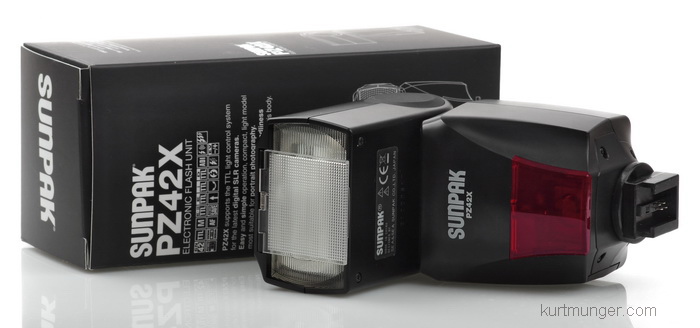
Sunpak PZ42X flash quick review

JUNE2011/sunpz42xbox.jpg
Box and contents
JUNE2011/sunpzxlcd.jpg
LCD lit up, showing manual mode settings

Specifications and general information.

Model
Price
About $145
Tested on
Sony A580
In the box
Flash and multi-language instruction manual, that’s it.
Build quality
Very good all around.
Hotshoe style
Sony proprietary type for this model, others available.
Guide number
42 (138′) ISO 100, @105mm zoom position, and 34 (112′) at 50mm zoom.
Guide number accuracy
Maximum output seems similar to other models with same rating.
LCD monitor
1.6″ X .8″ (40mm X 20mm).  No color.  Pushing the “light” button illuminates the screen in ruby red for about 10 seconds.  Displayed items include; flash range indicator, zoom position, TTL/Manual , Power ratio setting, exposure compensation ±1.5, digital (aps-c) or 35mm (full frame) mode, (WP) wide panel down indicator, and auto or manual zoom setting.
Lights and switches
On-off slider, test/charge button, lighted mode and select buttons.
Power source
4 AA, 1.5V
Recycle time
About 8-9 sec at 1/1, but will fire at reduced output in 3.5 seconds. 1/2 power recharge is almost instantaneous at reduced output, full output requires about 7 seconds.  1/4 power recharge almost instant at reduced output, full power requires about 5 seconds.  1/8 and lower is instantaneous at full output level.
Flash duration rating
Not rated.
Power saving function
Yes, after fifteen minutes it goes into sleep mode, but will never turn off completely; wakes up after pressing any button on flash, or the camera’s shutter button, but wait for flash to charge before using.
Adjustable power levels
Seven full levels only; 1/1, 1/2, 1/4, 1/8, 1/16, 1/32 and 1/64.
Wide angle diffuser type
Built-in, pulls out and down, see first product shot, covers 20mm, (13mm APS-C) and shows on LCD when attached (WP).
Bounce card or reflector plate
Not included.
Bounce positions
45°, 60°, 75°, and 90°.
Swivel positions
Left, 180°- right, 120°.
Zoom positions
Full frame: 20mm with diffuser, 24mm, 28mm, 35mm, 50mm, 70mm, 85mm and 105mm.  APS-C: 13mm with diffuser, 16mm, 19mm, 24mm, 34mm, 48mm, 58mm, and 70mm.  Will show many in-between lengths not listed in auto mode.
Zoom type
Internal, and fully automatic in auto mode.
Auto format zoom
Yes, but you have to manually select “35mm” or “digital” mode; “digital” means APS-C.
AF assist beam
Yes, red, works properly.
Custom functions
None listed.
Connections
None.
White balance info
No.
Modeling flash
No.
Multi-flash emission
No.
High speed sync
No support.
Wireless ability
None with Sony.
Sony ADI support
Yes.
Red eye reduction
No, only works with other brands, not supported by Sony.
Dimensions
2.6″W x 6.5H x 2.2D   65mm x 165mm x 57mm   Maximum length 6.5″ (165mm) including shoe mount.  Length and depth measured with flash flat.
Weight
8.8oz (249g) without batteries, 12.5oz (354g) with batteries.
Operating temp
0°-40°C,  32°-104°F
Quirks
Will not work with Radiopoppers™ triggers with Sony cable adapter, and won’t work well at all with Sony live-view mode.
Notes
Doesn’t function correctly (and is not usable) in Sony’s live view mode; seems to default to full power blast for all shots.  Tested on Sony A580, but may work properly with other brands.  Recharge times are too long at higher power settings.  This flash is the same one Fuji sells for the X100 camera at a much higher cost, only the hotshoe style is different.
Good for
Fully automatic use with Sony optical viewfinder camera.
Not good for
People wanting to use it in Sony live-view mode, wireless optical use, Radiopoppers™ use, or HSS.
Recommended?
Not for Sony users.


This comparison review will involve the Sony Carl Zeiss 16-35mm F/2.8 SSM, Minolta AF 17-35mm F/3.5 and the Konica Minolta AF 17-35mm F/2.8-4.  I’m only going to use the full frame A900 for the review below, to save time, and avoid making the page way to long and repetitive.  These lenses are really meant to be used of full frame cameras, and aren’t all that wide when used on APS-C bodies.
To see the complete individual lens reviews with full frame and APS-C results, go to the links above.
Sony CZ 16-35mm F/2.8 SSM
Minolta AF 17-35mm F/3.5 G
Konica Minolta AF 17-35mm F/2.8-4
Lens code
SAL-1635Z
2654-118
2695-110
Box contents
Front and rear caps, hood, soft-case and users manual.
Front and rear caps, hood, hard-case and users manual.
Front and rear caps, hood and users manual.
Cost
$1899
$1000-$1500 used on eBay
Runs around $300 used on eBay
Build quality
Very good
Very good
Good
Additional information
New Carl Zeiss design introduced by Sony in 2009
Retailed for $1700 in 2000, that equals about $2200 today.
Appears to be the same as the Tamron version
Specifications below
Optical configuration
17 elements in 13 groups
15 elements in 12 groups
14 elements in 11 groups
Angle of view
107°-63°
104°-63°
104°-63°
Aperture
9 blades, curved
7 blades, curved
7 blades, curved
Depth of field and focus scales?
Focus distance window, and focal length index marks at 16mm, 20mm, 24mm, 28mm, and 35mm.
Focus distance window with focal length index marks at 17mm, 20mm, 24mm, 28mm, and 35mm.
Focus distance scale, with focal length index marks at 17mm, 20mm, 24mm, 28mm, and 35mm.
Minimum focus, image plane to subject
11″  (279mm)
11.8″  (300mm)
13″  (330mm)
Minimum focus, end of lens barrel to subject
4.35″  (110mm)
5.7″  (145mm)
6″  (152mm)
Hard stop at infinity focus?
No
Yes
No
Length changes when focusing?
No
Yes
No
Focus ring turns in AF?
No
Yes
Yes
Filter size
77mm
77mm
77mm
Filter ring rotates?
No
No
No
Distance encoder?
Yes
No
Yes
Max magnification
0.24x or 1:4.2
0.16x or 1:6.25
0.19x or 1:5.3
Min. F/stop
F/22
F/22
F/22-32
Sony teleconverter compatible?
No
No
No
Length changes when zooming?
No
No
Yes
Dimensions W x L (my measurements)
3.27″ x 4.5″   83mm x 114mm  Add 2mm in width for AF/MF switch
3.2″ x 3.6″   82mm x 91mm, Filter ring is widest part
3.3″ x 3.5″   83mm x 88mm
Maximum  extended length (my measurements)
4.5″  (114mm)
3.7″  (93mm)
3.8″  (96mm)
Weight bare (my scale)
30.4oz  (863g)  31.7oz (899g) with caps
21.2oz  (600g)  22.2oz (630g) with caps
15.2oz  (431g)  16.04oz (466g) with caps


Product shots


September2009/supercompover1.jpg
Sony CZ 16-35mm, Minolta 17-35mm G, KM 17-35mm
September2009/supercompover2.jpg
Sony CZ 16-35mm, Minolta 17-35mm G, KM 17-35mm


The Sony is the biggest, (and heaviest) of the bunch, while the Minolta G and KM (Konica Minolta) are about the same size.  The KM is the only lens that increases in length as you zoom out.  You may also notice the front elements have different colored coatings, which is a good indicator of design/production date.


When looking at the tables below, note the Minolta G starts at F/3.5, the other two start at F/2.8 when at the widest focal length.  At 35mm, the KM starts at F/4 , so the crop will be missing at that length, and I’ve written “intentionally left blank” in that block.  The Minolta G starts at F/3.5, which goes along side of the Sony F/2.8 crop.  In other words, the Sony will always have the first crop at F/2.8.  The Konica Minolta will start at F/2.8 at 17mm, and F/4 at 35mm.  The Minolta G will start at F/3.5 at both lengths.


Also, the Sony will be at a slight disadvantage because it starts at 16mm, instead of 17mm, which makes the objects inside the center and corner crops at 16mm seem just a little smaller as compared to the KM and Minolta G.  I did this because most people will not use 17mm on a 16mm lens, they naturally crank the zoom to the widest angle, and even if I did use 17mm, there would be charges that I’m trying to favor the Sony.  In reality, the Sony is not hurt from this disadvantage.


Let’s see how much light fall-off we have with each lens, starting off at 16mm with the Sony, and 17mm with the others.


F/2.8/3.5
F/2.8/3.5 with regular UV filter
F/5.6
Sony 16-35mm
September2009/1628vsc.jpg
September2009/1628vscfltr.jpg
September2009/1656vsc.jpg
Minolta 17-35mm G
September2009/1735gx.jpg
September2009/1735gfltrx.jpg
September2009/1756gx.jpg
KM 17-35mm
September2009/1728km.jpg
September2009/1728fltrkm.jpg
September2009/1756km2.jpg


It looks like the Minolta G has the most light fall-off.  The KM has less overall, but it falls off hard, and almost clips the corners when using a regular filter at 17mm, although all three lenses show some additional light fall-off using filters at the widest focal length, the KM is the worst.  The Sony has the best overall control.  On all lenses, light fall-off diminishes some as you stop down.


35mm next.


F/2.8/3.5
F/4
F/5.6
Sony 16-35mm
September2009/3528vsc.jpg
September2009/3540vsc.jpg
September2009/3556vsc.jpg
Minolta 17-35mm G
September2009/3535xg.jpg
September2009/3540gx.jpg
September2009/3556gx.jpg
KM 17-35mm Intentionally left blank
September2009/3540km2.jpg
September2009/3556km2.jpg


The Sony has the best control of light fall-off at 35mm.  The Minolta G and KM have moderate amounts at F/3.5-4, but this really doesn’t show up very much in real pictures.  The KM blank space is a result of the variable aperture, and starts at F/4 at 35mm.


Let’s see how much distortion we have with each lens, starting off at 16mm, or 17mm, depending on what length the lens starts at.


16mm or 17mm distortion
Sony 16-35mm
September2009/czwdis.jpg
Minolta 17-35mm G
September2009/mgwdis.jpg
KM 17-35mm
September2009/kmwdis.jpg


All three lenses show complex wave-type distortion at the widest focal lengths.  The Minolta G has the least amount, and the KM has the most, but only slightly more than the Sony.


35mm next.


35mm distortion
Sony 16-35mm
September2009/cztdis.jpg
Minolta 17-35mm G
September2009/tdismg.jpg
KM 17-35mm
September2009/kmtdis.jpg


The Sony comes in last in distortion control at 35mm, showing moderate pincushion.  The Minolta G is nearly flat, and the KM shows mild pincushion distortion.


Flare and ghosting at 16mm-17mm below.


F/5.6 sun offset inside image
F/5.6 sun just out of image
F/5.6 sun centered
Sony 16-35mm
September2009/cz16off2.jpg
September2009/cz17out.jpg
September2009/cz16cent.jpg
Minolta 17-35mm G
September2009/mg17off2.jpg
September2009/mg17out.jpg
September2009/mg17cent.jpg
KM 17-35mm
September2009/km17off2.jpg
September2009/km17out.jpg
September2009/km17cent.jpg


The small pictures above show the entire image, but are still large enough to illustrate the differences between the lenses.  The Sony has the best control of glare and ghosting, the KM not far behind, both showing mostly green ghosts.  The Minolta G is easily the wost offender, showing orange and blue blobs in a line from the sun.  Full screen shots with the Minolta G look bad.  Sun centered shots look good with the Sony, and not very good with the Minolta G and KM.  The KM shows a nasty red ring around the image periphery, the Minolta G has a two step, diffused, but large orange ring that covers most of the image.


35mm next.


F/5.6 sun offset inside image
F/5.6 sun just out of image
F/11 sun centered
Sony 16-35mm
September2009/cz35off.jpg
September2009/cz35out.jpg
September2009/cz35cent.jpg
Minolta 17-35mm G
September2009/mg35off.jpg
September2009/mg35out.jpg
September2009/mg35cent.jpg
KM 17-35mm
September2009/km35off.jpg
September2009/km35out.jpg
September2009/km35cent.jpg


The 35mm shots look good with the Sony and KM, with little glare, but do have some green ghosts when the sun is near the image.  The Minolta G is bad, showing massive (mostly) orange blobs, and should probably not be used when the sun is near the image unless you want an artistic feel.  Overall, the Minolta G is by far the worst at controlling ghosting at any focal length, the Sony is the best.  The sun centered shots look good with the Sony and KM, the Minolta G has an orange diffused ring, covering most of the image.


Now on to some center crops at 16mm/17mm.


Sony 16-35mm
Minolta 17-35mm G
KM 17-35mm
F/2.8/3.5
September2009/cz28wb.jpg
September2009/mg35wb.jpg
September2009/km28wb.jpg
F/4
September2009/cz40wb.jpg
September2009/mg40wb.jpg
September2009/km40wb.jpg
F/5.6
September2009/cz56wb.jpg
September2009/mg56wb.jpg
September2009/km56wb.jpg
F/8
September2009/cz80wb.jpg
September2009/mg80wb.jpg
September2009/km80wb.jpg
F/11
September2009/cz11wb.jpg
September2009/mg11wb.jpg
September2009/km11wb.jpg


Check out the boring center crops.  You’ll notice there isn’t much sharpness difference in the center crops, even wide open.  The exposures times were the same for all lenses at each aperture, and it seems the KM requires a little negative exposure compensation to match the other lenses.  Super-wide zooms are typically pretty sharp at their largest aperture, and widest focal length, like 16mm/17mm here, so the results above are expected.  For better sharpness crops, go to the regular lens reviews.


Corners at 16mm/17mm.


Sony 16-35mm
Minolta 17-35mm G
KM 17-35mm
F/2.8/3.5
September2009/cz28cnwb.jpg
September2009/mg35cnwb.jpg
September2009/km28cnwb.jpg
F/4
September2009/cz40cnwb.jpg
September2009/mg40cnwb.jpg
September2009/km40cnwb.jpg
F/5.6
September2009/cz56cnwb.jpg
September2009/mg56cnwb.jpg
September2009/km56cnwb.jpg
F/8
September2009/cz80cnwb.jpg
September2009/mg80cnwb.jpg
September2009/km80cnwb.jpg
F/11
September2009/cz11cnwb.jpg
September2009/mg11cnwb.jpg
September2009/km11cnwb.jpg


Obviously, the Sony has the sharpest corners, and stopped down to F/8-11, the KM looks better than the Minolta G, which is a surprise.  All corner crops were taken at the same location within the frame, about 500 pixels from the very corner (left) of the image.  I re-positioned the Sony slightly so it would not have an advantage from being farther from the corners, since it’s wider than the others.  Exposure times for the corners were the same as the center crops, and the exposure differences here are from light fall-off.


35mm centers below.


Sony 16-35mm
Minolta 17-35mm G
KM 17-35mm
F/2.8/3.5
September2009/cz28t2.jpg
September2009/mg35t.jpg
Intentionally left blank
F/4
September2009/cz40t.jpg
September2009/mg40t.jpg
September2009/km40t.jpg
F/5.6
September2009/cz56t.jpg
September2009/mg56t.jpg
September2009/km56t.jpg
F/8
September2009/cz80t.jpg
September2009/mg80t.jpg
September2009/km80t.jpg
F/11
September2009/cz11t.jpg
September2009/mg11t.jpg
September2009/km11t.jpg


The 35mm centers show the sharpest on the Sony, but the Minolta G and KM are not too far behind.  The KM seems to have a bit less contrast than the Minolta G.


Check out the 35mm corners below.


Sony 16-35mm
Minolta 17-35mm G
KM 17-35mm
F/2.8/3.5
September2009/cz28cnt.jpg
September2009/mg35cnt2.jpg
Intentionally left blank
F/4
September2009/cz40cnt.jpg
September2009/mg40cnt.jpg
September2009/km40cnt.jpg
F/5.6
September2009/cz56cnt.jpg
September2009/mg56cnt.jpg
September2009/km56cnt.jpg
F/8
September2009/cz80cnt.jpg
September2009/mg80cnt.jpg
September2009/km80cnt.jpg
F/11
September2009/cz11cnt.jpg
September2009/mg11cnt.jpg
September2009/km11cnt.jpg


The 35mm corners on the Sony are much sharper at all apertures than on the KM or Minolta G.  I see some heavy color fringing on the Minolta G, less on the KM, and none on the Sony.  The crops above were exposed the same as the centers, but are darker because of light fall-off.


Check out the coma samples below.


Sony 16-35mm
Minolta 17-35mm G
KM 17-35mm
F/2.8/3.5
September2009/cz28cma.jpg
September2009/mg35cma.jpg
September2009/km28cma.jpg
F/4
September2009/cz40cma.jpg
September2009/mg40cma.jpg
September2009/km40cma.jpg
F/5.6
September2009/cz56cma.jpg
September2009/mg56cma.jpg
September2009/km56cma.jpg


Coma shows up near the image periphery in these lenses, but the Sony has superior control.  The shape of coma on the KM and Minolta G are different, but are about equally noticeable when viewed at normal sizes.  The two older lenses show strong coma at full apertures, but are about average for yesterday’s super-wide zooms.


Lateral color fringing crops below.


Lateral color fringing at 16mm/17mm
Sony 16-35mm
September2009/czcfb.jpg
Minolta 17-35mm G
September2009/mgcfb.jpg
KM 17-35mm
September2009/kmcfb.jpg


There isn’t much difference in visible color fringing along the sides, though the Minolta G seems to have the least.  The softness of the sides shows up more on the KM and Minolta G, the Sony has loads of contrast.  These 100% crops were taken from the middle-extreme left side at F/5.6.  It also shows the difference between 16mm, and 17mm.  I cropped the images equally, so the slightly wider Sony wouldn’t have an advantage.  These crops also show the Minolta G has a very subtle green cast as compared to the other two, that’s no big deal though.


Final thoughts.


The Sony is a very good lens, and it out performs the other lenses in almost all areas tested above.  The only deficiencies of the Sony are color fringing and distortion, and the Minolta G is the best in those areas, but not by much.  The Konica Minolta turned in good results also, and you’d be hard pressed to see the differences between the Sony and KM unless looking at 100% crops side-by-side.  The Minolta G is a good lens, but is lacking in a couple of areas, especially ghosting, where control is poor; the corners are decent, but not quite as sharp as the much less expensive KM when stopped down at the widest focal lengths.


In a nut-shell, the Minolta AF 17-35mm F/3.5 G seems a little dated.  It’s built well, and I like the way it feels and handles the best of all three, but due to poor ghosting control, and mediocre corner sharpness, I’d pass on this lens, especially since it sells on eBay between $1000-$1500, that’s just too much money based purely on optical performance.


The Konica Minolta does a very good job, when stopped down and viewed at normal sizes, you may not see the difference between it, and the Sony.   The selling price For the Konica Minolta AF 17-35mm F/2.8-4 at the time of this review is about $300 on eBay, That’s a real good deal, and $1600 less than the Sony!!


The Sony Carl Zeiss 16-35mm F/2.8 is a great lens, and very expensive.  The color and contrast are superb.  If you make a living using this focal length, I’d go ahead and pay the retail price of $1900, it’s worth it.  If you’re an amateur with a bunch of money, and demand top-notch image quality, get this lens.

Full review of the Tamron 60mm F/2 Di II macro lens. 

APRIL2011/tam60mmkit.jpg
Box and contents
The Sony A580 was used for this review.  For a better understanding of terms and methods used in this review,go here.
The usual center, mid-section and corner crops are located at the very bottom of the page.
Introduction.
Tamron introduced the 60mm F/2 Di II [IF] LD macro lens in 2009.  As of the time of this review, it’s the fastest AF macro lens available with a 1:1 reproduction rate.  If you carry a wide-angle zoom around normally as I do, this somewhat small lens could be put in a jacket pocket and serve as a fast, medium telephoto lens, with an equivalent coverage of 90mm in full frame terms.
Found on the outside of the lens: a focus distance window, (no DOF scale), a rubber ribbed manual focusing ring, and an AF/MF switch on the left side.  Build materials are mostly plastic, but metal is used for the mount.  Build quality is good, but nothing to write home about.  The lens body has an appealing black finish similar to Sony camera bodies, and it matches well.  Tamron claims the use of two “LD” elements in the design of the lens.  The lens says “made in Japan.”
Use.  This is a macro lens, meaning it’s been optimized for close focusing on flat subjects.  It’s very sharp and impressive at F/5.6-8 in macro range, but diffraction is very noticeable from F/11-22.  In product photography, I use F/11-22 most of the time, and find this lens to be noticeably softer than the Sony 100mm F/2.8 macro at those apertures.  At longer distances, the Tamron 60mm F/2 is excellent, and is far sharper at F/2.8 than the Sony 100mm macro.  I guess it all depends on what you plan on using it for.  For a walk-around medium telephoto, it’s darn good.  For product shot photography, I’d probably look at something else.

The aperture blades form a nice circle between F/2-8, however, at F/11-16 the hole becomes oblong.

EXIF data reads the correct 60mm focal length.
In the box is the lens, front and rear caps, plastic solid hood, and owner’s manual.
Focusing.  This lens has a relatively quiet motor inside to provide focusing, (similar to Sony’s SAM) and doesn’t use the slot-screw type system that’s typical for older lenses from Minolta and Sony.  All focusing is done internally, so the lens doesn’t extend out like many macro lenses.  My copy has somewhat poor auto-focusing, being slow and not very accurate, but I’ve heard others generally don’t have the accuracy problem; could be a little QC issue for Tamron.  The focusing ring has some back and forth slop, so it isn’t the best for accurate manual focusing, but does provide a lot of movement to help out, about 7/8 of a turn for close-in to infinity.  I found getting sharp focus using the optical viewfinder is pretty easy, and by using live view focus check it’s very easy, and accurate, (if your camera has this feature), although that procedure is not super handy.  There is instant manual focus override when in auto-focus mode, just turn the focus ring at any time to adjust, this feature is great when the lens doesn’t want to focus on the right thing.  Unfortunately, there are no focus limiter or focus stop buttons to help with focusing, those items are typically omitted on after-market lenses as a cost saving measure.  The minimum “working” focusing distance is about 4″ or 101mm, that’s still a lot of room for a 60mm macro lens, and is the result of the internal focusing design.
2594-kurtmunger-banner.gif
Requisite product shots.

APRIL2011/tam60mmsd.jpg
Side shot
APRIL2011/tam60mmbk2.jpg
Back side showing AF/MF switch
APRIL2011/tam60mmftel.jpg
Front element
APRIL2011/tam60mmxray.jpg
Tamron X-ray view
General information and specifications.

Lens
Box contents
Front cap, rear cap, hood, and users manual.
Cost
Approximately $524,  but often on sale for far less.
Build quality
Ok to good.
Additional information
Made for APS-C cameras, but also works on full frame with hard clipping of the extreme corners.
Specifications below
Optical configuration
14 elements in 10 groups
Angle of view
23˚ APS-C
Aperture
7 blades, curved
Full frame and APS-C
Made for APS-C cameras.
Depth of field and focus scales?
Focus distance scale.
Minimum focus, image plane to subject
About 9″  (230mm)
Minimum focus, end of lens barrel to subject
About 4.0″  (101mm)
Hard stop at infinity focus?
No.
Length changes when focusing?
No.
Focus ring turns in AF?
No
Filter size
55mm.
Filter ring rotates?
No
Distance encoder?
N/A
Max magnification
1:1
Min. F/stop
F/22
Sony teleconverter compatible?
No
Length changes when zooming?
N/A
Dimensions WxL  (my measurements)
2.8″ x 3.2″   72mm x 82mm.
Maximum  extended length (my measurements)
3.2″  (82mm)
Weight bare (my scale)
12.5oz  (355g) bare
Optical qualities summary.
Lens flare/ghosting.  Good control.  I mostly see a small orange blob in the image when the sun is close, or inside the frame, see examples below.
Light fall-off.  A little at F/2, but no problems.  See samples below.
Color fringing (CA).  Lateral color fringing control is above average.  I see just a little magenta and green at the edges of the image.  See example farther down the page.  You see some axial color fringing too, but it clears up mostly by F/5.6.
Bokeh.  Smooth, and best at F/2, see examples below.
Color.   Seems about the same as Sony lenses.
Close up filter.  N/A
Coma.  None.
Regular filters cause no additional light fall-off.
Filter size.  55mm.  Sony lenses that use 55mm filters are; 35mm F/1.8, 100mm macro, 50mm macro, 50mm F/1.4, 35mm F/1.4 G, 18-70mm, 18-55mm, 55-200mm, and the 75-300mm.
Distortion.  Minor barrel, with simple curve.
Distortion example directly below.
APRIL2011/tam60mmdis.jpg
Minor barrel distortion


Distortion is not a problem with this lens, but if you look closely you’ll see minor barrel distortion with a simple curve, which is easy to fix in post processing.


Bokeh samples.


           F/2
             F/2.8
APRIL2011/tam60mmbokf20.jpg
APRIL2011/tam60mmbokf28.jpg
           F/4
             F/5.6
APRIL2011/tam60mmbokf40.jpg
APRIL2011/tam60mmbokf56.jpg


Bokeh looks pretty smooth at wide apertures, but the aperture shape and slight ring shows up when stopped down smaller than F/4.

Light fall-off samples.
           F/2
              F/2.8
APRIL2011/tam60mmvig20.jpg
APRIL2011/tam60mmvig28.jpg
There is minor to moderate light fall-off at F/2, diminishing to almost nothing at F/2.8.  Results are about the same for close-up, and infinity focusing.
Light fall-off samples from full frame A900.
           F/2
              F/2.8
APRIL2011/tamvig1900f20.jpg
APRIL2011/tamvig1900f28.jpg
           F/5.6
              F/22
APRIL2011/tamvig1900f56.jpg
APRIL2011/tamvig1900f22.jpg

Although this lens is not made for full frame cameras, if you decide to use it on one, expect heavy light fall-off with clipping of the corners.  Don’t worry about this with an APS-C camera.


Flare and Ghosting


Small red blob F/5.6.
Green blobs F/5.6.
APRIL2011/tam60mmgst2.jpg
APRIL2011/tam60mmgst1.jpg
Ghosting control is pretty good, as seen above.  When the sun is in the image, there seems to be just one amber/orange colored blob visible, but severity depends on angle and aperture.  In most images, I saw the small orange blob, and not the green blobs you see in the right image.


Light loss at high magnification.


Here are the approximate F-numbers you will get as you increase the magnification, I made the table below by actual exposure sampling.  These numbers will not be indicated on the camera, and will still read F/2 even at 1:1 magnification, but look at your shutter speeds and you’ll notice the loss.  This is for your information only, so just shoot away, the camera will adjust your exposure automatically.  I’m simply providing this in case you’re wondering why your shutter speeds are so low when the LCD says F/2.


Magnification
F-number
1:10
2
1:5
2.2
1:3
2.5
1:2
2.8
1:1.5
3.2
1:1.2
3.5
1:1
4
 
 
Let’s check out the macro capabilities of this lens.

The sample shot was taken with the Sony A 580 16.2MP camera, so don’t compare it with some others that were taken with the 12.2mp A700.  The subject is a standard US stamp, 0.87″x 1.0″ or 22mm x 25mm.  Also, note the macro shot was taken as close to the subject as focusing allowed; in this case a very short 4″ (101mm), measured from the front of the lens barrel to the subject.  
 
This lens has a reproduction size of 1:1 which is true macro.  The full 1:1 stamp shot is displayed at full size by clicking the image, (3.7mb), as a reminder, you’re only seeing half the stamp because at 1:1 it focuses so close you can’t get the whole stamp inside the image.  I see a very sharp stamp shot, equal to, or better than other full macro shots tested here.  F/5.6-8 were sharpest at close focus.  As a side note; the “1996” on the bottom left of the stamp measures a mere 1mm wide.  
As close as you can get, F/8.


Lateral color fringing.


APRIL2011/tam60mmcf.jpg
Color fringing crop from far right side. F/5.6


This crop is from the last 700 pixels on the middle right side.  I see some magenta color fringing (and a little cyan) along the tree branches, but it’s controlled well overall, and not really noticeable unless viewed closely.


Conclusion. 

The Tamron 60mm F/2 macro lens has some really nice qualities, and a couple of negatives, but first the good stuff; it’s sharp at F/2 in the centers, and really sharp across the frame at F/5.6, which makes it a great walk-around medium telephoto lens, and is small enough to carry in a jacket pocket if a prime like this is too confining for you.


Now for the negatives; my copy has less-than-adequate focusing accuracy, but I may have received a less-than-perfect copy, which is unusual for Tamron.  I’ve reviewed about half a dozen Tamron lenses as of this review, and never had a problem before.  The other issue is diffraction when stopped down smaller than F/8.  The image is noticeably soft at F/11, and gets worse at F/16-22, this is something you’ll need to consider if you plan on using this lens for product photography, where working apertures are in the range of F/11-22 to get the depth of field on small stuff up-close, so if you’re looking to do that kind of work, you may want to check out the Sony 100mm macro lens, which is much sharper at those apertures when focused close.  I use the Sony 100mm F/2.8 macro for my product shots, and I tried the Tamron 60mm for shots of a future review lens, and noticed the sharpness differences right away.  Again, if you aren’t planning on using really small apertures, like F/11-22, this doesn’t matter.


I would highly recommend the Tamron 60mm F/2 lens when used out in the field at longer distances, where F/2 can come in handy for getting a defocused background, or hand-held available light situations.  For people wanting a good macro lens with plenty of working distance, and will be using it at close focus, I’d recommend the Sony 100mm macro.


2594-kurtmunger-banner.gif


Sample crops from the centers, mid-sections and corners.


          Center
          Mid-section
             Corner
F/2
APRIL2011/tam60mmctrf20.jpg
APRIL2011/tam60mmmidf20.jpg
APRIL2011/tam60mmcornf20.jpg
F/2.8
APRIL2011/tam60mmctrf28.jpg
APRIL2011/tam60mmmidf28.jpg
APRIL2011/tam60mmcornf28.jpg
F/4
APRIL2011/tam60mmctrf40.jpg
APRIL2011/tam60mmmidf40.jpg
APRIL2011/tam60mmcornf40.jpg
F/5.6
APRIL2011/tam60mmctrf56.jpg
APRIL2011/tam60mmmidf56.jpg
APRIL2011/tam60mmcornf56.jpg
F/8
APRIL2011/tam60mmctrf80.jpg
APRIL2011/tam60mmmidf80.jpg
APRIL2011/tam60mmcornf80.jpg
F/11
APRIL2011/tam60mmctrf11.jpg
APRIL2011/tam60mmmidf11.jpg
APRIL2011/tam60mmcornf11.jpg


There isn’t much difference in sharpness in any of the crops, but if you look closely, you’ll see the centers sharpen up nicely at F/2.8, (look at roof tiles) with the mid-sections and corners following a stop or two later.  Diffraction is very noticeable at F/11.  Maximum performance seems to be around F2.8-4 in the centers, F/5.6 in the mid-sections, and corners.  Exposure differences are from light fall-off.


Please check out the Tamron 60mm F/2 Di II macro at B&H Photo and help support the site!

Sample crops from the centers, mid-sections and corners.


The APS-C section using the Sony A700 is first, followed by the full frame results.


Janfeb2011/tref702.jpg
Tamron 70-200mm F/2.8 @70mm


Reference image for crops below.  The mid-section and corner crops come from repositioning the subject in the frame accordingly.  Subject is about 400′ (122m) away.


70mm


          Center
          Mid-section
             Corner
F/2.8
Janfeb2011/t70200f28ctr70.jpg
Janfeb2011/t70200f28mid70.jpg
Janfeb2011/t70200f28cor70.jpg
F/4
Janfeb2011/t70200f40ctr70.jpg
Janfeb2011/t70200f40mid70.jpg
Janfeb2011/t70200f40cor70.jpg
F/5.6
Janfeb2011/t70200f56ctr70.jpg
Janfeb2011/t70200f56mid70.jpg
Janfeb2011/t70200f56cor70.jpg
F/8
Janfeb2011/t70200f80ctr70.jpg
Janfeb2011/t70200f80mid70.jpg
Janfeb2011/t70200f80cor70.jpg
F/11
Janfeb2011/t70200f11ctr70.jpg
Janfeb2011/t70200f11mid70.jpg
Janfeb2011/t70200f11cor70.jpg


The 70mm performance is pretty good, with a slight lack of contrast at F/2.8, but looking very good at F/3.5 to F/4.  The mid-sections are almost as sharp as the centers.  As you move towards the corners, the sharpness drops a little, but more noticeable is the color fringing, (mostly magenta).  This type doesn’t go away as you stop down, that’s why it’s visible at all apertures.   Exposure differences in the corners are from light fall-off.


135mm


Janfeb2011/tref135.jpg
Tamron 70-200mm F/2.8 @135mm


Reference image for crops below.  Subject is about 500′ (152m) away.


135mm


          Center
          Mid-section
             Corner
F/2.8
Janfeb2011/t70200f28ctr135.jpg
Janfeb2011/t70200f28mid135.jpg
Janfeb2011/t70200f28cor135.jpg
F/4
Janfeb2011/t70200f40ctr135.jpg
Janfeb2011/t70200f40mid135.jpg
Janfeb2011/t70200f40cor135.jpg
F/5.6
Janfeb2011/t70200f56ctr135.jpg
Janfeb2011/t70200f56mid135.jpg
Janfeb2011/t70200f56cor135.jpg
F/8
Janfeb2011/t70200f80ctr135.jpg
Janfeb2011/t70200f80mid135.jpg
Janfeb2011/t70200f80cor135.jpg
F/11
Janfeb2011/t70200f11ctr135.jpg
Janfeb2011/t70200f11mid135.jpg
Janfeb2011/t70200f11cor135.jpg


With the lens zoomed to 135mm and using a wide-open aperture, you’ll see a slightly soft image, but stopping down to F/4 makes a big difference, and the mid-sections are as sharp as the centers.  The corners are pretty sharp too from F/5.6-11.


200mm


Janfeb2011/tref200.jpg
Tamron 70-200mm F/2.8 @200mm


Reference image above, subject is about 700′ (213m) away.


200mm


          Center
          Mid-section
             Corner
F/2.8
Janfeb2011/t70200f28ctr200.jpg
Janfeb2011/t70200f28mid200.jpg
Janfeb2011/t70200f28cor200.jpg
F/4
Janfeb2011/t70200f40ctr200.jpg
Janfeb2011/t70200f40mid200.jpg
Janfeb2011/t70200f40cor200.jpg
F/5.6
Janfeb2011/t70200f56ctr200.jpg
Janfeb2011/t70200f56mid200.jpg
Janfeb2011/t70200f56cor200.jpg
F/8
Janfeb2011/t70200f80ctr200.jpg
Janfeb2011/t70200f80mid200.jpg
Janfeb2011/t70200f80cor200.jpg
F/11
Janfeb2011/t70200f11ctr200.jpg
Janfeb2011/t70200f11mid200.jpg
Janfeb2011/t70200f11cor200.jpg


When near the long end, the image is a little soft at F/2.8-3.5, but sharpens up nicely at F/4.  The mid-sections are pretty sharp stopped down, with the corners looking almost as good.


____________________________________________________________________________________________________________________________________________________________


Sharpness crops using the full frame A900.


Below are crops from a test chart, in this case a magazine cover.  Lens to subject distances average about 20′ (6.1m).  Atmospheric conditions were not optimal during the full frame testing period, so I had to resort to indoor shooting, although this focusing distance is what you might find at an indoor concert or portrait session.


70mm


          Center
          Mid-section
             Corner
F/2.8
Janfeb2011/t70200ff7028ctr.jpg
Janfeb2011/t70200ff7028mid.jpg
Janfeb2011/t70200ff7028cor.jpg
F/4
Janfeb2011/t70200ff7040ctr.jpg
Janfeb2011/t70200ff7040mid.jpg
Janfeb2011/t70200ff7040cor.jpg
F/5.6
Janfeb2011/t70200ff7056ctr.jpg
Janfeb2011/t70200ff7056mid.jpg
Janfeb2011/t70200ff7056cor.jpg
F/8
Janfeb2011/t70200ff7080ctr.jpg
Janfeb2011/t70200ff7080mid.jpg
Janfeb2011/t70200ff7080cor.jpg
F/11
Janfeb2011/t70200ff7011ctr.jpg
Janfeb2011/t70200ff7011mid.jpg
Janfeb2011/t70200ff7011cor.jpg


A good performance at 70mm, and similar to the APS-C crops above.  I see a very acceptable image at F/2.8, and a very good image at F/4-8.  There is some noticeable magenta color fringing in the corner crops, but not really showing any more than what you see with the APS-C corner crops above.


135mm


          Center
          Mid-section
             Corner
F/2.8
Janfeb2011/t70200ff13528ctr.jpg
Janfeb2011/t70200ff13528mid.jpg
Janfeb2011/t70200ff13528cor.jpg
F/4
Janfeb2011/t70200ff13540ctr.jpg
Janfeb2011/t70200ff13540mid.jpg
Janfeb2011/t70200ff13540cor.jpg
F/5.6
Janfeb2011/t70200ff13556ctr.jpg
Janfeb2011/t70200ff13556mid.jpg
Janfeb2011/t70200ff13556cor.jpg
F/8
Janfeb2011/t70200ff13580ctr.jpg
Janfeb2011/t70200ff13580mid.jpg
Janfeb2011/t70200ff13580cor.jpg
F/11
Janfeb2011/t70200ff13511ctr.jpg
Janfeb2011/t70200ff13511mid.jpg
Janfeb2011/t70200ff13511cor.jpg


The whole image looks sharp at F/5.6-11.  The mid-sections and corners respond well to closing the aperture a couple of stops, but have plenty of resolution at F/2.8-4 if you look past the minor veiling haze.


200mm


          Center
          Mid-section
             Corner
F/2.8
Janfeb2011/t70200ff20028ctr.jpg
Janfeb2011/t70200ff20028mid.jpg
Janfeb2011/t70200ff20028cor.jpg
F/4
Janfeb2011/t70200ff20040ctr.jpg
Janfeb2011/t70200ff20040mid.jpg
Janfeb2011/t70200ff20040cor.jpg
F/5.6
Janfeb2011/t70200ff20056ctr.jpg
Janfeb2011/t70200ff20056mid.jpg
Janfeb2011/t70200ff20056cor.jpg
F/8
Janfeb2011/t70200ff20080ctr.jpg
Janfeb2011/t70200ff20080mid.jpg
Janfeb2011/t70200ff20080cor.jpg
F/11
Janfeb2011/t70200ff20011ctr.jpg
Janfeb2011/t70200ff20011mid.jpg
Janfeb2011/t70200ff20011cor.jpg


I see the same basic results here as with the 135mm crops, meaning a little soft at F/2.8, but sharpening up at F/4, where the whole image begins to look pretty darn good, especially for a full frame camera.  The corners are not quite as sharp as the mid-sections, and don’t seem to quite match the 135mm results, but they’re still very acceptable.  There is a tiny bit of color fringing noticeable (purple along the palm fronds) in this scene.  Exposure differences in the corner crops are from light fall-off.


Back to the Tamron 70-200mm F/2.8 standard review section

Sony and Minolta DSLR Brochures

Below are links to Sony and Minolta AF lens brochures and pamphlets.  Some are not currently available by Sony for some reason, so I’m offering them here as a convenience.  The pictures of the brochure covers are not linked.


This lens guide lists all available Sony lenses as of 8/09.  It’s available in four different languages.


Click here …

Read more »

Sony A Mount Cameras

Below you’ll find specifications for all Sony DSLR’s and SLT’s from the most recent at the top, to the oldest at the bottom. Model A99II Price $3199 body only, announced 9-16. Effective megapixels 42.4 LCD monitor 3.0″  1,228,800 pixels, articulating screen. Lens Zoom Recording media Memory stick pro duo, all SD Image stabilization Yes, in body up to 5-way ISO …

Read more »

Sony SteadyShot vs Sigma Optical Stabilizer

Sony DSLR users may, or may not know they don’t get any visual benefit from sensor-shift type image stabilization, that is, the Sony SteadyShot stabilization only begins its job once the mirror is up and out of the way, after you press the shutter button.  Canon and Nikon DSLR users have grown accustomed to seeing the smoothing effects of their …

Read more »

Sunpak PZ42X Flash Review

Sunpak PZ42X flash quick review

Box and contents LCD lit up, showing manual mode settings

Specifications and general information.

Model Sunpak PZ42X S
Price About $145 Tested on
Sony A580 In the box
Flash and multi-language instruction manual, that’s it. Build quality
Very good all around. Hotshoe style
Sony proprietary type for this model, others available. Guide number
42…

Read more »

Tamron 70-200mm F/2.8 Test Samples

Sample crops from the centers, mid-sections and corners.


The APS-C section using the Sony A700 is first, followed by the full frame results.


Tamron 70-200mm F/2.8 @70mm


Reference image for crops below.  The mid-section and corner crops come from repositioning the subject in the frame accordingly.  Subject is about 400′ (122m) away.


70mm


          Center           Mid-section…

Read more »

Scroll to Top