Photo Jottings - Page 10 of 127 - Photography equipment expertise

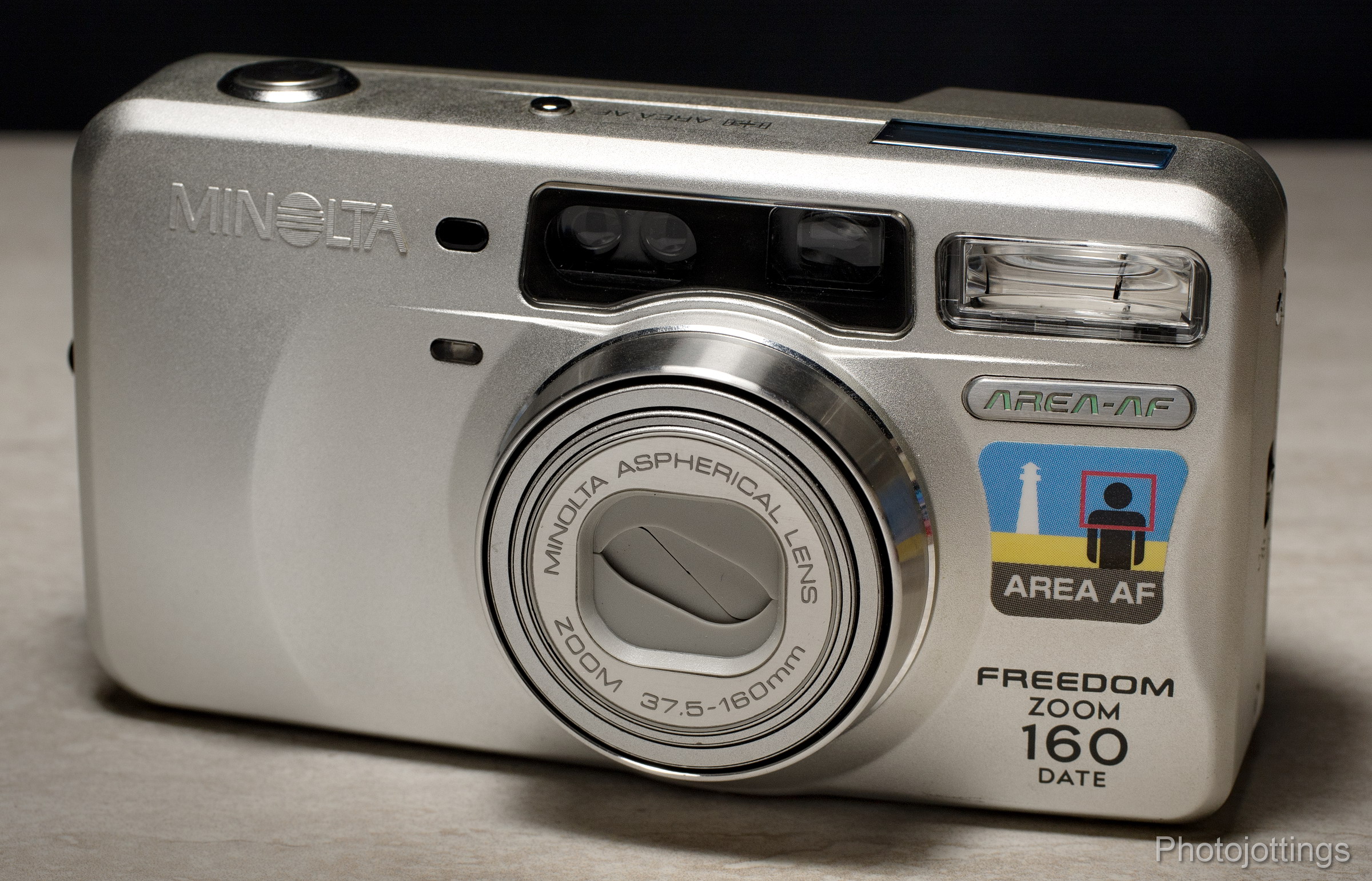
Minolta produced some really nice film cameras back in the day, and the Freedom Zoom 160 is no exception.  This camera is surprisingly small and lightweight for having such a large zoom range, which makes is very pocketable, and close to being as tiny as the Olympus XA!  Main features include a zoom range of 37.5-160mm, earth shattering high tech auto focus, (really, read the next paragraph!), auto loading, film advance, rewind, self timer, flash, auto parallax correction, and even a +1.5 exposure compensation setting!

The Minolta Freedom Zoom 160 came out near the end of the film camera era, (around 2001), so it had a lot of sophisticated features that we take for granted today, such as predictive AF, eyepiece sensor metering/AF activation, and flash distance integration to name a few.  In fact, Minolta claimed in a 2001 business ad the camera had: the world’s largest AF area in a film camera — the world’s first film camera with subject detection — the world’s first compact camera with matrix AF indication and automatic LED brightness control — advanced subject-weighted multi-segment metering — eye start, a 32-bit RISC processor, and a high-speed AF drive creating the world’s fastest focusing compact camera in its class.

All that sounds pretty cool, but how well does the camera actually work in real life? let’s find out now!


Name; Minolta Freedom Zoom 160 Date; Called Minolta “Riva 160” in other parts of the world.  Konica may have added their name and restyled the camera in later models.

Manufactured by; Minolta Co, LTD, Osaka, Japan.  Made in China.

Date of manufacture; 2001-2002?

Price; initial release retail price around $249+ in 2001; probably less at large discount stores, and by mid-2002, a Photo magazine ad stated the price around $200.  Current ebay prices are around $15-$25 for a good used copy.  I got mine for about $5 as it was purchased in a lot of 10.

Other versions; there is a Freedom Zoom 140 with a 37.5-140mm range; and has a corresponding change in apertures etc, but no exposure compensation; everything else seems the same as the 160.

Build material; mostly metal covered body with a clear plastic window over the view finder area, LCD and film reminder slot.

Weight and size; camera with battery, 7.4oz (210g).  Camera only 6.9 oz (195g).

Dimensions; Size is 4.4″ (110.5mm) wide, 2.4″ (60.5mm) high, and 2.0″ (51mm) deep including lens protrusion in off position.

Focal length; 4.3x zoom from 37.5-160mm.

Aperture; maximum aperture at 37.5mm is F/5.4; maximum at 160mm is a whopping F/12.4.

Focusing; area AF, which includes world’s largest AF area, predictive subject detection, matrix AF indication, and high-speed AF drive, has 942 focus steps. Focuses from 2.0′ (0.6m) at the wide end, to 3.1′ (0.95m) at 160mm.

Original print size; standard oversize prints 4″ x 6.″

Approximate resolution; will make excellent 5″x 7,” and good to excellent 8″x 10″ prints.

Lens; coated glass six elements in six groups design, with two double sided apherical elements.  37.5-160mm focal length, F/5.4-12.4 maximum aperture.  The zoom feature has 14 stop (focal lengths) settings total.

Shutter and speed; electromagnetic shutter and aperture.  Ten seconds to 1/500s.

Distortion; very straight at wide angle, and moderate barrel type at the telephoto end.

Color fringing; very minor magenta along the sides at high contrast areas.

Features; auto load, auto advance, auto rewind, flash on or off position, red-eye reduction, date imprinting on-off, goes to 12-31-2099!!, zoom lens, exposure compensation of +1.5, auto focus, auto film DX coding, tripod socket and self timer, continuous shooting, plus others.

Film; all 135 film cartridges, B&H, Amazon, eBay.

Flash.  range of 2.0-15.1 feet (0.6-4.6m) at wide angle, and telephoto; 3.1-6.6 feet (0.95-2.0m) at ASA 100.  has flash on-off, auto, auto red-eye reduction, fill, and slow sync night modes.  Uses distance integration (they call it ‘light intensity control’), for throttling the flash power at close range.  Recharges in 5-6 seconds with fresh battery.

Power; One CR123A 3v battery, lasts for about 10 rolls of 24 using the flash every other shot.  Usually available at big box stores or drug stores, but super expensive.  Get them much cheaper here: B&H, Amazon, eBay.

Viewfinder; small, with decent brightness, has auto illuminating parallax correction guidelines and red outlined AF areas.  Eye relief 17.3mm from viewfinder frame.  Magnification 0.38x-1.51x, field of view at 3m; 85%.  Also has orange flash ready light/shake warning, and green focus confirmation indicator along side of frame.  On the left side are eye detectors.

DX coding; from ISO 25-3200.  Non DX coded film is registered as ISO 100.

Accessories for this model;  Minolta remote control RC-3.

Crippling features and omissions; none, but a diopter correction for viewfinder would’ve been handy in this price range.

Good features; super fast and accurate AF, auto parallax correction, exposure compensation, and excellent metering.

Go here for the manual download, or here to view a copy, and make sure you tip the site owner!

Product shots with descriptions.  Click for larger images.
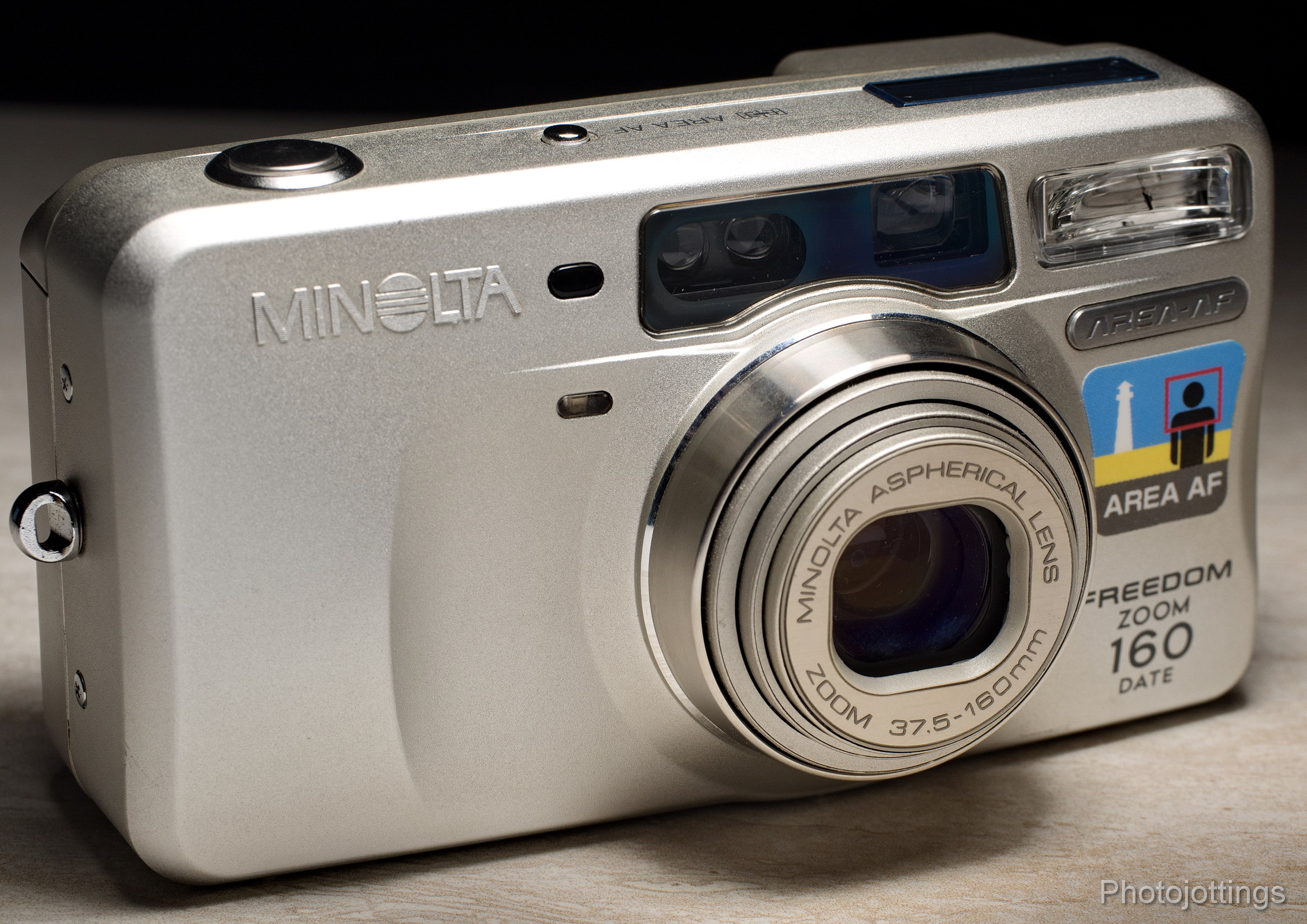
From view with the power turned on.  The Area AF sticker is still on this pristine sample.  From left to  right; along the side is a strap lug; the two small windows are for the remote control.  The large window above the lens is for the AF/metering on the left, and viewfinder on the right. The flash is at the right top corner.

The only two items on the bottom are the tripod socket and tiny mid-roll rewind button.  On the left lower corner is the battery compartment.

The back of the camera shows the viewfinder, which has two oblong openings on the left; those are for eye detecting and starting the AF and metering.  The two circular holes on the right side are for focus and flash, the top one turns solid green when focus is locked, and flashes green when it can’t lock.  The bottom indicator is for flash charging; solid orange for flash ready, and flashing orange for flash charging or shake/low shutter speed warning.  The three buttons in the middle group from left to right are: flash on-off, auto, auto red-eye reduction, fill, slow sync night mode, and exposure compensation +1.5 EV.  The middle button is for setting the timer, remote use, and continuous shooting (about 2 frames per second) mode.  The right button is for setting the date for imprinting, either on or off.  The W-T button is for zooming, and finally we have the on-off button in the upper right corner.
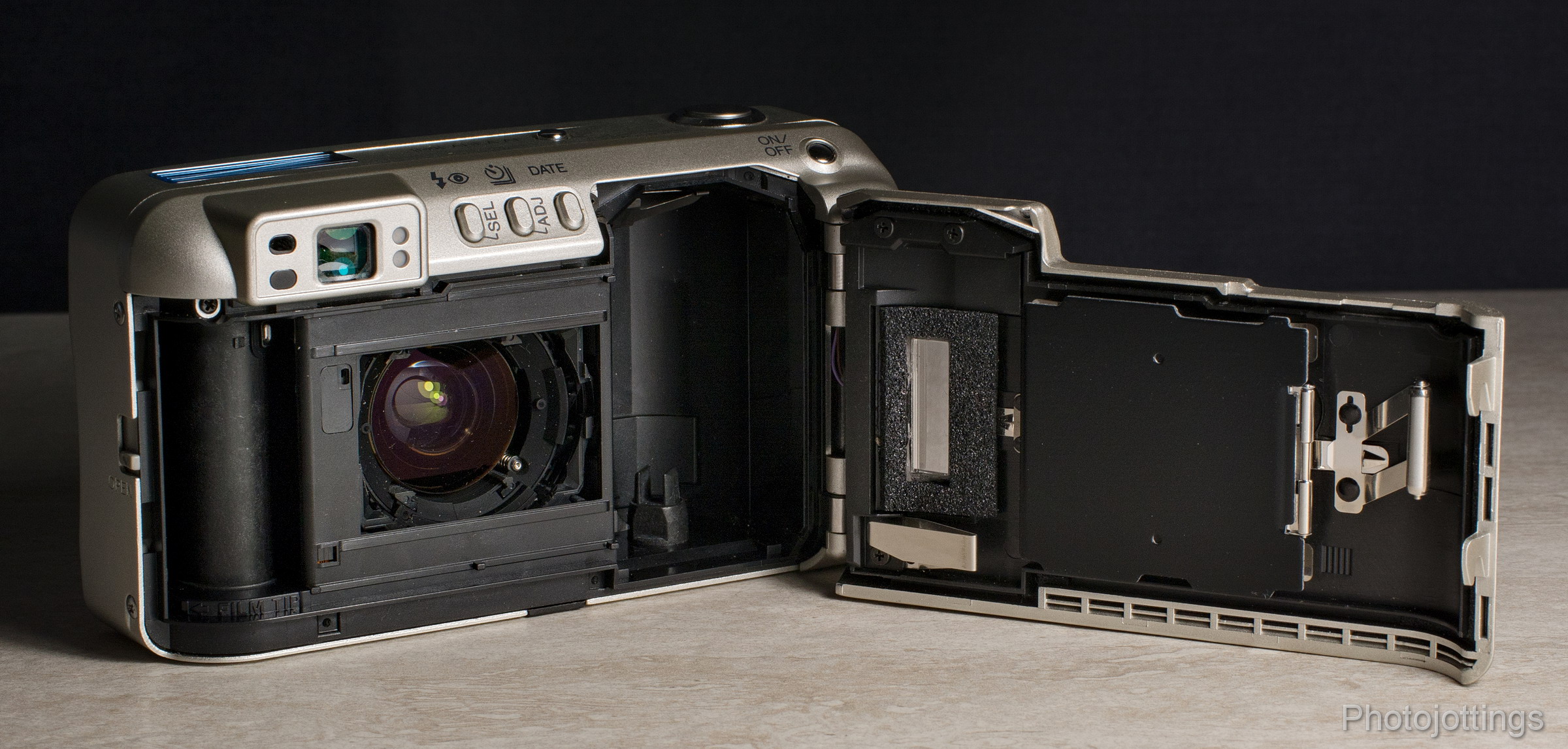
With the back open you can see the camera has some decent features like a real film pressure plate, a spring steel film tensioner and thick light sealing foam around the film reminder window, but none along the perimeter of the back cover.  Nice multi coatings visible on the lens and viewfinder glass.

Here the lens is extended to 160mm.  The camera won’t stay like this too long, and will turn off after eight minutes of inactivity.

Along the top is a small LCD with a lot of info to show, just not all at once.  A few settings that appear on the LDC: the frame count is on the right, the date goes where the — — — lines are, (in this case it is turned off), the auto focus mode is center left, and flash info on the left.

The round middle button is for selecting the AF modes, which shows up on the LCD.  The big chrome button on the right is the shutter.
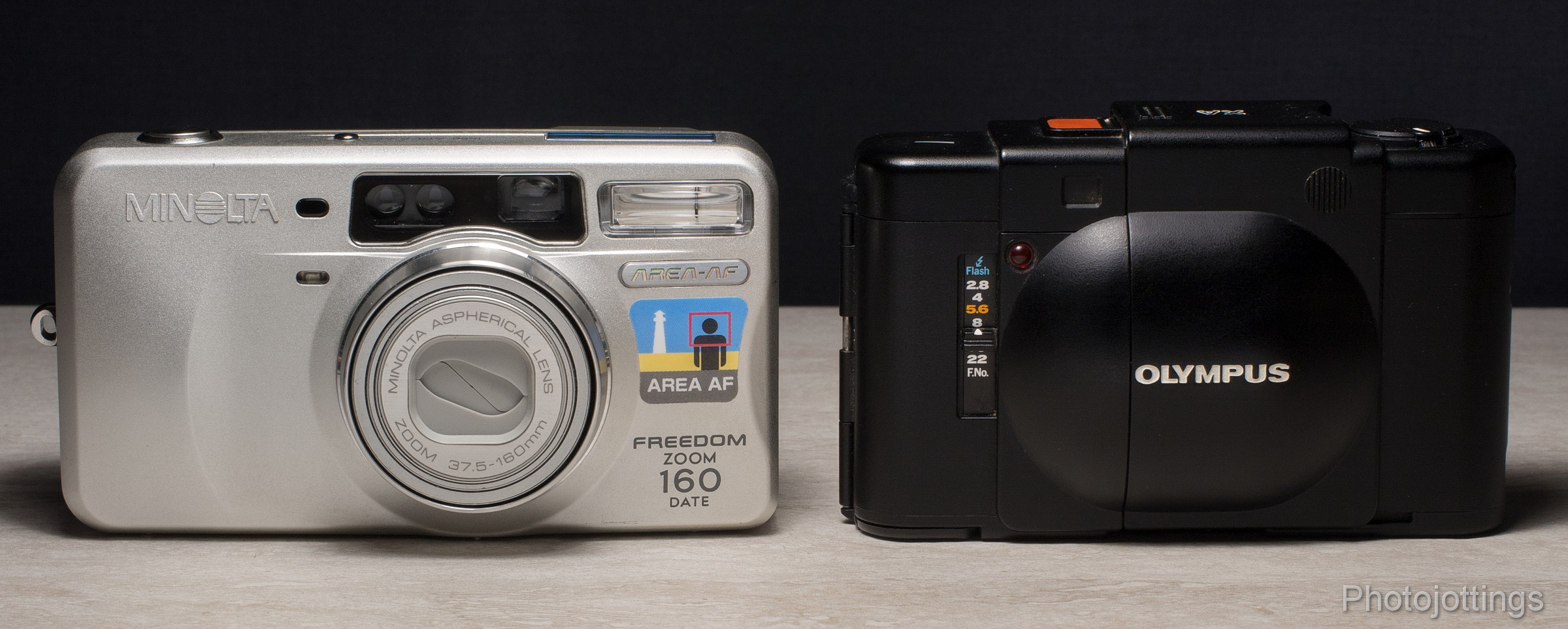
The Minolta Freedom Zoom 160 is almost as small as the Olympus XA, but the Olympus doesn’t have a built in flash, and when added, it becomes noticeably larger than the Minolta.


Here are some test images scanned on a Nikon Super Coolscan 9000 ED.  All are 3000 pixels wide; there is no additional resolution from scanning at a higher sample rate.  Kodak Ultra Max 400 film used.  Click for larger images.

Entrance to detention center; 37.5mm.  Some softness along the left side; very good center sharpness.

Close focus at the wide end.  I’m not sure what aperture it chose for this shot, but the depth of field at close focus is pretty expansive.

Taken at about 85mm, focused about half way to house.

All the way out to 160mm.  Notice the objects along the sides, I could not see them in the viewfinder.
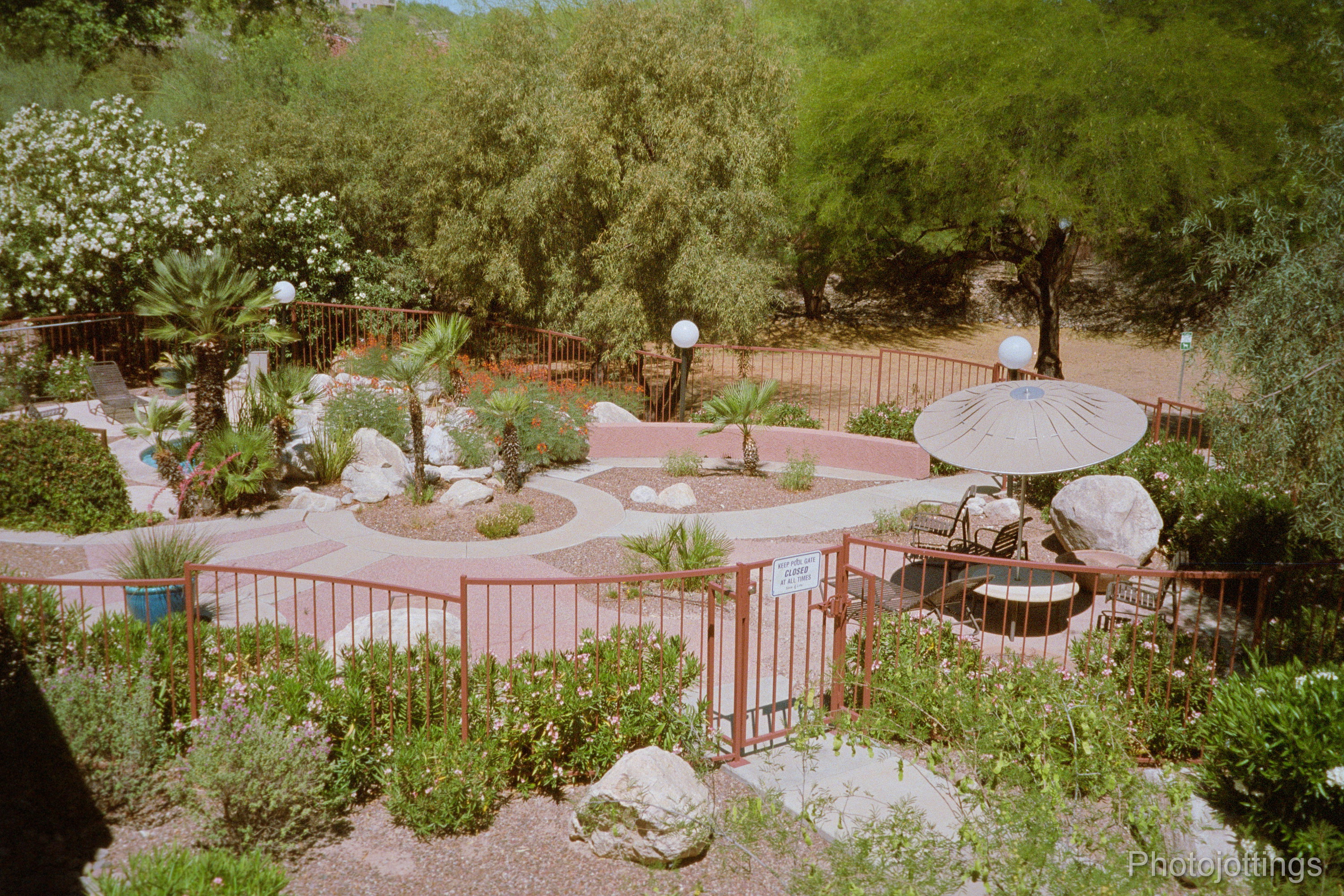
Wide angle shot.  Nice detail in the central area, but softens as you go out to the sides.

Interior shot using the flash.  Blow out at left is caused by the flash hitting a white wall just out of view.  Decent flash power for lighting up a room.

Canyon Ridge detention center at about 50mm.  I couldn’t see the green street sign (upper right) in the viewfinder.


Conclusion.

The Minolta Freedom Zoom 160 Date is definitely a hidden gem in the compact film camera world.  The AF is super quick and accurate; I had no missed focus shots at all, which is very surprising.  The metering system is excellent, all frames where correctly exposed; (I used Kodak Ultra Max 400—not my favorite film, but I had a few extra rolls in the drawer…), and the handy exposure compensation setting was very useful in back-lit situations.  Good news for this hidden gem; current prices are dirt cheap on ebay, around $15-$25

There isn’t much to dislike about the Minolta Freedom Zoom 160, it’s a super small and light-weight snap-shot camera, but I have to whine about something right?  First, the starting focal length of 37.5 is a bit long for me, I’d prefer a little wider coverage starting around 28-32mm.  The maximum aperture at the long end is a whopping F/12.4, so depth of field is pretty expansive, and getting background blur is tough unless you’re close to your subject either at the wide or telephoto end.

The lens on this little camera is good, but not great.  As you probably have noticed by looking at the images above, the centers at wide angle are pretty sharp, but contrast and resolution fall off gradually as you near the sides.  At longer focal lengths, a lack of contrast is more noticeable than a lack of resolution.  With a compact camera in this price range and sporting a 4.3x zoom lens, Minolta had to make some compromises on quality.  I think the goal here was to provide a lens that was acceptably sharp in the centers for portraits and flowers for example, and use the long reach of the telephoto as a marketing gimmick.

Even though the lens is not super sharp, I really like this camera for those quick one-handed snaps shots; the exposures and focusing are about as close to perfect as you can get, and the built-in flash is great for people pictures. I’d much prefer this Minolta for quick snaps than the equally tiny Olympus XA, which lacks the flash and requires manual rangefinder focusing.

The Minolta Freedom 160 Zoom is a great compact camera for people that want to have fun taking snap shots, and just want bright and colorful prints to share with friends and family like we all did back in the film days, and even now I guess.

For better colors and shadows than what you see above, try film like Kodak Ektar, Portra, or even Fuji 400h.  B&H, Amazon, eBay.

Please consider buying your goodies through my links, doing so helps support the site, thanks!
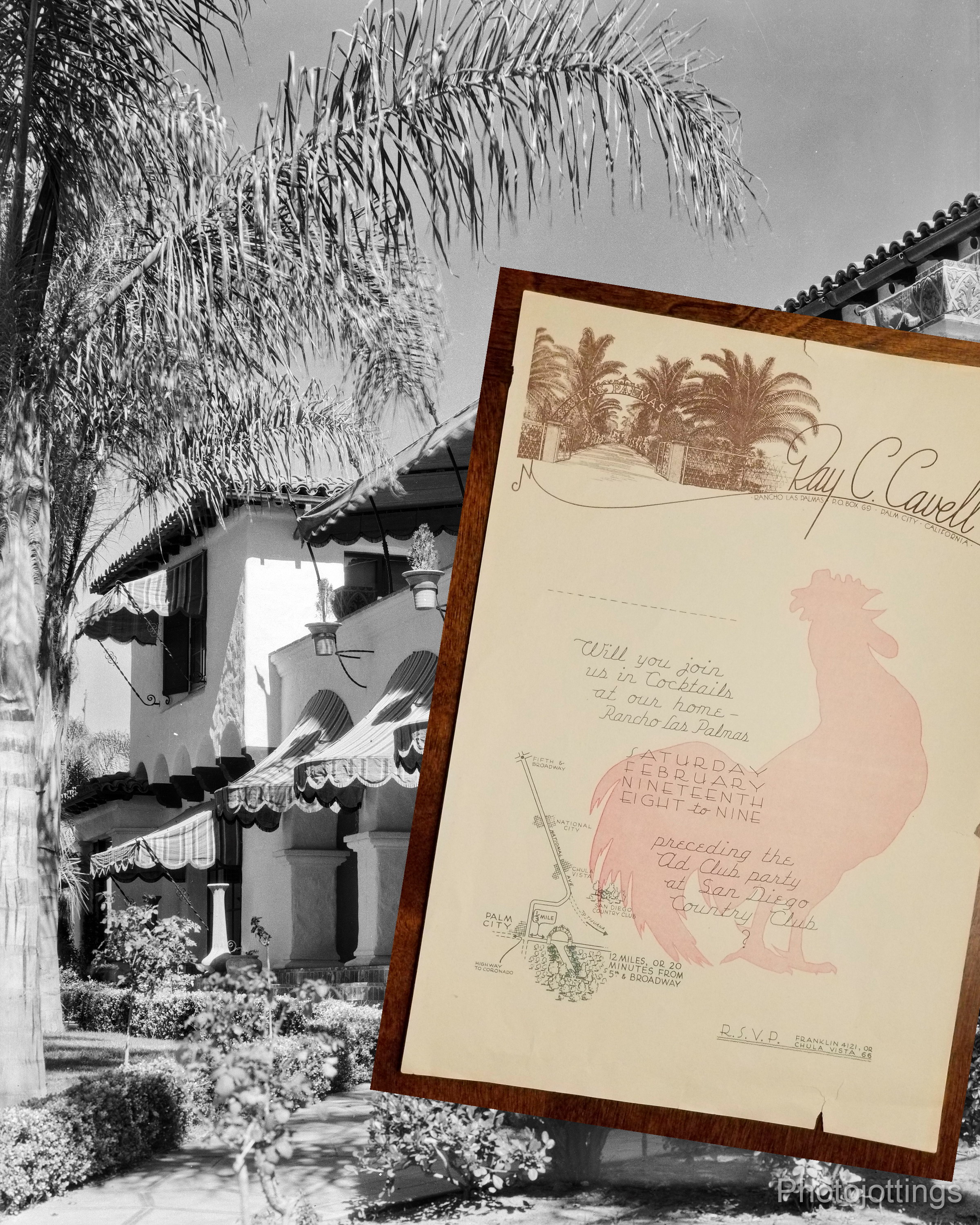
 

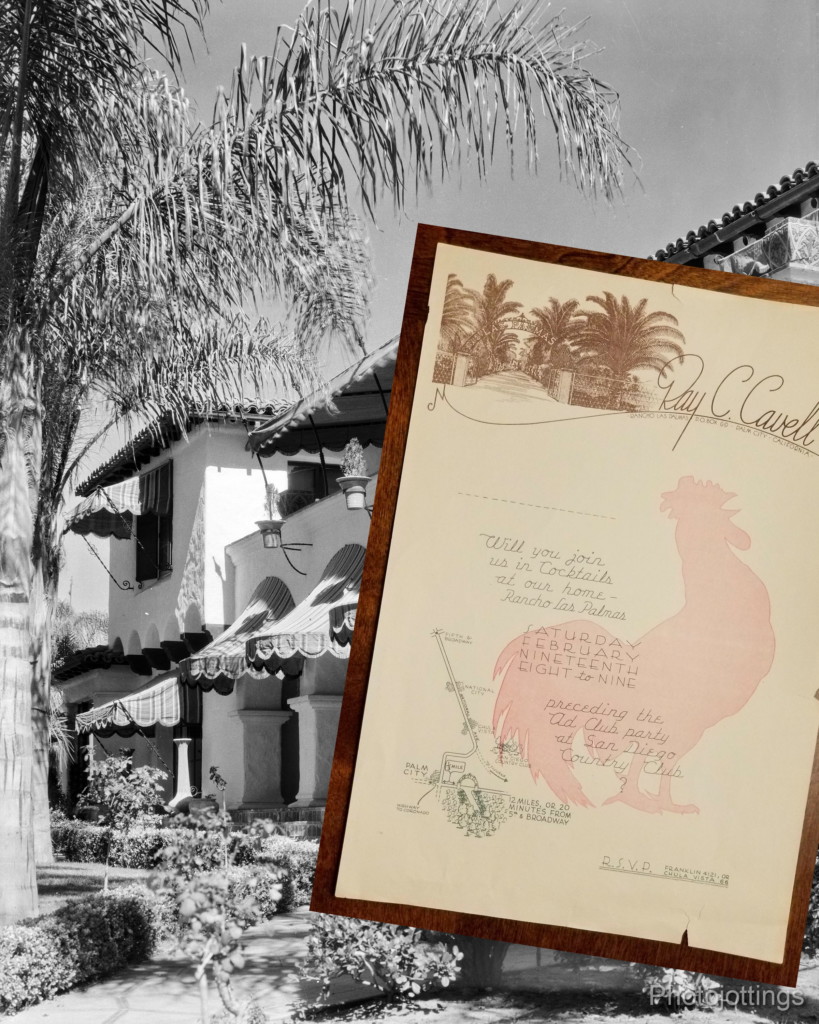
Hop aboard the time travel train and let’s head to Palm City California for a brief visit—in 1938!  Will you join us in Cocktails at our home?

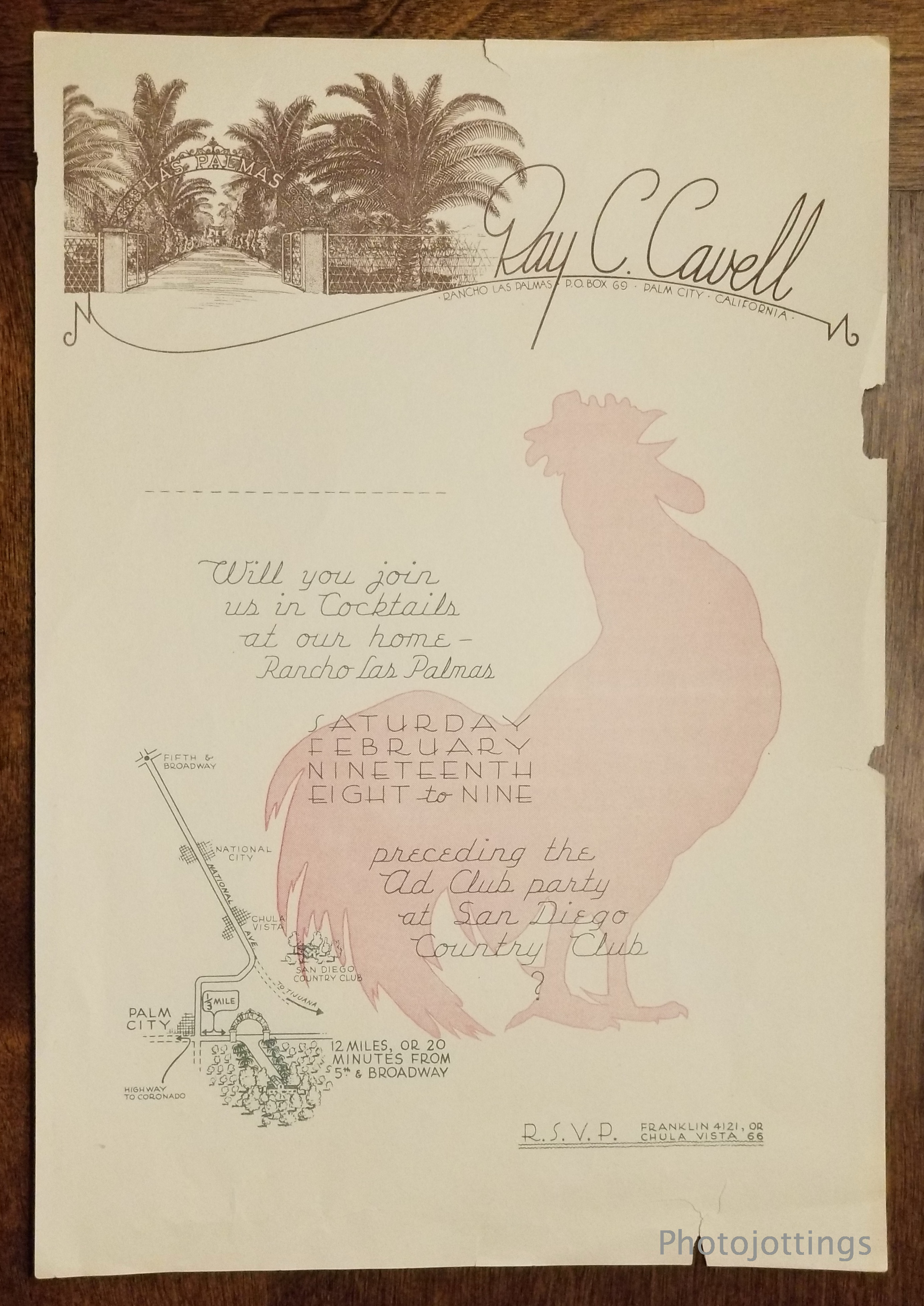
I purchased this group of 18 Kodak nitrate negatives via ebay, mostly 8×10″ size, along with a nice paper invitation for Cocktails after an ‘Ad Club party’ at the San Deigo Country Club.  No year is given, but the date, (Saturday, February 19th) gives us a pretty good clue to the actual year.  According to online sources, the home was built in 1929, and the Cavell’s sold it and moved on in 1939, so 1938 is the only year between those dates that Saturday the 19th in February occurs.

A little history on Ray Cavell: Ray and partner Laurence Klauber were holders of an electrical patent in 1916 for ‘current distributing apparatus’ according to an ‘Electrical World review publication’  and assigned it to San Diego Consolidated Gas and Electric the same year.  I’m guessing this is where Ray made his fortune.  Earlier in life Ray contributed a plan to a 1911 Popular Mechanics Magazine for a quick and easy ‘pen holder’ for holding a ‘beam compass point.’  So It seems Ray was a pretty clever guy.

The beautiful two story Spanish Colonial called ‘Rancho Las Palmas’ is located about 12 miles south of San Diego, California.  According to online records the current property is about five acres, with the home being approximately 9000sf.  However, it looks like that number may be a combination of three different houses on the property, so I’d guess the main home in the pictures below was half that size.  Amazingly, the house and larger outbuildings as pictured in 1938 are still there, skip to the bottom to see!  I’m surprised the place wasn’t torn down and replace with a bunch of inexpensive houses as is the case surrounding the property now.

Unfortunately, I don’t have any information about how these images came to be, so the next best thing would be to do a bit of guess work.  Since they appear to be take by an amateur, (crooked, missed focus, poor compositions, and developing issues), I’m thinking maybe Ray Cavell the homeowner took these himself.  Obviously he had enough money to hire a Professional Photographer, but maybe he didn’t want anyone lurking about the property all day waiting for those decisive moments, especially with the wife and daughter around.  Maybe Ray Cavell already had a basic 5 x 7″ camera, but after reading some photography related magazines of the day he decided to move up to some ‘professional’ equipment and bought an 8×10″ view camera for some official documentation of his Ranch.

As far as exactly when the images were taken, I can only guess that these were made as the Cavell’s were getting ready to sell, and wanted some memories to take with them.  The house sold in 1939, so these pictures were probably taken either in 1938 around the time of the Cocktail gathering, (that’s why the paper invitation is included in the folder with negatives), or possibly just before they moved out.

The scanned (Epson V700) negatives below show the entire area of the image, nothing has been cropped inside from the holder marks.  Many of the negatives have issues from either improper developing or more likely nitrate negative degradation. The pictures are presented at 3000 pixels wide; there is more resolution in the negatives, but I choose to limit the size so they would be more mobile friendly.  Most are 8×10″ Kodak Nitrate Negatives unless otherwise noted.

Click images for larger versions.

Your personal invitation to Ray C Cavell’s ‘Rancho Las Palmas’ home.

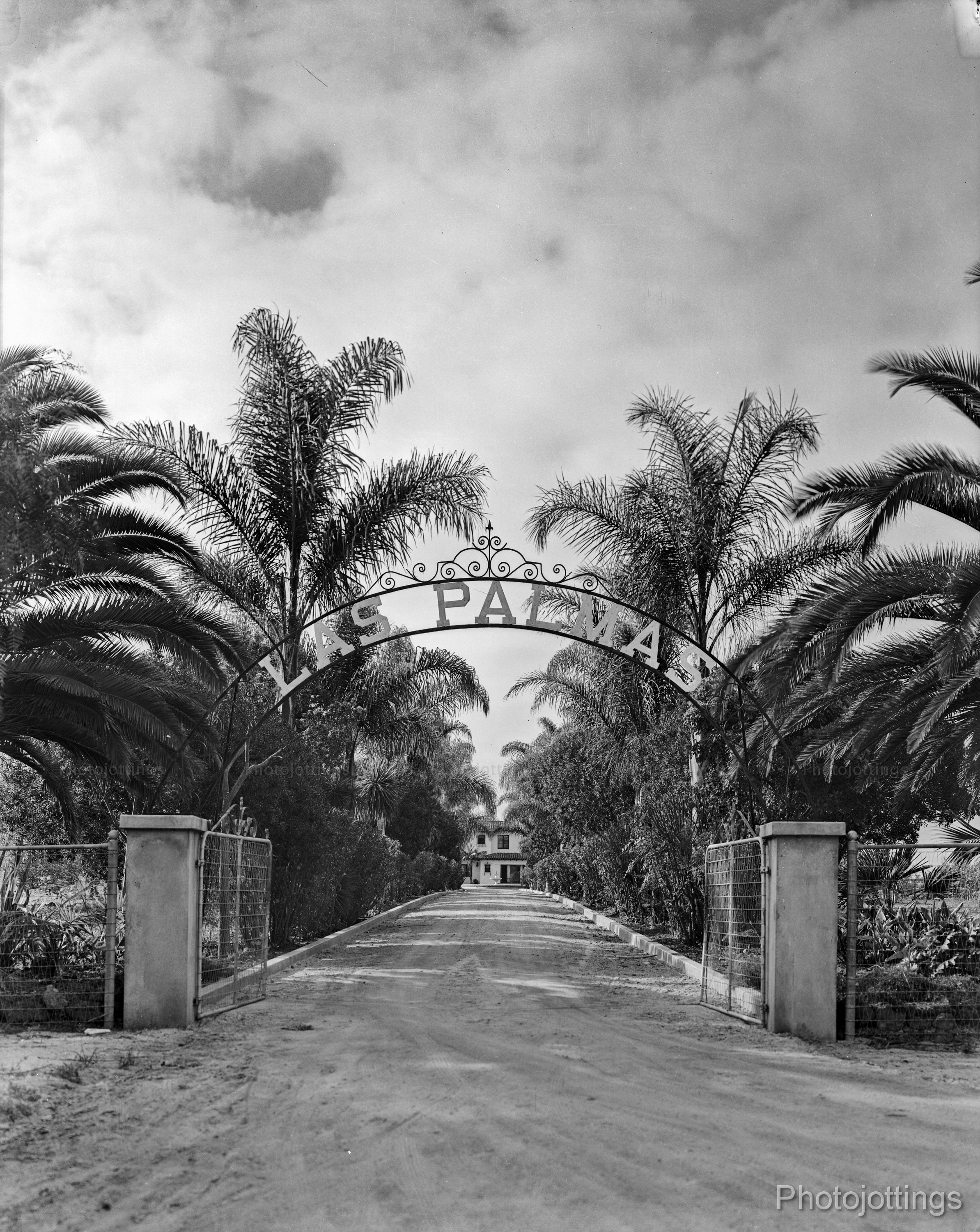
Looking south to the entrance from Palm ave.  Dirt entrance with curbs seems to show a home under construction, but mature landscaping suggests it was taken near the end of their time here.

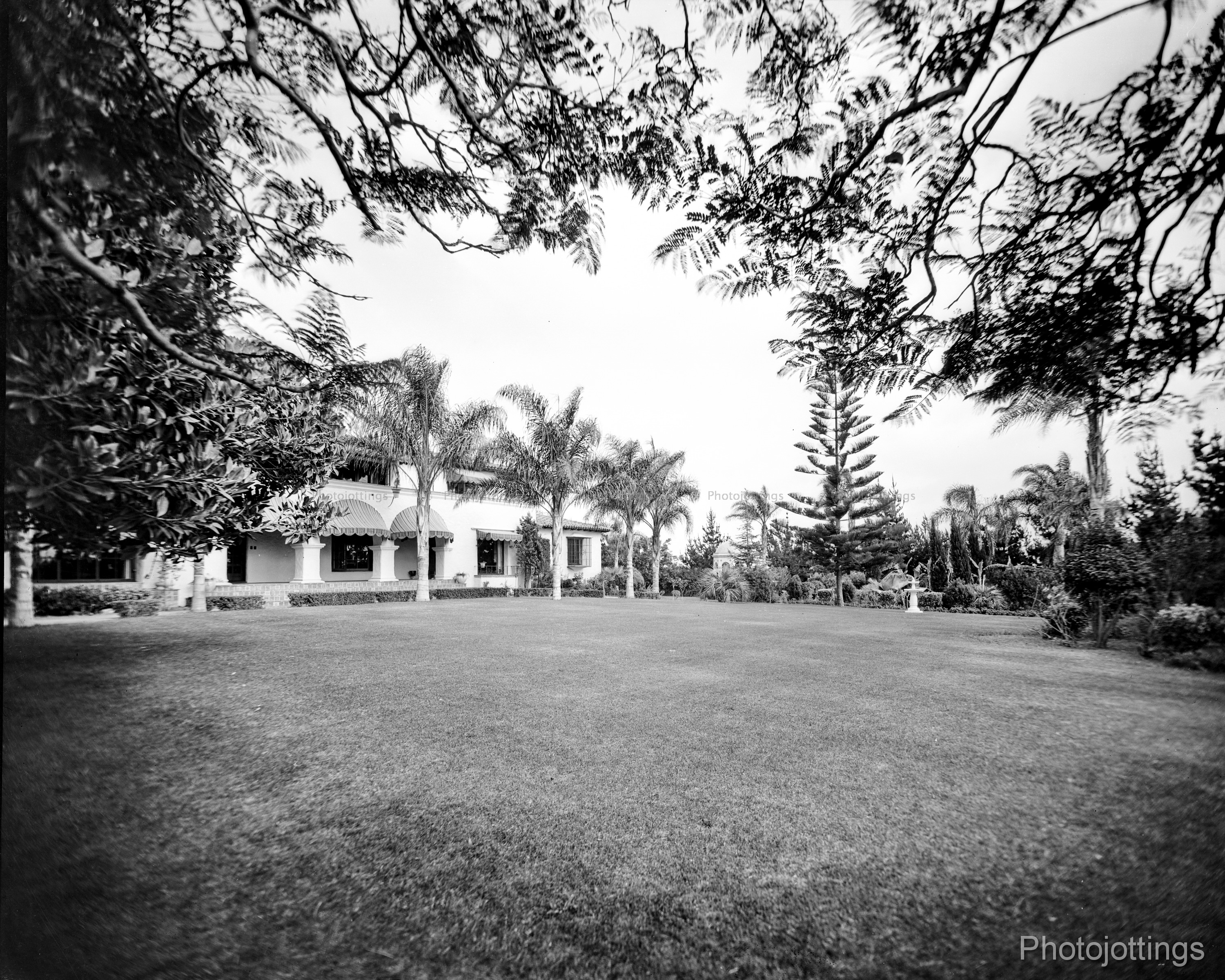
This scene is the west side of the home, using a wide angle lens of around 125mm.  Locally common non-native (Norfolk Island) Star Pine on right.  From a 5×7″ Kodak negative.

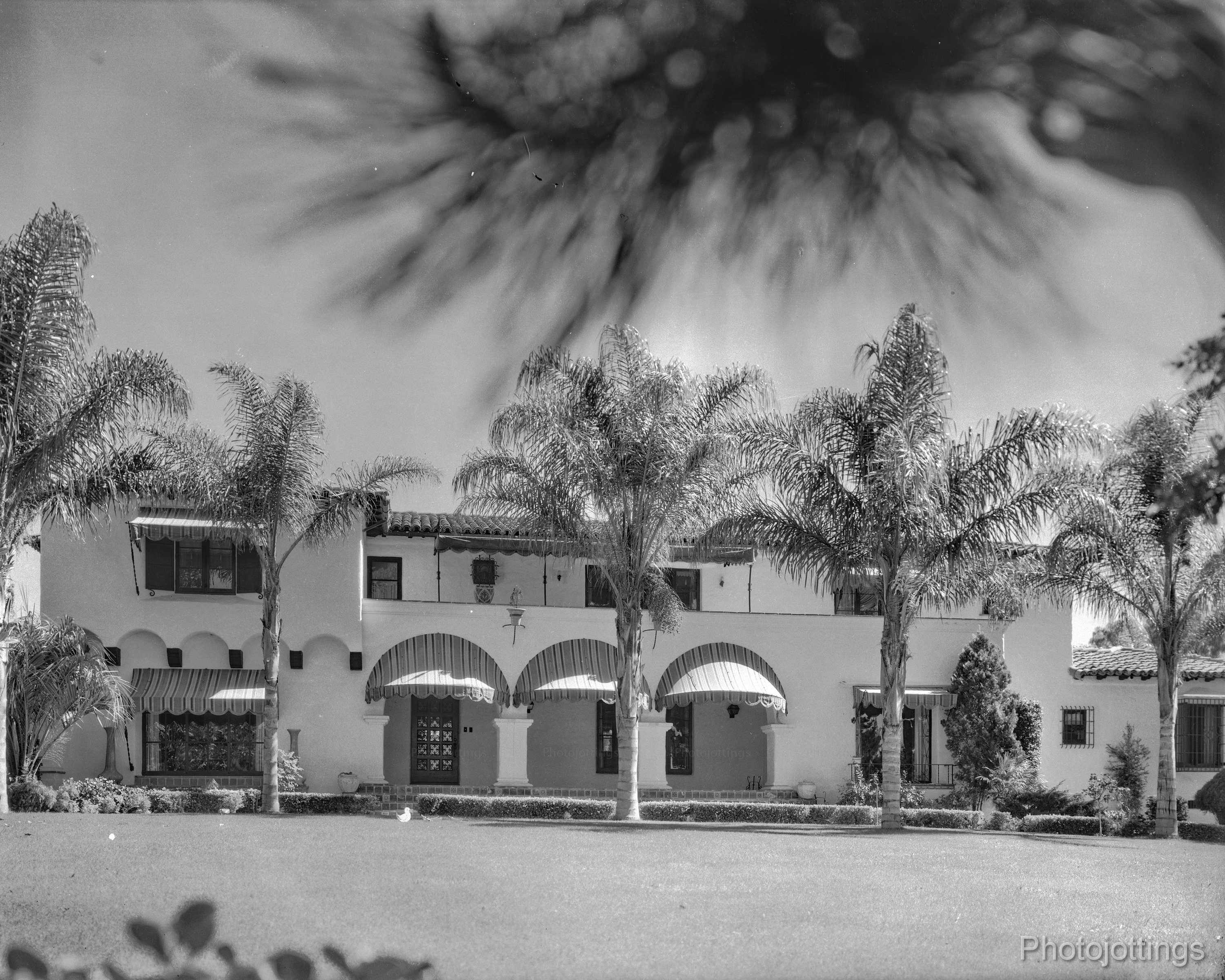
Odd composition here, and not a fan of the foliage in the sky; it’s also crooked; but a cool duck has landed on the lawn to keep our eye from those distractions.

A decent shot here probably using a wide angle lens of around 150mm.  I have a chair almost identical to the two metal strap chairs on the right under the umbrella.  Nice twisted ironwork bracing the fabric awnings.  East or North end of the home.

The east or North end of the home.  A wide angle 5×7″ version from the shot above. I like this composition, however, the moving foliage is very distracting, maybe it was windy.  Using the sunny 16 rule, the settings for this shot are probably around F/32, 1/8 second.

My favorite from the series, and this may be Ray’s wife Myrle; she’d be about 38 here, and apparently was a Real Estate agent for 60 years, and lived to be about 105!  Looks like a ‘normal’ lens of 300mm using an 8×10″ camera.  Background Mountains are in Mexico.

Interior scene with wide angle (possibly 150mm) lens. I’m guessing from experience a five minute exposure at F/45.

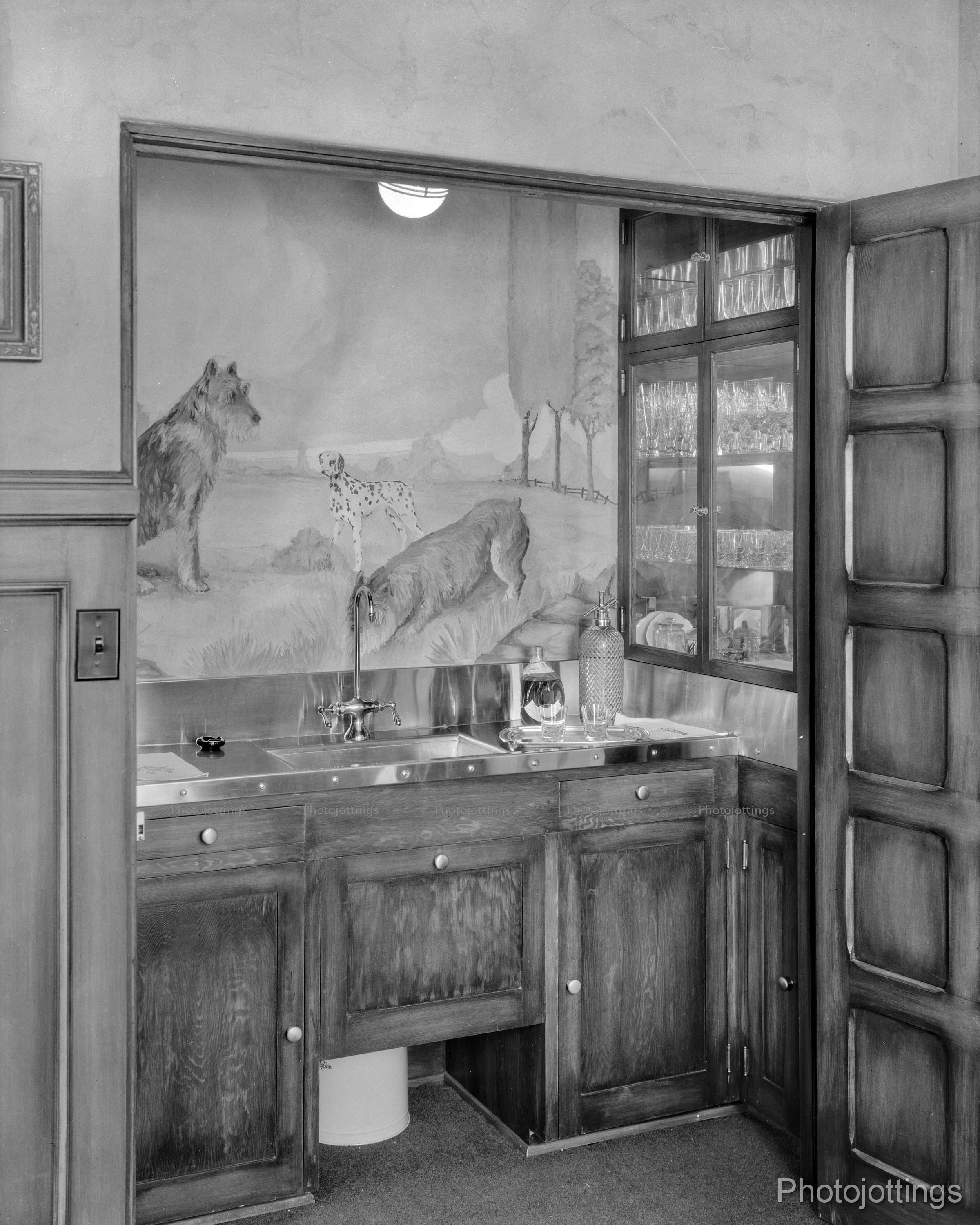
Don’t be vague, ask for Haig!  The bar with what could be a mural of the family pets.

Another shot of the west lawn.  This composition doesn’t work for me, half the entire image is the uninteresting bare lawn.

Here I included the margins to show the little photo bomber in the right lower corner, this may be the daughter Sallie.

I’m not sure what happen here, an artistic effect, or they just plain forgot to level the camera.

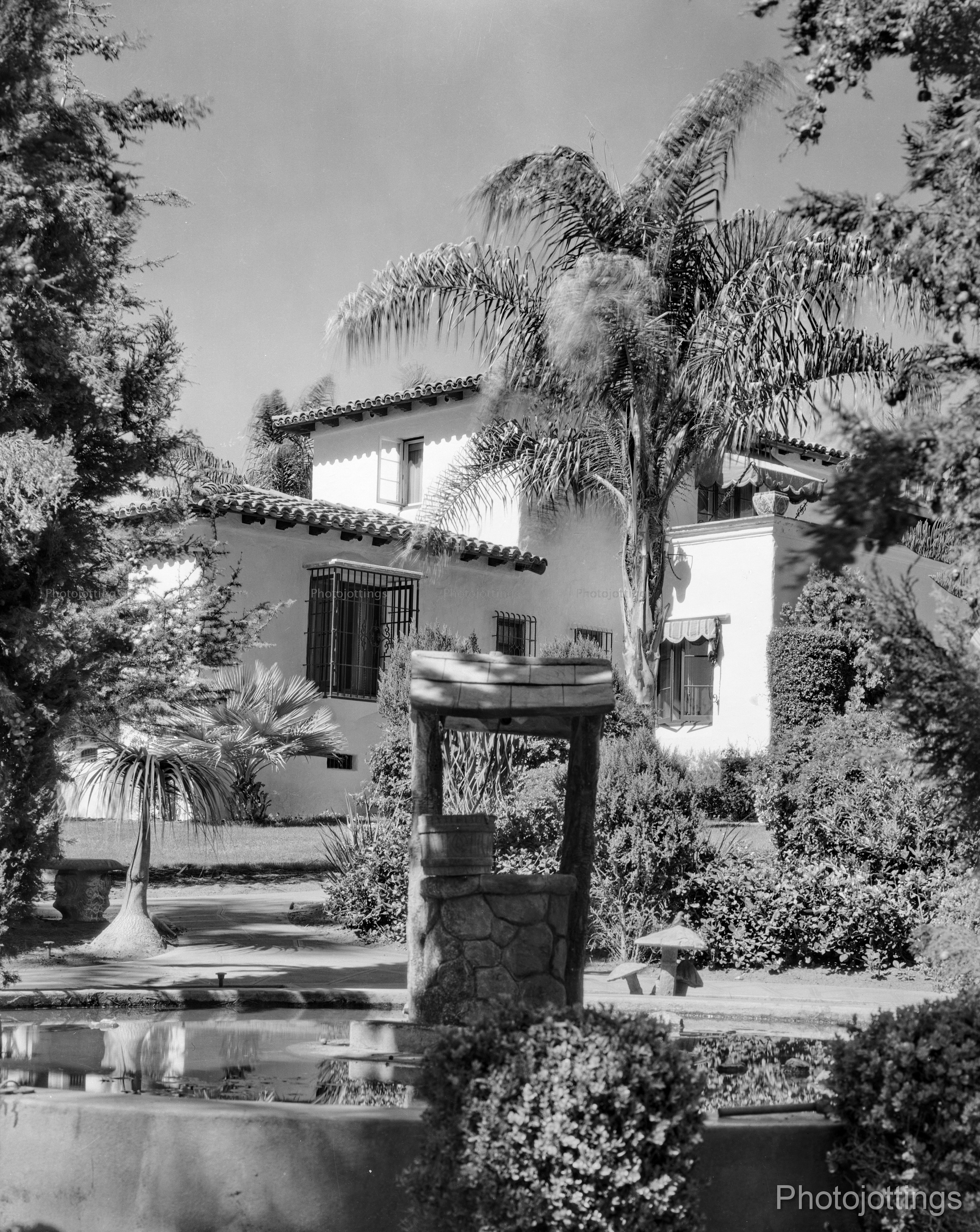
East section of home.  Wishing well inside concrete pond.  Notice the mushrooms and elephant foot palm.

A nice composition here, but again, the blurred foliage is distracting.

Chickens feeding. Based on the invitation sheet, this may be the main focus of the ranch.  A little under exposed, but to stop movement, they had to keep the  shutter speeds up.

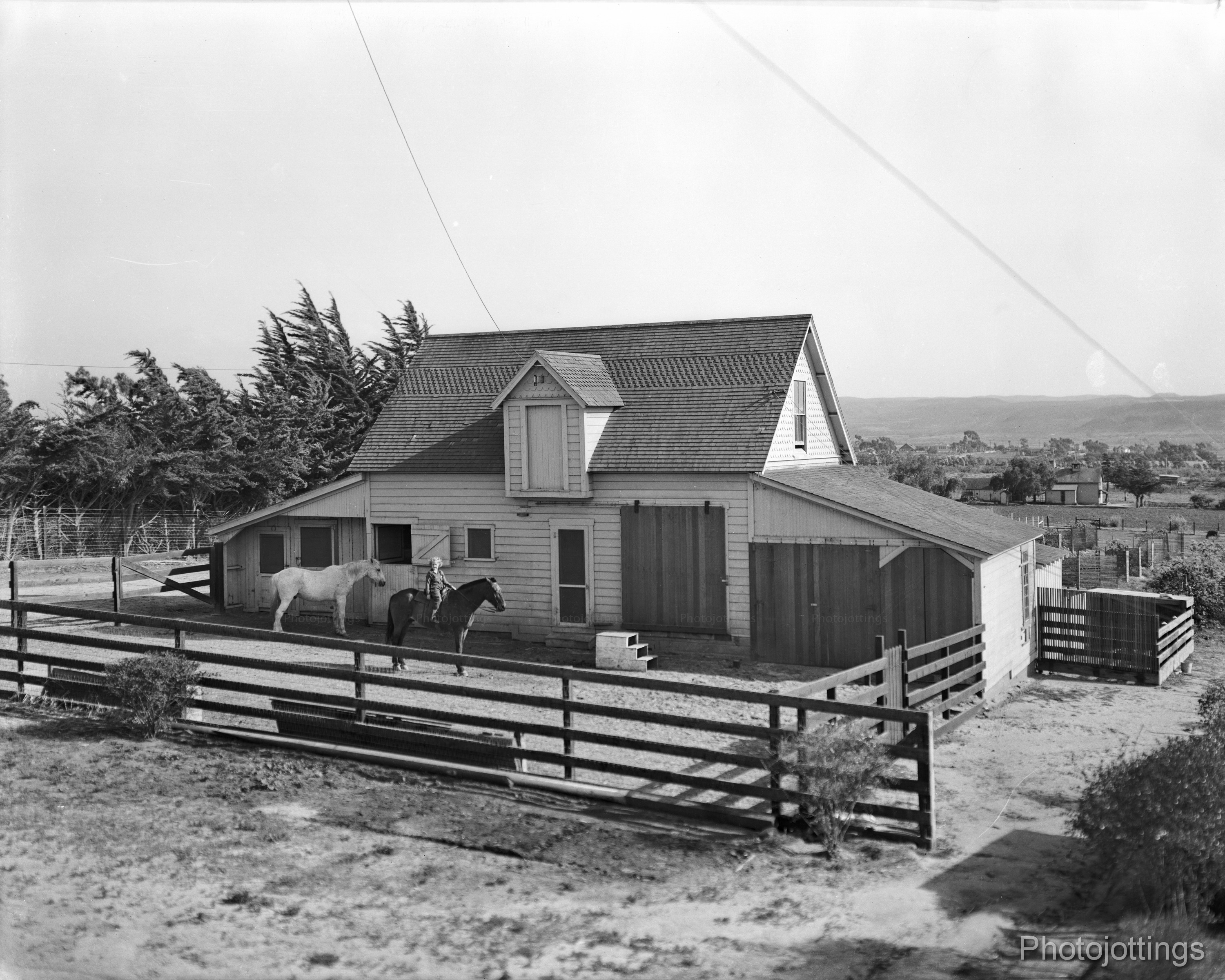
The Barn.  Could that be little Sallie on the horse?  Facing south, and looking into Mexico.

A wider view of the west facing property on a different (and cloudy) day from most of the above shots.

Another cloudy west lawn scene very similar to the one below the bar scene.

The guest house(?) in center.  The barn is off to the left in this view.  Notice the dog laying in the shade by the dog house.  The small building behind the swing set and merry-go-round looks like a kids playhouse.

That’s it for the whole set.  A very interesting, and expensive home for the time, and the best part, it’s still there!

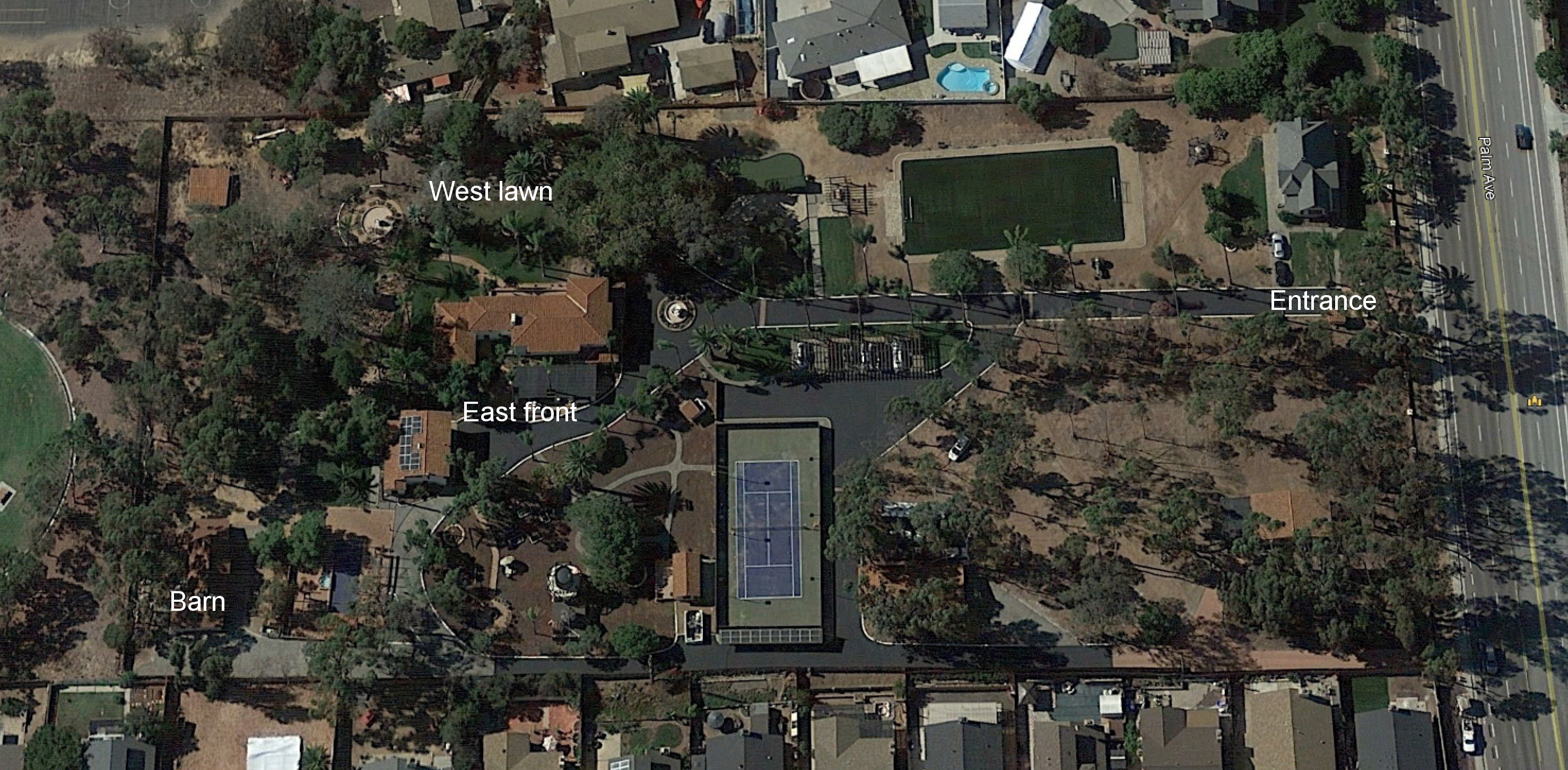
Here’s the place as it looks from above in 2016, see the Google map view here.  North is to the right.

Thanks for stopping by!

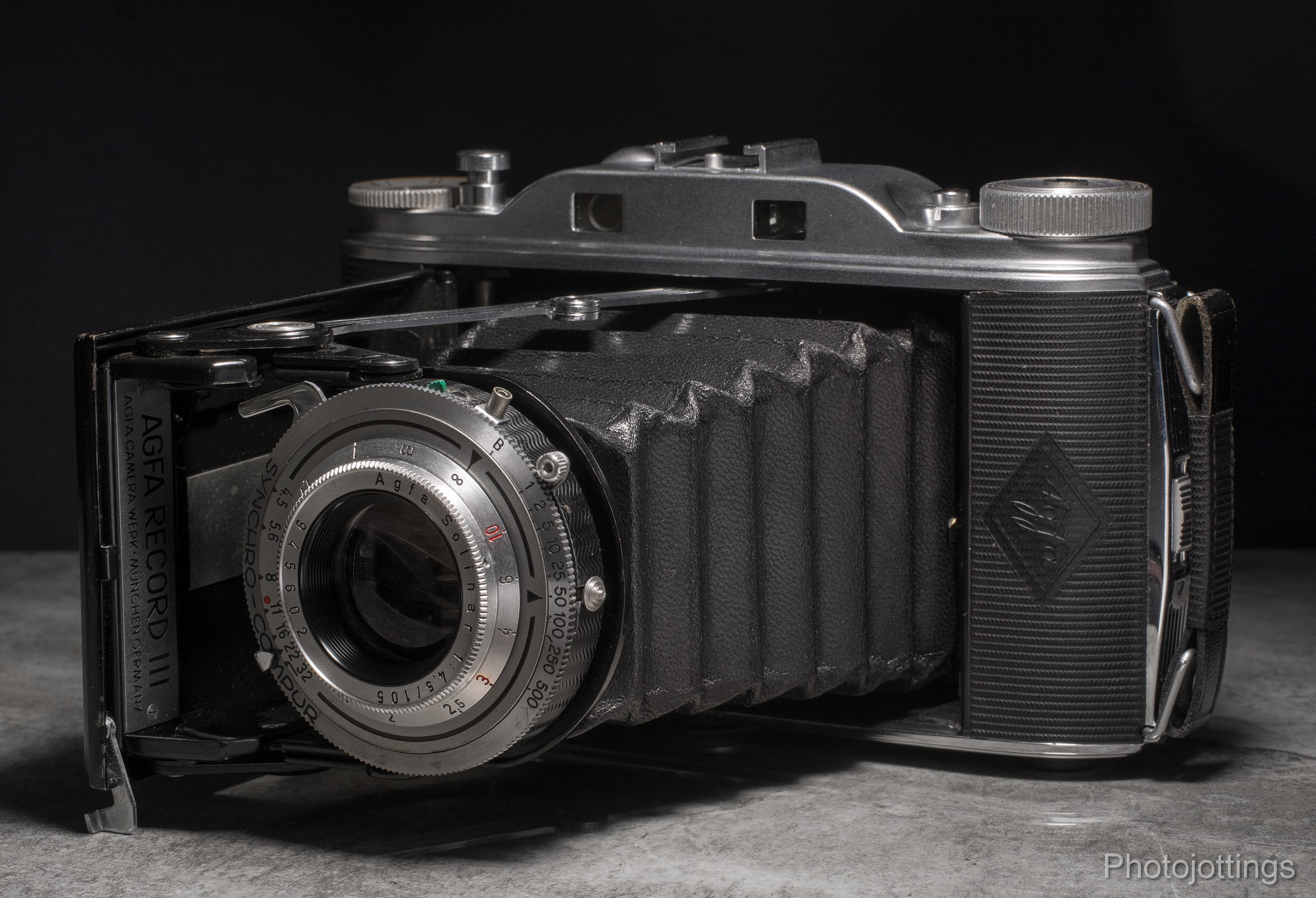
Our review camera for this week is the Agfa Record III; a classic 1950s 6×9 self erecting folder featuring an uncoupled rangefinder, a high speed shutter, and a four element lens.  This is my favorite camera, and I’ve taken more pictures with it than any other camera except maybe my old Canon A-1 I used back in the 1980s.

I really like the fact that it’s very compact when folded; it’ll fit in the back pocket of your jeans, or in a jacket pocket.  These old folders take no batteries, they’re fully manual; you advance the film, focus, set the aperture and shutter speed; then cock and press the shutter and boom, you have a great picture; or maybe just a regular picture!  Thankfully, the camera uses widely available 120 film, and any good photo shop should charge you about the same amount as your 135 film for processing, scanning and printing.

Believe it or not; this Agfa Record III with Solinar lens will come close to the resolution of the Fuji GW690III, and even the Kodak Medalist.  I have dozens of folders, mostly by Kodak and Zeiss Ikon with Tessar lenses, but also a few Voightlander Bessas with Heliar lenses; and this Agfa Record with Solinar lens will out-perform all of them.  How can this be you ask?  I’m not sure, but my copy seems to have the lens centered very well to the film plane, with the lens elements correctly set and the rangefinder nearly perfect.  Unfortunately, based on my experiences, that type of perfection was not normal at all for these folders; in fact, the Zeiss Ikon that my dad bought brand new had the focusing front element incorrectly set, so the images at less than infinity were not even in focus, but the small prints you received looked good!!  It’s not until you look at the film with a 22x loupe, or do a high sample rate scan and view it on your computer screen that you notice the problems.

If you’re wondering what a good folder from the 1950s is really capable of, check out the many sample images below.

Well, that’s enough of a general introduction, let’s look more closely at the specifics of the Agfa Record III with Solinar lens.

Name; AGFA Record III, order no. 1470/313.

Manufactured by; AGFA Kamerawerk AG, (Aktien-Gesellschaft für Anilin-Fabrikation), Munich, Germany

Made in; Munich, West Germany.

Date of manufacture; Approximately 1952-1955.

Price; a few sites are listing the original price as 196 DEM or German Marks, I’m not sure if that’s accurate; it seems a little too cheap; that would be around $46 in 1955 based on the exchange rate of 1=4.2.  Maybe they all copied one person that made an error or just guessed.

Build material; all metal body, with a leather bellows.  Fit and finish are very good.

Box contents; unsure, but probably the camera and instruction manual, or a leather case with the deluxe kit.

Weight; my measurements, no film, 24.9oz (707g).

Dimensions; my measurements; 6.25″ (162mm), 3.6″ (98mm) tall, and 1.6″ (43mm) deep closed, open 5.0″ (127mm).  All dimensions include protrusions.

Focal length; 105mm.  47° diagonal angle of view.

Aperture;  F/4.5-F/32 manually set, no detents.  Marked aperture settings include; F/4.5, F/5.6, F/8, F/11, F/16, F/22 and F/32.  You can set in-between the aperture marks.

ISO; no settings, but back then Agfa recommended an exposure index of ASA 40 in the owner’s manual.

Focusing distance; 3′ (1m) to infinity.

Viewfinder; circular opening, with a magenta hue.  No guide lines or parallax correction marks.  Rangefinder circle is about average in brightness and size, see picture below.

Approximate resolution; good film and technique will make very sharp 16×20″ or larger prints; and about the same as today’s better digital cameras with a good lens.  See sample images farther down the page.

Distortion; none of my images show any discernible distortion.

Light fall-off; I see mild to moderate “corner shading” when shooting at F/4.5-8; at other apertures I don’t see much.

Color fringing; none that I notice.

Background blur or “bokeh;” looks good when close to the subject at wide apertures, see picture below.

Lens; Agfa Solinar, coated, 105mm (4.1″) F/4.5, with 4 elements in 3 groups, (‘Tessar’ type).  The outer diameter of the lens protrusion is approximately 37mm, so you may be able to use 37mm push-on filters, but I haven’t tried it.  Approximate equivalent in 135 format: 50mm F/2.1.

Shutter and speed; Synchro Compur 9 speed shutter, with speeds settings at 1, 2, 5, 10, 25, 50, 100, 250, 500, plus bulb.  Also has ‘X’ and ‘M’ flash sync settings.

Film; standard 120 roll, with a picture area of 56mm x 84mm.  The “6×9” picture area is 5.4x larger than 135 film.

Flash; none, but has cold shoe and 3mm contact nipple with ‘X’ and ‘M’ shutter settings.

Power; none.

Accessories for this model; filters from Agfa include; light-yellow, medium-yellow, yellow-green, and orange-red.  A 37mm slip-on hood is available with a tan/brown leather pouch.

Crippling features and omissions; nothing really, it’s just a  simple folding camera for convenience.

Good features; compact, fits in back pocket of jeans, or larger front pockets.  Rangefinder is very handy, even though it’s uncoupled.  And finally, it has a premium high speed shutter with a sharp lens.

Quirks; you have to keep pushing down the shutter button after the shutter fires for the double exposure prevention to work; although that could be a problem with my copy only.

Problems; many samples may not be ‘perfect’ from the factory, meaning the lens might not be centered, and the focusing might be off.  Older cameras have a host of issues, like holes in the bellows, focusing stiff or stuck  completely, shutter not firing correctly etc.

Other versions; there are models ‘I’ and ‘II’ which did not have rangefinders, and usually had a cheaper shutter and/or lens combination.

Go here to see the owner’s manual and make sure you tip the site owner.

Product shots with descriptions.  Click pictures for larger versions.

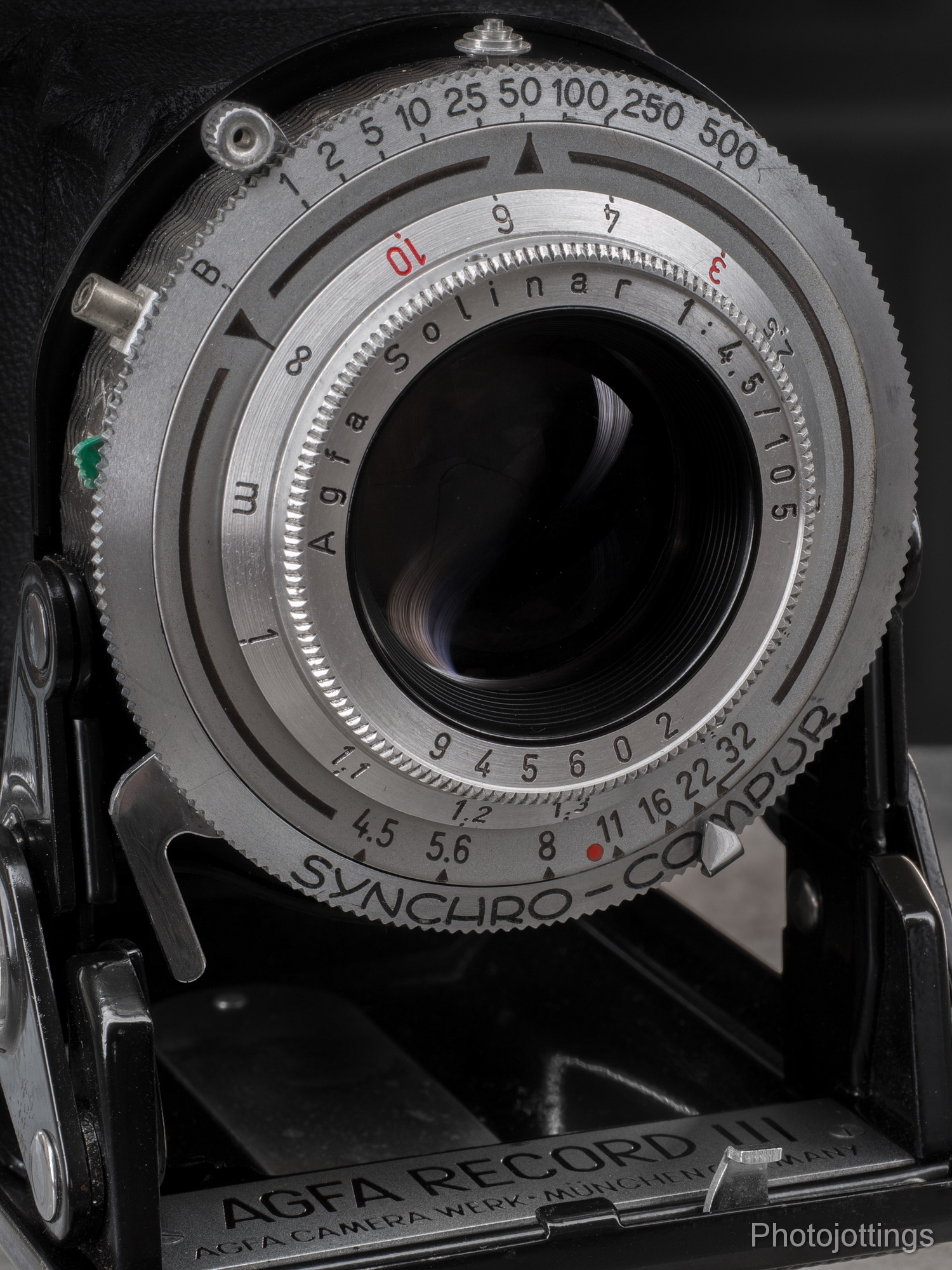
The lens and shutter combination.  Going clockwise, the green lever is for the flash synchronization, next is the 3mm flash contact nipple, then the shutter cocking lever.  On top is the self timer button, you pull it back while pushing the cocking lever all the way over until is stays put.  Press the shutter button and the self timer starts.  Do not use the self timer in ‘B’ mode, or at 1/500, the spring tension is too high.  On the bottom we have the aperture lever and index.  There are no detents, so you can go in-between marks if you want.

The red ‘3‘ and ‘10‘ on the focus ring, and ‘O‘ at F/9 is for ‘two point’ focusing.  Set the aperture lever to F/9 on the red dot.  At ‘3‘ the depth of field is between 2.5-5m (8′-16’), and at ‘10‘ between 5m-∞ (16’-∞).  These two setting are ‘safe’ for quick shooting.

The chrome boomerang shaped lever on the left is for tripping the shutter via a metal rod from the top button, or you can bypass the top button, and double exposure prevention system by manually pushing it out until the shutter trips.

The little bent flat tab sticking out at the bottom right is a swing-out leveler for horizontal tabletop shooting.  Funny, but the owner’s manual doesn’t tell you this.

A view of the top.  From the left is the winding knob with the arrow, next is the self erecting release button for popping out the lens.

The cold shoe is for holding a flash, light meter or auxiliary viewfinder.

The milled wheel next to the cold shoe is the rangefinder indicator ring; this is where you get the distance when the two images coincide or merge; from here you take the reading and transfer it to the lens focusing ring.

On the top right we have the shutter button that is threaded for a cable remote.

Just below the shutter button is the little round double exposure indicator window.  If it’s red, the shutter is locked, and you must advance the film winder until you hear an audible ‘click’ and the red dot disappears, now the shutter is ready to operate.

The large round dial is a depth of field ring.  Set the aperture directly over the distance mark you’re using, and the lines to the left and right indicate the approximate depth of field.  In the case above, F/11 is set at the distance mark of 6m, so everything from 4m to almost infinity is within acceptable sharpness.

On the bottom we have the ¼-20 tripod socket.  If you’re using a small base tripod, or quick release plate, you might have to shim up the bottom to make it tight because of the protrusion of the film spool holders.  I find a couple of pieces of a paint sticks work well.

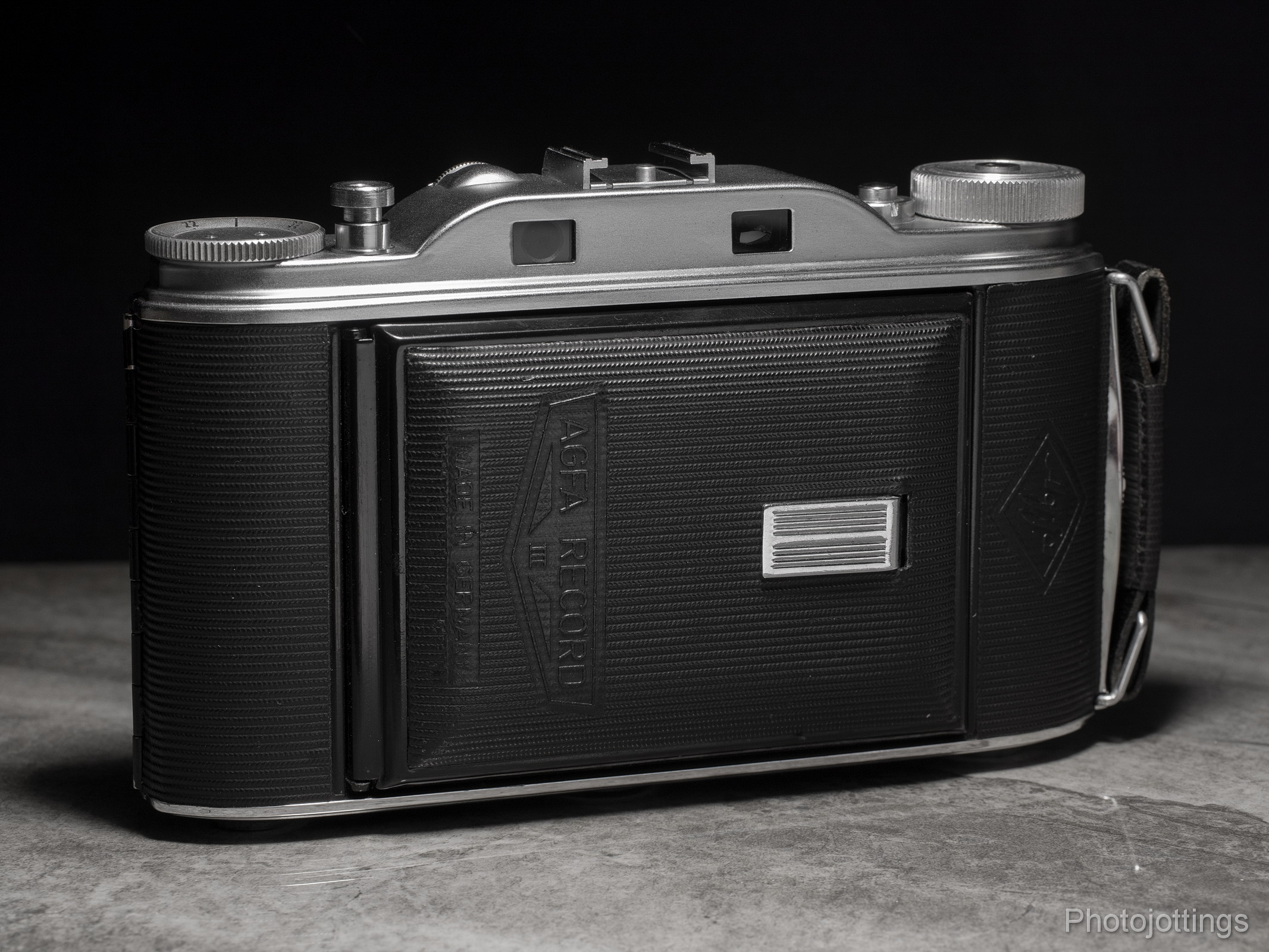
The front of the closed camera shows the chrome vertical leveling foot against the nice faux leather cover with embossed manufactures identification.

The left rectangular window is the rangefinder; it has a circle inside.  The window to the right is the viewfinder.

The backside is pretty spartan.  The circular viewfinder opening is quite small, but adequate for framing your shot.  The lever next to the red window operates a cover, you move the lever up to see the frame numbers on the backing paper, and spring tension keeps it closed.  The camera back is opened by the lever on the left side here, just under the leather hand strap.

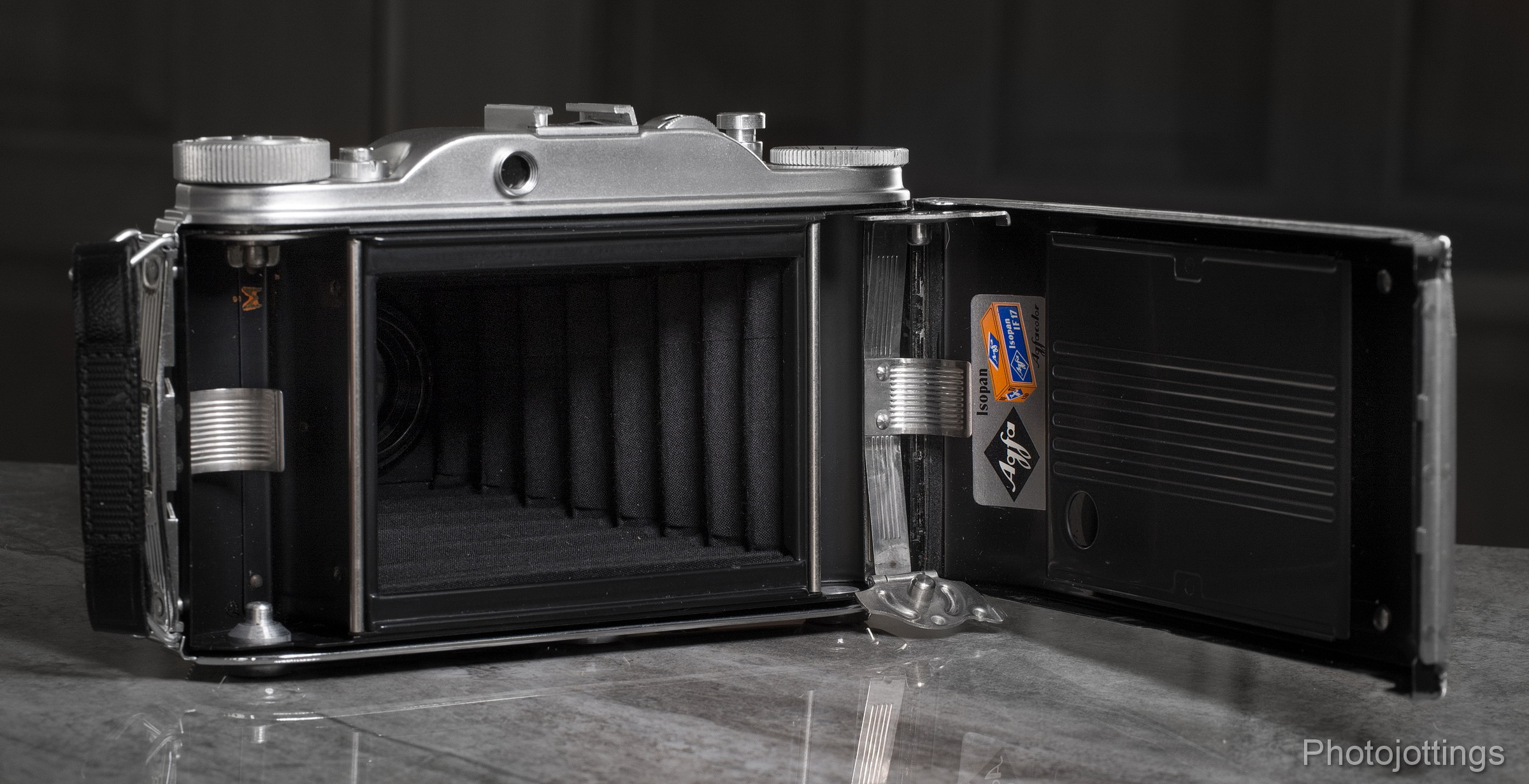
With the back cover opened we can see the lens retaining ring and aperture blades and of course the folded up bellows.  Also visible is the film pressure plate, and the Agfa film sticker recommending Isopan IF 17 B&W film (ASA 40).

Another view of the interior, this time with the bellows extended.  The roll holder on the right, (supply side) has a nice feature where the entire holder swings out, and the bottom drops out for easier spool insertion.

The original Agfa leather case is still in good shape.

The factory plastic slip-on hood has been mounted.  Obviously, you’ll need to install it after opening the camera, it won’t fit inside when closed.

Here is the Agfa leather carrying case for the hood, and a couple of filters.  The Agfa case bottom says; 37mm, 6088, Made in Germany.  The filers pictured here are B&W 37mm slip-on type.

The filters and hood will stack; meaning when the filter is on the lens, the hood will mount to the outside of the filter.  You can even stack filters if you want, although I don’t know at what point you’ll start to get clipping in the picture corners.

The small case will also hold a filter or two snuggled in a divided pouch in the area under the hood.  The case has a slit in the back for attaching it to the strap of the camera carrying case.

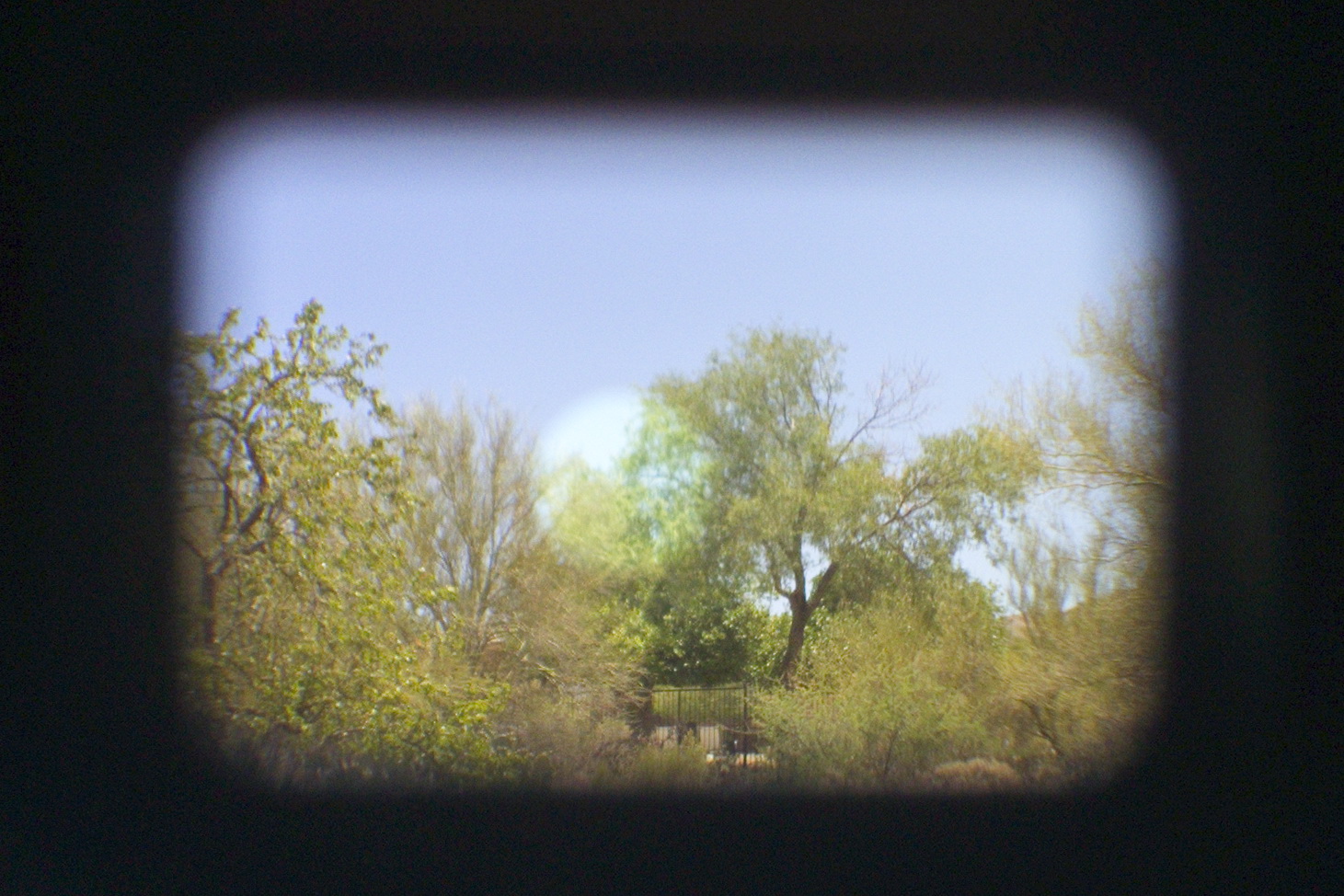
This is what you see through the viewfinder.  The faint circle (rangefinder patch) is where you merge the two images to determine the focus distance.  The rangefinder patch is actually much brighter than what you see in this awful cell phone shot.

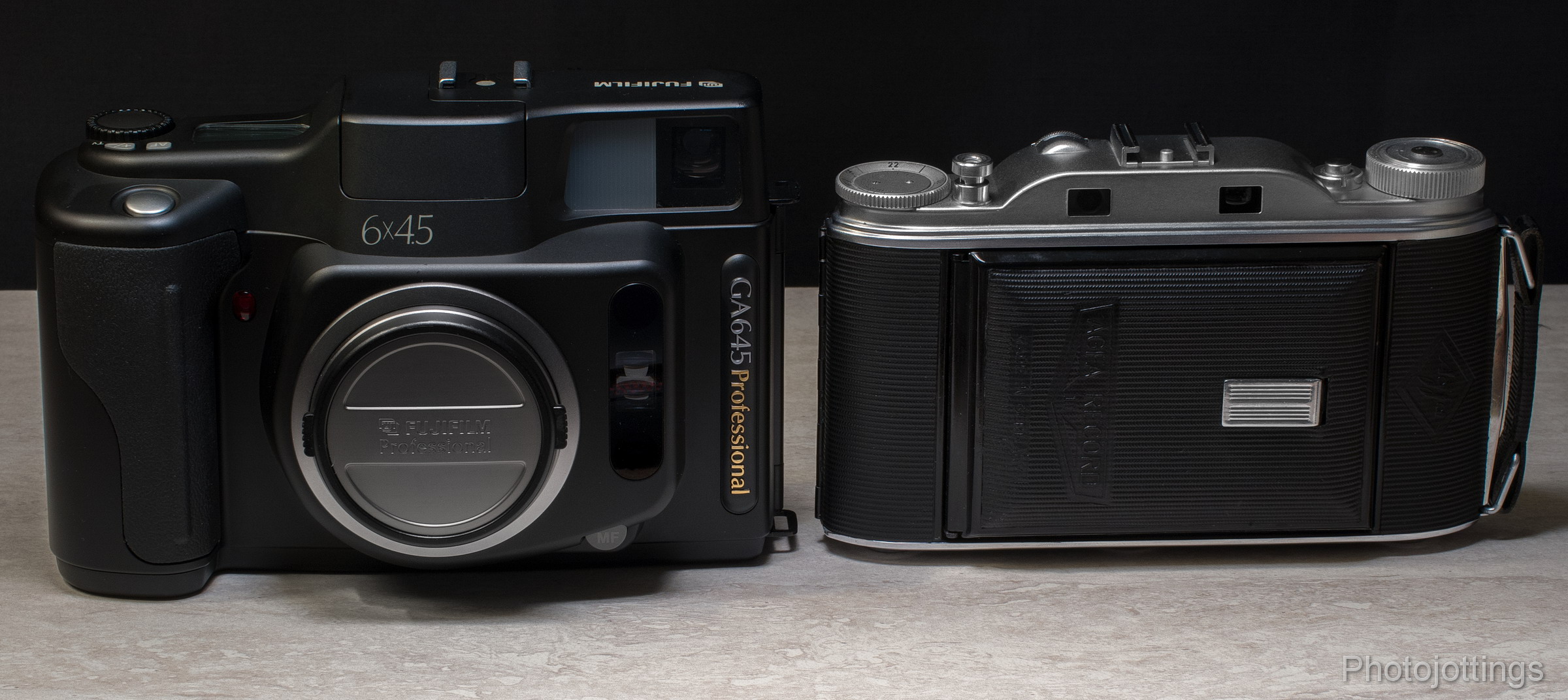
The Agfa Record III is much smaller than the Fuji GA645, but has twice the ‘negative’ size.


Sample shots below.

Here are a few samples for your viewing pleasure.  They’re about 5000-6000 pixels on the long end.  Click images for a larger version.

Cool water feature, without the cool water.  F/22 1/50s.  Kodak Portra 400.

Goofy gal, near close focus at F/8, 1/250 sec.  Focus is on the music bar and notes.  Fuji Pro 400h.

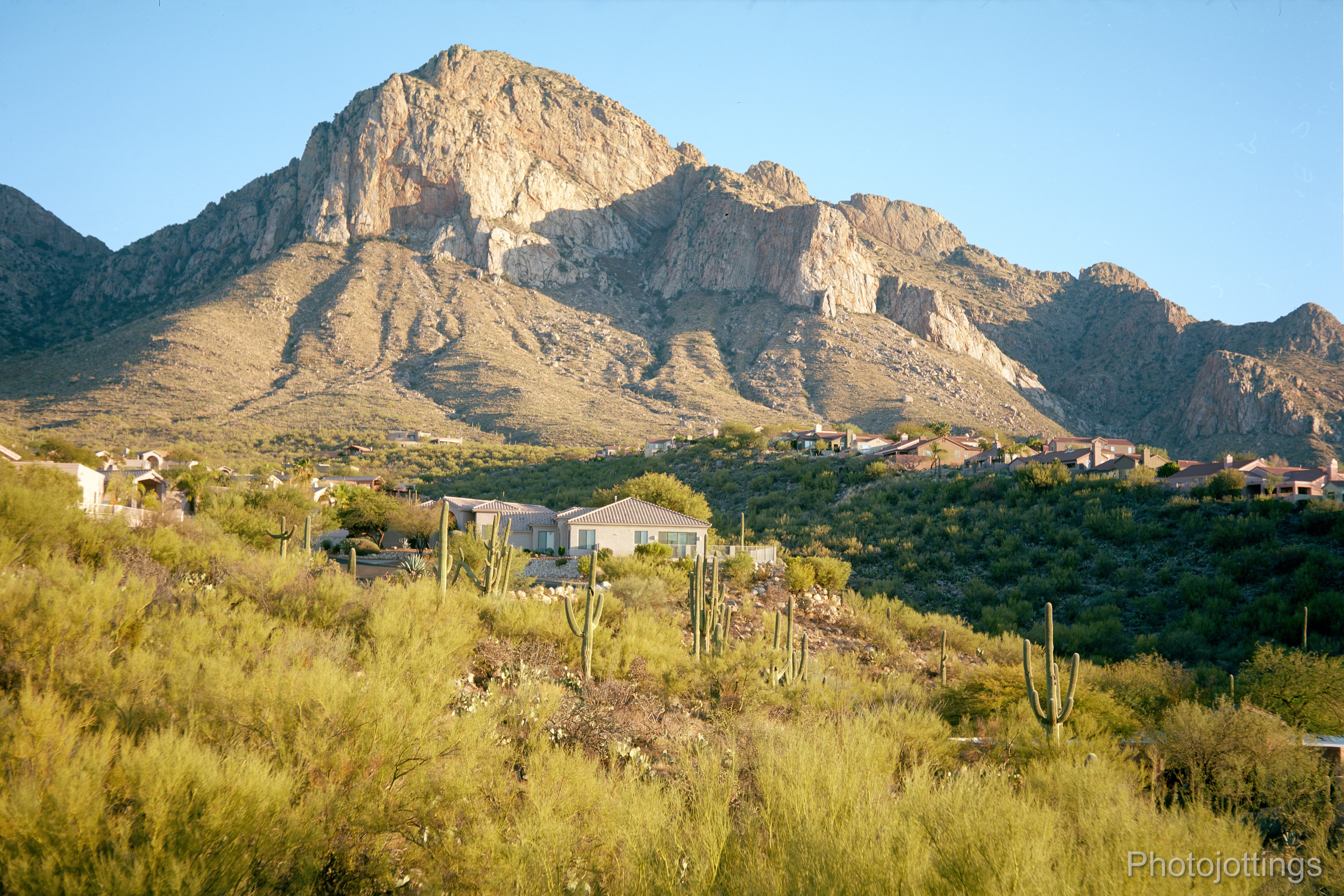
Sentinel of the Desert, F/16, 1/100s.  Focused on the Sentinel.  Kodak Portra 400.

Forest floor daisies, close focus, at F/11, 1/100s.  Kodak Portra 400.

Lions performing synchronized projectile vomiting, F/16, 1/50s.  Fuji Pro 400h.

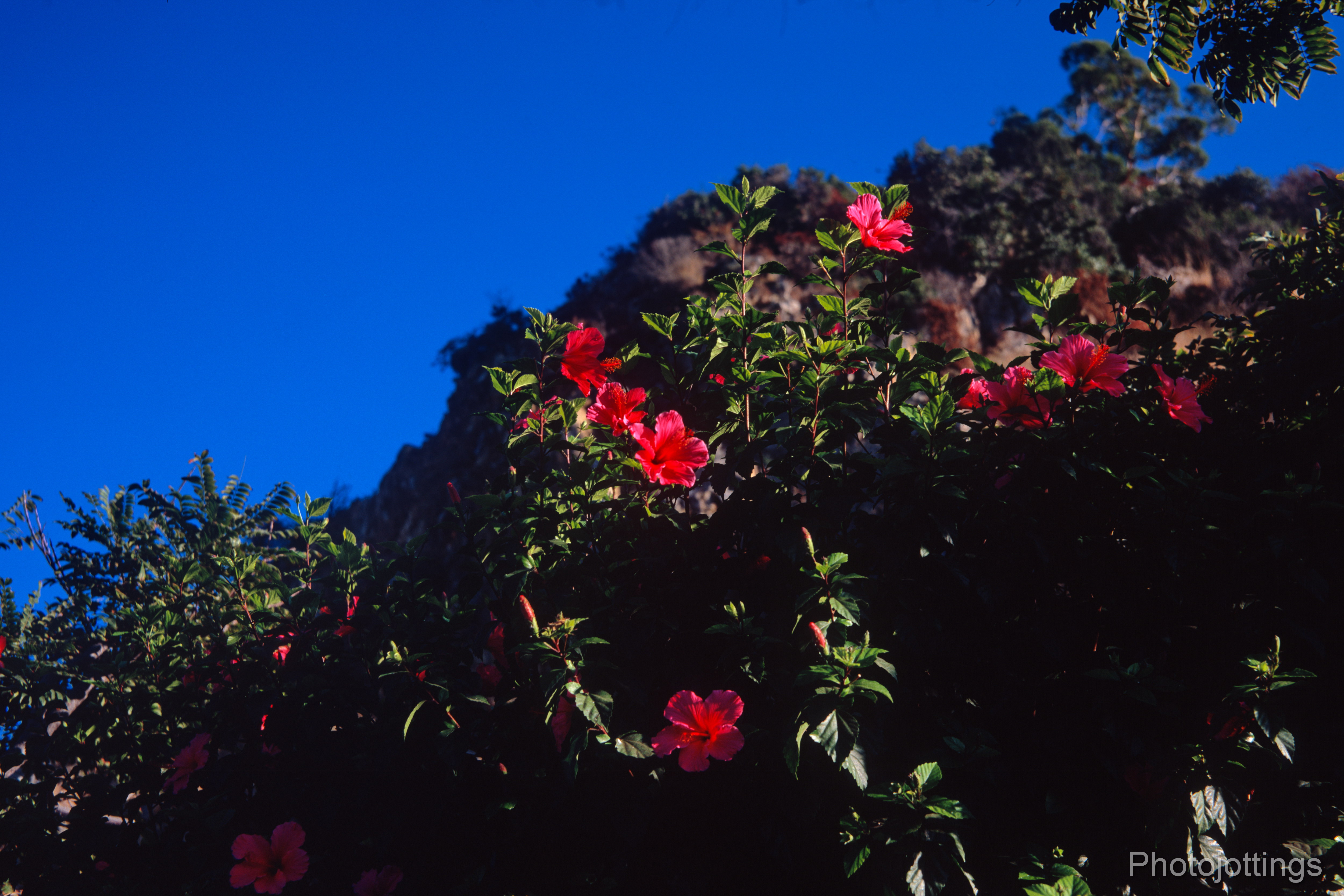
Red Hibiscus at near close focus,  F/11, 1/100s.  I missed the focus slightly.  Fuji Velvia 100.

Rocky Beach, F/11, 1/50s.  Very late afternoon sun with high speed color reversal film.  Focused on the people in the middle.  Fuji Provia 400X.

No fish, so they called Olive Garden.  F/5.6, at 1/50s.  Limited depth of field here and focused on the fire pit.  Very sharp in the central part of the picture, and totally usable at this aperture.  Fuji Provia 400X.

Here’s what you get when you don’t continue pressing the shutter button all the way down after the shutter fires; a double exposure.  Either really neat, or two wasted pictures out of 8.

No lens distortion here.  Fuji Pro 400h

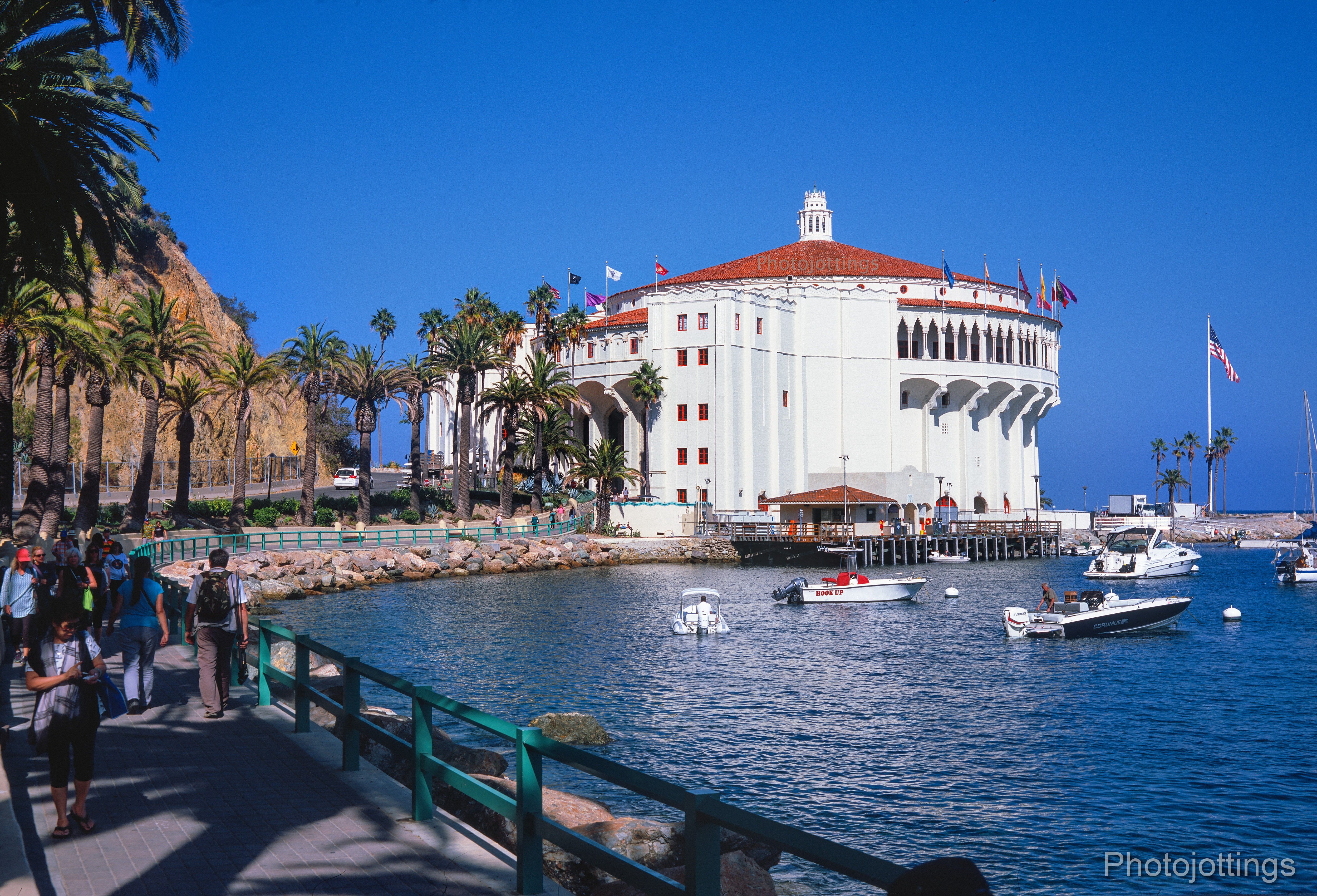
As I was wandering along the railing green, not knowing where I went, by chance I saw a pleasant scene, the Casino of content.  F/16, 1/100s.  Fuji Velvia 100.

Test scene below.

All test shots are displayed at 6000 x 4000 pixels wide when enlarged, and that’s all the resolution included in the film.  Scanned on a Nikon Coolscan 9000 ED.

Here is our standard Mountain test scene, this time using Kodak Ektar 100 film.  A tripod was used, but no filters.  Click to enlarge.

F/4.5.  Quite sharp in the middle, and very usable for an 8×10″ print.

F/5.6, a slight bump in sharpness in the central area.

F/8.  Anther slight bump in resolution and contrast.

F/11.  The whole image get noticeably sharper, especially along the sides.

F/16.  Very minor sharpness changes along the extreme sides.

F/22.  Another increase in sharpness from F/16.  F/22 is the best aperture for landscape shooting, the whole image is very sharp here, even along the sides. Diffraction creeps in at F/32 (not shown).

Conclusion.

The Agfa Record III is actually just an average 1950s folder on the outside; with front cell focusing, uncoupled rangefinder and pedestrian looks.  The more expensive models of the time like the Zeiss Super Ikontas, and Voightländer Bessas most often had faster lenses, coupled rangefinders and unit focusing like view cameras.  However, what the little Agfa Record III lacks in features is made up with what appears to be a nearly perfect lens and rangefinder system; both seem like they would probably exceed the factory average specifications.  Again, as I said in the introduction, this Agfa Record III appears to produce an overall slightly sharper image than my many other four element Tessar and five element Heliar folders at stopped down apertures.  I’ll post some comparisons in the near future, after I’ve reviewed those cameras.

If you’ve read the whole review, you know now why I like the camera so much.  It gives far more resolution than any ’35mm’ camera, (including the most outrageously expensive Leicas), along with very smooth images as a result of the big negative size.  It’s also about the same size as a typical fixed lens 35mm camera, so why bother carrying around something that produces technically inferior pictures, right?

Even though this camera seems almost perfectly set up, my other folders from the same period produce great results too, and are just as good as the Agfa if you aren’t interested in the very sharpest poster size prints.  In all honesty, I rarely print larger than 8″x 10,” so the extra resolution gets wasted, but the images printed at that size are super smooth and sharp!!

So it’s two thumbs up for the Agfa Record III.

Please consider buying through my links and help support the site. Thanks for visiting!

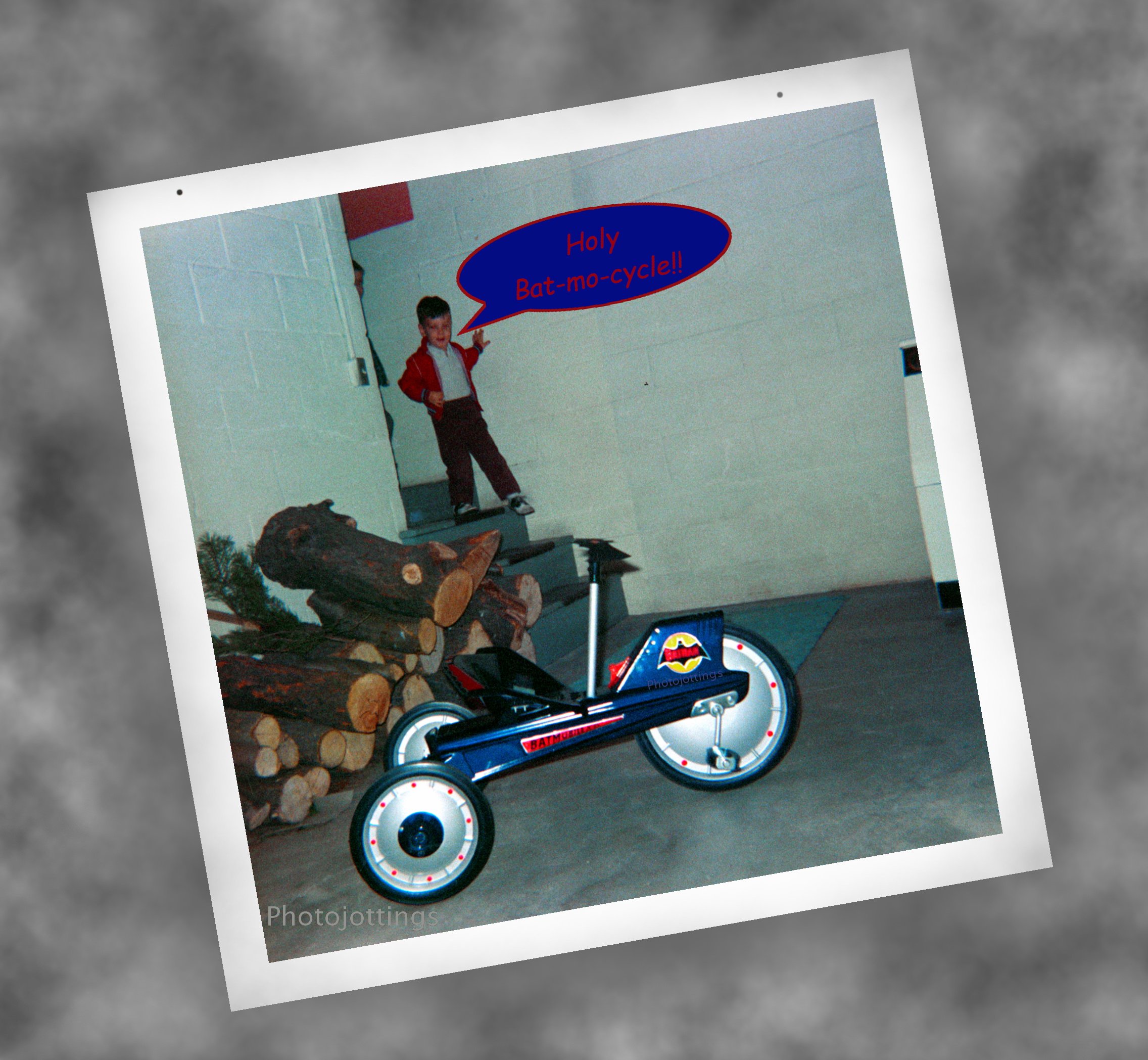
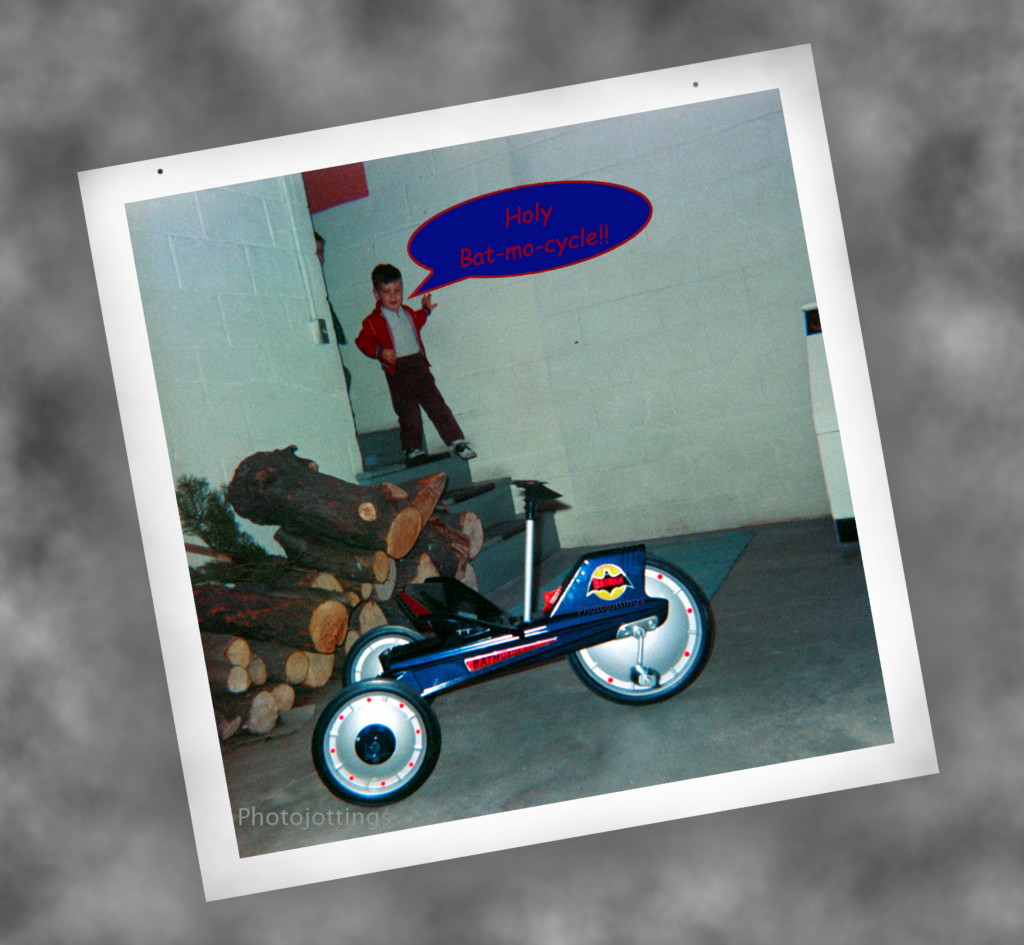
You don’t see to many of these unique ‘tricycles’ around anymore, even at the old toy shows.  I received this Mattel Batmobile X-15 for my birthday I think in 1966.  My Dad paid about $20 for it, and seemed more excited than I was at the reveal in the basement.  My brother is right behind me on the stairs, and was also pretty excited about it.

This ‘Batmobile’ is rather unique in that it steered by turning and leaning the rear wheels, (like a road graders front wheels), by moving the steering bar or ‘Joy Stick’ either to the left or right.  It had an adjustable seat, with a seat belt to keep you in place while banking, turning and swooping about the basement floor.  And if that wasn’t cool enough, it even made a ‘roaring sound as you peddled, (the faster you pedal, the louder it roars was the marketing pitch); which no doubt was probably quite annoying the parents, so Mattel made a wise marketing move and designed it so you could turn off the sound via a red switch in front of the steering bar.

Another cool feature; notice the top of the steering bar had a sharp ‘Bat’ shaped decorative cap, perfect for poking your eye out when you hit something; luckily, I never did that, but look at the picture below and see how easy it would be.

The Batmobile X-15 was the same as the V-RROOM! X-15, both from Mattel.  Not visible here but the other side opposite the Batman Insignia with yellow insert was an embossed ‘supercharger’ intake, (see it here), which made the cool ‘roaring’ sound.  I think Mattel included a set of decals for customizing the look a bit.

I remember having fun riding this, but I don’t think I had it very long for some reason; maybe is wasn’t too practical or it fell apart, I’m not sure.

My first ride!   Check out the fake exhaust ports spewing hot flames in the rear.  Captured with my folks trusty Kodak Instamatic 100 that took 126 cartridge film.  This was print negative film, and it looks as good today as it did back then; even the actual print is still sharp and colorful.

It’s the Mattel V-ROOM! X-15, WOW!!  That kid looks a little more excited riding it than I was in the picture above.  This little contraption was made during the Space and Jet age craze of the 1960s, and promises to be a ‘Jet on wheels’ where one can bank, turn and swoop with the ‘joy stick.’

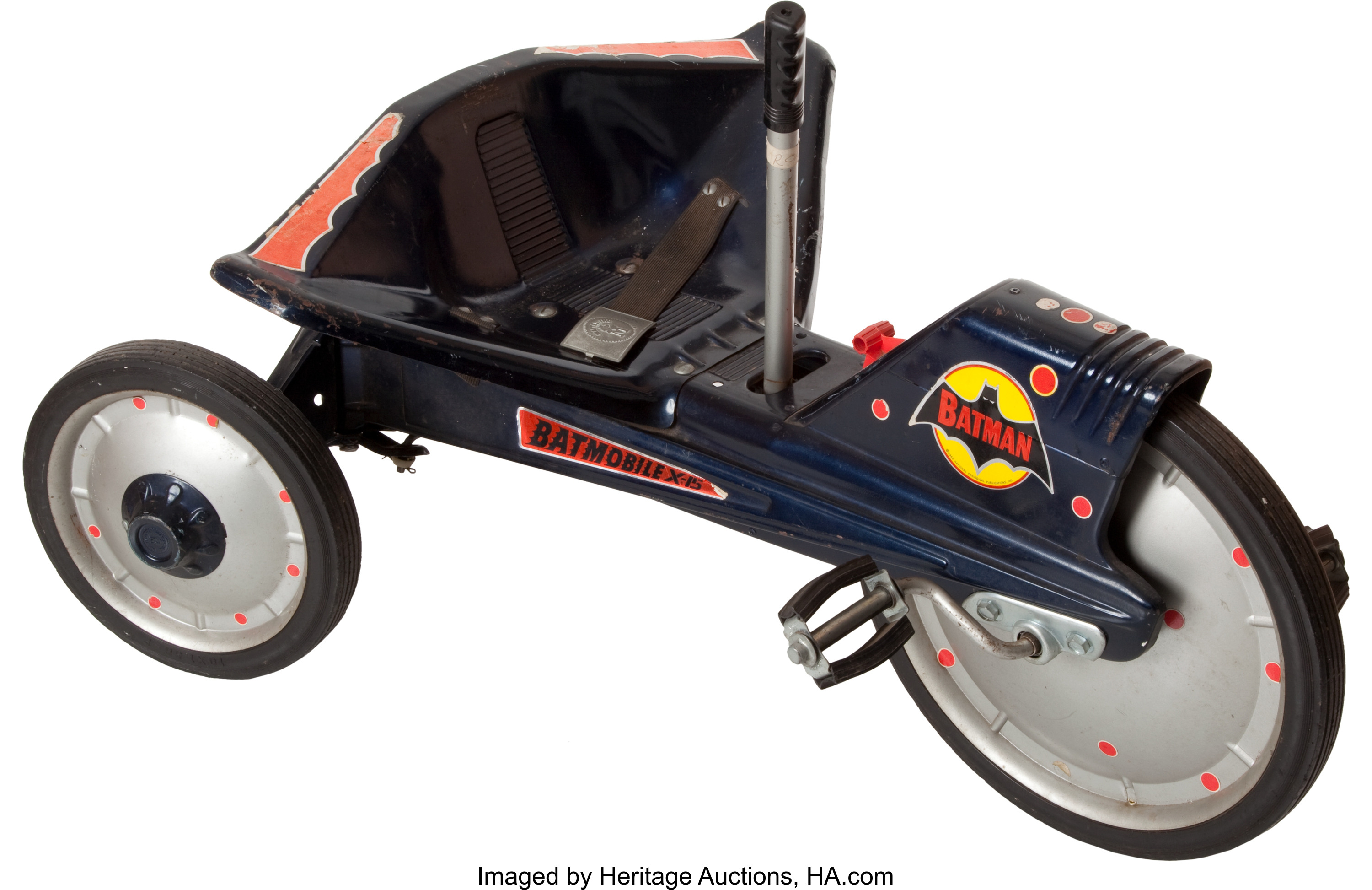
A closer look from Heritage Auctions.  It appears this copy had some extra red dot stickers applied to the front.

That’s it for the Batmobile X-15 Three wheeler from Mattel; hope you enjoyed this 1960s trip down memory lane.

Fuji BIG View-Finder—-Fuji BIG dis-appointment!

As the name suggests, the Fuji has a big, and delightfully bright viewfinder, which also happens to be very sharp.  It’s also very light-weight and easy to use.

Apparently, Fuji wanted to offer something different to the masses at the time, so they made a camera with a big bright view-finder, along with a wide angle Carl Zeiss 29mm lens, that’s right, a 29mm lens, instead of the industry standard of 28mm.  Well, the lens is not really made by Carl Zeiss, I just made that up for fun.  I’m guessing it’s a glass two element lens based on the poor side performance.

I purchased this Fuji along with 9 other cameras for $45 on ebay, so less than $5 bucks apiece.  The Big View-Finder really isn’t worth that much, since you can get a smaller single use camera that works just as well, and has the film already inside!

If you’re bored at work and want to blow 5 minutes, by all means check out the review.  If you value your off-duty time, go here for better offerings.

Let’s check out the specs on the Fuji Big View-Finder Auto 10.


Name; FujiFilm Big View-Finder Auto 10; and may go by ‘Clear Shot Auto 10’ in markets outside US.

Manufactured by; Fuji Photo Film Co, LTD, Tokyo, Japan.  Made in China.

Date of manufacture; late 1990s?

Price; I’m guessing around $30-$40 back in the day, normally sold in a blister pack with a short roll of ASA 400 film, wrist strap and two AA batteries.  Get one now at ebay for less than $10.

Build material; dark champagne color plastic body with a clear plastic window over the view finder, flash, and film reminder slot.

Weight and size; camera with batteries, 8.0oz (228g).  Camera only 6.0 oz (169g).

Dimensions; Size is 4.7″ (120mm) wide, 2.8″ (73mm) high, and 1.6″ (40mm) deep.

Focal length; 29mm.

Aperture; about F/5.6 or F/8.

Focusing; fixed, the lens is probably focused around 6-8 feet, or 2-2.5m.

Original print size; standard oversize prints 4” x 6,” at this size the pictures will look pretty good.

Approximate resolution; will make good 4″x 6″ prints.

Lens; it looks like a Fujinon glass two element with coatings.

Shutter and speed; probably a two bladed shutter; I can’t see the shutter without tearing it apart.  The shutter speed is fixed, with a tested speed of 1/75.

Distortion; moderate barrel type.

Color fringing; not much noticeable.

Features; semi-auto loading, auto advance and rewind.

Film; all 135 film cartridges, B&H, Amazon, eBay.

Double exposure prevention; Yes.  There is no way to get a double exposure even if you want one without screwing up the camera.

Flash.  approximately 10 at ASA 100.  Recharges in 5 seconds with fresh batteries.  Fuji claims red-eye reduction feature, but I did not notice the typical pre flashes you get with real red-eye reduction.

Power; two AA batteries.

Viewfinder; very bright, (and big), with guide lines but no parallax correction.

Accessories for this model;  none.

Crippling features and omissions; nothing really, it’s for super quick and easy wide angle snapshots.

Good features; seems to expose correctly in good light with ISO 100-400 speed film; it has a decent flash, along with auto film advance and semi auto rewind.  Defaults to ISO 100 with non DX coded film.

Product shots with descriptions.  Click for larger images.

Here you can see the heavily worn bottom of the camera.  The wrist strap lug is on the left, two AA batteries go in the compartment on the left, and the slot and arrow are for rewinding the film.  It takes about a minute or more to fully rewind a 36 roll.  Underneath the lens is the lens cover slider, you need to have it open for the camera to work.

Nothing much to see here except the back of the view-finder, and the film reminder window.  The little round hole next to the view-finder glows green when the flash is ready.  Just visible on top is the shot counter window and the shutter button.

With the back open, we can see the DX contacts for either 100-200, or 400 speed film; it defaults to 100 on non DX coded film.  On the back is a real pressure plate for a flat film gate, which is surprising; I would’ve thought it to be a curved gate based on the poor lens edge performance.

The viewfinder is surprisingly BIG and bright, with simple guide lines.  The view is actually very bright outside of the guide lines, not dark as you see it here.  It’s also sharper than what you see in this picture; it was taken with my cheap cell phone.


Here are some test images scanned on a Nikon Coolscan 9000 ED.  All are 2400 pixels wide; there is no additional resolution from scanning at a higher sample rate.  Kodak Gold 200 film.  Click for larger images.

The lonely cement pond.  Look at the very blurry corners, and the middle to upper right area.

Smoking room. The flash was used here.  Notice the barrel distortion on the white door frames.

Don’t point this thing into the sun.

Another view of the cement pond with beautification roses.  Notice the nasty blurry section on the right side.

Really small backyard, or really big pool.  See the shadow of a creep in the lower left corner.


Conclusion.

The FujiFilm Big View-Finder Auto 10 is one of those cameras where you think to yourself, why did they make this?

I do like the wide angle lens; almost all point and shoot cameras back then were sporting 35mm lenses, so 29mm is something different.  The flash is useful for lighting up subjects that are close to the camera, and the auto advance is great for one handed use.

Unfortunately, the biggest disappointment is the lens quality; it’s just short of being awful.  So ok, the centers are actually pretty sharp, and that would be useful for a central subject, but for landscape pictures, the lens has poor contrast and is just too blurry around the periphery.  The only reason someone might use this instead of a disposable camera would be film choice; otherwise you can get a Fuji quick snap or Kodak Fun Saver disposable for about the same price as a roll of film.  The Fuji Big View-Finder reminds me of the Kodak Star 535, both have cheap two element lenses, but the 535 lens is noticeably  better.

Anyhow, this is a one and done camera; I never really bonded with it, so off to Good Will it goes.

A much better camera for the same price would be something like this one.

Please consider buying your goodies through my links, doing so helps support the site, thanks!


I’ve been playing with my new Kodak Medalist II the last couple of months, and suddenly realized I have a direct comparison image from the Kodak and Fuji GW690III taken during my mountain scene test shots.  I still haven’t had the chance to do a proper test sequence with the Kodak, but I will once I get a few spare minutes, and of course take some other sample shots too.

Fun fact; the Kodak Medalist 100mm lens is so sharp, you have to be very careful about focusing, you can’t just crank it out to infinity at long distances like you do with other cameras, like the Fuji GW690III.  Crazy, but I screwed up most of the Kodak mountain test shots because I focused on the ridgeline behind the houses in the center, instead of the center house, oh well, $20 in film and processing down the drain.

This isn’t an exact comparison as the Kodak has a 100mm lens, and the Fuji 90mm, so the Kodak covers less area, giving it an advantage.  However,  I used Porta 160 for the Kodak Medalist, and Kodak Ektar 100 for the Fuji.  Ektar is slightly smoother and a bit sharper than Portra 160, so that may reduce the Medalist’s advantage.  The images were taken a few days apart, but at the same time of day.

In a nut-shell, and off the cuff since I only have one picture each for comparing: The early 1940s Kodak Medalist lens is really impressive; it has less color fringing than the late 1970s Fuji lens design, and is slightly sharper along the sides at F/22.

Inside the red border in the top image represents approximately where the Kodak 100mm lens coverage is as compared to the 90mm Fuji lens.

Comps from the extreme left side, (top row), center, (middle row), and extreme right side, (bottom row).  Fuji on the left, Kodak on the right.

The left side is slightly sharper on the Kodak, extending inward about a third from the side.  The center seems sharper on the Fuji if you factor in the coverage area differences.  The right side is sharper on the Kodak, extending inward about a quarter to an eighth from the side.  The Kodak has a mildly soft area on the middle/right side probably from film flatness issues; scroll around the full size image to see this.

Here are the full size images.

Fuji GW690III full image, F/22. 9000×6000 Kodak Ektar 100.

Kodak Medalist II full image F/22, 9000×6000 Kodak Portra 160.

That’s it for this quick comp of  two images.


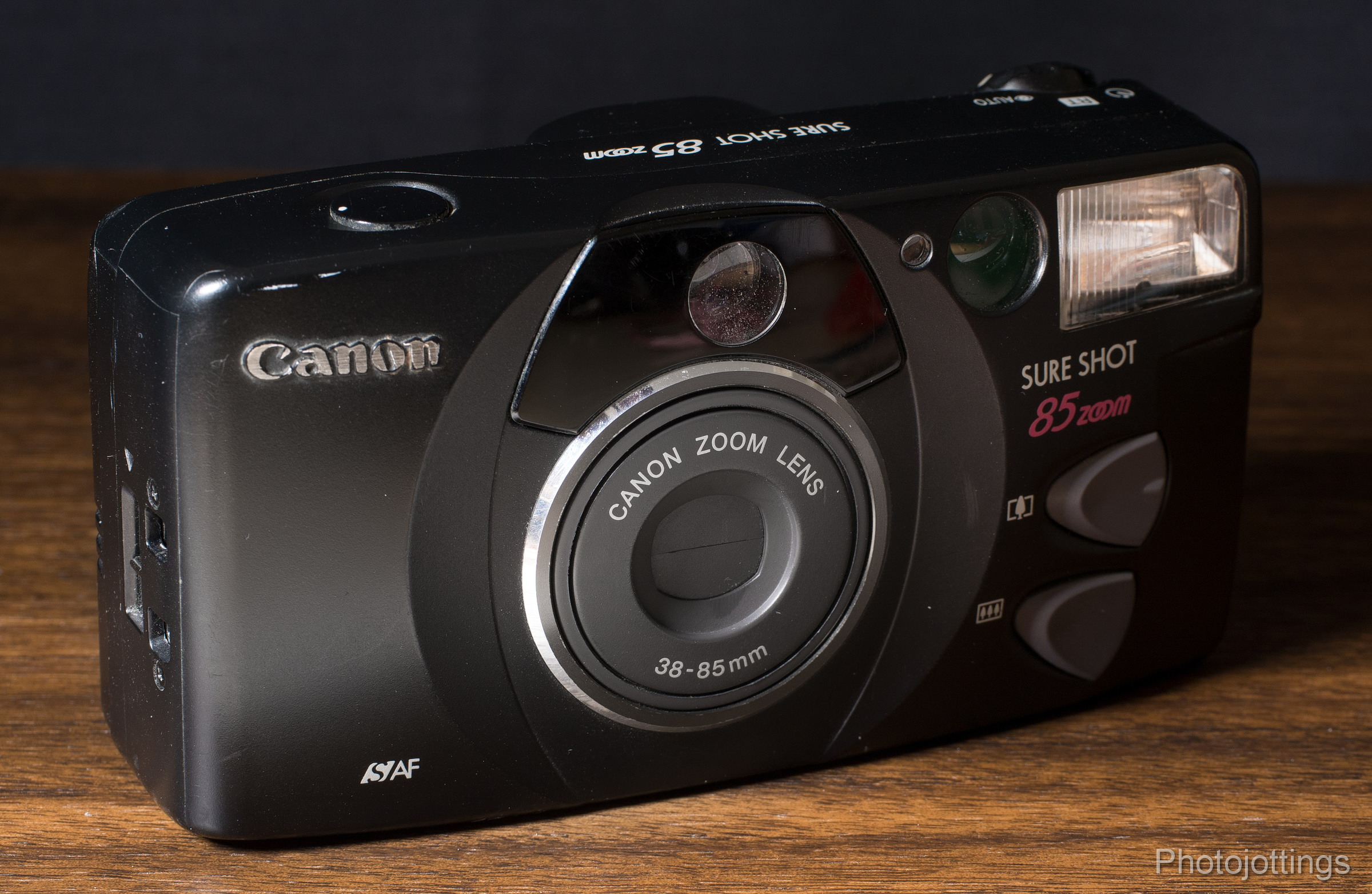
So one morning my neighbor walks up to me with this camera and wants to know if it has any film in it.  I looked in the little window slit in the back and saw no film, and then opened the back to show her.  I asked her if she was going to take some pictures, and she said no, I’m going to throw it away.  Of course she ended up giving it to me; and so I added this Canon Sure Shot Zoom 85 to my collection!!

This late 90s black beauty is actually a swell camera; the lens quality is better than what I would’ve guessed, especially for a zoom; it has a 6/6 design with one aspherical element.  Other nice features include excellent AF accuracy and exposure metering, a good zoom range, and a ‘real time’ shutter setting for super quick snaps!

Pick up one of these for a song, (or even less like me), or around $10-20 for a good used copy on ebay.

The Canon marketing pamphlet states: “Here’s a camera that makes it so easy to reach a new level of picture-taking excellence. A camera that’s so compact and stylish, you’ll always want it with you… for the moments you don’t want to miss. Slip the Sure Shot 85 Zoom into your pocket and get ready for great times, and great pictures!”  So in other words, if you buy this camera, you’ll be ‘ready’ to have great times, and great pictures, but maybe you won’t.  You might end up having mediocre times, and bad pictures, just like everyone else.

Is this the camera we’ve all been dreaming of, or is it just another uninspiring cheap camera for the masses?  Either way, let’s take a closer look at the Canon Sure Shot Zoom 85.

Name; Canon Sure Shot Zoom 85; called Autoboy Luna 85 in Japan, and Prima Zoom 85 in Europe.

Manufactured by; Canon Inc. Tokyo, Japan.  Made in China.

Date of manufacture; late 1998, through 2002?

Price; retail around $250+ in 1998; probably less at large discount stores.  Current ebay prices are around $10-20 for a good used copy, or less than $60 for a brand new one in the box; depending on availability.

Other versions; there is a ‘Platinum’ colored model out which seems to be more popular than the Black model.  Also, both come either with, or without a ‘Date’ back: Canon says models with the date back and panorama mode are available only in areas outside of the USA.  The ‘Date’ back calendar ends in 2019, so hurry and buy one before that feature is useless!

Build material; plastic body with a clear plastic window over the view finder, flash signal, and film reminder slot.

Weight and size; camera with batteries, 8.3oz (236g).  Camera only 7.7 oz (219g).

Dimensions; Size is 4.8″ (123mm) wide, 2.5″ (64mm) high, and 1.7″ (42mm) deep.

Focal length; 2.2x zoom from 38-85mm.

Aperture; maximum aperture at 38mm is F/4.2; maximum at 85mm is F/8.7.

Focusing; artificial intelligence -smart- (Saf), (aiaf) 3 point auto focus, (one point in RT mode), manual states from 2.0′ (0.6m).

Original print size; standard oversize prints 4″ x 6.″

Approximate resolution; will make excellent 5″x 7,” and good to excellent 8″x 10″ prints.

Lens; coated glass six elements in six groups design, with one apherical lens element.  38-85mm focal length, F/4.2-8.7 maximum aperture.  The zoom feature has five settings, probably about 38mm, 45mm, 55mm, 70mm, and 85mm.  There are no in-between settings.

Shutter and speed; program type electromagnetic shutter and aperture.  Two seconds at maximum apertures in flash-off mode.  In auto/flash-on/self timer modes; wide end; 1/36 sec at F/4.2, 1/500 seconds at F/34.  Telephoto end; 1/83 seconds at F/8.7, 1/500 at F/34.   Self timer with flash use; 1/2 seconds to 1/36 at the wide end, and 1/2 second at the long end.

Distortion; mild type pincushion at 38mm, 85mm looks pretty straight.

Color fringing; mild to moderate magenta colored lateral type.

Features; auto load, auto advance, auto rewind, flash on or off position, red-eye reduction lamp, zoom lens, auto focus, ‘real time’ shutter setting, auto film DX coding, tripod socket and self timer.

Film; all 135 film cartridges, B&H, Amazon, eBay.

Flash.  Guide number of 13.4 at ASA 100.  Recharges in 4-5 seconds with fresh battery.

Power; One CR123A 3v battery, lasts for about 10 rolls of 36 using the flash every other shot.  Usually available at big box stores or drug stores, but super expensive.  Get them much cheaper here: B&H, Amazon, eBay.

Viewfinder; small, with decent brightness, but no guidelines except parallax correction.  Has a middle auto focus framing box.

DX coding; from ISO 25-3200.  Non DX coded film is registered as ISO 25.

Accessories for this model;  none that I know of.

Crippling features and omissions; mode dial is hard to turn unless using two hands holding the camera, and two fingers to turn it.  Two seconds max shutter speed is too short for the small maximum apertures of this camera; so good night shots on a tripod may require ISO 800-1600 film.

Good features; accurate and reasonably fast AF, and sharp lens at all focal lengths.

Product shots with descriptions.  Click for larger images.

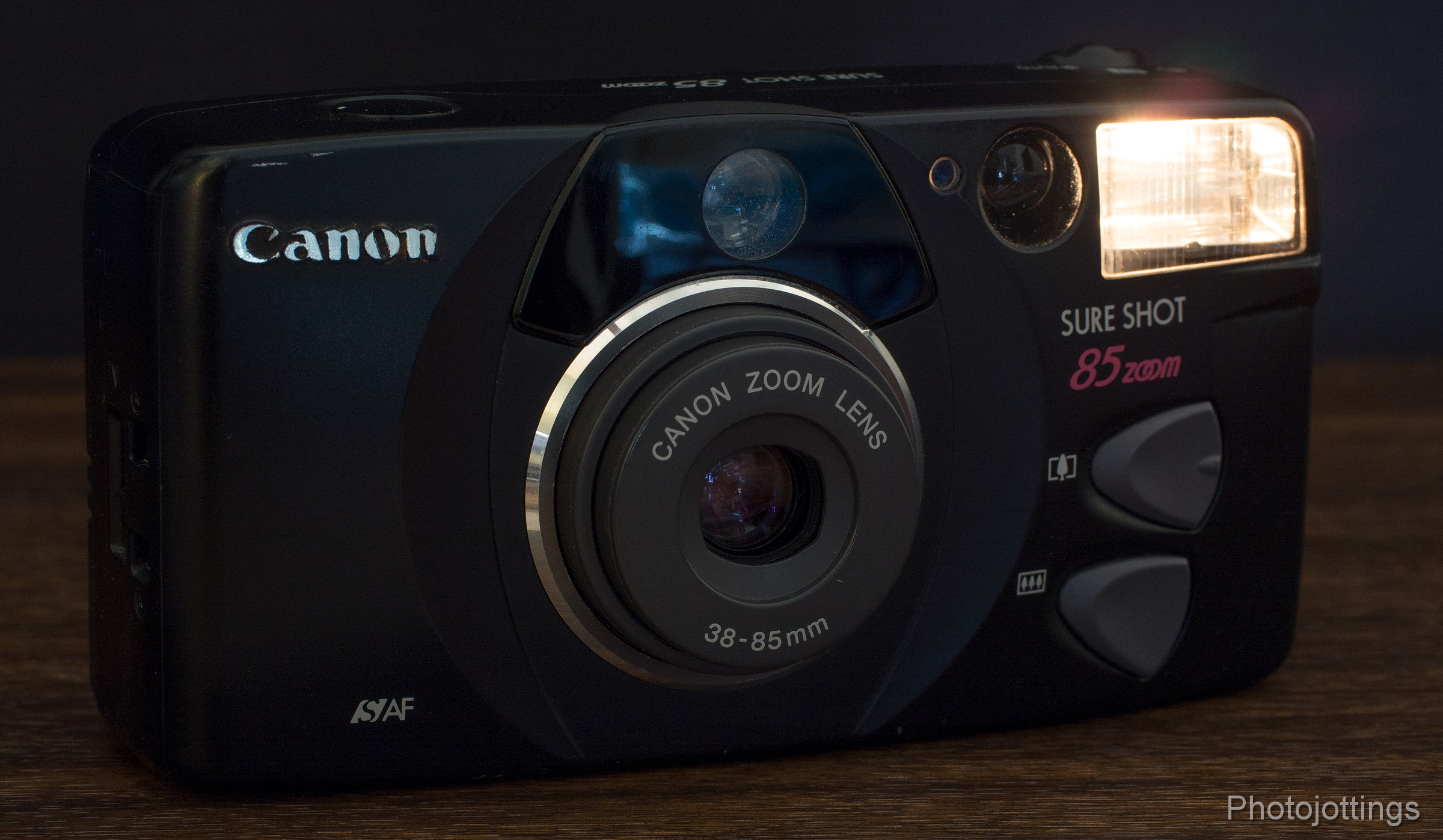
The Canon Sure Shot Zoom 85 shown with the automatic lens cover closed.  The circular window above the lens is the viewfinder.  The little round widow to the right is for metering.  The large circular window next to the flash is the auto focus light receptor, with the light emitter to the left of the viewfinder, (hard to see in this picture).  The gray buttons are for zooming in and out.

The only two items on the bottom are the tripod socket and tiny mid-roll rewind button.

On top we have the circular viewfinder located dead center.  The two little lights stacked next to it are for focus lock (top green lite), and shake (low shutter speed) warning in flash off mode (bottom orange lite), and flash charge on auto modes.  To the left is the LCD window which shows battery life, and shot count.  The mode dial on the left has the following settings: the upper most setting is the 10 second self timer; next is “RT” is for ‘real time’ shooting, which sets the AF first, and then releases the shutter in 0.03 seconds after pressing the shutter button. Following the ‘RT’ setting is ‘auto’ mode with red-eye reduction.  Below the ‘OFF’ setting is the green outlined ‘auto‘ mode; this is used when you don’t want red-eye reduction flash.  The two settings under the green auto mode are flash on, then flash off.  I like the ability to set the flash either on or off, sometimes in auto mode the camera doesn’t guess correctly, and your picture comes out either blown out, or under-exposed.

With the back open you can see the camera has some decent features like a real film pressure plate, a spring steel film tensioner and thick light sealing foam.

The red-eye reduction light is actually a little bulb inside the flash housing that runs continuously during a half press, and about 1 second after a full stroke of the shutter button.  The manual states it’s good for up to 6′ (2m), but that’s probably stretching it.  In this picture the lens is extended to the 38mm position.

Here the lens is extended to 85mm.  With the power on and zoomed in, the camera will automatically zoom back to 38mm after four minutes of inactivity.  The lens will stay in the 38mm position indefinitely if you forget to turn it off; fortunately, there is no battery drain.  As stated above, the zoom feature has five settings, probably about 38mm, 45mm, 55mm, 70mm, and 85mm.  There are no in-between settings.


Here are some test images scanned on a Nikon Super Coolscan 9000 ED.  All are 3000 pixels wide; there is no additional resolution from scanning at a higher sample rate.  Click for larger images.

Corrections center; 38mm using Kodak UltraMax 400 film.

Close focus.  Check out the weird star shaped background blur, especially along the left the the secondary tree trunk in the back.  Kodak Portra 160.

A river doesn’t run through it, unless it’s mid to late summer. Taken at 85mm, using Kodak UltraMax 400 film.

Old Catalina Hwy, about 38mm using Kodak Portra 160 film.  Notice the shadow differences between this Portra film and the UltraMax 400 above and below.

The Dog Pound Ranch.  I see some mild pincushion distortion at 38mm along the top pipe.  Kodak UltraMax 400 film.

Wash-out at the wash.  Check out the odd shaped aperture ghost at the top center.  Kodak Portra 160.

Little house on the rocks at 85mm.  Kodak Portra 160.


Conclusion.

The Canon Sure Shot 85 Zoom is very impressive considering you can get them really cheap through ebay or garage sales.  For the price of a pack of cigarettes, you can have a nice quality vacation or snap shot camera that will give you excellent prints up to 8″x10.”

Pluses include fast and accurate AF, excellent exposure metering for print film, (I did not try slide film, but I’m guessing it would do a  good job of metering for that type of film).  The ability to turn the flash on or off is quite useful, and the flash is reasonably powerful. The six element lens is surprisingly sharp at all focal lengths, and exhibits low color fringing, distortion, and light fall off; again, not bad for a $5-10 garage sale camera!!

I appreciate the tripod socket, but I doubt I’d ever do any low light shooting with this camera, the maximum 2 seconds isn’t long enough for low light conditions with the F/4.2 or F/8.7 apertures, plus, if you use the self timer, the maximum shutter speed is only 1/2 second.  A couple of negatives to report; the mode dial is a pain in the butt to turn, the movement is restrained way too much, and it’s too short and flat for adult finger manipulation; but it’d be great for little child like fingers.  Also, the viewfinder is usable, but a bit on the diminutive side, and not very bright.  Oh well, one can’t have everything on their wish list right?

Bottom line; the Canon Sure Shot 85 Zoom really shines, especially when using clean and colorful fine grain film like Kodak Ektar, Portra, or even Fuji 400h.  B&H, Amazon, eBay.

Please consider buying your goodies through my links, doing so helps support the site, thanks!
 

Here are a few samples from the Fuji GA645Zi zoom.  This medium format camera is the third and final model in the Fuji GA645 series, and the only one with a zoom feature, but only at four focal lengths, 55mm, 65mm, 75mm and 90mm, there are no in between settings.  So far the quality of both the lens and camera seem very good.  I’m in the process of testing it out right now, and have only put two rolls through it, but I do plan on shooting a few more test rolls as time and opportunity permits.

Below are four samples taken with the Fuji GA645Zi.  All were flat scanned on the Nikon Super Coolscan 9000 ED and downsized to 5500 pixels wide.  There is a little more detail to see by keeping them around 6500 wide, but they really look better on the screen at a smaller size.  Click pictures for larger size.

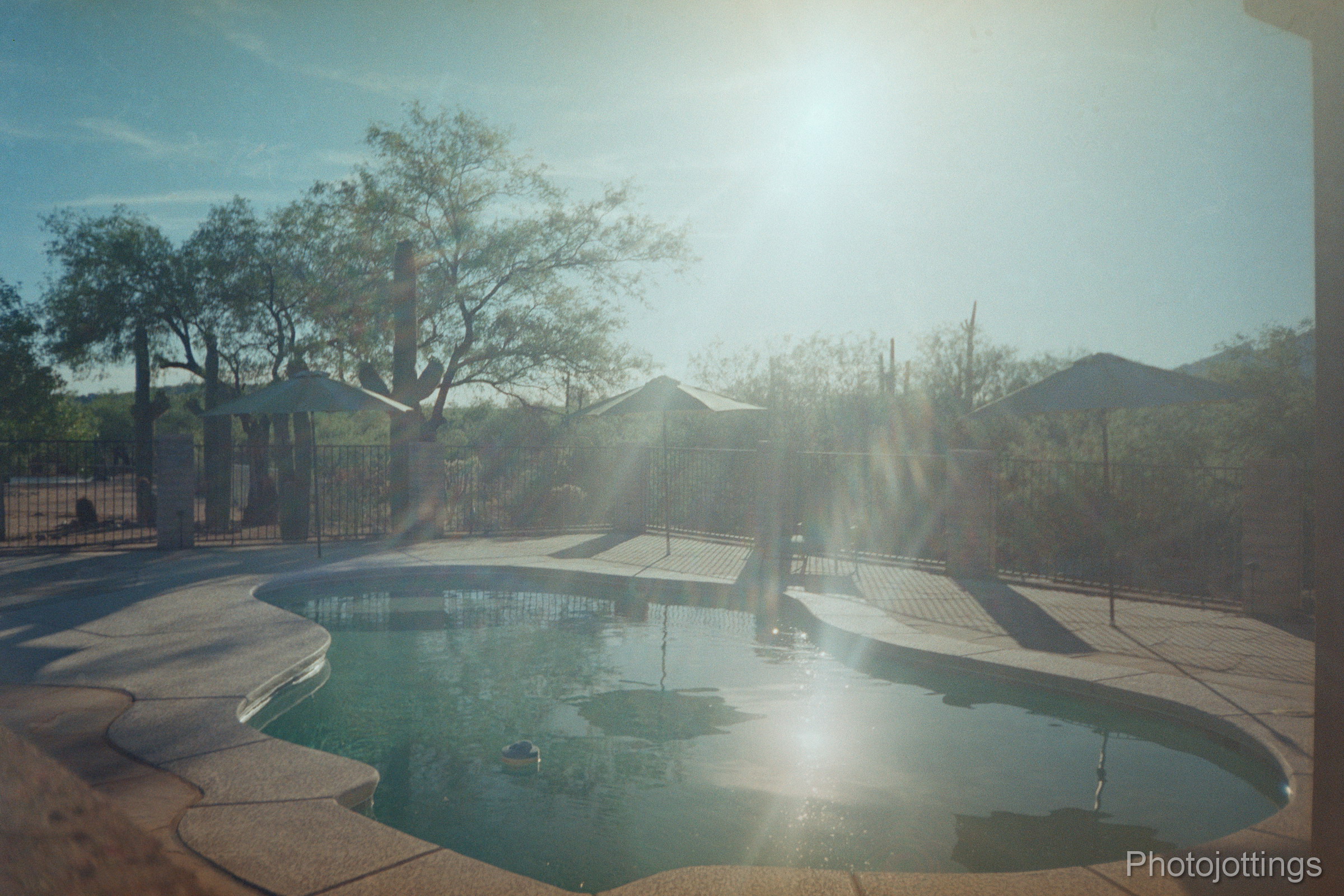
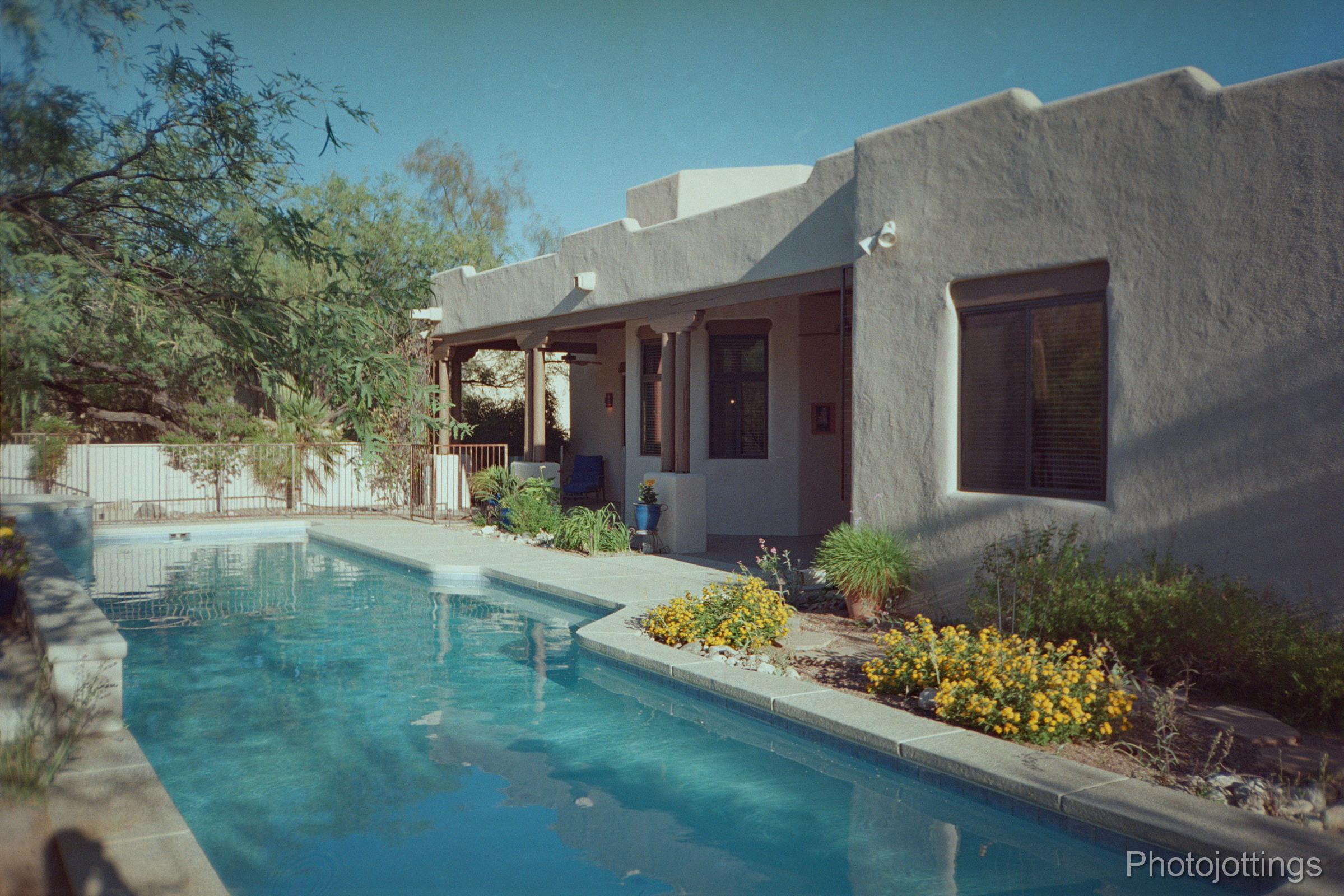
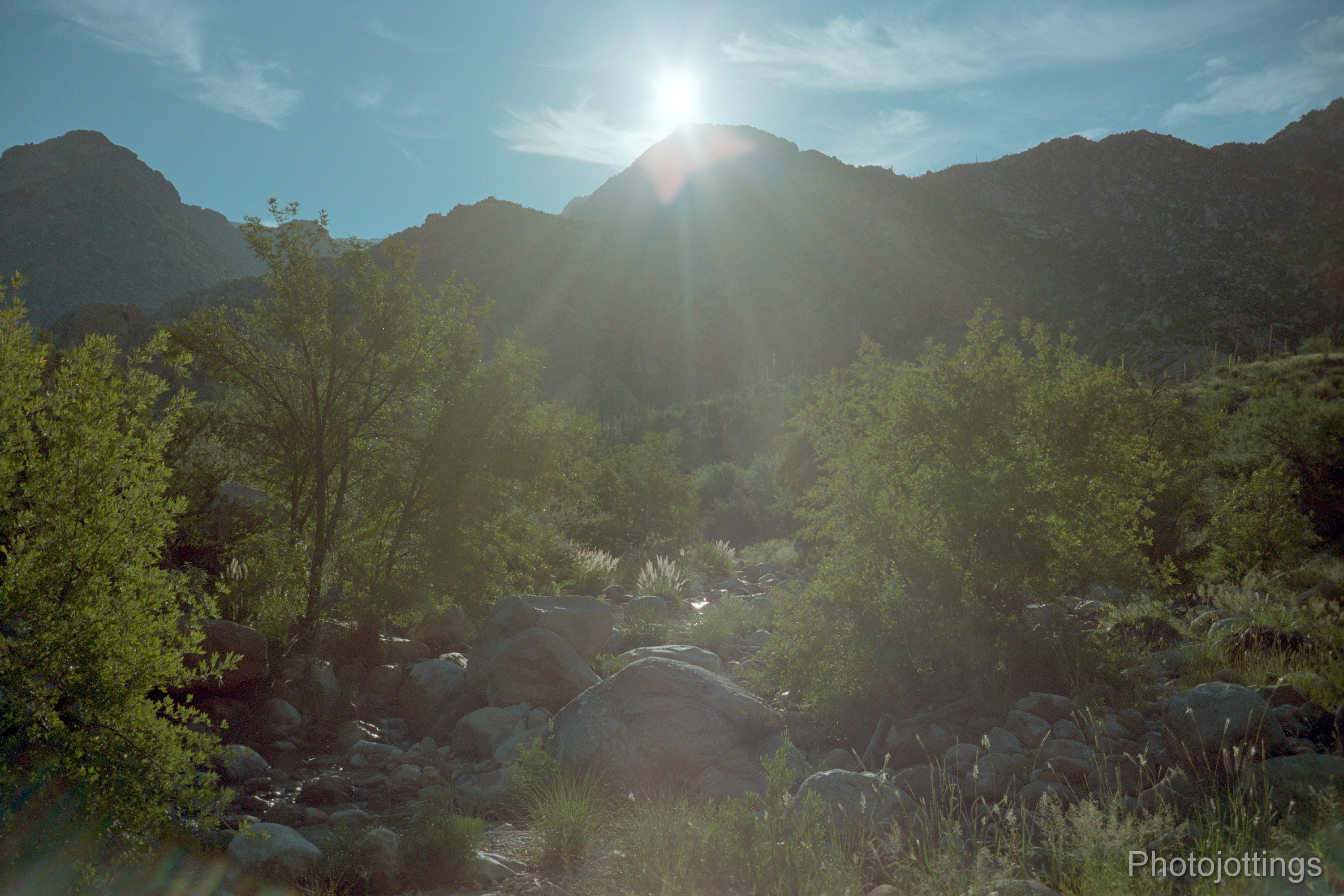
ADT will get you!!  Late afternoon house front at F/11, at 55mm using Kodak Ektar 100.

Close focus at F/4.5, 55mm. Pretty smooth highlight blur in the central area.  Kodak Ektar 100.


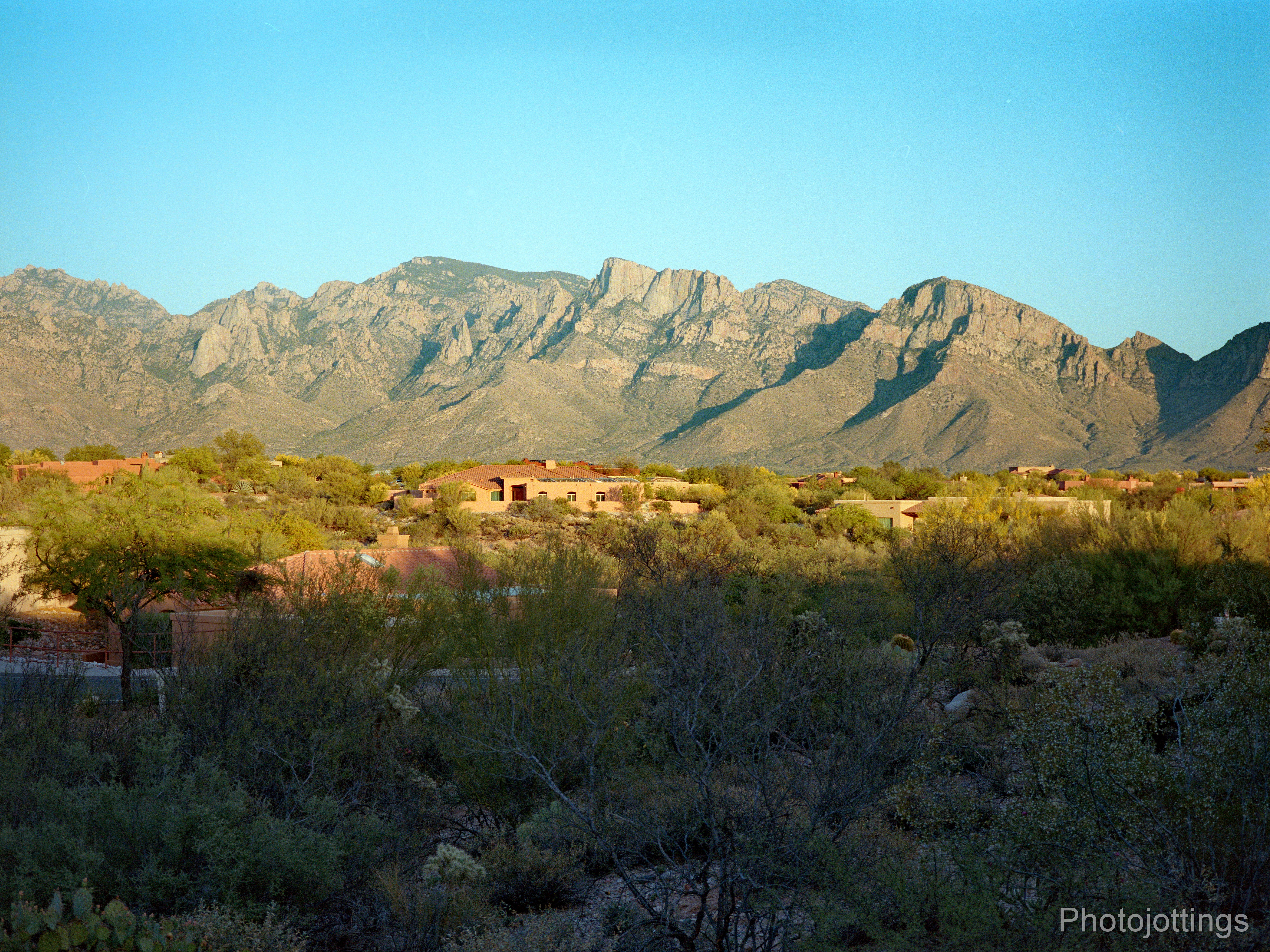
Mountain range in late sun at F/8, 90mm; the maximum aperture at this focal length is F/6.9, so it’s less than a half stop from being wide open.  Kodak Ektar 100.

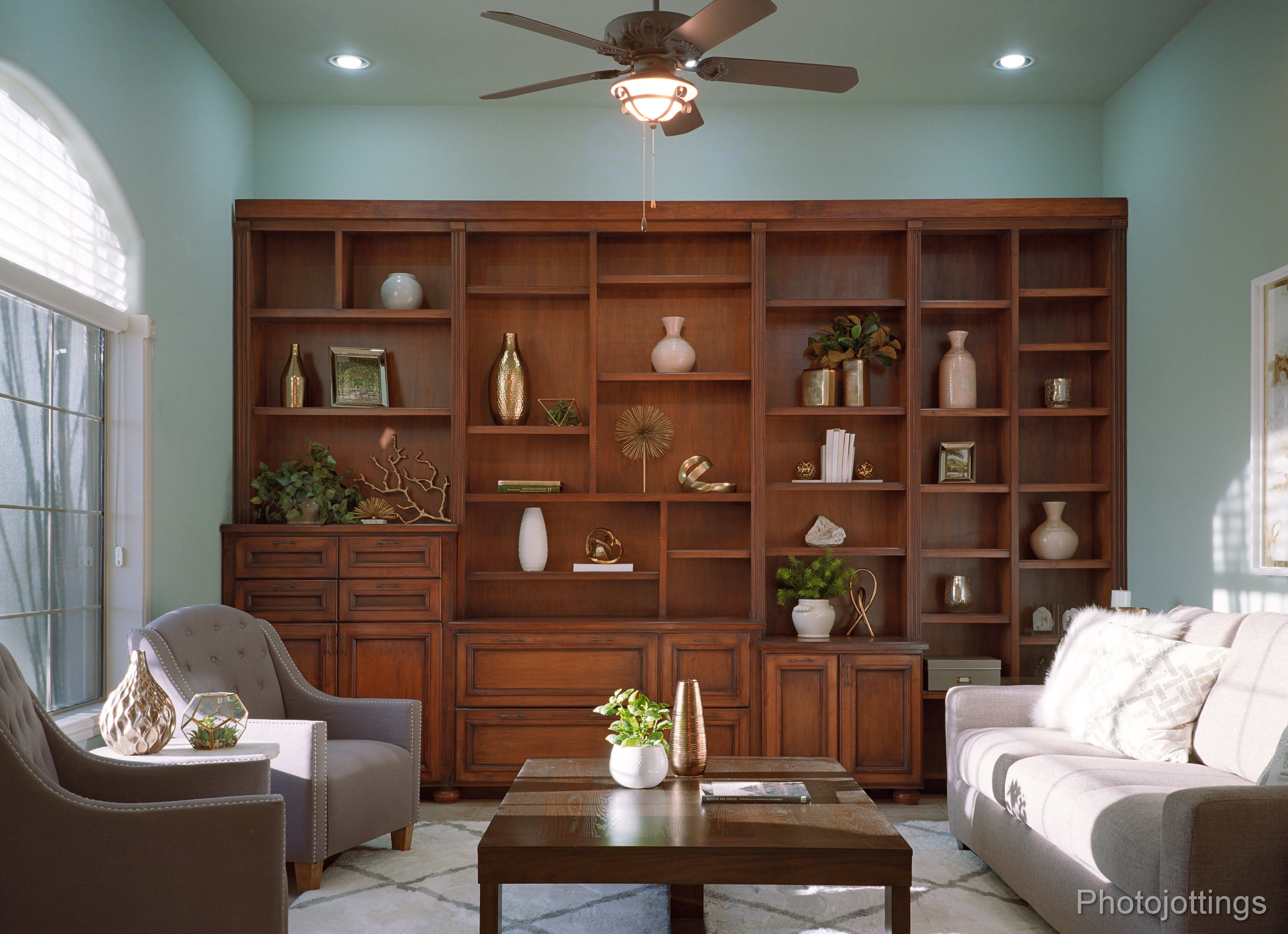
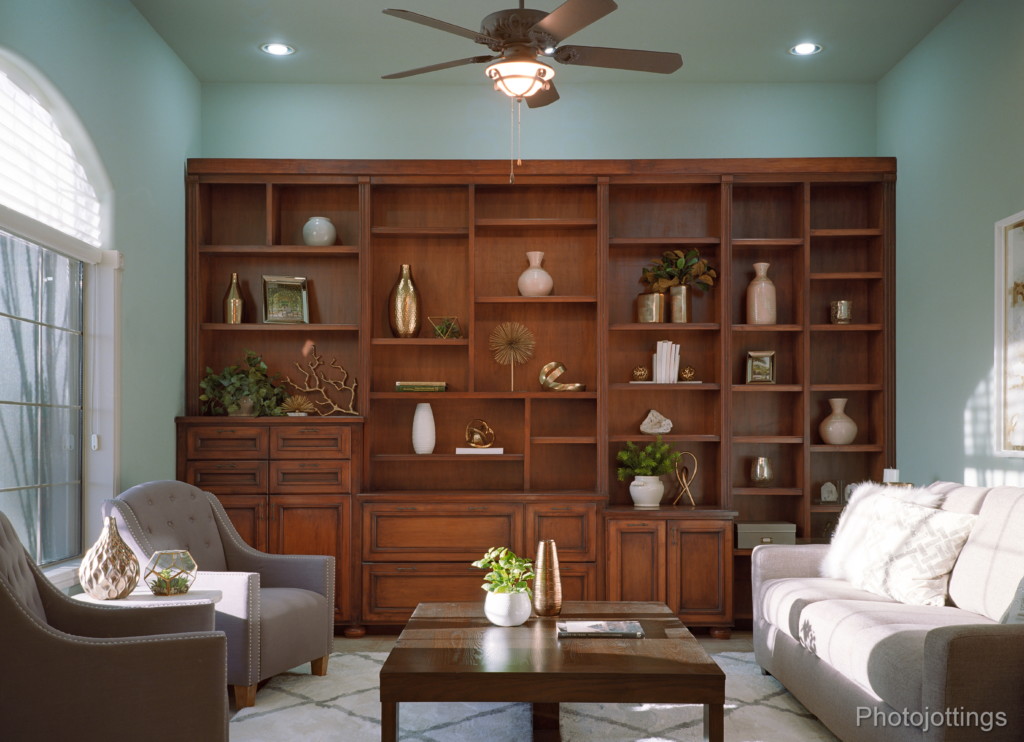
Study, F/11, 2 seconds at 55mm.  An Interior Designer staged this room, and I photographed it with the Fuji GA645Zi: it was almost the first shot from the camera after I bought it; so I had my fingers crossed!!  I did have a Digital back-up though.  No blown-out highlights in the white pillows in direct sun; use the same settings on your digital camera and both the pillows and couch turn into a nasty blotch.  Kodak Ektar 100.

That’s it for this quick post; I hope to have a review out in the near future.

Minolta Freedom Zoom 160 Date Review

Minolta produced some really nice film cameras back in the day, and the Freedom Zoom 160 is no exception.  This camera is surprisingly small and lightweight for having such a large zoom range, which makes is very pocketable, and close to being as tiny as the Olympus XA!  Main features include a zoom range of 37.5-160mm, earth shattering high tech auto focus, (really, read the next paragraph!), auto loading, film advance, rewind, self timer, flash, auto parallax correction, and even a +1.5 exposure compensation setting!

The Minolta Freedom Zoom 160 came out near the end of the film camera era, (around 2001), so it had a lot of sophisticated features that we take for granted today.  In fact, Minolta claimed in a 2001 business ad the camera had: the world's largest AF area in a film camera -- the world's first film camera with subject detection -- the world's first compact camera with matrix AF indication...

Read more »

Agfa Record III 105mm F/4.5 Solinar review

Our review camera for this week is the Agfa Record III; a classic 1950s 6x9 self erecting folder featuring an uncoupled rangefinder, and a four element lens.  This is my favorite camera, and I've taken more pictures with it than any other camera except maybe my old Canon A-1 I used back in the 1980s.

I really like the fact that it's very compact when folded; it'll fit in the back pocket of your jeans, or in a jacket pocket.  These old folders take no batteries, they're fully manual; you advance the film, focus, set the aperture and shutter speed; then cock and press the shutter!  Thankfully, the camera uses widely available 120 film, and any good photo shop should charge you about the same amount as your 135 film for processing, scanning and printing.

Believe it or not; this Agfa Record III with Solinar lens will come close to the resolution of the...

Read more »

Kodak Moment #13, the Batmobile X-15!

You don’t see to many of these unique ‘tricycles’ around anymore, even at the old toy shows.  I received this Mattel Batmobile X-15 for my birthday I think in 1966.  My Dad paid about $20 for it, and seemed more excited than I was at the reveal in the basement.  My brother is right behind me on the stairs, and …

Read more »

FujiFilm Big View-Finder Auto 10 review

Fuji BIG View-Finder----Fuji BIG dis-appointment!

As the name suggests, the Fuji has a big, and delightfully bright viewfinder, which also happens to be very sharp.  It's also very light-weight and easy to use.

Apparently, Fuji wanted to offer something different to the masses at the time, so they made a camera with a big bright view-finder, along with a wide angle Carl Zeiss 29mm lens, that's right, a 29mm lens, instead of the industry standard of 28mm.  Well, the lens is not really made by Carl Zeiss, I just made that up for fun.  I'm guessing it's a glass two element lens based on the poor side performance.

I purchased this Fuji along with 9 other cameras for $45 on ebay, so less than $5 bucks apiece.  The Big View-Finder really isn't worth that much, since you can get a smaller single use camera that works just as well, and has the film already inside!

If you're bored at work and want to blow 5 minutes, by all means check out the review.  If you value your off-duty time, go here for better offerings.

Read more »

Kodak Medalist and Fuji GW690III comparison image

I've been playing with my new Kodak Medalist II the last couple of months, and suddenly realized I have a direct comparison image from the Kodak and Fuji GW690III taken during my mountain scene test shots.  I still haven't had the chance to do a proper test sequence with the Kodak, but I will once I get a few spare minutes, and of course take some other sample shots too.

Fun fact; the Kodak Medalist 100mm lens is so sharp, you have to be very careful about focusing, you can't just crank it out to infinity at long distances like you do with other cameras, like the Fuji GW690III.  Crazy, but I screwed up most of the Kodak mountain test shots because I focused on the ridgeline behind the houses in the center, instead of the center house, oh well, $20 in film and processing down the drain...

Read more »

Canon Sure Shot Zoom 85 review

The Canon Sure Shot 85 Zoom is very impressive considering you can get them really cheap via ebay or garage sales.  For the price of a pack of cigarettes, you can have a nice quality vacation or snap shot camera that will give you excellent prints up to 8"x10."

This late 90s black beauty is actually a swell camera; the lens quality is better than what I would've guessed, especially for a zoom; it has a 6/6 design with one aspherical element.  Other nice features include excellent AF accuracy and exposure metering, a good zoom range, and a 'real time' shutter setting for super quick snaps!

Is this the camera we've all been dreaming of, or is it just another uninspiring cheap camera for the masses?  Either way, let's take a closer look at the Canon Sure Shot Zoom 85...

Read more »

A few samples from the Fuji GA645Zi zoom

Here are a few samples from the Fuji GA645Zi zoom.  This medium format camera is the third and final model in the Fuji GA645 series, and the only one with a zoom feature, but only at four focal lengths, 55mm, 65mm, 75mm and 90mm, there are no in between settings.  So far the quality of both the lens and camera seem very good.  I'm in the process of testing it out right now, and have only...

Read more »

Scroll to Top