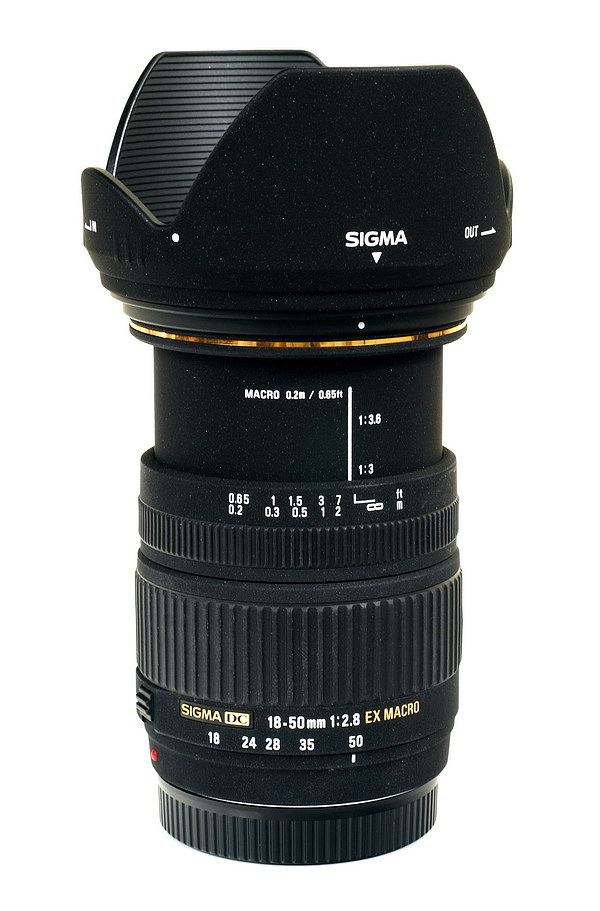
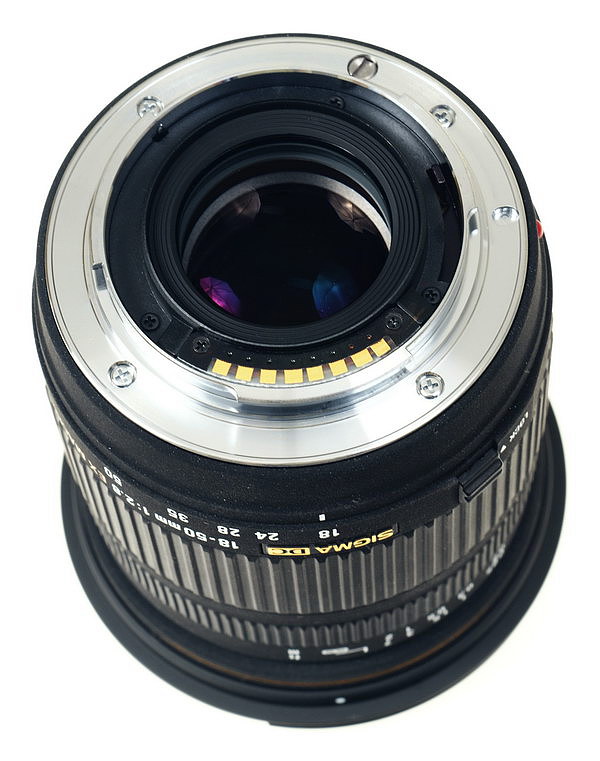
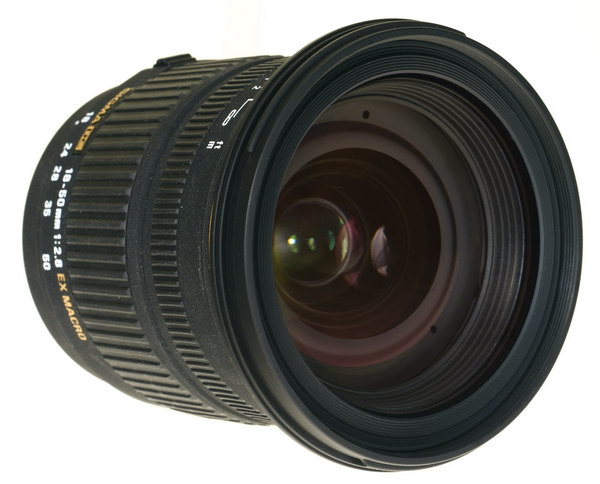
Photo Jottings - Page 40 of 127 - Photography equipment expertise

Here’s a brief look at the Sigma 10-20mm F/4-5.6 EX DC zoom lens.  Scroll down for the review.

Lens
Box contents
Front and rear caps, hood, nice softcase and users manual.
Cost
About $479
Build quality
Good
Additional information
See another model with this focal length, the Sigma 10-20mm F/3.5with HSM focusing
Specifications below
Optical configuration
14 elements in 10 groups
Angle of view
102°-64°
Aperture
6 blades, straight
Full frame and APS-C
APS-C only, 35mm equivalent, 15-30mm.  Will work on full frame, but vignettes massively at 10-14mm.  Turn on APS-C size capt. for good pictures.
Depth of field and focus scales?
Focus distance scale only
Minimum focus, image plane to subject
9.5″  (240mm)
Minimum focus, end of lens barrel to subject
4.4″  (112mm)
Hard stop at infinity focus?
No
Length changes when focusing?
No
Focus ring turns in AF?
Yes
Filter size
77mm
Filter ring rotates?
No
Distance encoder?
No
Max magnification
0.15x
Min. F/stop
F/22-32
Sony teleconverter compatible?
No
Length changes when zooming?
Yes
Dimensions W x L (my measurements)
3.27″ x 3.2″   83mm x 81mm
Maximum  extended length (my measurements)
3.35″  (85mm)
Weight bare (my scale)
12.7oz  (362g)  13.7oz (390g) with caps
Requisite product shots.
Aug08/1020box2.jpg
Here’s the box and contents
Aug08/1020fthd.jpg
Front with plastic petal hood
Aug08/1020bk2.jpg
Rear shot, look at warped aperture
Aug08/1020sdex2.jpg
Side shot fully extended
Aug08/1020ft.jpg
Front view, that’s not dust you see, it’s Sigma’s sparkly dirt-look finish
october08/s1020mtfc.jpg
Sigma MTF screen grab, incomplete, but this is all they give.
october08/s1020xray.jpg
X-ray view
The Sony A700 was used for this review.  For a better understanding of my review methods and terminology, go here.
The Sigma 10-20mm F/4-5.6 EX DC is currently the widest of the super-wide angle zooms available for your Sony APS-C sensor camera, and isn’t designed to be used on full frame/film cameras.  The lens is finished in the standard Sigma sparkly dirt-look black which I hate, however, quality is good, with a nice fit and finish.  It also has rubber ribbed grip areas around the zoom and focus rings, a metal mount, and a distance scale, which you’ll need, see below.  The lens says made in Japan.  This lens is identical in size, weight and close focusing distance to the Sony 11-18mm, but they are optically much different.  Sigma claims they use three aspherical, and three “SLD” elements in the construction of this lens.  Note; don’t set this lens mount side down at 10mm, the rear element will touch the surface and wobble around.
Zoom control is nice and smooth and the barrel extends out (clockwise) another 4mm at full extension.  The focal length numbers come at; 10mm, 12mm, 14mm, 17mm and 20mm.  Oddly enough, my lens won’t register 14mm in the EXIF data, all other numbers show up, even in-between lengths (except 19mm), but 14mm is written on the barrel, so it should show, this is the same missing data as the Sony 11-18mm.  There’s a lot of room between each number, so you could shoot different scenes at the same length as it appears in the data, but it may look substantially closer, or farther away, that’s in the design, they don’t put enough internal length sensor contacts to mark every single change of movement.  Other lenses are like this too, it’s not a defect, but maybe the missing 14mm is.
Auto-focusing is troublesome, typical for Sigma.  At 10mm, I have to set the focus ring to the 1 meter mark, where everything from about 6′ or 2m will be in sharp focus.  Auto-focus will choose something past infinity, and everything will be out of focus. At 20mm, the infinity mark is fine.  Manually focusing is easy, as you have 1/5 turn from close-in to infinity, which is plenty of rotation, and the focus ring is smooth and easy to turn.  The closest focusing distance from lens barrel to subject is 4.4″ or 112mm.  The problem above effects my lens.  Due to the obvious lack of quality control, another copy may, or may not have this problem.  I’ve had several Sigma lenses over the years, and they’ve all had focusing issues.


Aperture/focal length guide for the Sigma 10-20mm F/4-5.6.  This lens has overlapping numbers, depending on tiny movements of the zoom ring, this is quite common.  Look below for guide.  Also, this lens did not register 14mm in the EXIF data, which is the same as the Sony 11-18mm.  So why do they put 14mm on the barrel?  Also no 19mm, but that’s no problem.


Maximum aperture
F/4
F/4.5
F/5
F/5.6
Range
10mm-11mm
11mm – 13mm
15mm – 16mm
17mm – 20mm
Flare and ghosting.  Lens flare is very strong at all focal lengths with the aperture wide open.  If the sun is in the image, or just outside, you’ll have some rough looking shots, depending on the scene.  One stop down helps tremendously.  See small sample of flare below, at full size it looks terrible.  The Sigma is much worse than the Sony 11-18mm in this department.  Good news though; if you shoot at F/8, things look much better, and the sun doesn’t cause any real problems, other than a couple of small ghosts.  Overall, ghosting is well controlled, and better than the Sony 11-18mm.  This lens comes with a nice plastic petal type hood, but it doesn’t help the situation described here.  Use your hand when the sun is close to the image periphery, which will eliminate the flare, but only when the sun is actually outside the image.
This lens is multi-coated and looks very similar to the Sony 11-18mm front.
Filter use;  no vignetting when using normal filters.
Filter size.  77mm.  Sony lenses using this size are: 70-200mm G, CZ 24-70mm, and CZ 135mm F/1.8
Coma.  Light wide open at 10mm.  Stopped down, no problems.  This isn’t something to worry about, it’s only in the corners.  See crops below.
Color.  Looks the same as Sony lenses.
Lateral color fringing is about average with the Sigma 10-20mm, It shows up at all apertures and all focal lengths.  Stopping down doesn’t help, you’ll have to live with it or remove it with your imaging software.  It’s mostly magenta/cyan along the sides of the image, a little better control here than the Sony 11-18mm.

Aug08/1020brl.jpg
Moderate barrel distortion, 10mm
Aug08/1020pin.jpg
Moderate pincushion distortion at 20mm.

Barrel and pincushion distortion.
  The distortion at 10mm-11mm is odd mustache type, hard to correct in post processing.  There is no flat point in the zoom range, and pincushion starts around 13mm.  The Sony 11-18mm is better at controlling distortion.  In landscape shots, this distortion rarely shows up unless you’re shooting straight lines near the image edges.  A workaround for the mustache distortion is to zoom out to 11-12mm for architectural type shots.

Lens Bokeh.  The Sigma 10-20mm F/4-5.6 is just so-so to harsh in this department.  Generally, everything is in focus less than 15′ (4.5m) and beyond, so background blur isn’t something I’d worry about with this lens.  See crops below.

light fall-off, directly below, looks strong at 10mm and F/4, stopping down to F/5.6 helps, but at F/11 there is still a small amount.  You’ll find some too at 20mm, F/5.6.  Check out the sample below and see how light fall-off looks in a real picture from this lens.  The Sony 11-18mm is much better at controlling light fall-off or corner shading.
    10mm @ F/4
  10mm @ F/5.6
Aug08/102040lfw.JPG Aug08/102056lfw.JPG
    20mm @ F/5.6
   20mm @ F/8
Aug08/102056tellf.jpg Aug08/102080tellf.jpg


Random shots below.


    10mm @ F/4 Light fall-off
  10mm @ F/4 massive flare
Aug08/1020lfover.jpg
october08/1020sunfl40c.jpg
    10mm @ F/4 bokeh
  10mm @ F/5.6 bokeh
october08/1020bokw40.jpg october08/1020bokw56.jpg
    20mm @ F/5.6 bokeh
  20mm @ F/8 bokeh
october08/1020boktel56.jpg october08/1020boktel80.jpg
    10mm @ F/4 coma
  10mm @ F/5.6 coma
october08/s1020cm40.jpg october08/s1020cm56.jpg
The left shot above shows light fall-off at F/4, 10mm, which really isn’t noticeable with a real picture, it’s quite different from the test shots above.  This shows you why you shouldn’t worry about stuff like this.  The right shot is massive flare, F/4 at 10mm.  It’s bad here (and looks worse enlarged) as I said above, it’ll ruin your shot.  Close the aperture one stop (F/5.6) and things look much better, and F/8 looks pretty good at all focal lengths.  This flare is visible in most sun shots, though sometimes a busy background can hide it.  The Sony 11-18 has this also at F/4.5, but it isn’t nearly as bad as the Sigma.  There used to be filters that did the same thing as you see in the flare shot, and you paid good money for them.  Some people may actually like this affect.  Good news for ghosting, control is good, and much better than the Sony 11-18mm.  There’s a faint red ring that can be seen at the corners when the sun is close to the center of the image, just barely visible in the top right shot.  If you don’t like to take pictures with the sun in the image, don’t worry about all this.
Bokeh shots in the middle.  This lens isn’t for getting creamy smooth backgrounds, just about everything is sharp in a real picture, so don’t worry about the rather harsh looking background blur.  You can occasionally make out the six bladed aperture, even wide open, again, no big deal on a super-wide angle lens.
Coma, bottom row.  Light at 10mm and F/4.  No problems stopped down.
Corner softness at 10mm.  See cropped images below.
    10mm @ F/4
  10mm @ F/5.6
Aug08/1020cn40w.jpg Aug08/1020cn56w.jpg
    10mm @ F/8
  10mm @ F/11
Aug08/1020cn80w.jpg Aug08/1020cn11w.jpg


20mm corners.


    20mm @ F/5.6
  20mm @ F/8
Aug08/1020cn56tel.jpg Aug08/1020cn80tel.jpg
The 10mm corners are soft wide open, two stops down makes them nice and sharp.  At 20mm, one stop down and everything is sharp.  This lens is sharper in the corners at the wide end than the Sony 11-18mm.  If you’re using this lens at 10mm for its intended purpose, you won’t care about the corners anyway.  If you’re taking pictures of your home or architectural type shots, and you want everything super sharp, stop down to F/8 but not F/11, where softening of the image occurs due to diffraction.  For indoors, use a tripod if you can’t get the shutter speeds you require for hand-held use.
Center samples at 10mm next.
    10mm @ F/4
  10mm @ F/5.6
october08/1020cnw40.jpg october08/1020cnw56.jpg


20mm centers.


    20mm @ F/5.6
  20mm @ F/8
october08/1020cntel56.jpg october08/1020cntel80.jpg
Look at the boring pictures above.  This isn’t the way to shoot this lens, but it shows you real results.  Feel free to shoot at F/4-8 with this lens at any focal length.    Leave F/11 alone, it’s a little soft due to diffraction.
Examples of the differences in focal lengths at wide angle below.
11mmres.jpg
11mm (16.5mm equivalent)
10mmres.jpg
10mm (15mm equivalent)
Look at the difference in area covered going from 11mm to 10mm.  It’s noticeable here, but you probably wouldn’t really see it unless compared side-by-side.
Check out the close focus shot.

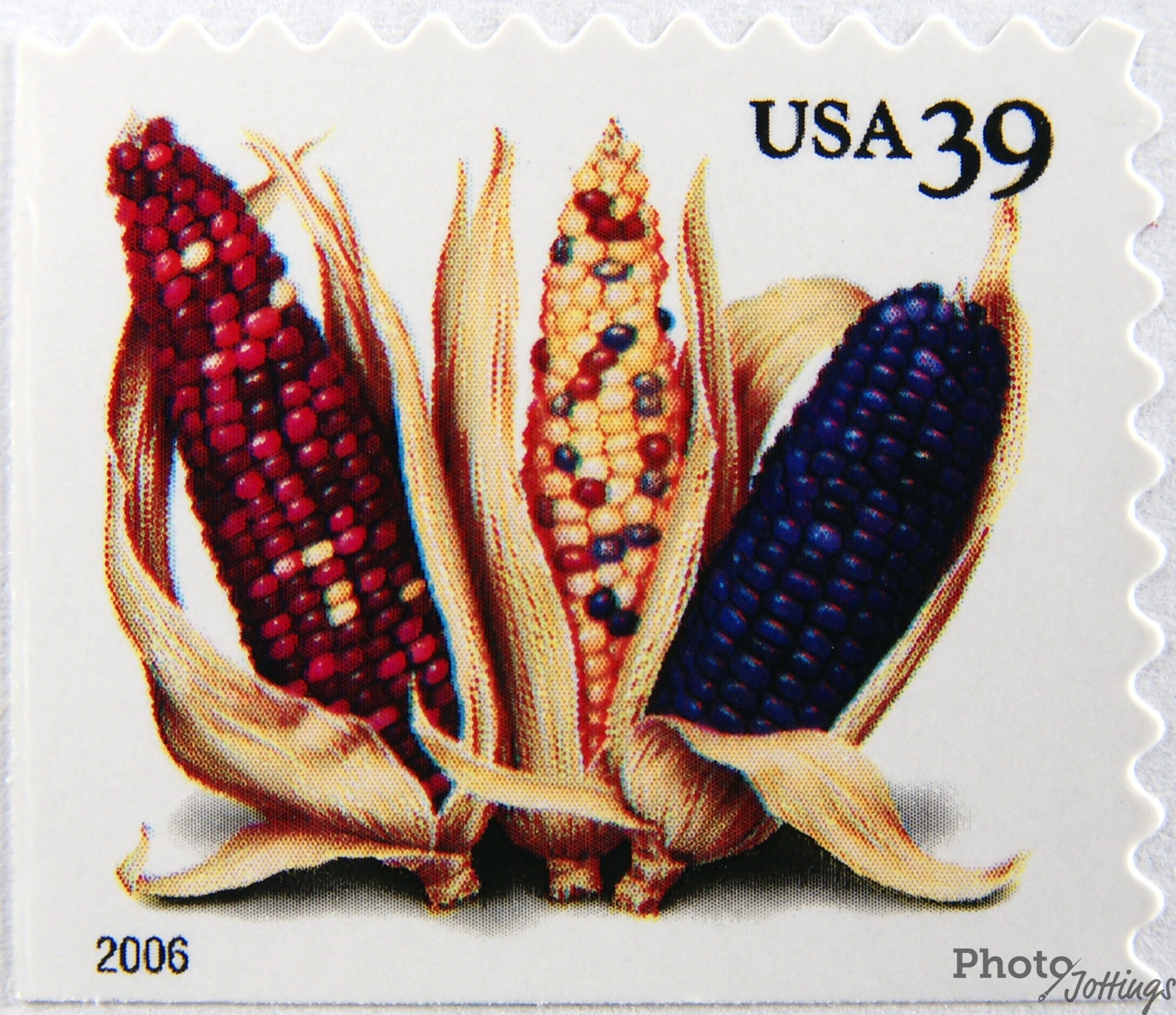
Below, check out the sample, cropped to reduce size, and click (144kb) to see image.  The sample shot was taken with the Sony A700 12.2MP camera.  The subject is a standard US stamp, 1″x 3/4″ or 25.4mm x 19mm.  Also, note the macro shot was taken as close to the subject as focusing allowed; In this case, 4.4″ or 112mm, measured from the front of the lens barrel to the subject, the same as the Sony 11-18mm.
This lens has a small reproduction size at 0.15x.  It isn’t meant to be a good close up lens, so don’t use it for this.  The image below was taken at F/8, but F/5.6 was similar.
100% crop, click for larger image F/8
Conclusion.The Sigma 10-20mm F/4-5.6 is currently the widest of the super-wide angle zooms you can buy for your Sony APS-C sensor camera that accepts regular filters, that’s important, because theSigma 8-16mm will not, so you can’t use a cloud saving graduated neutral density filter.  Cost wise; it’s less than the Sony 11-18mm by a good chunk of change.  If the widest you’ve ever shot is 18mm, you’ll be in for a surprise when looking at 10mm.  This also brings up some problems, see the last paragraph.

The Sigma 10-20mm F/4-5.6 super wide angle lens turned in a very good performance, although it’s not perfect.  Flare/veiling glare is harsh wide open at all focal lengths, and the focusing issues as mentioned in the introduction.  There are some good things too; ghosting is well controlled, the corners are sharp at one or two stops down; and at 10mm, you’ll have plenty of room to pack some fun in the image.  This lens is very good if you shoot at F/8-11; you won’t need to worry about focusing issues, because you’ll have a huge DOF, and flare is mostly gone at F/8 as I stated earlier.  Note: there could be sample variations, so my copy may not be indicative of all.  If you don’t like taking pictures with the sun in the image, don’t worry about the flare issue.
To give you an idea about how much this lens will cover, at 10mm or 15mm in 35mm terms, you can get an entire normal-sized bedroom in the frame, from wall to wall, standing at the door.  The lens at 10mm covers a lot of real estate.  Unless used correctly, most people will not enjoy their results with this lens.  Problematic areas include, getting your shoes in the shot, I’ve done it, getting way too much ground or sky in the image, and winding up with pathetic tiny unrecognizable objects strewn across the middle of the frame, because you were too far away from your subject and didn’t understand the proper use of the lens, I’ve done all of those things.  Try some forced perspective type shots, like getting the camera square in the middle of the action or object of interest, that makes it much more interesting.
This super wide angle lens is also good for taking pictures of rooms or areas where you can’t back off enough with a normal lens, this is also called “getting it all in” and sometimes you just feel the need to do it, but is shunned by many photographers.  Used in this way walls tend to want to tilt hard over from the lens not being exactly level (keystone), and things near the periphery look elongated, but some of that can be corrected in imaging software.
Don’t forget to check out the newer Sigma 10-20mm F/3.5 HSM, if you have the extra money, I’d get this lens.
2594-kurtmunger-banner.gif

Full review of the Sigma 8-16mm F/4.5-5.6 DC HSM lens

endof2011/s816box.jpg
Box and contents
The Sony A580 was used for this review.  For a better understanding of terms and methods used in this review,go here.
The usual center, mid-section and corner crops are located at the very bottom of the page.
Introduction.
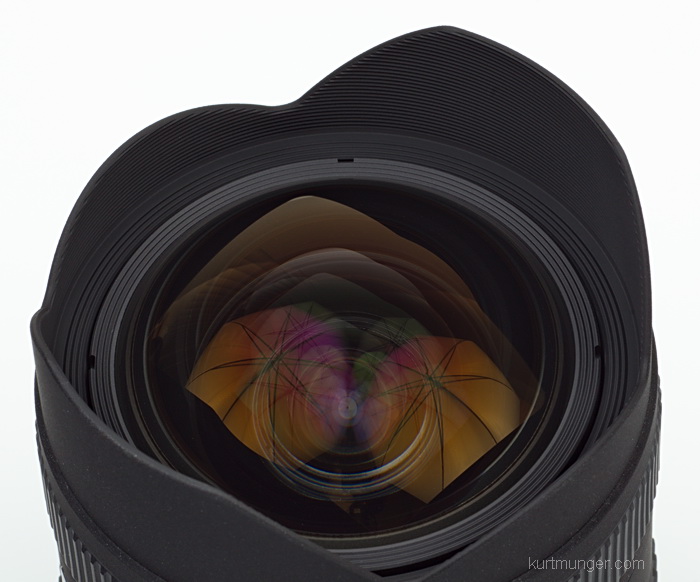
Sigma now offers an APS-C ultra-wide zoom that has the same focal range as the full frame Sigma 12-24mm F/4.5-5.6 I reviewed a few years ago.  This downsized version includes Hyper-Sonic Motor (HSM) focusing, a different optical formula, no rear gel slot (that comes with the full frame version), and neither one can use screw-on filters because of the bulbous front elements and built-in hoods.
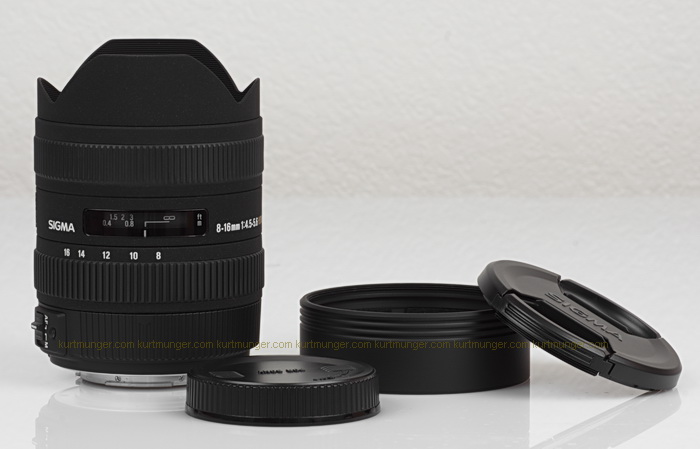
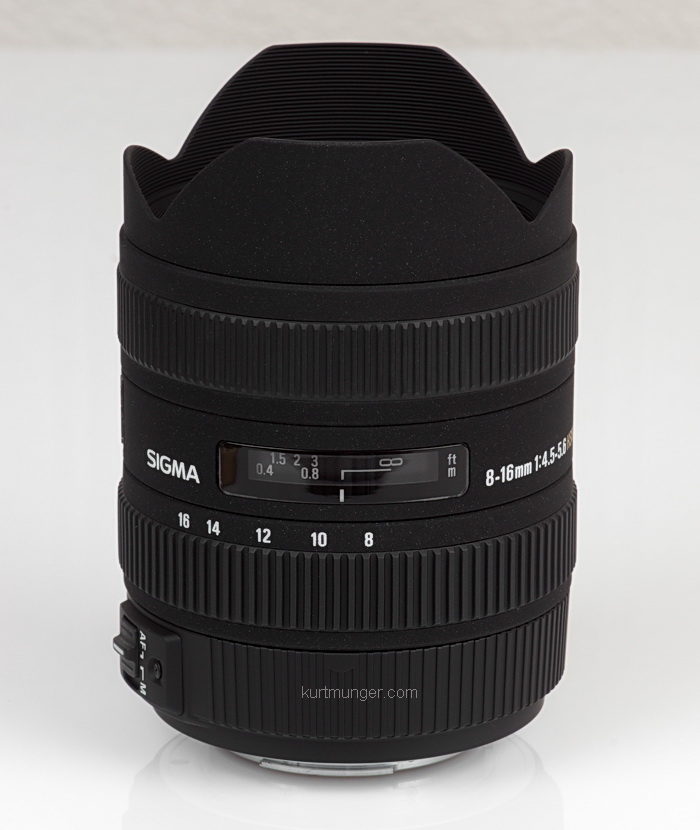
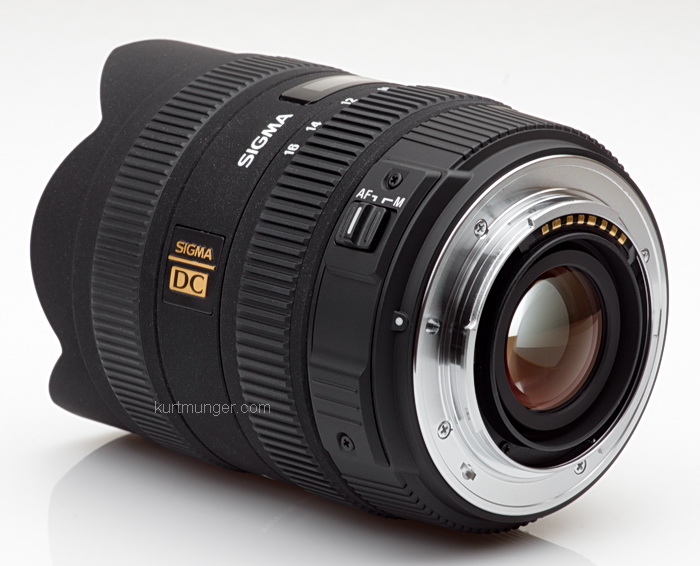
The Sigma 8-16mm F/4.5-5.6 DC HSM has a very good build quality, with a mix of metal and plastic, and unfortunately has the standard sparkly rough black finish you see on many of Sigma’s other lenses.  I don’t care for this type of look, but oh well.  This lens sports a focus distance window, (no DOF scale), a rubber ribbed manual focusing ring at the front, a rubber ribbed zoom ring at the back with focal length marks at 8mm, 10mm, 12mm, 14mm and 16mm.  Also included is an AF/MF switch on the left side to turn off the HSM.  Sigma claims the use of a whole bunch of fancy hybrid/FLD type elements in the design of the lens.  This Sigma model is ‘made in Japan’.
Zooming from 8mm to 16mm causes the front optical group to drop about 3/8″ or 8mm.
Avoid setting the lens down on the mount side without the cap at 8mm because the very curved rear element sticks out and will touch the surface and wobble around.


Don’t try using this on your full frame camera without APS-C size capture on, it vignettes hard at 16mm, and at 8mm blocks about half the image.


The 8-16mm focal length seemingly covers the same area as 12-24mm on a 35mm film or full frame digital camera, but in reality, the 12-24mm has slightly wider coverage.

EXIF focal length data reads correctly at the index marks for 8mm, 10mm, 12mm and 16mm.  At the 14mm mark the data reads 15mm, just like the other super wide zooms I’ve tested; there is no 14mm in the data at any zoom setting, in fact, I’ve never seen 14mm in the EXIF data on any super-wide zoom.
In the box is the lens, front and rear caps with adapter, soft case, and owner’s manual.  The front cap is a standard Sigma 72mm.
Focusing.  This lens has a quiet ‘HSM’ motor inside to provide focusing, (similar to Sony’s SSM, but not SAM).  All focusing is done internally.  The focusing ring turns about 130°, which allows precise manual focusing, although my copy is aggressively damped, so it’s almost too hard to turn with one finger.  Focusing seems pretty accurate, and that’s unusual for a zoom lens this wide.
Cleaning.  Do not clean this lens by using a blower bulb/brush on the front or rear elements, there are gaps in both, and you could wind up shooting dust inside the lens.  Use a proper cleaning cloth and carefully wipe the front element with the zoom between 8-10mm, or in the ‘up’ position.
2594-kurtmunger-banner.gif

Requisite product shots.

endof2011/s816prts.jpg
Lens, rear cap, front cap adapter, front cap.
endof2011/s816sd.jpg
Side shot
endof2011/s816bk.jpg
Back side
endof2011/s816ft.jpg
Front element in the 16mm position
endof2011/s816prts.jpg
Front element in the 8mm position
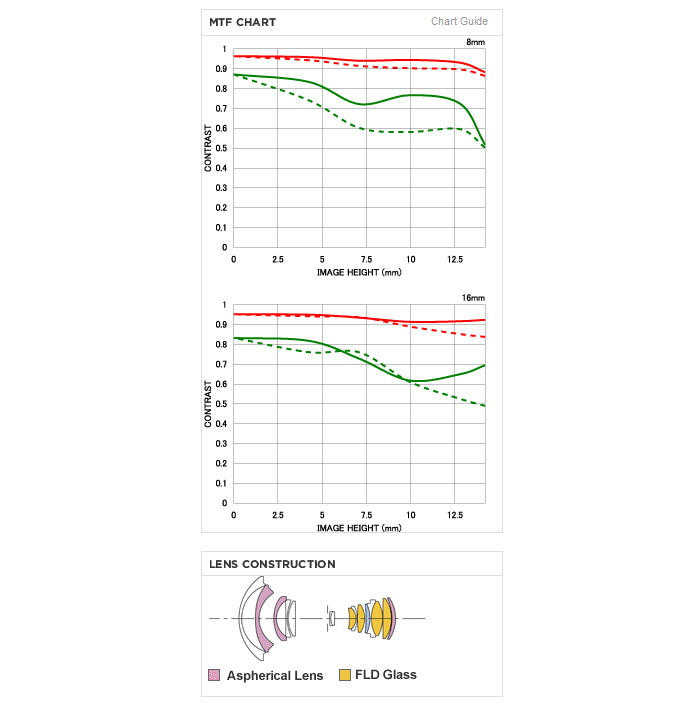
endof2011/sig816mtf.jpg
Sigma X-ray view and incomplete MTF chart

General information and specifications.

Lens
Box contents
Front cap, rear cap, cap adapter, nice softcase and users manual.
Cost
Approximately $699
Build quality
Very good.
Official Sigma info
Go here Sigmaphoto.com for the lens page.
Additional information
As of this review, Sigma’s HSM may not be compatible with all Sony cameras.
Specifications below
Optical configuration
15 elements in 11 groups
Angle of view
114.5˚-76° APS-C
Aperture
7 blades, curved
Full frame and APS-C
Made for APS-C cameras only, but will work on Sony full frame using APS-C size capture.
Depth of field and focus scales?
Focus distance scale in window.
Minimum focus, image plane to subject
About 8.4″  (213mm)
Minimum focus, end of lens barrel to subject
About 2.5″  (63mm)
Hard stop at infinity focus?
No.
Length changes when focusing?
No.
Focus ring turns in AF?
No
Filter size
Not able to accept filters, and no rear gel slot.
Filter ring rotates?
No, there is no filter ring.
Distance encoder?
Seems to work ok.
Max magnification
1:7.8 or 0.13x
Min. F/stop
F/22
Sony teleconverter compatible?
No
Length changes when zooming?
No
Dimensions WxL  (my measurements)
3.0″ x 4.1″   76mm x 104mm.
Maximum  extended length (my measurements)
4.1″  (104mm)
Weight bare (my scale)
19.5oz  (554g) bare
Optical qualities summary.
Lens flare/ghosting.  About average control.  I sometimes see some small green/magenta blobs in the image when the sun or bright lights are near the edges, or inside the frame, see examples below.  Flare is sometimes heavy with the sun at the very edges of the image.
Light fall-off.  Moderate amount at 8mm, F/4.5, and minor as you zoom out.  See samples below.
Color fringing (CA).  Lateral color fringing control is average to above average for an ultra-wide zoom.  I see minor magenta and cyan along the edges of the image at all focal lengths, but mostly at the long end, or 16mm.  See example in the sharpness crops at the bottom of the page.
Bokeh.  Fairly harsh at all apertures and lengths.  Getting background blur is not easy at 8mm.  See examples below.
Color.   Seems about the same as Sony lenses.
Close up filter.  N/A
Coma.  None.
Regular filters will not accept filters.
Filter size.  Due to the bulbous front element and built in hood, you can’t use filters.
Distortion.  Minor to moderate barrel and pincushion, depending on focal length, see samples below.
endof2011/s816dis8.jpg
Moderate barrel distortion at 8mm
endof2011/s816dis10.jpg
Minor barrel distortion at 10mm.
endof2011/s816dis13.jpg
Minor pincushion distortion at 13mm.
endof2011/s816dis16.jpg
Moderate pincushion distortion at 16mm.


The distortion pattern changes as you zoom from 8-16mm.  I see moderate to heavy barrel distortion at 8mm, becoming less at 10mm; at 13mm it flattens out some, but gets a little wavy, and by the end of the zoom it shows some minor pincushion.


Bokeh samples.


          8mm   F/4.5
            8mm   F/8
endof2011/s816bok8f45.jpg
endof2011/s816bok8f80.jpg
           16mm  F/5.6
             16mm  F/8
endof2011/s816bok16f56.jpg
endof2011/s816bok16f80.jpg


Bokeh looks somewhat harsh at all zoom lengths, having a hard outlined edge, however, it’s hard to get any background blur (especially at 8mm!) unless you focus on something very close.  Bokeh is out of focus highlight blur, and not simply how far out of focus the background is.

Light fall-off samples.
           8mm  F/4.5
              8mmF/5.6
endof2011/s816vig8f45.jpg
endof2011/s816vig8f56.jpg
           16mm  F/5.6
              16mm  F/8
endof2011/s816vig16f56.jpg
endof2011/s816vig16f80.jpg

light fall-off is not a problem with this lens, especially as you zoom out.


Flare and  ghosting.


Small line of dots extending from sun.  8mm, F/8.
Large green and orange blobs at 16mm, F/8.
endof2011/s816gst8mmf8.jpg
endof2011/s816gst16mmf8.jpg
Ghosting control is generally good.  When the sun is in the image a green spot and amber/orange colored blob might be visible, especially against a dark colored background.  When stopped down hard, like F/11-22, ghosting is much more noticeable.  Use your hand to block bright light sources when they’re out of the image, but be careful not to get your hand in the image!
Coma samples
8mm, F/4.5.
8mm, F/8.
endof2011/s816comaf45.jpg
endof2011/s816comaf8.jpg
Coma takes the form of weird, smeared blobs at points of light in the corners of the image, especially in super wide angle lenses.  Coma in not a problem with the Sigma 8-16mm F/4.5-5.6.  100% crops from the far corners.

Aperture/focal length guide for the Sigma 8-16mm F/4.5-5.6 DC HSM

Maximum aperture
F/4.5
F/5
F/5.6
Range
8mm-9mm
10mm – 12mm
13mm – 16mm


Let’s check out the macro capabilities of this lens.
 

The sample shot was taken with the Sony A 580 16.2MP camera, so don’t compare it with some others that were taken with the 12.2mp A700.  The subject is a standard US stamp, 0.87″x 1.0″ or 22mm x 25mm.  Also, note the macro shot was taken as close to the subject as focusing allowed; in this case a very short 2.5″ (63mm), measured from the front of the lens barrel (permanent hood) to the subject.  
 
I see a somewhat small (0.13x) shot, (click for full cropped image, 269k), from F/5.6-F/8.  It does seem to lack some contrast, but shows good detail.  As a side note; the “1996” on the bottom left of the stamp measures a mere 1mm wide.  
As close as you can get, F/8.


Cap adapter issues.


8mm, with adapter and filter.
16mm, with adapter and filter.
endof2011/8mmwadap.jpg
endof2011/16mmwadap.jpg
The included adapter cap has 72mm filter threads at the end to give the pinch type cap something to grab, and you can put a standard 72mm filter on the end, but this is what happens.  You could to this for effect, but I’d rather do it in post processing to avoid wrecking the image in case you change your mind.


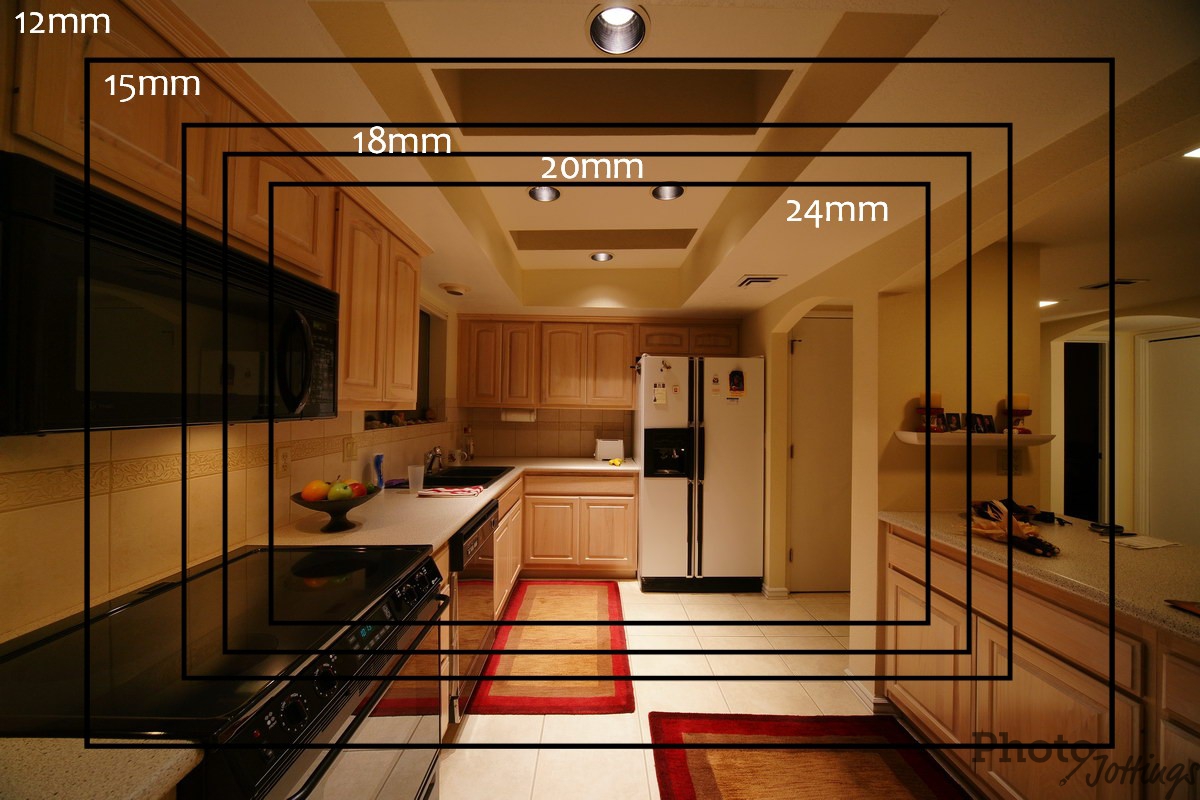
Capture area guide below.


Comparative views at different focal lengths, click for larger size.
This is the same image I used a couple of years ago in the Sigma 12-24mm review to show how much coverage you get between 12mm and 24mm.  In our case, the 8mm end of the APS-C Sigma is basically the same as the full frame 12mm, and 16mm is the same as 24mm.  Don’t use the wide end of this lens for any serious interior photography, it’s too hard to light properly, and it looks funny, like this image.

Conclusion


The Sigma 8-16mm F/4.5-5.6 DC HSM ultra-wide zoom is a specialty lens, meaning it will probably appeal to a rather small segment of people that really want wide, and I mean shoes-in-the-picture wide!  This lens (at the widest focal lengths) begs to be jammed in the middle of an interesting plant or work of art, or taking non-traditional views of urban environments.  Folks wanting this type of lens should not be too concerned about the technical image quality, and instead focus their interests and efforts on effective composition.  If you want a really fun ultra wide lens, check this one out.


If you’re really concerned about the image quality of the lens, here’s my take: it’s very sharp over most of the frame at F/5.6 between 8-10mm; around 12-16mm the mid-sections and corners don’t quite match the centers, but the performance is still very acceptable.  Light fall-off is very low, ghosting control is slightly above average in most cases, color fringing control is average for this type of lens, and overall handling is quite good. The distortion pattern is typical of this class of zooms, and is mostly correctable in post processing.  I found the auto-focusing to be very accurate, which is unusual for an ultra-wide zoom lens.


This is not a very good interior/Real estate photography lens because it’s simple too wide over most of the zoom range.  Try properly lighting a room when using 8mm, it’s basically impossible.  Plus, the exaggerated view just doesn’t look believable.  If you want to sell your photography to an architect, interior designer, homebuilder or Real Estate agent etc, your work needs to be believable, not funny or artsy.  For good looking Interiors, start in the 14mm (20mm full frame) range, but try to stay at 16mm (24mm FF) or longer.  For a better interior focal range, check out the Sigma 10-20mm F/4-5.6 EX DC, or Sigma 10-20mm F/3.5 EX DC HSM.


I would highly recommend the Sigma 8-16mm F/4.5-5.6 DC HSM for landscapes and artistic photography, especially when using 8-10mm!


2594-kurtmunger-banner.gif


Sample crops from the centers, mid-sections and corners.


8mm.


          Center
          Mid-section
             Corner
F/4.5
endof2011/s816ctr12f45.jpg
endof2011/s816mid12f45.jpg
endof2011/s816corn12f45.jpg
F/5.6
endof2011/s816ctr12f56.jpg
endof2011/s816mid12f56.jpg
endof2011/s816corn12f56.jpg
F/8
endof2011/s816ctr12f80.jpg
endof2011/s816mid12f80.jpg
endof2011/s816corn12f80.jpg
F/11
endof2011/s816ctr12f11.jpg
endof2011/s816mid12f11.jpg
endof2011/s816corn12f11.jpg


The 8mm centers look pretty sharp wide open at F/4.5, but stopping down helps the mid-sections and corners sharpen up nicely.  Distance from camera to subject is about 20′ (6.1m).


13mm.


          Center
          Mid-section
             Corner
F/5.6
endof2011/s816ctr13f56.jpg
endof2011/s816mid13f56.jpg
endof2011/s816corn13f56.jpg
F/8
endof2011/s816ctr13f80.jpg
endof2011/s816mid13f80.jpg
endof2011/s816corn13f80.jpg
F/11
endof2011/s816ctr13f11.jpg
endof2011/s816mid13f11.jpg
endof2011/s816corn13f11.jpg


At 13mm, the image looks plenty good at F/5.6, and stopping down doesn’t help sharpness.  You can get F/5 at 13mm; I used F/5.6 so I could keep everything the same when comparing this lens with another Sigma lens.  Distance from camera to subject is about 25′ (7.6m).


16mm.


          Center
          Mid-section
             Corner
F/5.6
endof2011/s816ctr16f56.jpg
endof2011/s816mid16f56.jpg
endof2011/s816corn16f56.jpg
F/8
endof2011/s816ctr16f80.jpg
endof2011/s816mid16f80.jpg
endof2011/s816corn16f80.jpg
F/11
endof2011/s816ctr16f11.jpg
endof2011/s816mid16f11.jpg
endof2011/s816corn16f11.jpg


The 16mm crops show about the same performance at 13mm, which is good, but not perfect.  Check out the color fringing (magenta) in the corner crops along the house.  I do see noticeably soft images at all zoom lengths at F/11 and smaller due to diffraction.


That’s it for the review, if you’d like to help out the site, please visit B&H Photo if you’re thinking of purchasing the Sigma 8-16mm F/4.5-5.6 DC HSM lens.


2594-kurtmunger-banner.gif
Full review of the Sigma 10-20mm F/3.5 EX DC HSM lens

JUNE2011/sig1020box.jpg
Box and contents
The Sony A580 was used for this review.  For a better understanding of terms and methods used in this review,go here.
The usual center, mid-section and corner crops are located at the very bottom of the page.
 
Introduction.
Sigma now offers a high quality, constant aperture, super wide zoom that has the same focal range as the Sigma 10-20mm F/4-5.6 I reviewed a few years ago.  The newer Sigma includes a relatively fast, (and constant) F/3.5 aperture, along with a few other things like Hyper-Sonic Motor (HSM) focusing, a better build quality, and unfortunately, a poor choice 82mm filter ring.  Is it worth upgrading if you already have the older version?  Is it worth the money if you’re looking to buy your first super wide zoom?  Read on!
The Sigma 10-20mm F/3.5 HSM has a very good build quality, with a mix of metal and plastic, and a smooth satin black finish, which is much nicer than the standard sparkly rough black finish used on many of Sigma’s other lenses.  This lens sports a focus distance window, (no DOF scale), a rubber ribbed manual focusing ring at the front, a rubber ribbed zoom ring at the back with focal length marks at 10mm, 12mm, 14mm, 17mm and 20mm.  Also included is an AF/MF switch on the left side to turn off the HSM.  Sigma claims the use of a whopping four Asperical elements, two “ELD” and one “SLD” element in the design of the lens.  Most of those abbreviations are marketing spin, and are meant to make you think this lens has what others in the same class may not have.  The lens says “made in Japan.”
Zooming causes the lens to extend (raises the front section) to its longest at 10mm; becoming shortest at 14mm, then starts to extend out again at 20mm.


Works on full frame sensor without APS-C size capture on, but clips corners hard between 10-15mm.


The 10-20mm focal length covers the same area as 15-30mm on a 35mm film or full frame digital camera.

EXIF focal length data reads correctly at the index marks for 10mm, 12mm, 17mm and 20mm.  At the 14mm mark the data reads 15mm, just like the other sigma 10-20mm lens, there is no 14mm in the data at any zoom setting, in fact, I’ve never seen 14mm in the EXIF data on any super wide zoom, why is that?
In the box is the lens, front and rear caps, plastic petal type hood, soft case, and owner’s manual.
Focusing.  This lens has a relatively quiet motor inside to provide focusing, (similar to Sony’s SSM) and doesn’t use the slot-screw type system that’s typical for older lenses from Minolta and Sony.  All focusing is done internally, so your polarizer and graduated neutral density filters will stay in the position you originally set them in.  The focusing ring turns about 130°, which allows precise manual focusing, although my copy is aggressively damped, so it’s too hard to turn with one finger.  Focusing seems pretty accurate, although at longer distances the lens wants to focus slightly past infinity, which can cause some soft shots, depending on temperature or your camera’s calibration etc.  Fortunately, manually focusing with a super wide zoom is pretty easy; for most subjects beyond 10′ or 20′ (4-7m), just set the focus at the infinity mark, stop the aperture down a little and forget it.  At the long end with a wide aperture, you might have to “tweak” that setting a bit.  I rarely use AF on super wide lenses.
2594-kurtmunger-banner.gif
Requisite product shots.

JUNE2011/sig1020sd3.jpg
Side shot
JUNE2011/sig1020bk3.jpg
Back side
JUNE2011/sig1020ft5.jpg
Front element
JUNE2011/sig1020cht.jpg
Sigma X-ray view and incomplete MTF chart
General information and specifications.

Lens
Sigma 10-20mm F/3.5 EX DC HSM
Box contents
Front cap, rear cap, hood, nice softcase and users manual.
Cost
Approximately $650
Build quality
Very good.
Additional information
Better built and faster than the original Sigma 10-20mm F/4-5.6
Specifications below
Optical configuration
13 elements in 10 groups
Angle of view
102˚-64° APS-C
Aperture
7 blades, curved
Full frame and APS-C
Made for APS-C cameras only, but will work on full frame using APS-C size capture.
Depth of field and focus scales?
Focus distance scale in window.
Minimum focus, image plane to subject
About 9.5″  (240mm)
Minimum focus, end of lens barrel to subject
About 3.75″  (95mm)
Hard stop at infinity focus?
No.
Length changes when focusing?
No.
Focus ring turns in AF?
No
Filter size
82mm, bad choice by Sigma, as they’re expensive.
Filter ring rotates?
No
Distance encoder?
N/A
Max magnification
1:6.6 or 0.15x
Min. F/stop
F/22
Sony teleconverter compatible?
No
Length changes when zooming?
Yes
Dimensions WxL  (my measurements)
3.43″ x 3.47″   87mm x 88mm, widest at filter ring.
Maximum  extended length (my measurements)
3.6″  (92mm) longest at 10mm.
Weight bare (my scale)
18.3oz  (520g) bare
Optical qualities summary.
Lens flare/ghosting.  Very good control.  I sometimes see a small green blob in the image when the sun or bright lights are near the edges, or inside the frame, see examples below.
Light fall-off.  moderate amounts at F/3.5, but it makes a smooth transition from the corners to the center.  See samples below.
Color fringing (CA).  Lateral color fringing control is below average for a super wide zoom from the twenty first century.  I see magenta and cyan along the edges of the image at all focal lengths.  Axial color fringing (occurs all over) is noticeable at wide apertures, but stopping down get rid of this.  See example farther down the page.
Bokeh.  Smooth at F/3.5, but fairly harsh at other apertures, see examples below.
Color.   Seems about the same as Sony lenses.
Close up filter.  N/A
Coma.  A tiny bit at F/3.5, 10mm, gone at F/4.5.
Regular filters cause no additional light fall-off.
Filter size.  82mm, and a poor choice by Sigma as this size is not used on very many lenses, (none for Sony), and they’re expensive as compared to the normal 77mm size you’d find on a super wide-angle lens.  You can use 77mm filters with caution, see the light fall-off samples for more info.
Distortion.  Minor to moderate barrel and pincushion, depending on focal length, see samples below.
JUNE2011/sig1020dis10.jpg
Moderate barrel distortion at 10mm
JUNE2011/sig1020dis12.jpg
Minor barrel distortion at 12mm.
JUNE2011/sig1020dis16.jpg
Minor pincushion distortion at 16mm.
JUNE2011/sig1020dis20.jpg
Moderate pincushion distortion at 20mm.


The distortion produced by this lens at 10mm is somewhat simple in that it doesn’t have “mustache” type like the similar, but less expensive Sigma 10-20mm model; however, it does seem to have a “flat” section in the middle at all focal lengths, so it isn’t so easy to completely correct in post processing, although the distortion isn’t very noticeable unless you’re shooting straight lines along the edges of the image, such as architectural or interior subjects.  Distortion is almost flat at 14mm.


Bokeh samples.


          10mm   F/3.5
            10mm   F/5.6
JUNE2011/sig1020bok35w.jpg
JUNE2011/sig1020bok56w.jpg
           20mm  F/3.5
             20mm  F/5.6
JUNE2011/sig1020bok35t.jpg
JUNE2011/sig1020bok56t.jpg


Bokeh looks pretty smooth at wide apertures, but the aperture shape and slight ring shows up when stopped down smaller than F/4.5.  It’s hard to get any background blur (especially at 10mm!) unless you focus on something very close.  Bokeh is out of focus highlight blur, and not simply how far out of focus the background is.

Light fall-off samples.
           10mm  F/3.5
              10mmF/5.6
JUNE2011/signew10mmf35.jpg
JUNE2011/signew10mmf56.jpg
           20mm  F/3.5
              20mm  F/5.6
JUNE2011/signew20mmf35.jpg
JUNE2011/signew20mmf56.jpg
           10mm  F/3.5  Close focus
              10mm  F/3.5, with 77mm filter
JUNE2011/signewclose.jpg
JUNE2011/signewfltr2.jpg

The light fall-off signature transitions from dark to light gradually and smoothly, so it isn’t very noticeable.  Close focus shows a somewhat hard transition, but that’s at maximum reproduction range.


It is possible to use 77mm filters on this lens at all focal lengths if you hold the filter up directly against the lens face.  If you use an 82mm-77mm step-down ring, you’ll see clipped corners at 10mm-12mm, but the rest of the focal range is clear.


Full image light fall-off.


JUNE2011/sig1020vigover.jpg


This image (showing shadowy person with long legs and huge head) illustrates real world light fall-off from 10mm, F/3.5.  It doesn’t bother me.  The soft spot (cactus) on the left side is mostly caused by being out of the focus range.  Specs, 10mm, F/3.5, ISO 200, 1/3200sec, +0.30eV.


Flare and  ghosting.


Small green dot at top center, with sun out of shot.  10mm, F/5.6.
Nothing at 20mm, F/5.6.
JUNE2011/sig1020gst10b.jpg
JUNE2011/sig1020gst20.jpg
Ghosting control is generally very good.  When the sun is in, or near the image, a green spot or amber/orange colored blob might be visible, but it doesn’t happen much.  When stopped down hard, like F/11-22, ghosting is much more noticeable.  Use your hand to block bright light sources when they’re out of the image, even if the hood is on, especially at the super wide end.
Coma samples
10mm, F/3.5.
10mm, F/4.5.
JUNE2011/sig1020cma35.jpg
JUNE2011/sig1020cma45.jpg
Coma takes the form of weird, smeared blobs at points of light in the corners of the image, especially in super wide angle lenses.  The Christmas tree lights here show just a small amount of coma at 10mm, but it clears up quickly by stopping down the aperture.  100% crops from the far corners.
 
 
Let’s check out the macro capabilities of this lens.

The sample shot was taken with the Sony A 580 16.2MP camera, so don’t compare it with some others that were taken with the 12.2mp A700.  The subject is a standard US stamp, 0.87″x 1.0″ or 22mm x 25mm.  Also, note the macro shot was taken as close to the subject as focusing allowed; in this case a very short 3.75″ (95mm), measured from the front of the lens barrel to the subject.  
 
I see a somewhat small (0.15x), but sharp stamp shot, (click for cropped image, 314k), all the way from F/3.5-F/8.  As a side note; the “1996” on the bottom left of the stamp measures a mere 1mm wide.  
As close as you can get, F/4.


Lateral color fringing.


JUNE2011/sig1020cf.jpg
Color fringing crop from far right side, 10mm, F/5.6


This crop is from the last 700 pixels on the middle right side.  I see some pretty heavy magenta and cyan color fringing along the tree branches, but is mostly removable in RAW using CA sliders.


Conclusion. 

The Sigma 10-20mm F/3.5 super wide-angle zoom has some really nice qualities, but isn’t perfect; then again, what lens is?  If you own the slower and cheaper Sigma 10-20mm F/4-5.6, should you upgrade?  Would this be a good lens for Real Estate or interior photography?


On the plus side for the upgraded Sigma is the excellent build quality, it looks and feels like an expensive lens.  It also has a constant, relatively fast F/3.5 aperture, and is sharp in the centers at that aperture, at all focal lengths.  The mid-sections are pretty sharp at F/5.6, although not super sharp like the centers.  On the down side; the corners are soft at wide apertures at all focal lengths, but do sharpen up to acceptable levels around F/5.6-8 depending on zoom length.  Another issue is color fringing, it’s strong, and noticeable along the sides of the image (at all focal lengths), especially if you look at your pictures fully enlarged on your computer screen.  A fix for this is to shoot in RAW and fix it with CA (chromatic aberrations) sliders, if you have that feature in your photo editing software.


The HSM focusing system is almost silent, and mostly accurate, but not really any better than the old slot/screw system.  The last thing I’d like to mention is distortion, this new Sigma doesn’t have the annoying “mustache” type of distortion at 10mm that the old one has, and that makes it easier to fix.  If you shoot mainly between 12-20mm, there isn’t much difference.


Now to answer the questions in the first paragraph; people that already own the Sigma 10-20mm F/4-5.6 should ask themselves, do I need more light gathering ability at the longer focal lengths?  If not, there is no reason to upgrade.  Yes, the new lens is sharper in the centers, especially at 10mm, but is that the length you use the most, and is that the most important quality you’re looking for?  If you don’t already own a super wide-angle zoom, and are considering the two Sigma’s, I’d probably go with the new version, as it isn’t much more money, and it offers a stop and a third of light at the long end, that’s important if you shoot in low light without a tripod.


People getting into Real Estate photography will be happy with this lens, however, stay away from the super-wide end, that’s showing way too much for interior shots, and will be nearly impossible to light properly.


Bottom line; the Sigma 10-20mm F/3.5 is a very good choice for a super wide zoom, if you’re worried about the soft corners, simply use a little less focal length, and crop the extreme corners out.  I almost always straighten and crop my images a little bit; most people do, and that would eliminate the soft corners.


2594-kurtmunger-banner.gif


Sample crops from the centers, mid-sections and corners.


10mm.


          Center
          Mid-section
             Corner
F/3.5
JUNE2011/sig1020new35ctrs.jpg
JUNE2011/sig1020new35mid.jpg
JUNE2011/sig1020new35corn.jpg
F/4
JUNE2011/sig1020new40ctr.jpg
JUNE2011/sig1020new40mid.jpg
JUNE2011/sig1020new40corn.jpg
F/5.6
JUNE2011/sig1020new56ctr.jpg
JUNE2011/sig1020new56mid.jpg
JUNE2011/sig1020new56corn.jpg
F/8
JUNE2011/sig1020new80ctr.jpg
JUNE2011/sig1020new80mid.jpg
JUNE2011/sig1020new80corn.jpg
F/11
JUNE2011/sig1020new11ctr.jpg
JUNE2011/sig1020new11mid.jpg
JUNE2011/sig1020new11corn.jpg


The 10mm centers look pretty sharp wide open at F/3.5, but stopping down to F/4 helps bring up the contrast.  The mid-sections sharpen up nicely at F/5.6, but never quite equal the centers.  The corners sharpen up reasonably well at F/5.6, although no match for the centers or mid-sections.  The softness at the corners transitions quickly, so a little bit of cropping can remove the blurry extreme corner areas.  Distance from camera to subject is about 25′ (7.5m).


16mm.


          Center
          Mid-section
             Corner
F/3.5
JUNE2011/sig1020new35ctrm.jpg
JUNE2011/sig1020new35midm.jpg
JUNE2011/sig1020new35cornm.jpg
F/4
JUNE2011/sig1020new40ctrm.jpg
JUNE2011/sig1020new40midm.jpg
JUNE2011/sig1020new40cornm.jpg
F/5.6
JUNE2011/sig1020new56ctrm.jpg
JUNE2011/sig1020new56midm.jpg
JUNE2011/sig1020new56cornm.jpg
F/8
JUNE2011/sig1020new80ctrm.jpg
JUNE2011/sig1020new80midm.jpg
JUNE2011/sig1020new80cornm.jpg
F/11
JUNE2011/sig1020new11ctrm.jpg
JUNE2011/sig1020new11midm.jpg
JUNE2011/sig1020new11cornm.jpg


At 16mm, the centers are pretty sharp at all apertures, but the mid-sections require another stop or so to peak, and then look about the same as the centers, that’s good.  The corners look awful at F/3.5-4, but do respond positively when closing the aperture, and by F/8 seem acceptable.  The subject is two large rocks with a small pot placed next to them.  Distance from camera to subject is about 35′ (10.5m).


20mm.


          Center
          Mid-section
             Corner
F/3.5
JUNE2011/sig1020new35ctrt.jpg
JUNE2011/sig1020new35midt.jpg
JUNE2011/sig1020new35cornt.jpg
F/4
JUNE2011/sig1020new40ctrt.jpg
JUNE2011/sig1020new40midt.jpg
JUNE2011/sig1020new40cornt.jpg
F/5.6
JUNE2011/sig1020new56ctrt.jpg
JUNE2011/sig1020new56midt.jpg
JUNE2011/sig1020new56cornt.jpg
F/8
JUNE2011/sig1020new80ctrt.jpg
JUNE2011/sig1020new80midt.jpg
JUNE2011/sig1020new80cornt.jpg
F/11
JUNE2011/sig1020new11ctrt.jpg
JUNE2011/sig1020new11midt.jpg
JUNE2011/sig1020new11cornt.jpg


Performance at 20mm looks about the same as 16mm, which is good except for the extreme corners.  The tree branches are waving in the breeze, that’s why the shadows are different.  Distance from camera to subject; about 70′ (21m).


Please check out the Sigma 10-20mm F/3.5 EX DC HSM at B&H Photo and help support the site!

Here’s a brief look at the Sigma 12-24mm F/4.5-5.6 EX DG zoom lens.  Scroll down for the main review.

Lens
Box contents
Front ring with cap, rear cap, softcase, gel template and users manual.
Cost
$829 street price, (Sony mount).
Build quality
Very good
Additional information
APS-C users will be better served with the Sigma 8-16mm F/4-5.6 DC HSM.
Specifications below
Optical configuration
16 elements in 12 groups
Angle of view
122°-84° full frame, 99°-61° (?) APS-C.
Aperture
6 blades, straight
Full frame and APS-C
Yes, full frame and APS-C.   APS-C equivalent, 18-36mm
Depth of field and focus scales?
Focus scale, DOF scale for (W) wide end, and (T) telephoto end.
Minimum focus, image plane to subject
11″ (280mm)
Minimum focus, end of lens barrel to subject
4.85″  (123mm)
Hard stop at infinity focus?
No
Length changes when focusing?
No
Focus ring turns in AF?
Yes
Filter size
Rear gel slot, front cap 82mm.
Filter ring rotates?
No
Distance encoder?
?
Max magnification
0.14x
Min. F/stop
F/22-29
Sony teleconverter compatible?
No
Length changes when zooming?
No
Dimensions WxL  (my measurements)
3.4″ x 4.0″   87mm x 102mm, barrel width at focus ring, 3.15″ (80mm)
Maximum  extended length (my measurements)
4.0″  (102mm)
Weight bare (my scale)
16.8oz  (478g)  19oz (541g) with caps
Requisite product shots.

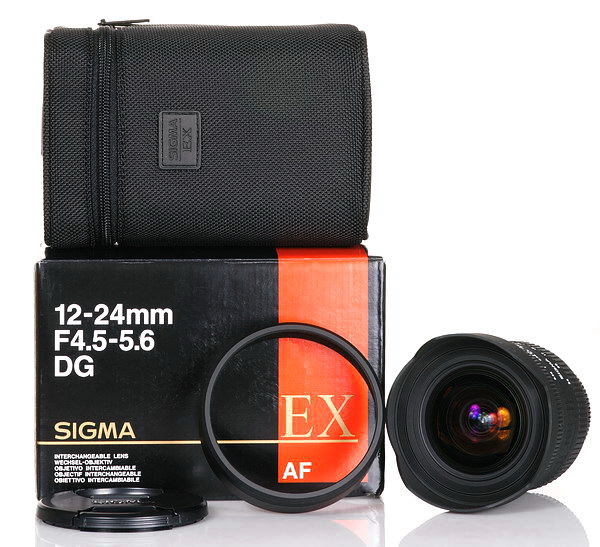
Jan2009/s1224kitz.jpg
Box and contents
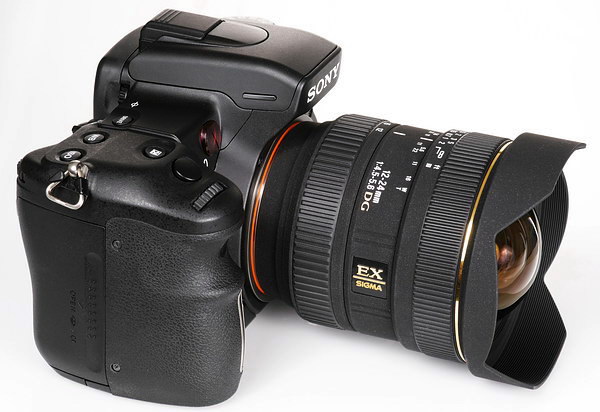
Jan2009/s1224a700z.jpg
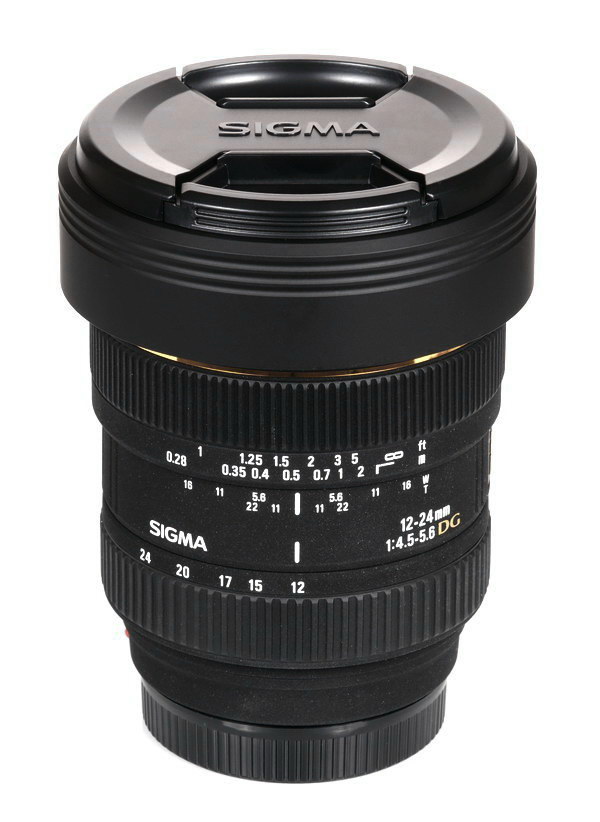
With A700
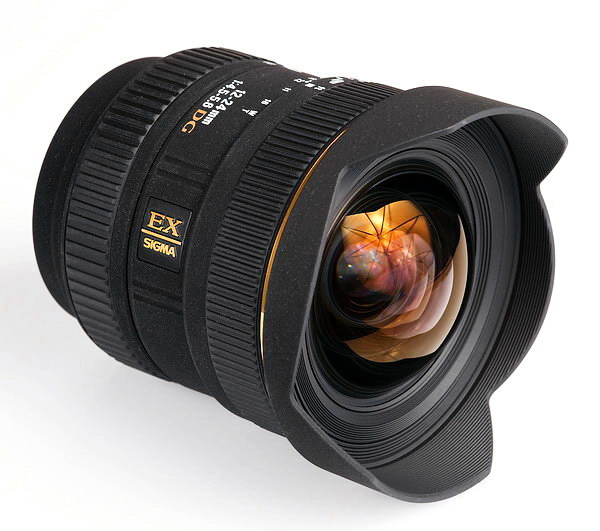
Jan2009/s1224ftoffx2z.jpg
Front element
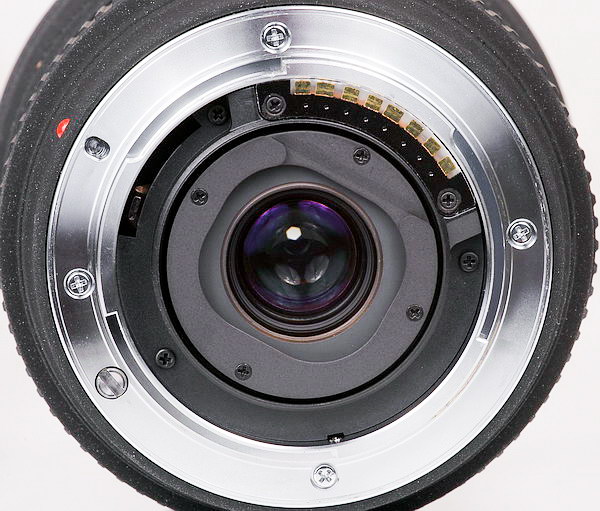
Jan2009/s1224bkx.jpg
Backside with gel slot.
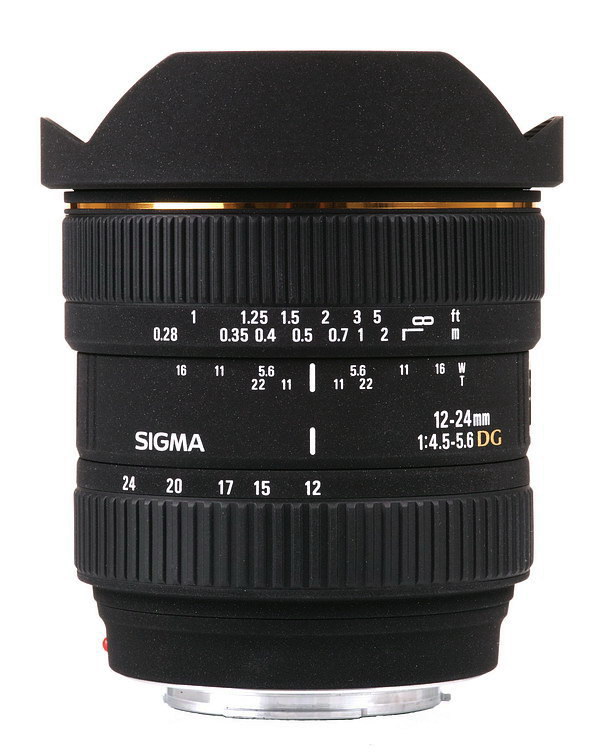
Jan2009/s1224ftz.jpg
Side shot showcasing Sigma’s sparkly dirt-like finish.
Jan2009/s1224fttopx2z.jpg
Ring and cap
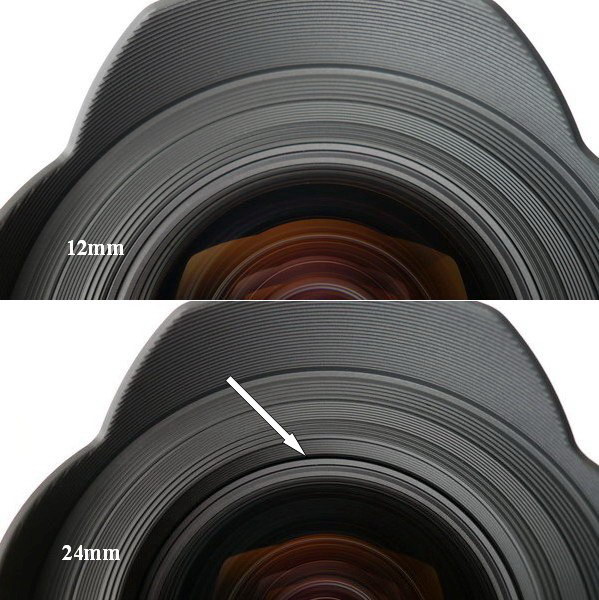
Jan2009/s1224comp2.jpg
Zooming in drops front element.
Jan2009/s1224mtf.jpg
Sigma screen grab MTF chart, incomplete, but this is all they give.
Jan2009/s1224xray.JPG
X-ray view
The Sony A700 and Sony A900 were used for this review.  For full frame results, go to the bottom of the page.  For a better understanding of my review methods and terminology, go here.
The (made in Japan) Sigma 12-24mm is about the widest zoom you can get for a full frame camera, but is approximately equivalent to 18-36mm on APS-C bodies, so people (really wanting ultra-wide) using a cropped sensor camera may want to consider the Sigma 10-20mm F/4-5.6 zoom, which has a coverage of 15-30mm, equivalent.


Build quality is very good.  It looks like it has ABS plastic around the barrel, zoom and focus rings, and a petal type, metal, built-in hood.  The zoom and focus rings have ribbed rubber around them for easy gripping.  The finish is black sparkly dirt-look paint which I think looks atrocious, but some people thinks it’s great.  The zoom action is dampened well and stays put, and the focus ring is very easy to turn.  The lens doesn’t change length while focusing or zooming, though zooming from 12mm-20mm drops the front element to its lowest level, then it raises slightly at 24mm.  I’d keep this lens set at 12mm when just walking around, as you might introduce dirt inside the lens when zoomed to other lengths because of the gap, see image above.  Focal length numbers come at 12mm, 15mm, 17mm, 20mm and 24mm.  EXIF data reads mostly good, but the 15mm mark on the lens barrel shows 16mm in the data, and 14mm doesn’t show up, but that’s normal I guess,  see sigma 10-20mm review above.  No big deal here.  Sigma claims to have three asperical elements, and four “SLD” elements in the construction of this lens, see last image above.
In the box comes the lens with a cap and ring, both separate, plus a nice softcase and gel template for film users.  You won’t be using a filter in the front, even though the cap ring is threaded, because of very strong vignetting at wide angle, especially on full frame.  The ring is metal, and has a felt-like substance around the inside (which makes it fit tight) so it doesn’t slip off or scratch the hood when you install or remove it.
Auto-focusing is fast, though not so accurate which is usual for Sigma.  The lens wants to go past infinity focus to the hard stop too much of the time, but this is easy to rectify.  Just use manual focus and set the focusing ring to the infinity mark (not to the end of travel) for everything past 10ft (3m) and your pictures will be sharp.   Manual focusing takes just over 1/5 turn from Close-in to infinity, with no back slop.
There is a new version of this lens using HSM focusing with a nicer finish, check it out here.

Aperture/focal length guide for the Sigma 12-24mm F/4.5-5.6  This lens has one set of overlapping numbers, for instance; you can get F/4.5 or F/5 at 15mm, depending on tiny movements of the zoom ring, this is quite common.  Look below for guide.  Also, as usual, this lens did not register 14mm(!) or 19mm, 21mm and 23mm in the EXIF data.


Maximum aperture
F/4.5
F/5
F/5.6
Range
12mm-15mm
15mm – 17mm
18mm – 24mm
Lens flare/ghosting.  Flare poor, ghosting good.  Check out the samples below.  If the sun is near the outside edge of the image, you’ll need to block it with your hand, If the sun is in the image, you’ll see some heavy flare with the lens at its maximum aperture.  Pointing it directly at the sun near 12mm looks ok stopped down one or two stops, and looks bad stopped down to F/16-22, which results in a wagon wheel look around the sun.  This lens has a petal type permanent hood, but as usual, it doesn’t do much good, especially at 12mm, use your hand for the best control.
Color fringing.  Average control, and very similar to other ultra-wides I’ve tested.  You’ll see mostly red/green along the sides of the image in areas of harsh contrast.
Bokeh.  Average for an ultra-wide.  You won’t notice any background blur unless you focus on something within a few feet (1-2m) from the lens.  See crops below.
Color.  Similar to other Sigma and Sony lenses.
Coma.  None.  See crops below.
Close-up filter.  N/A.
Filter size is 82mm.  The front cap is 82mm, which attaches to the supplied ring, and the ring slips over the hood.  The ring has threads for a filter, but you won’t be able to use one without vignetting at the widest end.  See light fall-off below, especially in the full frame section.
Normal filters.  I didn’t test this as I have no 82mm filter, but read light fall-off paragraph.
Distortion.  See below.  Almost mild at both ends using an APS-C camera.  At 12mm, very slight pincushion distortion at close focus, very slight barrel distortion at infinity focus.  Distortion is nearly flat past 15mm at infinity.  Very good control here, especially for an ultra-wide.
Distortion examples
Jan2009/s1224wbrl.jpg
12mm, mild barrel distortion.
Jan2009/s1224pin.jpg
24mm, slight pincushion.


Random samples


12mm, F/4.5 light fall-off
12mm, F/4.5 sun centered
Jan2009/s1224over.jpg
Jan2009/s1224sun8.jpg
12mm, F/5.6 sun just out of frame
12mm F/5.6, sun blocked with hand
Jan2009/s1224sunfl1.jpg
Jan2009/s1224sunfl2.jpg
12mm F/4.5
12mm, F/7.1
Jan2009/s1224sunfl4.jpg
Jan2009/s1224sunfl3.jpg
Bokeh,  12mm F/4.5
Bokeh,  12mm F/5.6
Jan2009/s1224bokw45.jpg
Jan2009/s1224bokw56.jpg
Bokeh,  24mm F/5.6
Bokeh,  24mm F/8
Jan2009/s1224boktel56.jpg
Jan2009/s1224boktel80.jpg
Coma,  12mm F/4.5
Coma,  12mm F/5.6
Jan2009/s1224cma45.jpg
Jan2009/s1224cma56.jpg
The top left shot shows light fall-off in a real picture, and there’s no problem.  Make sure you take the ring that holds the cap off the hood, otherwise you’ll get sharp vignetting at 12mm.  The top right shot shows what happens when you point this lens directly into the sun at 12mm, F/4.5.  There’s massive flare, just like the Sigma 10-20mm, but stopping down helps much.
The second row shows what happens when the sun is a little outside the frame.  If you hold up your hand to block the light from hitting the front element, you’ll nearly eliminate this problem.  There still is a couple of small ghosts visible, but that’s real tough to get rid of as you usually wind up with your hand in the shot.  Ghosting is well controlled overall, though on a full frame camera you’ll see a big red/orange blob in the corner when the sun is outside the image at a certain angle, (not shown), I didn’t notice it using an APS-C camera.  All this stuff is noticeable in the viewfinder, so just pay attention and block the sun, or frame the image from a different angle.
The third row down shows what to expect when you shoot with the sun in the image.  Harsh flare wide open, but stopped down two stops or less results in a much better looking picture.  I see a large pink ghost in the corner.  The performance is similar at 24mm.  Also notice the unspectacular six-pointed sun star, due to the six bladed aperture, couldn’t Sigma have thrown in another blade?  How much more could that cost?
Bokeh.  The background blur isn’t very good, then again, you shouldn’t be getting much blur unless you focus on something that’s just a few feet (1-2m) in front of you.  At F/8, and infinity focus, everything should be sharp past the 10′ (3m) point.
Coma.  No problems at all, and very good control.  I just posted these crops for people that want to see something.
Light fall-off.
Noticeable on a cropped sensor camera wide open at 12mm, but it blends softly towards the center so real pictures don’t show much, if any corner shading.  See full frame results at the bottom of the page which look substantially different.  Note; make sure you take the lens cap ring off from around the hood, otherwise, you’ll get sharp vignetting in the extreme corners at 12mm, at all apertures, move out to 13mm and things look good.
           12mm F/4.5
             12mm F/5.6
Jan2009/s1224vigw45b.jpg
Jan2009/s1224vigw56b.jpg
           24mm F/5.6
             24mm F/8
Jan2009/s1224vigtel56b.jpg
Jan2009/s1224vigtel80b.jpg
Center and corner sharpness.

Below are crops from the image centers at 12mm.

              12mm F/4.5
           12mm F/5.6
Jan2009/s1224ctrw45.jpg
Jan2009/s1224ctrw56.jpg


Now the 12mm corner crops.


           12mm F/4.5
             12mm F/5.6
Jan2009/s1224cnw45.jpg
Jan2009/s1224cnw56.jpg
           12mm F/8
             12mm F/11
Jan2009/s1224cnw80.jpg
Jan2009/s1224cnw11.jpg
The 12mm center crops (top set) look pretty sharp wide open, possibly showing a tiny bit more contrast at F/5.6, however, that’s as good as it gets, so you don’t need to stop down further.  The corners (bottom set) look good wide open, but do sharpen up ever-so-slightly by stopping down the aperture.  It looks like the sharpest corners come at F/11.
Below, look at the 24mm centers.
           24mm F/5.6
              24mm F/8
Jan2009/s1224ctrtel56.jpg
Jan2009/s1224ctrtel80.jpg


24mm corners below.


           24mm F/5.6
              24mm F/8
Jan2009/s1224cntel56.jpg
Jan2009/s1224cntel80.jpg
           24mm F/11
              24mm F/16
Jan2009/s1224cntel11.jpg
Jan2009/s1224cntel16.jpg
The 24mm centers (top set) look great at the maximum aperture of F/5.6, and don’t appear to sharpen up by stopping down.  The corners (bottom set) are somewhat soft wide open, but look better at F/11.  Overall, they’re very acceptable to me.
Let’s check out the macro capabilities of this lens.

Below, check out the sample and click (131kb) for a 100% cropped portion of the full image.  The sample shot was taken with the Sony A 700 12.2MP camera.  The subject is a standard US stamp, 1″x 3/4″ or 25.4mm x 19mm.  Also, note the macro shot was taken as close to the subject as focusing allowed; in this case a rather short 4.85″ (123mm), measured from the front of the lens barrel to the subject.
As close as you can get, F/5.6.
The Sigma 12-24mm has a common (ultra-wide) reproduction ratio of 0.14x, and turned in a decent close focus shot, taken at F/5.6.  Don’t use this lens if you like taking tons of close up pictures, that’s not what it was designed for.

Full frame results using the Sony A900 below.


Check out the differences when using a film or full frame camera below.  I’m only pointing out the noticeable issues as compared to the APS-C bodies, so if I don’t show it here, the results are not significantly different enough to warrant posting an additional set of images in this section.


Light fall-off


         12mm F/4.5
          12mm F/5.6
Jan2009/s1224ffvigw45.jpg Jan2009/s1224ffvigw56.jpg
         12mm F/8
          12mm F/11
Jan2009/s1224ffvigw80.jpg
Jan2009/s1224ffvigw11.jpg
         24mm F/5.6
          24mm F/8
Jan2009/s1224ffvigtel56.jpg
Jan2009/s1224ffvigtel80b.jpg


Light fall-off is heavy at 12mm, F/4.5, stopping down lessens the severity, but will not eliminate all dark corners.  At 24mm, there’s mild corner darkening with a very smooth transition, which is not noticeable in real shots.  Note; make sure you take the lens cap ring off from around the hood, otherwise you’ll get extreme vignetting from 12-20mm with full frame coverage.


Full image from A900 below.


Jan2009/s1224ffoverx.jpg


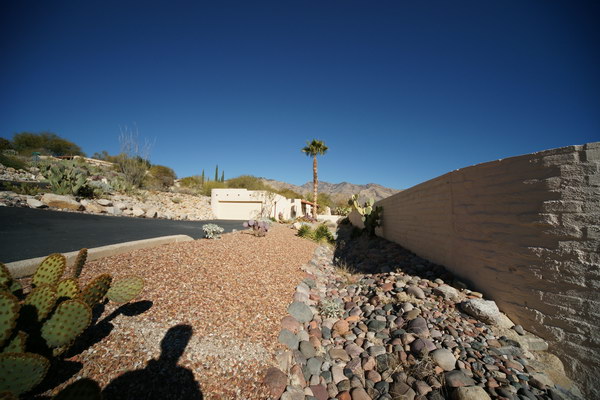
Here’s yet another variation of the all-too-typical backyard scene.  This time we see the results of the lens set to 12mm and F/4.5, the worst settings for dark corners.  As you can see, the corners really are dark, and noticeable, but not too bad in real life, you can always stop down the aperture, which lightens up the corners.  Also understand, you’re covering a lot of sky, even in this view, you’re going from near the horizon (middle of image) which is lighter blue, to almost overhead, darker blue.  Don’t let that fool you into thinking that’s part of light fall-off, see “Bad use” image below for a better illustration of this effect.  Tricky, these ultra wides!  On a minor note; I had the camera jammed inside this prickly pear cactus, between the pads, otherwise, you’d see houses and driveways using this lens at 12mm.  I took another shot using F/11, which allowed a DOF to make everything sharp, and didn’t notice any light fall-off.


12mm corner samples next.


         F/4.5
          F/5.6
Jan2009/s1224ffcnw45.jpg Jan2009/s1224ffcnw56.jpg
         F/8
          F/11
Jan2009/s1224ffcnw80.jpg
Jan2009/s1224ffcnw11.jpg


The 12mm corners don’t look much different than the APS-C crops, that’s good.  Stopping down helps out, and F/11 looks great, but F/16 was the absolute sharpest.  I wouldn’t use F/16 though, as the centers soften slightly, and you don’t want to compromise the centers for better corners.  These crops were taken from the extreme corners, so don’t worry about this as it might be covered by a picture frame.


24mm corners below.


         F/5.6
          F/8
Jan2009/s1224ffcntel56x.jpg Jan2009/s1224ffcntel80x.jpg


The 24mm corners don’t seem to sharpen up by closing down the aperture, you mostly see minor light fall-off that’s gone at F/8.  Obviously, the corners aren’t as sharp as the centers, but for full frame, ultra-wide extreme corner shots, they’re pretty darn good.


Distortion next.


Jan2009/s1224ffbrldis.jpg
Barrel distortion @ 12mm on A900
Jan2009/s1224ffpindis.jpg
Pincushion distortion @ 24mm on A900


There is mild to moderate distortion at both ends on the A900, but not enough to be noticeable unless you’re shooting horizons or buildings.  The distortion pattern on both ends is a simple curve, and is easy to fix in photo imaging software.


Coma results with full frame.


F/4.5
F/5.6
Jan2009/s1224ffcma45.jpg Jan2009/s1224ffcma56.jpg


There is no coma on a full frame camera.  I see some small light streaks, but they’re gone at F/8.  You wouldn’t notice this stuff at normal viewing sizes.  The 100% crops in this A900 section are from the extreme corners.  Printed out as you see them on your screen would measure 65″ (1.65m) wide!


Capture area guide below.


Comparative views at different focal lengths, click for larger size.


Here’s a guide to the approximate area you can capture at varying focal lengths.  Click the image for a larger view, (230kb).  There’s quite a bit of difference between 12mm and 15mm, so you APS-C users can see what you’re missing.  I based the focal length lines on the lens marks and/or the EXIF data and actual picture.  Slight variations can occur between lenses, or the lens may not be marked properly, that’s why I use the word “approximate” up front.


Sample shots below.


Bad use.


Jan2009/s1224bad.jpg


Good use.


Jan2009/s1224gd2.jpg


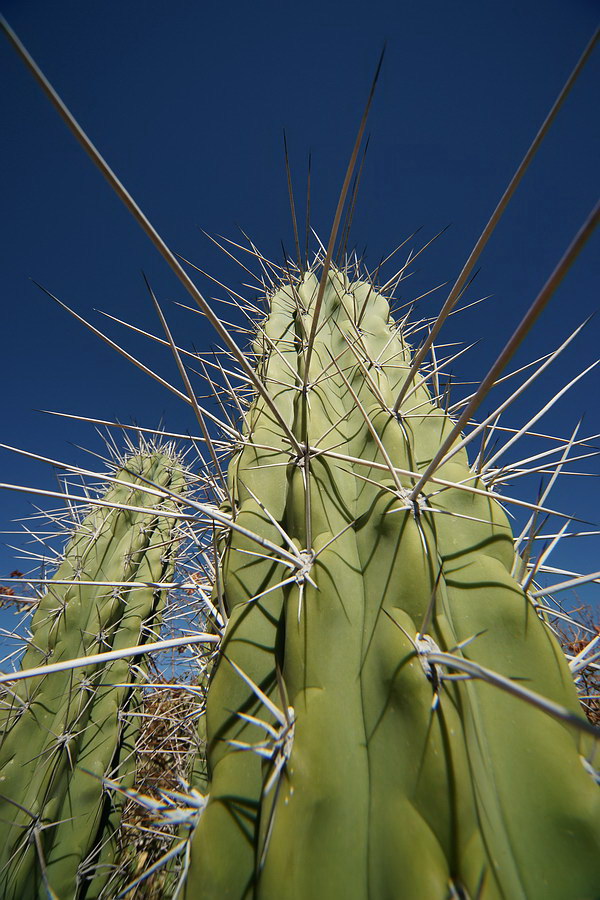
Above are examples as to how you might use this lens.  The top image is trying to “get it all in” and looks poor because there’s too much sky and ground involved, in addition to the photographers shadow, and it’s not very interesting, maybe it would be to the owner of the house.  It also highlights light fall-off at 12mm, F/4.5.  The bottom shot I think is more interesting, and more appropriate for this lens, do to the fact that the cactus needles seem to want to stick right in your face!!  The needles were actually sticking in the front of the lens when I fired off this shot, not in my face thankfully.  At 12mm, I was able to get a broader view of the cactus, while retaining, and accentuating the long needles.  The front of the lens was about 5″ (120mm) from the cactus trunk, the needles are 4″-6″ (100-150mm) long.


Conclusion. 
For people jumping on the super ultra-wide bandwagon, (mainly full frame owners) make sure you understand how to use this lens, and the vast coverage you’re going to get, as opposed to a measly 28mm, or 24mm wide.   The 12mm end is so wide, you’ll need to jam the camera in the middle of the subject to avoid getting undesirable things in the view, like your feet.  It’s really too wide for interior shots unless zoomed all the way in, the shot above is good for showing the differences in coverage, but isn’t very interesting.  It can however, be suitable for interiors and outside shots, you just have to make sure you fill the frame with something interesting, if you use it like a standard length lens, you’ll wind up with a band of sky (or ceiling) at the top, a band of floor (or ground)  at the bottom, and a strip of objects too small to make out in the middle.  Filling the frame with an interesting subject requires either a really big subject, or jamming the camera very close to, or in the middle of the subject.
For APS-C users; This lens is very similar to the Sigma 8-16mm F/4.5-5.6 DC HSM, and Sigma 10-20mm F/4-5.6 EX DC, also tested here.  If you’re looking for the widest possible lens, buy one of those instead of the 12-24mm.  The approximate 35mm equivalent is 15-30mm with the Sigma 10-20mm on your APS-C camera, the Sigma 12-24mm is 18-36mm.  There’s a big difference in coverage between 15mm-18mm, look a the chart above.  I’m not forgetting the Sony 11-18mm F/4.5-5.6, it’s good too, just not quite as wide.
For full frame users; This is a fun lens for people that like ultra-wide coverage, and is the widest zoom available as of this review.  It turned in a very good full frame performance overall, but you have to make sure you understand how to get the most out of this Sigma lens.  The focusing isn’t the best, and sun flare is very strong at the widest available aperture.  To counter this, use manual focus and set it at infinity for sharp shots past 10′ (3) or so, then stop down to F/8 where sun flare is much better controlled, and light fall-off is not so harsh.  Also, as I’ve said before, make sure you pay attention in the viewfinder, and make adjustments as necessary, like using your hand to shield the front element when the sun is close to the image, or shooting from a slightly different angle to mitigate flare and ghosting. If you use these pointers, your pictures will come out nice and clean.
Please check out the Sigma 12-24mm F/4.5-5.6 EX DC at B&H Photo, (plus the newer version), it helps me to keep adding useful information to the site.
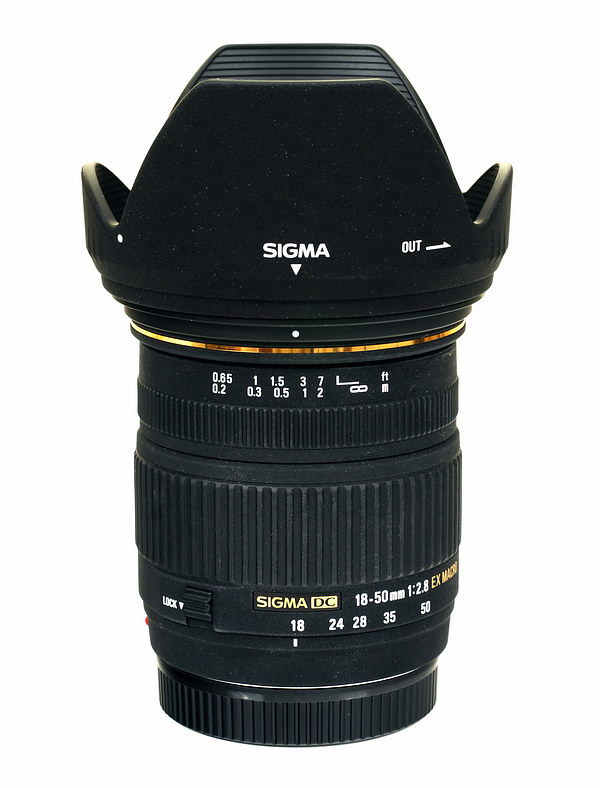
Here’s a brief look at the Sigma 18-50mm F/2.8 EX DC  macro zoom lens.  Scroll down for the review.

Lens
Sigma 18-50mm F/2.8 EX DC macro zoom lens
Box contents
Front and rear caps, hood, nice soft-case and users manual.
Cost
$419 street price.
Build quality
Good to very good
Additional information
Good macro size, but comes real close (1.0″) to front of lens.  See the Tamron 17-50mm F/2.8 XR Di II.
Specifications below
Optical configuration
15 elements in 13 groups
Angle of view
76°-32° with 1.5x crop sensor
Aperture
7 blades, circular
Full frame and APS-C
APS-C only, 35mm equivalent, 27-75mm.  Works on full frame, but vignettes massively at all focal lengths, turn on APS-C size capt. for good pictures.
Depth of field and focus scales?
Focus distance scale
Minimum focus, image plane to subject
7.9″  (200mm)
Minimum focus, end of lens barrel to subject
1.0″  (25.4mm)
Hard stop at infinity focus?
No
Length changes when focusing?
No
Focus ring turns in AF?
Yes
Filter size
72mm
Filter ring rotates?
No
Distance encoder?
?
Max magnification
0.34x
Min. F/stop
F/22
Sony teleconverter compatible?
No
Length changes when zooming?
Yes
Dimensions W x L (my measurements)
3.1″ x 3.4″   79mm x 86mm-around filter ring
Maximum  extended length (my measurements)
4.4″  (111mm)
Weight bare (my scale)
16.9oz  (479g)  17.8oz (506g) with caps
Requisite product shots.

Aug08/sig1850box.jpg
Box and contents
Aug08/sig1850sd.jpg
Side view fully drawn in, with included hood, note zoom lock.
Aug08/sig1850sdex.jpg
Side shot fully extended, note sparkly dirt like finish
Aug08/sig1850bk.jpg
Rear shot
Aug08/sig1850ft.jpg
Big front element
october08/s1850mtf.JPG
Sigma MTF screen grab, incomplete, but this is all they give.
The Sony A700 was used for this review.  For a better understanding of my review methods and terminology, go here.
This lens has been replaced by the Sigma 17-50mm F/2.8 OS HSM.
The Sigma 18-50mm F/2.8 EX macro lens, made in Japan, is equivalent in focal range to most standard walk-around zooms, but has the constant fast aperture of F/2.8, which the others don’t have.  Currently, Sony has no fast lens like this in the APS-C or “DT” only category.  Sigma says they use two asperical elements and one “SLD” element in the construction of the lens.  It has a 7 blade circular aperture.  This lens handles very nicely, and seems better in some respects than Sony branded lenses.  The actual construction quality is pretty good, my only complaint is the atrocious sparkly-dirt finish they apply.  I just hate it and you can see what I’m talking about by looking at the product shots above.  Other than that, everything is right.  A few items to note; if you set this lens mount-side down at 18mm without the rear cover on, the rear element will touch the surface and cause the lens to wobble slightly.  The “DC” in the lens name means it’s for APS-C sensors only, and the “EX” means it has gold stuff on the barrel to make it look like it’s higher quality.  Also, the owners manual says not to use gasoline or fuel oil to clean the lens, darn it!  They didn’t say anything about not smoking a cigarette if you should do so.
Zoom control is smooth and even, and dampened nicely.  It extends out 1.0″ (25.4mm) at 50mm.  This lens extends out as you turn the zoom ring counter-clockwise, the opposite of most Sony/Minolta lenses.  The focal length numbers are checked at; 18mm, 24mm, 28mm, 35mm, and 50mm. The EXIF data reads correctly.  The lens has a Zoom lock, and works only at 18mm, but you shouldn’t need it unless you like to hike or run with it.
Focusing is a mixed bag.  Don’t get upset now, auto-focusing works good, maybe a little slow, but at F/2.8 it can render images slightly out-of-focus at times, just check your shots occasionally when shooting at F/2.8.  The focus ring turns in AF.  Manual focusing works well, with about 1/6 of a turn from close-in to infinity.  The focus ring is nice and tight, with no slop.  The closest focusing distance from lens barrel to subject is 1.0″ or 25.4mm.


Flare and ghosting.  Average control at ghosting.  Green blobs, sometimes large depending on angle, see image below.  Flare is strong when the sun is at, or just out of the frame, especially towards the long end.  The lens comes with a plastic petal-type hood which isn’t very effective for controlling flare or ghosting, use your hand when needed.
This lens is multi-coated and has the common green/magenta look that matches some Sony lenses perfectly.
Filter size.  72mm.  This size isn’t very popular with Sony, but they do use it on the 20mm F/2.8, 135mm F/2.8 STF, and the 85mm F/1.4
Filter use.  There’s very light vignetting using regular filters at 18mm, F/2.8.
Coma.  Light wide open, 18-24mm, closing the aperture one or two stops eliminates it.  No issues from 35-50mm.
Color.  Looks the same as Sony lenses.
Lateral color fringing.  Very good control here at the long end, say 35mm-50mm.  At wide angle it’s about average, I see mostly purple/red.  Stopping down doesn’t help with this kind of color fringing.
Aug08/1850brl.jpg
Moderate to strong barrel distortion. 18mm
Aug08/1850pin.jpg
Light pincushion distortion at 50mm.

Barrel and pincushion distortion.
  The distortion at 18mm is moderate to strong, but disappears rapidly, 22mm-30mm is flat.  From 32mm pincushion starts, and results in light to moderate distortion at 50mm.  See pictures above.   Oddly, distortion seems strongest at 50mm, which turns into barrel (not pincushion as above) focused very close, as in large macro image, see stamp macro below.
Lens Bokeh.  The Sigma 18-50mm F/2.8 EX DG macro has a decent background blur near 18mm, F/2.8, but looks too harsh towards the long end.  See images below.
light fall-off, directly below.  Moderate at 18mm and F/2.8, stopping down helps out.  Other focal lengths look mild.  Usually, closing the aperture one stop will eliminate most of the dark corners, but there isn’t a problem except possibly wide open at 18mm.  See small image sample below the test shots, where it’s hardly visible.
    18mm @ F/2.8
  18mm @ F/4
Aug08/185028vigw2.jpg Aug08/185040vigw2.jpg
    50mm @ F/2.8
   50mm @ F/4
Aug08/185028vigL2.jpg Aug08/185040vigL2.jpg


Examples of light fall-off and flare.


    18mm @ F/2.8 Light fall-off
  18mm @ F/5.6 ghosting
Aug08/1850lf2.jpg october08/s1850sunfl.jpg
    18mm @ F/2.8 bokeh
  18mm @ F/4 bokeh
october08/s1850bokw28.jpg october08/s1850bokw40.jpg
    50mm @ F/2.8 bokeh
  50mm @ F/4 bokeh
october08/s1850boktel28.jpg october08/s1850boktel40.jpg
    18mm @ F/2.8 coma
  18mm @ F/4 coma
october08/s1850cmal28.jpg october08/s1850cmal40.jpg
The top left picture above shows light fall-off or corner shading at 18mm, F/2.8, which is barely noticeable in real shots, this is also laughable because you very rarely need to shoot F/2.8 in daylight, this shot was 1/3200 sec.  The top right image is ghosting at 18mm, F/5.6, which is average, to slightly below average in this department.  No problems with the sun centered in the image.  Flare is strong, especially at the long end.
Bokeh examples in the middle, and they really aren’t too smooth.  At full wide angle and F/2.8, things look ok, but stopped down, or anything at the long end is harsh.
Coma, bottom row, looks light, and is completely gone at F/5.6 @18mm.  Light to nothing past 24mm.
Corner softness.
18mm corners below.
    18mm @ F/2.8
  18mm @ F/4
Aug08/1850cn28w.jpg Aug08/1850cn40w.jpg
    18mm @ F/5.6
  18mm @ F/8
Aug08/1850cn56w.jpg Aug08/1850cn80w.jpg


50mm corners 


    50mm @ F/2.8
  50mm @ F/4
Aug08/1850cn28tel.jpg Aug08/1850cn40tel.jpg
    50mm @ F/5.6
  50mm @ F/8
Aug08/1850cn56tel.jpg Aug08/1850cn80tel.jpg
The 18mm corners are soft with the aperture wide open, and stopping down helps much, F/8 looks good.  Up towards 50mm, the corners don’t start off as soft as they are at 18mm, and respond nicely to a couple stops down to F/8.  Basically, the wide end takes three stops to get sharp corners, 50mm; two stops.  With the aperture closed to F/5.6, the corners are sharp enough at all lengths to please most people, unless you like staring at your pictures blown up on your computer screen to insane levels.  If you’re taking pictures in broad daylight, you won’t need F/2.8, and more likely will be shooting at F/5.6-8, so again, corner softness doesn’t matter here.
Center samples next.
18mm centers
    18mm @ F/2.8
  18mm @ F/4
Aug08/1850ctr28w.jpg Aug08/1850ctr40w.jpg
    18mm @ F/5.6
  18mm @ F/8
Aug08/1850ctr56w.jpg Aug08/1850ctr80w.jpg


50mm centers.


    50mm @ F/2.8
  50mm @ F/4
Aug08/1850ctr28tel.jpg Aug08/1850ctr40tel.jpg
    50mm @ F/5.6
  50mm @ F/8
Aug08/1850ctr56tel.jpg Aug08/1850ctr80tel.jpg
Look at the boring center crops above.  With a wide open aperture the centers are pretty sharp, but one stop down looks a bit sharper.  You’ll only notice the sharpness differences if you compare the 100% crops side-by-side like I’ve done here.
Check out the close focus shot.

Below, check out the sample (610kb) and click to see a 100% cropped portion of the full image.  The sample shot was taken with the Sony A700 12.2MP camera.  The subject is a standard US stamp, 1″x 3/4″ or 25.4mm x 19mm.  Also, note the macro shot was taken as close to the subject as focusing allowed; In this case a super close 1.0″ or 25.4mm, measured from the front of the lens barrel to the subject.

This lens has a large reproduction size at 0.34x.  It did a good job at F/8 but F/11 is just as sharp.  The macro shot below is a little dark in the middle, as I was so close (1.0″) away, the lens barrel blocked my light.  This is a problem in the field, so you may not be able to get the full reproduction size macro unless the conditions are just right.  Also notice the barrel distortion in the crop below, funny how it has pincushion at 50mm with normal focus distances, and barrel at close focus.

100% crop, F/8 click me
Conclusion.
The Sigma 18-50mm F/2.8 EX macro lens is well built, (but ugly, sparkly, dirt-look finish), handles nicely and is sharp in the centers at all focal lengths, even wide open, and produces an excellent macro image.  Average items include color fringing at wide angle, though good at 50mm, distortion, and light fall-off.  Below average items include flare control, corner softness at wide angle, and accurate focusing at large apertures; check your shots.  The soft corners don’t matter in good light, where you’ll probably be using F/5.6-8 and won’t be needing F/2.8.  In low-light, soft corners won’t show up much.  This lens performs similarly to the Konica Minolta AF 28-75mm F/2.8 lens, but the Sigma has a much better focal length for APS-C cameras, equalling 27-75mm, where the Konica Minolta is 42-112mm.
Overall, this is a very good lens, and is a bargain, with a street price around $419.
Currently Sony offers an excellent, but more expensive DT 16-50mm F/2.8 SSM lens.
Sigma replaced this review lens with a better version, not yet reviewed.
Here’s a brief look at the Sigma 30mm F/1.4 EX DC.  Scroll down for the review.

Lens
Box contents
Front and rear caps, carrying case, hood and a users manual.
Cost
$489 Street price
Build quality
Good
Additional information
For APS-C camera bodies only.
Specifications below
Optical configuration
7 elements in 7 groups
Angle of view
46°
Aperture
8 blades, straight
Full frame and APS-C
Just APS-C, equivalent, 45mm
Depth of field and focus scales?
Focus scale only
Minimum focus, image plane to subject
15.7″  (400mm)
Minimum focus, end of lens barrel to subject
10.4″  (264mm)
Hard stop at infinity focus?
No
Length changes when focusing?
No
Focus ring turns in AF?
Yes
Filter size
62mm
Filter ring rotates?
No
Distance encoder?
?
Max magnification
0.10x
Min. F/stop
F/16
Sony teleconverter compatible?
No
Dimensions W x L (my measurements)
2.83″ x 2.32″   72mm x 59mm
Maximum  extended length (my measurements)
2.32″  (59mm)
Weight bare (my scale)
11.8oz  (335g)  12.7oz (360g) with caps.
Requisite product shots.

Jan2009/3014fta700z.jpg
Mounted on Sony A700.
Jan2009/3014kitz.jpg
Box contents with no box
Jan2009/3014sdz.jpg
Side shot highlighting dirt-like finish
Jan2009/3014ftupz.jpg
Focused up close
Jan2009/3014ftdwz.jpg
Focused at infinity
Jan2009/3014bkz.jpg
Backside
Jan2009/3014mtf.jpg
MTF chart
Jan2009/3014sg.jpg
X-ray view.
All testing done with the Sony A700.  For a better understanding of the terms and methods used for this review, go here.                   

The Sigma 30mm F/1.4 EX DC (made in Japan) is made to be used on an APS-C body only, and will produce massive dark corners if used on a full frame camera.  This 30mm lens has an angle of view similar to a 50mm lens on a full frame 35mm type camera, and is an attempt by Sigma to capture a market share in this focal length and speed that Sony (and many other brands) seem to ignore.  This would be a good lens for hand-held, available light shooting, (although a much better lens would be the Sony DT 35/1.8).  Sigma claims the use of two “ED” glass elements and one aspherical element in the construction of the lens.  Box contents include a petal type plastic hood, and a nicely padded black carrying case.  Sigma advertises this lens as having “HSM” or hyper-sonic motor.  The Sony version of this Sigma lens has no “HSM” which is the same as Sony’s SSM, or in-the-lens focusing motor. As a result of this omission, the Sony version is about 3.5oz (100g) lighter than the spec sheet states from Sigma.

Build quality is good.  Fit, finish and overall feel are the same as other Sigma lenses.  It has a dull, sparkly, dirt-look black finish that I hate, but that doesn’t matter as far as quality is concerned.  The lens has a focus distance scale with ft and m using white numbers along the focus ring.  There is also a gold band towards the end of the barrel, which Sigma says is a mark of superior build and optical quality.  This is a marketing gimmick, and especially egregious to Minolta users, as some Minolta “G” lenses used to have the same gold type band in the same place.
Focusing.  This lens has a fairly short focus throw, and results in speedy auto-focus operation.  It also seems accurate for the most part, but tended to focus slightly behind the subject at close to medium distances, (only a problem at F/1.4), but was right on at the infinity mark.  The lens focuses by extending the front inner section, but that doesn’t add to the overall length, see pictures above.  There’s a little slop in the focus ring if you wiggle it while engaged in auto-focus mode, that’s no big deal though.  Manually, the focus ring is not dampened enough for my taste, but I don’t use manual focus much anyways.  When going through the entire focus range, you’ll rotate the ring a 1/4 turn.  The focus ring turns in auto-focus mode.
The lens is multi-coated and resists flare and ghosting with above average results, and similar to other primes in this range.  Sometimes green and magenta diffused looking blobs show up depending on background content and color, but overall it has good control.  I see no hard ghosts at any angle or aperture.  Veiling glare is shows up when the sun is close to the image, about the same as other lenses with this basic focal length.  In the box you’ll also get a plastic “DiaPetal” hood which means it has two different shaped “petals” across from each other, see photo above.  As usual, the hood really doesn’t do any good, so use you hand to block the sun or other bright lights if possible.
Filter size is 62mm.  Sony uses this size on the; CZ 16-80mm, 16-105mm, 18-250mm, 18-200mm, 24-105mm, and the 70-300mm G.
Normal filters, cause no additional vignetting.
Coma.  A moderate amount at F/1.4, almost nothing at F/2.  See sample crops below.
Color looks similar to Sony lenses.
Bokeh is smooth, though it can look busy, especially as you go towards the edges of the frame.  The results are much the same as the Sony 50mm F/1.4.  See samples crops below.
Color fringing.   There is axial color fringing wide open, but lessens greatly by F/2, and is gone past F/4.  Lateral color fringing, which occurs along the sides of the image is controlled very well, and is above average in my opinion.
Random shots below.
Virtually no flare or ghosts, F/5.6
No rings or flare with sun centered, F/5.6
Jan2009/30mmsunoff.jpg Jan2009/30mmsunctr.jpg
Bokeh, F/1.4
Bokeh, F/2
Jan2009/s30bok14.jpg Jan2009/s30bok20.jpg
Bokeh, F/2.8
Bokeh, F/4
Jan2009/s30bok28.jpg Jan2009/s30bok40.jpg
Coma, F/1.4
Coma, F/2
Jan2009/s30mmcma14.jpg Jan2009/s30mmcma20.jpg


The top left shot shows the absence of flare and ghosts when the sun is in the image.  Occasionally you see a couple of diffused green and magenta blobs, but depending on background content, they may not show up much, if at all.  The right shot shows the sun dead center, with no rings or flares.  Very good control of flare and ghosting.  The shots above show the results of the eight bladed aperture; eight pointed sun stars, which aren’t nearly as exciting as 14-16 pointed stars from a 7-9 bladed aperture.  Oh well.


The middle crops show bokeh.  Out of focus background highlights look smooth, but can look a little busy as you move away from the center.  Bokeh slightly degrades with foreground blur.


The bottom row shows coma.  Wide open at F/1.4, there is moderate coma, but just one stop down and it’s nearly gone.


Distortion below.


Jan2009/s30mmdis.jpg
Moderate barrel distortion.


The image above shows moderate bulging, or barrel distortion.  It has a nice even arc, and would be easy to straighten out in photo editing software.


Light fall-off.


F/1.4
F/2
Jan2009/s30vig14.jpg Jan2009/s30vig20.jpg
F/2.8
F/4
Jan2009/s30vig28.jpg Jan2009/s30vig40.jpg
Light fall-off or corner darkening is mild to moderate at F/1.4-F/2.  It falls off from the corners quickly in the image, but hardly shows in normal pictures.
Jan2009/30mmover.jpg


The picture above was taken at F/1.4, 1/2000s ISO 100.  There’s very little noticeable light fall-off in the corners on a real picture.


I wonder how sharp the corners are?


         F/1.4
          F/2
Jan2009/30mmcn14z.jpg Jan2009/30mmcn20z.jpg
         F/2.8
          F/4
Jan2009/30mmcn28z.jpg
Jan2009/30mmcn40z.jpg
         F/5.6
          F/5.6, from center of image
Jan2009/30mmcn56z.jpg
Jan2009/30mmcnctr56z.jpg
         F/8
          F/11
Jan2009/30mmcn80z.jpg
Jan2009/30mmcn11z.jpg


The corners don’t look too good, even at F/8.  There’s a huge difference in sharpness and contrast as compared to the centers.  I threw in a center shot at F/5.6 to show you how big the difference is.  I left F/16 out as it begins to soften.  The results here are bad for a prime lens.


How sharp are the centers if the images are enlarged to a staggering size?


         F/1.4
          F/2
Jan2009/30mmctr14b.jpg Jan2009/30mmctr20b.jpg
         F/2.8
          F/4
Jan2009/30mmctr28b.jpg Jan2009/30mmctr40b.jpg
Center sample results.
Judging by the crops above, F/1.4 shows a fair amount of veiling haze and color fringing, but those awful things nearly disappear just one stop down.  Maximum sharpness seems to be in the area of F/2.8 to F/8 when looking at real pictures.  There’s no gain in center sharpness by stopping down past F/2.8-F/4, though things still look sharp at F/11, then F/16 softens due to diffraction.  Here’s some bad news though; the very centers are sharp as stated above, but the image periphery is very soft, especially at apertures wider than F/2.8.  Almost half the frame is soft at F/1.4-F/2.  The above crops were taken at dead center and focused at infinity.
Close focus sample.
Below, check out the close focus shot, a 100% cropped portion of the full image.  The sample shot was taken with the Sony A 700 12.2mp camera.  The subject is a standard US stamp, 1″x 3/4″ or 25.4mm x 19mm.  Also, note the macro shot was taken as close to the subject as focusing allowed; In this case, 10.4″ or 264mm, measured from the front of the lens barrel to the subject.
Jan2009/S30mac523z.jpg
No larger image, F/5.6,
This close focus stamp shot is very small, and has a rather poor reproduction size of 0.10x.  For the best test chart shots, use F/5.6-F/8.  It’s really hard to tell in the image above, I could’ve used F/2.8 and nobody would have noticed, as I had to flip through all the sample images carefully just to be able to tell the difference.
My final thoughts.
This Sigma 30mm F/1.4 EX DC is marketed at cropped sensor camera owners wanting the same basic view as a 50mm lens has on a full frame camera, and a fast aperture (F/1.4), typical for a “normal” prime lens.  This lens has the equivalent view of 45mm on a Sony APS-C camera.  It’s noticeably a little wider than a 50mm lens on a full frame camera, so the focal length is not exaggerated, or off.
The sigma lens has a couple of good traits though, one of which is good control of lateral color fringing, and the other is the high center sharpness at F/2 and beyond.
Unfortunately, there are a few big downers.  The biggest downer is the soft areas along the periphery of the image at F/1.4-F/5.6, sometimes covering almost half the frame at wide aperture settings, and those settings (F/1.4-F/2) are probably the reason why you’re thinking of buying this lens.  The corners look bad unless stopped down to F/11.  Granted, you don’t buy this lens for sharp corners, especially when using wide apertures, but it should perform better.  There is also one more item to note; the lens doesn’t seem to stop down correctly at F/11-F/16, and causes about 2/3 of a stop underexposure at those apertures.  It looks like the aperture may not be closing down incrementally as it should.  I don’t know if this is a quality control problem, or inherent in the design.
Thankfully, I don’t own this lens, so I’m not compelled to send it back and have it checked out.  If you absolutely have to have this focal length and fast aperture, go ahead and gamble.  With a street price of $489, I’d look at something else, especially if my copy passed Sigma’s quality control standards.  If you can get by using a slightly longer focal length, buy the much better, and cheaper Sony 35mm F/1.8.
Full review of the Sigma 35mm F/1.4 DG lens. 

summer2013/s3514box.JPG
Box and contents
The Sony A77 and A900 were used for this review.  For a better understanding of terms and methods used in this review, go here.
The usual center, mid-section and corner crops are located at the very bottom of the page.
Introduction.
The full frame coverage Sigma 35mm F/1.4 DG HSM lens was introduced in late 2012, and is available for most major camera mounts, including Sony alpha which is tested here.  This is Sigma’s first Global Vision ‘Art’ series of lenses; and as such; claims to take artistic expression to a new level—so are you ready to be whisked away to a new level of expressiveness?  Or are you happy being in the lower levels of the dreaded artistic doldrums?  Either way, read on!
Found on the outside of the lens is an AF/MF switch and focus distance scale under a clear plastic window, plus depth of field hash marks (F/16) between the focus index mark.  The Sigma 35mm F/1.4 has a plastic focusing ring along with what appears to be a metal body, and of course a metal mount.  Build quality is very good, with a nice fit and finish, and it feels solid in the hand.  The lens body has an appealing black matte paint finish.  Filter size is a somewhat odd 67mm, which is used only on Sony’s full fame 28-75mm F/2.8 lens; and a couple of NEX lenses like the 18-200mm.
Sigma claims the use of 4 ‘SLD’ (special low dispersion), elements, 2 aspherical, and 1 ‘FLD’ (fluorite) glass element in the design of the lens.  The Sigma 35mm F/1.4 DG says ‘made in Japan’.
The Sigma 35mm F/1.4 HSM uses a focus design that moves the rear optical group slightly outside the mount at infinity, therefore, don’t set the lens bottom down without a rear lens cap when set to infinity or the rear element will make contact with the surface, and will wobble around.  The lens doesn’t extend out when focusing.
In the box is the lens, front and rear caps, plastic petal type hood, and a thoughtful (but worthless) padded carrying case and owner’s manual.
Focusing.  The manual focusing ring is damped a tiny bit too much in my opinion, and is hard to turn with one finger, but It doesn’t “wander” when jiggling the camera.  Focus ring travel is 1/4 of a turn form close-up to infinity, which is a good amount of travel, and allows precise focusing, but will depend on your focusing screen and eye sight.
AF; This lens uses a focusing motor inside the body, and Sigma calls it HSM or “hyper-sonic motor.”  HSM is almost silent, and pretty fast, and it’s better than Sony’s cheap SAM system, but not better than the excellent Sony SSM system.  With Sigma HSM, you can over-ride the AF system by simply turning the manual focus ring after the AF locks.
When using F/1.4-2 at closer focusing distances like a living room or a small restaurant, my copy of the Sigma 35mm F/1.4 focused slightly behind the subject with my A900 and A77, and AF micro adjustments did not completely correct this issue.  Sigma sells a USB ‘Dock’ (not available for Sony at this time) that you can use to try and correct focusing problems like this.  This devise eliminates the hassle for Sigma to get the AF protocols right, and allows Sigma to churn out more lenses with defective focusing; but in turn allows the end user to spend their own time and money to do this job, smart thinking Sigma!  On a more happy note; at longer focusing distances there were no problems with focusing accuracy on either the A900 or A77.
2594-kurtmunger-banner.gif
Requisite product shots.

summer2013/s3514sd.JPG
Side shot showing ‘Art’ series badge, filter size, serial number and lens name.
summer2013/s3514bk.JPG
Back side showing moving rear focusing group at infinity
summer2013/s3514ft.JPG
Green and magenta coated front element.
summer2013/s3514swt.JPG
AF switch on left side
summer2013/s3514mtf2.jpg
Sigma X-ray view and incomplete MTF chart
General information and specifications.

Lens
Box contents
Front cap, rear cap, hood, padded case and users manual.
Cost
Approximately $899
Build quality
Very good.
Additional information
Introduced late 2012. Sigma’s page for this lens.  A good alternative to the more expensive Sony 35mm F/1.4 G lens.  Don’t forget about the less expensive Rokinon 35/1.4.
Specifications below
Optical configuration
13 elements in 11 groups
Angle of view
63.4˚ full frame,  43.4˚ APS-C
Aperture
9 blades, curved
Full frame and APS-C
Made for full frame, but works fine on APS-C cameras.
Depth of field and focus scales?
Depth of field hash marks at F/16, and focus distance scale in window.
Minimum focus, image plane to subject
11.8″  (300mm)
Minimum focus, end of lens barrel to subject
5.9″  (150mm)
Hard stop at infinity focus?
No.
Length changes when focusing?
No.
Focus ring turns in AF?
No.
Filter size
67mm.
Filter ring rotates?
No
Distance encoder?
Yes
Max magnification
0.19x or 1:5.2
Min. F/stop
F/16
Sony teleconverter compatible?
No
Length changes when zooming?
N/A
Dimensions WxL  (my measurements)
3.07″ x 3.75″   78mm x 94mm.
Maximum  extended length (my measurements)
3.75″  (94mm)
Weight bare (my scale)
23.4oz  (663g) bare.
Optical qualities summary.
Lens flare/ghosting.  About average control.  I occasionally see some green and orange colored arcs and ghosts.
Light fall-off.  Heavy on full frame wide open, and low on APS-C.  See samples below.
Color fringing (CA).  Lateral color fringing control is above average and hardly noticeable.  You see some axial color fringing also when the aperture is wide open, but it clears up mostly by F/2.8, see crops in the full frame section.
Bokeh.  Mostly smooth, see examples below.
Color.  Seems about the same as Sony lenses.
Close up filter.  N/A
Coma.  A tiny amount noticeable in the far corners at F/1.4.
Regular filters cause no additional light fall-off problems using APS-C or full frame cameras.
Filter size.  67mm.  As of this review, only one Sony full frame lens uses a 67mm filters; the 28-75mm F/2.8.
Distortion.  Very minor barrel type on both sensor sizes.
Distortion sample directly below.
summer2013/s3514dis.jpg
Mild barrel distortion.


Distortion is mild using an APS-C camera.

Light fall-off samples, (APS-C).
           F/1.4
              F/2
summer2013/s3514vig14.jpg
summer2013/s3514vig20.jpg

Light fall-off is very light and not a problem, even at F/1.4 with a filter attached.


Bokeh samples.


           F/1.4
             F/1.4 along lower side
summer2013/s3514bok14.jpg
summer2013/s3514bok14c.jpg
           F/2
             F/2.8
summer2013/s3514bok20.jpg
summer2013/s3514bok28.jpg


Bokeh in the center area looks pretty smooth at all apertures, however, I see some spherochromatism at F/1.4-2.8, which causes that particular aperture bokeh to appear less smooth than at other apertures.  Spherochromatism shows itself as colored tinges around blurred highlights, such as when the foreground is blurred, you’ll get red outlined highlights, with the background blurred, you’ll get green outlined highlights, this goes away as you stop down, and is mostly noticeable on fast lenses when used wide open.  Bokeh along the sides of the frame is harsh at wide apertures, but that’s typical for this type of lens.  Distance to in-focus subject; about 6′ (2m) with the background about 12′ (4m) away.


Maximum reproduction size.

Check out the cropped image of the stamp.  The sample shot was taken with the Sony A77 24MP camera.  The subject is a standard US stamp, 0.87″x 1.0″ or 22mm x 25mm.  Also, note the macro shot was taken as close to the subject as focusing allowed; in this case a short 5.9″ (150mm), measured from the front of the lens barrel to the subject.  
 
This lens has an approximate reproduction size of 0.19x (1:5.2) which is about average for this type of lens, and it turned in a sharp image of the stamp.  At close focus I noticed sharp images from F/1.4 to F/11, (which is crazy), the only difference being some color fringing at F/1.4-F/2.  The stamp shot is displayed full size, but cropped.  As a side note; the “1996” on the bottom left of the stamp measures a mere 1mm wide.  
As close as you can get, F/2. Click for larger image.


_______________________________________________________________________


Full frame results using the Sony A900 below.


Check out the differences when using a film or full frame camera below.  I’m only pointing out the noticeable issues as compared to the APS-C bodies, so if I don’t show it here, the results are not significantly different enough to warrant posting an additional set of images in this section.


Light fall-off


            F/1.4
              F/2
summer2013/s3514vig14ff.jpg
summer2013/s3514vig20ff.jpg
            F/2.8
              F/4
summer2013/s3514vig28ff.jpg
summer2013/s3514vig40ff.jpg


There is definitely more light fall-off using a full frame camera, with noticeably dark corners and mid-sections at F/1.4, but it clears up nicely by closing the aperture one or two stops.  Using a regular “thick” type filter produces little to no additional light fall-off.

Full frame distortion.
summer2013/s3514disff.jpg
Mild barrel distortion.


I see some minor barrel distortion with full frame coverage, (although straightening out at the ends); it’s mostly repairable in post processing.


Conclusion. 

The Sigma 35mm F/1.4 EX DG HSM is a fast, wide angle lens that is well suited for available light, hand held conditions, such as night-time street scenes.  This fast, wide focal length is a welcome addition to the full frame alpha mount as Sony hasn’t shown any real sense of urgency to update its aging fleet of full frame lenses.  Currently Sony has a dated 35/1.4 G lens designed in the 1980s by Minolta, and an excellent newer 35/1.8 DT lens that is much lighter, smaller and less expensive than the Sigma, but only works with APS-C cameras.  Another lens on the radar in this focal length is the Rokinon/Bower/Vivitar/Walimex/Samyang/pro-optic/Falcon/Opteka 35/1.4 with manual focusing.  So out of all those, which one is the sharpest, and/or best overall?  Unfortunately, I don’t have the other lenses on hand for a comparison, but I can make an uneducated guess based on memory and going over other reviews on this site.


First off, let’s see what’s good about the Sigma 35mm F/1.4 DG lens.  The best quality is probably the overall sharpness at F/1.4; it’s quite impressive from center to corner.  Distortion is managed well, as is lateral color fringing and coma.  I also like the close focus performance, it’s really sharp at the widest apertures, that’s crazy for this type of lens, I’m not sure how they manged that, or if it was a design accident.


A couple of items that weren’t so great; focusing at shorter distances with a wide aperture; both of my cameras focused behind the subject so much so that the shot was not very usable, but this wasn’t a problem at longer distances at any aperture.  Also, magenta axial color fringing was a little strong for what I was expecting, but this type goes away as you stop down the aperture, so not really a big deal.


So is the Sigma 35/1.4 DG better than the Sony 35/1.4 G?  Based on memory, I’d say at F/1.4-2 the Sigma is much sharper, but they probably average out around F/2.8-4.  How about the Rokinon 35/1.4 manual focus lens?  I’d say the optical performance is roughly the same as the Sigma.


APS-C users will probably be better served with the Sony DT 35/1.8; it’s much less expensive, smaller and lighter and gives very good performance, however, there is a 2/3 stop advantage to the F/1.4 lenses, that may be important for night-time street shooters.


2594-kurtmunger-banner.gif


Full image showing crop area.


summer2013/s3514over.jpg


Sample crops from the centers, mid-sections and corners.


          Center
          Mid-section
             Corner
F/1.4
summer2013/s3514ctr14.jpg
summer2013/s3514mid14.jpg
summer2013/s3514corn14.jpg
F/2
summer2013/s3514ctr20.jpg
summer2013/s3514mid20.jpg
summer2013/s3514corn20.jpg
F/2.8
summer2013/s3514ctr28.jpg
summer2013/s3514mid28.jpg
summer2013/s3514corn28.jpg
F/4
summer2013/s3514ctr40.jpg
summer2013/s3514mid40.jpg
summer2013/s3514corn40.jpg
F/5.6
summer2013/s3514ctr56.jpg
summer2013/s3514mid56.jpg
summer2013/s3514corn56.jpg
F/8
summer2013/s3514ctr80.jpg
summer2013/s3514mid80.jpg
summer2013/s3514corn80.jpg
F/11
summer2013/s3514ctr11.jpg
summer2013/s3514mid11.jpg
summer2013/s3514corn11.jpg


At F/1.4, the centers are sharp, but lack contrast; and more so as you move towards the sides.  There’s a big jump in contrast in the centers at F/2, although the sides still lag a bit behind.  Moving to F/2.8, I see a very sharp center, with the sides starting to show improvement. At F/4, the whole frame is looking quite good; however, F/8 seems to be the best for the extreme corners.  Stopping down past F/5.6 or so shows some softening in the centers due to diffraction.  The mid-sections were taken from the same place as the APS-C corners would be.  Exposure differences are from light fall-off.  Distance to subject is around 300′ (91m).


That’s it for the review.  Please check out the Sigma 35mm F/1.4 DG here to help support my site, thanks!


Janfeb2011/s70200oldkt2.jpg
Box and contents
The Sony A580 and A900 were used for this review.  The APS-C section is first, followed by the full frame differences.  The usual side-by-side test crops are located at the very bottom of the page.  For a better understanding of terms and methods used in this review, go here.   Check out the differences between this lens and three other similar lenses.
This lens was discontinued by Sigma in early 2012, and replaced by their newest 70-200mm F/2.8 lens, also reviewed here.

Introduction.

The Sigma 70-200mm F/2.8 II HSM macro telephoto zoom lens is made in Japan and features a constant fast aperture of F/2.8 with a nice build quality and focusing system, similar to Sony’s 70-200mm G lens.  It looks like most of the lens is made of metal, and feels very solid in the hand.  The zoom and focus movements are smooth and quiet.  The lens body has a nice matte black finish, with the zoom and focus rings, hood and the tripod collar being the standard Sigma sparkly finish that looks cheap in my opinion.  This lens was designed for a full frame camera.  If you have an APS-C camera, the equivalent capture area will be 105mm-300mm.
The official name for this lens is; Sigma 70-200mm F/2.8 EX DG APO macro HSM II, although not always in that order.  If you break down the abbreviations, you come up with following which is directly from Sigma’s website; EX which means; “the exterior of this lens is EX-finished to denote the superior build and optical quality, and to enhance its appearance.”  DG means; “these are large-aperture lenses with wide angles and short minimum focusing distances. With an abundance of peripheral illumination, they are ideal lenses for Digital SLR Cameras whilst retaining suitability for traditional 35mm SLRs.”  HSM is; “this lens uses a motor driven by ultrasonic waves to provide a quiet, highspeed AF.”  APO is; “in order to attain the highest quality images, the APO lens has been made using special low-dispersion (SLD) glass and is designed to minimize color aberration.”  All that sounds like a bunch of crap if I may say so myself!  A couple of other items to note; the “Macro” designation usually means is can focus closely at full zoom with a reproduction rate larger than 0.25x.  The “II” means the lens has been upgraded in some way from the original.  Most 70-200mm F/2.8 lenses have the same things as the Sigma, they just use different marketing BS aimed at novices to make their products look superior.
The Sigma 70-200mm F/2.8 HSM II is fairly basic in that is has no focus hold, or focus limiter switches, the only switch is the AF/MF on the side.  There is an adjustable tripod collar that separates in the middle by way of a knob that unscrews and pulls up for release.  To rotate the collar you simply loosen the knob, adjust and re-tighten.
The zoom action is just right for one or two finger rotation, and it seems to stay put with normal use.  Focal length index marks come at 70mm, 85mm, 100mm, 135mm and 200mm, and the EXIF data matches those lengths, although when set at 85mm the camera data often reads 90mm, no big deal.  The zoom movement is internal, meaning the lens doesn’t change length when zooming.
In the box is the lens, front and rear caps, petal shaped plastic hood with ridges on the inside, black padded softcase with strap, and owner’s manual with warranty card.
Focusing.  The very large focusing ring is near the front part of the lens, and does not turn during auto-focusing.  If you want to tweak the focus point in AF mode, just turn the manual focusing ring at any time for instant focus override.  Focusing is done internally, so there is no lens length change or filter ring rotation.  This lens uses a quiet HSM or “hyper sonic motor” for AF, and is very similar in design and operation to Sony’s SSM, or “super sonic wave motor.”   Both systems use a motor inside the lens to adjust focus, instead of the older Minolta and Sony slot/screw drive set up dating back to 1985.  Sigma’s HSM system focuses pretty fast, and mostly accurately, although ultimate accuracy will depend on each camera and lens calibration.  Going from close focus to infinity takes almost a 1/2 turn of the ring, which makes manually focusing more precise, that is, if your eye sight is good enough to see the sharpness changes in the viewfinder.
Note; Sigma’s owner’s manual makes the following statement when using Sigma teleconverters; “In case of Sony AF mount, it is possible to use AF when attaching TCs with a serial number above 5000001.  AF will not work if the TCs serial number is lower than 5000001.”
APRIL2011/BHbanner.gif
Product shots of the review lens.

Janfeb2011/s70200oldsd.jpg
Side view
Janfeb2011/s70200oldbk.jpg
Backside showing AM/MF switch
Janfeb2011/s70200oldft.jpg
Front element
Janfeb2011/s70200tc.jpg
Removeable tripod collar
APRIL2011/sighsm702000mtf2.jpg
MTF chart from Sigma


General information and specifications.


Lens
Box contents
Front and rear caps, users manual, tripod collar, hood and soft case.
Cost
$949 at time of review, discontinued in 2012.
Build quality
Very good
Additional information
Different design than the more expensive Sigma 70-200mm F/2.8 EX DG OS HSM
Specifications below
Optical configuration
18 elements in 15 groups
Angle of view
34°-12° full frame, 23°-8° APS-C measured on the diagonal.
Aperture
9 blades, curved
Full frame and APS-C
Made for full-frame, but works fine on APS-C.   APS-C equivalent, 105-300mm
Depth of field and focus scales?
Focus distance window, and focal length index marks at 70mm, 85mm, 100mm, 135mm, and 200mm.
Minimum focus, image plane to subject
38.9″  (988mm)
Minimum focus, end of lens barrel to subject
29.4″  (747mm)
Hard stop at infinity focus?
No
Length changes when focusing?
No
Focus ring turns in AF?
No
Filter size
77mm
Filter ring rotates?
No
Distance encoder?
No
Max magnification
0.28x, or 1:3.5
Min. F/stop
F/22
Sony teleconverter compatible?
No
Length changes when zooming?
No
Dimensions WxL  (my measurements)
3.4″ x 7.25″   87mm x 184mm.
Maximum  extended length (my measurements)
7.25″  (184mm)
Weight bare (my scale)
42.2oz (1196g) bare.  Tripod collar 4.9oz (138).  Hood, 2.4oz, (68g).  All together including caps, hood and collar, 50.5oz (1431g).
Optical qualities summary.
Lens flare/ghosting.  Average for a telephoto zoom.  I see mostly green ghosts if the sun is at the edge, or inside the image.  Look below for examples.  Veiling glare seems a little strong as you zoom out, so prepare to block the sun or other super-bright light source with your hand to keep the contrast up in your shots, if the sun isn’t actually in the shot.
Color fringing (CA).  Slightly below average control.  Look for moderate to strong amounts of lateral color fringing at and near 200mm, diminishing to almost nothing at 70mm.  See full frame section for sample crop.  I see some mild axial color fringing at large apertures.
Bokeh.  Looks pretty smooth towards the long end, and just a hair busy at the short end.  Check out the sample crops below.
Color.   Slightly warm as compared to Sony lenses.
Close up filter.  N/A
Coma.  None.
Regular filters cause no additional light fall-off problems.
Filter size is 77mm.  This is the standard size for most 70-200mm F/2.8 zooms.  Sony lenses that use 77mm filters are; CZ 24-70mm F/2.8, 70-200mm F/2.8 G, CZ 135mm F/1.8, 11-18mm F/4.5-5.6, and the 70-400mm G.
Distortion.  You’ll notice mild to moderate barrel distortion at 70mm, mostly flat around 85mm, but pincushion starts quickly as you zoom out.  Check out the cropped samples below.
Image samples from APS-C camera below.
APRIL2011/sigIIwidis.jpg
70mm, mild barrel distortion.
APRIL2011/sigIIteldis.jpg
200mm, mild pincushion distortion.
Bokeh quality.
           70mm F/2.8
             70mm F/4
APRIL2011/sigIIbok7028.jpg
APRIL2011/sigIIbok7040.jpg
           200mm F/2.8 
             200mm F/4
APRIL2011/sigIIbok20028.jpg
APRIL2011/sigIibok20040.jpg


Out of focus background highlights look pretty smooth zoomed out, and the 70mm highlights showing a little blurred point in the middle, visible in the F/2.8 70mm crops, and very minor ringed blur at 70mm, F/4.


Light fall-off.
           70mm F/2.8
             70mm F/4
APRIL2011/sigII70200vigw28.jpg
APRIL2011/sigII70200vigw40.jpg
           200mm F/2.8 
             200mm F/4
APRIL2011/sigII70200t28.jpg
APRIL2011/sigII70200t40.jpg
Light fall-off or corner shading is not noticeable in real pictures at any focal length or aperture using an APS-C camera.
Let’s check out the macro capabilities of this lens.

Below, check out the 100% cropped portion (760kb) of the full image.  The sample shot was taken with the Sony A580 16.2MP camera.  Don’t directly compare this sample with most other stamp shots as they were taken with the Sony A700 12.2mp camera.  The subject is a standard US stamp, 0.87″x 1.0″ or 22mm x 25mm.  Also, note the macro shot was taken as close to the subject as focusing allowed; in this case a long 29.4″ (747mm), measured from the front of the lens barrel to the subject.
This lens has a reproduction size of 0.28x which is quite large for a telephoto zoom lens, and produced a sharp, close shot of the postage stamp.  F/8 was the sharpest at close focus, but F/5.6 and F/11 looked good also.  There is strong color fringing along the black letters and numbers.  As a side note; the “1996” on the bottom left of the stamp measures a mere 1mm wide.
Close focus. F/8. Click for larger image.


____________________________________________________________________________________________________


Full frame results using the Sony A900.


Check out the differences when using a full frame camera below.  I’m only pointing out the noticeable issues as compared to the APS-C bodies, so if I don’t show it here, the results are not significantly different enough to warrant posting an additional set of images in this section.


Light fall-off


           70mm F/2.8
             70mm F/4
APRIL2011/sigII70200ffvigw28.jpg
APRIL2011/sigII70200ffvigw40.jpg
           200mm F/2.8
             200mm F/4
APRIL2011/sigII70200ffvigt28.jpg
APRIL2011/sigII70200ffvigt40.jpg


Light fall-off is a little stronger with full frame coverage, but only noticeable when the lens is wide open and zoomed out.  There is no additional light fall off when using regular thickness filters, such as polarizers, UV protectors etc.


Flare and ghosting issues.


70mm F/5.6
70mm F/5.6
APRIL2011/sigII7056gst.jpg
APRIL2011/sigII7056gst2.jpg
200mm F/2.8
200mm F/5.6 
APRIL2011/sigII20028gst2.jpg
APRIL2011/sigII20056gst.jpg


I see some green ghosts when the sun is in the image, and some flare when the sun is outside the image.  The bottom left shot shows some strong flare even when the sun is far from the frame.  A fix for this is holding your hand up to block the sun.  The hood works ok, but not as good as you hand.


Full image from A900 below illustrating light fall-off.


APRIL2011/sigIIvigffover.jpg


This boring full scene shows light fall-off from 200mm, F/2.8.  It’s hardly noticeable and poses no problems in my opinion.  Shot was taken at 200mm, F/2.8, ISO 200 1/3200sec 0.30ev.


Lateral color fringing.


APRIL2011/sigIIffcf.jpg


This full frame 200mm, F/5.6 crop shows somewhat strong color fringing, and was taken from the last 700 pixels of the image on the middle left side.  This type of color fringing doesn’t go away as you stop down.  Look at the magenta, and to a lesser extent cyan colors along the house corners etc.


Full frame distortion samples next.


APRIL2011/sigII70200disff70mm.jpg
Moderate barrel distortion @70mm
APRIL2011/sigII70200disff105mm.jpg
mild to moderate pincushion @105mm
APRIL2011/sigII70200disff200mm.jpg
Moderate to strong pincushion distortion @ 200mm


There is moderate barrel distortion at 70mm, but it flattens out very quickly, and by 85mm-100mm it turns to pincushion.  Thankfully the distortion shape is a simple curve, and is easy to fix with distortion correction sliders.


APRIL2011/BHbanner.gif
Conclusion. 

The Sigma 70-200mm F/2.8 HSM II is a lower-cost alternative to the more expensive Sony model, also tested here.


This Sigma fast telephoto zoom lens is very impressive for the price.  Build quality is very similar to the Sony, and it offers the same type of fast, almost silent focusing system, which uses a motor inside the lens, and works just as good as Sony’s SSM in my opinion.  There are a couple of things missing though, there are no focus hold or focus limiter buttons to speed up focusing in certain situations, but not everyone will miss those items.   On the upside, the lens performs very well optically, with good contrast across the frame, especially at the short end, along with relatively low distortion and light fall-off, although color fringing at the long end is quite noticeable in some images.


The Sigma 70-200mm HSM II is very sharp at almost all apertures near the short end, however, as you zoom out near 200mm, the image sides are not quite as sharp as the Sony or Tamron equivalents, but that’s only visible when you display the crops side-by-side as I’ve done here, (see below).


The Tamron 70-200mm F/2.8 also tested here performs about the same optically, but doesn’t come close in focusing speed or build quality.


Final thoughts; Sigma’s quality control is awful, I used three lenses for this review, the third lens they sent me was a winner.  If you want to try your luck, and are patient, you might wind up getting a good one, at which point you’ll be hard pressed to tell the differences between the Sigma 70-200mm F/2.8 HSM II and the Sony 70-200mm F/2.8 G, in both sharpness, focusing accuracy and speed.  At the time of this review the Sigma is about half the price of the Sony, which makes it a great bargain…..if you get a good one!


Check out the replacement for this discontinued lens;  Sigma 70-200mm F/2.8 OS HSM reveiw, and price here.

____________________________________________________________________________________________________
Sharpness crops next, using the full frame Sony A900.
70mm
          Center
          Mid-section
             Corner
F/2.8
APRIL2011/sgIIhsm7028ctr.jpg
APRIL2011/sgIIhsm7028mid.jpg
APRIL2011/sgIIhsm7028corn.jpg
F/4
APRIL2011/sgIIhsm7040ctr.jpg
APRIL2011/sgIIhsm7040mid.jpg
APRIL2011/sgIIhsm7040corn.jpg
F/5.6
APRIL2011/sgIIhsm7056ctr.jpg
APRIL2011/sgIIhsm7056mid.jpg
APRIL2011/sgIIhsm7056corn.jpg
F/8
APRIL2011/sgIIhsm7080ctr.jpg
APRIL2011/sgIIhsm7080mid.jpg
APRIL2011/sgIIhsm7080corn.jpg
F/11
APRIL2011/sgIIhsm7011ctr.jpg
APRIL2011/sgIIhsm7011mid.jpg
APRIL2011/sgIIhsm7011corn.jpg


There isn’t much change to see as you stop down, most of the boring crops look the same, and the small differences wouldn’t be noticeable in real use.  The mid-section crops above are in the same general area as the corners would be using an APS-C camera.


200mm


          Center
          Mid-section
             Corner
F/2.8
APRIL2011/sigII200f28ctr.jpg
APRIL2011/sigII200f28mid.jpg
APRIL2011/sigII200f28corn.jpg
F/4
APRIL2011/sigII200f40ctr.jpg
APRIL2011/sigII200f40mid.jpg
APRIL2011/sigII200f40corn.jpg
F/5.6
APRIL2011/sigII200f56ctr.jpg
APRIL2011/sigII200f56mid.jpg
APRIL2011/sigII200f56corn.jpg
F/8
APRIL2011/sigII200f80ctr.jpg
APRIL2011/sigII200f80mid.jpg
APRIL2011/sigII200f80corn.jpg
F/11
APRIL2011/sigII200f11ctr.jpg
APRIL2011/sigII200f11mid.jpg
APRIL2011/sigII200f11corn.jpg


The 200mm centers are pretty sharp, even wide open, but as you move towards the sides of the image, resolution and contrast, (which is more noticable) deteriorate.  I see an abundance of color fringing in the corners too.  The mid-section crops above are in the same general area as the corners would be using an APS-C camera.

Sigma 12-24mm F/4.5-5.6 EX DG Zoom Review

Here’s a brief look at the Sigma 12-24mm F/4.5-5.6 EX DG zoom lens.  Scroll down for the main review. Lens Sigma AF 12-24mm F/4.5-5.6 EX DG (D) zoom lens Box contents
Front ring with cap, rear cap, softcase, gel template and users manual. Cost $829 street price, (Sony mount). Build quality Very good Additional information
APS-C users will be better…

Read more »

Sigma 18-50mm F/2.8 EX DC Macro Review

Here’s a brief look at the Sigma 18-50mm F/2.8 EX DC  macro zoom lens.  Scroll down for the review. Lens Sigma 18-50mm F/2.8 EX DC macro zoom lens Box contents
Front and rear caps, hood, nice soft-case and users manual. Cost $419 street price. Build quality Good to very good Additional information
Good macro size, but comes real close (1.0″)…

Read more »

Sigma 70-200mm F/2.8 II APO EX DG Macro HSM Review

Full review of the Sigma 70-200mm F/2.8 II APO EX DG Macro HSM lens for Sony Box and contents The Sony A580 and A900 were used for this review.  The APS-C section is first, followed by the full frame differences.  The usual side-by-side test crops are located at the very bottom of the page.  For a better understanding of…

Read more »

Scroll to Top