Photo Jottings - Page 36 of 127 - Photography equipment expertise

Here’s a brief look at the Minolta AF II APO teleconverters.  Scroll down for more info.

Lens
Minolta AF 1.4x and 2x teleconverters II APO
Box contents
Both come with front and rear caps, plus a nice carrying case.
Cost
N/A
Build quality
Very Good.
Value
That all depends.  For Sony users, not a very good value.  See Sony teleconverters review here.
Add. Info
No auto-focus on Sony lenses.  They work on other select Minolta lenses, see below.

Specifications compiled using various Internet sources.

Lens
Minolta AF 1.4x and 2x teleconverters II APO
Elements
1.4X has 5, 2.0X has 6
Groups
1.4X has 4, 2.0X has 5
Angle of view
N/A
Min. focus (macro)
Same as lens used.
Max. magnification
1.4X or 2.0X  of the attached lens.
Min. F/stop
N/A
Filter diameter
N/A
Dimensions
1.4X is 2 1/2″ x 13/16, (64 x 20mm)  2.0X is 2 1/2 x 1 11/16 (64 x 43.5mm)
Weight
1.4X 5.9oz (168g)   2.0X  7.06oz (200g)

Requisite product shots.

2008/mintc20a.jpg
2x with case.
2008/min20box.jpg
2x box and contents.
2008/mintc14a.jpg
1.4x with case
2008/mintcbk.jpg
Rear view, 1.4x on right.
2008/mintcfr.jpg
Front view, 1.4x on right.
The Minolta AF II APO teleconverters are frequently found on eBay.  They’re quite a bit less expensive than their equivalent Sony models, but you won’t get auto-focusing on any Sony lenses.  They aren’t compatible with SSM focusing.  They will meter correctly and provide proper EXIF data.
The Minolta AF II APO have updated gearing for high-speed focusing as opposed to the older Minolta AF APO models.
They are both multi-coated and have a predominately amber color.
Compatibility: for the most part, the Minolta AF teleconverter II APO 1.4x is fully compatible withthe Minolta 200mm F/2.8, 200mm F/4 macro, 300mm F/2.8, 300mm F/4, 400mm F/4.5 and 600mm F/4 including all HS-APO G models of each lens.  The 2x teleconverter is fully compatible with the Minolta 200mm F/2.8, 300mm F/2.8, including all HS-APO G models of each lens.
Optically, they’re the same as the new Sony models, but without the ability to auto-focus on Sony lenses.  If you’re building a Sony DSLR system, do not buy these teleconverters, pay the extra money and get a full functioning 8 pin Minolta APO (D) or Sony.  Note: the Sony 135mm F/2.8 STF lens will accept teleconverters, but will not auto-focus by design, and is not an auto-focus lens.
For a full review of the Sony models, and a basic look at what the picture quality would be with these teleconverters mounted on a Sony 70-200mm F/2.8 G SSM lens, go here.

Sony 35mm F/1.4 G and Minolta AF 35mm F/2

These two fast lenses were initially designed back in the mid-to-late 1980s.  The Sony 35mm F/1.4 G was updated in 2006, and costs about $1370 new.  The Minolta AF 35mm F/2 I’m using here came out in the late 1980s, and typically runs around $600-700 used.
To sum up the differences quickly, the Sony 35mm F/1.4 is sharpest in the extreme corners at F/2 up to around F/5.6, but the Minolta is sharpest in the mid-to-far centers.  Both the centers are close in sharpness, but the Minolta 35mm is sharpest at F/2.  The Minolta 35mm F/2 has more light fall-off wide open, and more noticeable ghosting when bright lights are inside the image, probably due to the fact that it hasn’t been updated with new coatings like the Sony 35mm F/1.4 G.
Jan2010/35mmcompover.jpg
entire scene


The entire scene is above.  The center crops and mid-crops are represented in the white outlined boxes, I placed the center area in the corner when shooting the corner crops.  All focusing was done at infinity.


Center crops directly below.


Sony 35mm F/1.4                                                          Minolta AF 35mm F/2

          F/2
          F/2
Jan2010/s35f20ctr.jpg
Jan2010/m35f20ctr.jpg
          F/2.8
          F/2.8
Jan2010/s35f28ctr.jpg
Jan2010/m35f28ctr.jpg
          F/4
          F/4
Jan2010/s35f40ctr.jpg
Jan2010/m35f40ctr.jpg
          F/5.6
          F/5.6
Jan2010/s35f56ctr.jpg
Jan2010/m35f56ctr.jpg
          F/8
          F/8
Jan2010/s35f80ctr.jpg
Jan2010/m35f80ctr.jpg
          F/11
          F/11
Jan2010/s35f11ctr.jpg
Jan2010/m35f11ctr.jpg
F/2  exposure adjusted to match Minolta on right
          F/2  same image as the top
Jan2010/s35f20ctra.jpg
Jan2010/m35f20ctr.jpg


Surprisingly, the Minolta has better contrast at F/2, and seems about the same stopped down—super good performance!!  The Sony is probably as sharp as the Minolta past F/2.8 even though it may not look like it.  The exposure values are the same for each lens, but the Sony is taking in more light, about 1/3eV, that’s why they look different.


Just in case you think if the exposures were the same for each lens, the images would be the same in sharpness, I’ve adjusted the Sony F/2 shot to match the Minolta F/2 shot; check out the bottom row to see what I’m talking about.


I’m guessing the subject (Sun City Vistoso sign) distance is about 100′ or 30m.

Now for some corner crops.


Sony 35mm F/1.4                                                          Minolta AF 35mm F/2

          F/2
          F/2
Jan2010/s35f20cn.jpg
Jan2010/m35f20cn.jpg
          F/2.8
          F/2.8
Jan2010/s35f28cn.jpg
Jan2010/m35f28cn.jpg
          F/4
          F/4
Jan2010/s35f40cn.jpg
Jan2010/m35f40cn.jpg
          F/5.6
          F/5.6
Jan2010/s35f56cn.jpg
Jan2010/m35f56cn.jpg
          F/8
          F/8
Jan2010/s35f80cn.jpg
Jan2010/m35f80cn.jpg
          F/11
          F/11
Jan2010/s35f11cn.jpg
Jan2010/m35f11cn.jpg


Noticeable here are the sharper extreme corners of the Sony 35mm at F/2.8-5.6, although not really a surprise.  What is a surprise is the Minolta has better mid-to-outer frame sharpness, illustrated in the crops below and also in the color fringing crops at the bottom.   Light fall-off is noticeable at F/2 on the Minolta, but clears up mostly at F/2.8.  The corner crops were taken from (near) the last 300 pixels of the left lower corner.


Mid-level crops.


          F/2
          F/2
Jan2010/sf20xx.jpg
Jan2010/mf20xx.jpg
          F/2.8
          F/2.8
Jan2010/sf28xx.jpg
Jan2010/mf28xx.jpg
          F/4
          F/4
Jan2010/sf40xx.jpg
Jan2010/mf40xx.jpg
          F/5.6
          F/5.6
Jan2010/sf56xx.jpg
Jan2010/mf56xx.jpg
          F/8
          F/8
Jan2010/sf80xx.jpg
Jan2010/mf80xx.jpg
          F/11
          F/11
Jan2010/sf11xx.jpg
Jan2010/mf11xx.jpg


Check out the differences in the mid-to outer frame crops here.  The Minolta is clearly sharpest at larger apertures, and seems slightly better to F/11.  Again, the exposure settings are all the same, but the Sony is brighter and subsequently may fool you into thinking there isn’t much difference if you darkened up the Sony shot to match the Minolta, that’s why I put in the adjusted crop in the center crop section at F/2.  Both lenses were sharpest at the infinity hard stop, and trying to short focus didn’t seem to sharpen them up any more when using small apertures, like F/5.6-11 etc.


Distortion below.


Jan2010/m35mmdis.jpg
Minolta AF 35mm F/2
Jan2010/s35disg.jpg
Sony 35mm F/1.4


Both lenses seem to have about the same level of barrel distortion, although I don’t have the crops lined up exactly the same, which makes the Minolta look a bit flatter.


Ghosting samples below.


Sony 35mm at F/5.6
Minolta AF 35mm at F/5.6
Jan2010/s35gst1a.jpg
Jan2010/m35gst1.jpg
Sony 35mm at F/11
Minolta AF 35mm at F/11
Jan2010/s35f11gst.jpg
Jan2010/m35f11gst.jpg


Both lenses have their fair share of ghosting, but the Sony 35mm seems to produce a little less, most likely due to having updated coatings.  The Sony has a green/purple look on the front element, the Minolta has a bluish cast, which is a typical color of the 1980s.


Color fringing below.


Jan2010/s35cf1.jpg
Sony 35mm @F/5.6
Jan2010/m35cf1.jpg
Minolta AF 35mm @F/5.6


These color fringing crops were taken from the last 700 pixels at the middle left side.  The Sony 35mm has slightly more color fringing, (I would have guessed just the opposite), seen mostly at the edges around the car window, but what’s more noticeable is the sharper details at this area of the image (left side middle this time) from the Minolta 35mm, (both taken at F/5.6), which backs up the results of the mid-area crops above.


That’s all for this comparison, hope you enjoyed it.


________________________________________________________________________________________


Sony 28mm F/2.8 and Minolta AF 28mm F/2

This time I’m comparing the Sony 28mm F/2.8 to the faster, and more expensive Minolta AF 28mm F/2 lens, both reviewed in full also.
To sum up the differences quickly, the center sharpness crops look almost identical, a surprise to me as I originally thought the Minolta was sharper based on memory alone–bad idea!  The biggest difference is in the corners, where the Minolta is much sharper, especially stopped down.  As far as ghosting is concerned, the Sony (with the updated coatings) is the clear winner, and that’s no surprise based on past comparisons with updated primes.  Color fringing control (lateral) is best with the Minolta.  Distortion is nearly identical.  The Sony A900 was used in this comparison.
Check out the center crops below.
Sony 28mm F/2.8                                                          Minolta AF 28mm F/2
          F/2
          F/2
Intentionally left blank
Jan2010/m28ctr20cr.jpg
          F/2.8
          F/2.8
Jan2010/s28ctr28cr.jpg
Jan2010/m28ctr28cr.jpg
          F/4
          F/4
Jan2010/s28ctr40cr.jpg
Jan2010/m28ctr40cr.jpg
          F/5.6
          F/5.6
Jan2010/s28ctr56cr.jpg
Jan2010/m28ctr56cr.jpg
          F/8
          F/8
Jan2010/s28ctr80cr.jpg
Jan2010/m28ctr80cr.jpg
          F/11
          F/11
Jan2010/s28ctr11cr.jpg
Jan2010/m28ctr11cr.jpg


I see the same center sharpness for both lenses, and the F/2 crop for the Minolta is pretty sharp, but has some veiling haze.  There is no axial color fringing visible at all with either lens from F/2.8 on.
Now for some corner crops.


Sony 28mm F/2.8                                                           Minolta AF 28mm F/2

          F/2
          F/2
Intentionally left blank
Jan2010/m28cn20cr.jpg
          F/2.8
          F/2.8
Jan2010/s28cn28cr.jpg
Jan2010/m28cn28cr.jpg
          F/4
          F/4
Jan2010/s28cn40cr.jpg
Jan2010/m28cn40cr.jpg
          F/5.6
          F/5.6
Jan2010/s28cn56cr.jpg
Jan2010/m28cn56cr.jpg
          F/8
          F/8
Jan2010/s28cn80cr.jpg
Jan2010/m28cn80cr.jpg
          F/11
          F/11
Jan2010/s28cn11cr.jpg
Jan2010/m28cn11cr.jpg


Noticeable here are the sharper corners of the Minolta, no surprise though as I was impressed by the corner performance way back when I originally reviewed this lens.  Check out the color fringing on the corner crops of the Sony 28mm, (noticeable in the wood trailer components and white rim), the Minolta has much less, which is a bit unusual as it is a mid-80s design.


Distortion control


Jan2010/s28discr.jpg
Sony 28mm moderate barrel distortion
Jan2010/m28discr.jpg
Minolta AF 28mm F/2, moderate barrel distortion


Both lenses show moderate barrel distortion, but the Minolta may be just a bit flatter, depending on how picky you want to be.


Ghosting samples below.


Sony 28mm, F/5.6 sun fully in shot
Minolta AF 28mm F/5.6 sun fully in shot
Jan2010/s28gstcr.jpg
Jan2010/m28gstcr.jpg
Sony 28mm F/5.6 sun just at edge
Minolta AF 28mm F/5.6 sun just at edge
Jan2010/s28gst2cr.jpg
Jan2010/m28gst2cr.jpg


Ghosting control is clearly best with the updated Sony lens when the sun is in the frame, so if shooting into the sun is something you like to do, you may want to stick with the Sony, although sometimes I like the look and feel you get with ghosts.  When the sun is at the edge, or just out of the image, there isn’t much difference between the two, (bottom row).


That’s it for this comparison!


________________________________________________________________________________________


Sony DT 30mm F/2.8 and Sony 28mm F/2.8

A few people wondered aloud about using the new Sony DT 30mm F/2.8 macro lens as a prime, and comparing it to something similar, like the Sony 28mm F/2.8 lens.  I did just that, and came to a few conclusions.  I think the 30mm is about the same in center sharpness as the 28mm, but the 30mm has sharper corners, well illustrated below.  Both lenses has some ghosting, neither one better than the other.  The distortion is about the same for both.  Color fringing in the corners is not at all noticeable on the 30mm, but is noticeable on the 28mm, see the corner crops below.  One other item of interest; the 30mm must be focused very precisely at infinity for maximum sharpness, the 28mm is best at the hard stop, this might be an issue if you’re a pixel peeper.  I would get the 30mm and check my focus, as opposed to buying the 28mm as a prime, but that’s just me.  With the 30mm, you get a macro and wide angle lens all in one.
Check out the center crops below.
Sony DT 30mm F/2.8                                                    Sony 28mm F/2.8
          F/2.8
          F/2.8
November09/s3028x.jpg
November09/s2828x.jpg
          F/4
          F/4
November09/s3040x.jpg
November09/s2840x.jpg
          F/5.6
          F/5.6
November09/s3056x.jpg
November09/s2856x.jpg
          F/8
          F/8
November09/s3080x.jpg
November09/s2880x.jpg
          F/11
          F/11
November09/s3011x.jpg
November09/s2811x.jpg


Even when factoring in the slightly shorter focal length of the 28mm, there is very little if any difference in sharpness in the centers between the two lenses, but the 28mm seems to have a little more contrast in my opinion.  All shots taken at infinity focus.
Now for some corner crops.


Sony DT 30mm F/2.8                                                    Sony 28mm F/2.8

          F/2.8
          F/2.8
November09/s3028cnx.jpg
November09/s2828cnx.jpg
          F/4
          F/4
November09/s3040cnx.jpg
November09/s2840cnx.jpg
          F/5.6
          F/5.6
November09/s3056cnx.jpg
November09/s2856cnx.jpg
          F/8
          F/8
November09/s3080cnx.jpg
November09/s2880cnx.jpg
          F/11
          F/11
November09/s3011cnx.jpg
November09/s2811cnx.jpg


The 30mm is obviously sharper in the extreme corners at all apertures, which is somewhat of a surprise.  I see some moderate color fringing in the 28mm corners, and none in the 30mm.  All shots taken at infinity focus.


Distortion control


November09/30discp.jpg
Sony DT 30mm
November09/20discp.jpg
Sony 28mm


Both lenses exhibit the same basic distortion pattern, and same control.


Ghosting samples below.


Sony DT 30mm F/5.6
Sony 28mm F/5.6
November09/30cpfl.jpg
November09/28cpfl.jpg


The 30mm suffers from a pesky multi-colored arc in the corners, the 28mm has some diffused ghosts in the same area.  I’d say the flare and ghosting are different on both lenses, but neither one comes out on top in my opinion.


Check out the difference in area covered.


November09/2830comp.jpg
Coverage difference between 28mm, 30mm.


The sample shot above shows the coverage differences between the 30mm macro lens, and 28mm, with the 30mm coverage defined by the red lines.  The coverage differences are not really something to worry about.  I didn’t merely extrapolate the differences above from the specs sheet, I shot both lenses at the same center point, and outlined the exact coverage on the 30mm.


________________________________________________________________________________________


Sony CZ 16-80mm F/3.5-4.5 and the Tamron 17-50mm F/2.8 XR Di II

This is a quick comparison of the Sony CZ 16-80mm and Tamron 17-50mm F/2.8 at their widest focal length, and at 50mm.  I’m using 16mm at the wide end for the Sony as there is no 17mm in the EXIF data, and it’s real hard to adjust the Sony to match the Tamron exactly, you’ll also see there is a difference in coverage at 50mm, even when set to that exact length.  I’m using the largest apertures available for the Sony, which starts at F/3.5 at 16mm, and F/4.5 at 50mm.  The Tamron starts off at F/2.8, but that’s not what we’re concerned with in this quick, limited review.
You’ll notice both lenses are pretty sharp in the centers at both focal lengths used, (and all apertures) with the Sony having a disadvantage here because of the extra coverage between 16mm-17mm.  At 50mm, the Sony has a slight advantage as the coverage is less, you’ll see what I mean when you examine the crops below.  Distortion is nearly the same at wide angle on both lenses, meaning moderate barrel distortion, and at 50mm (not shown) there is mild pincushion on both.  Color fringing control is best on the Tamron, which is a surprise.  The Sony and Tamron have small amounts of lateral CA near the wide end, and almost zero at 50mm.
In a nut-shell, I’d recommend the Tamron if you need the extra stop of light, or don’t have the money for the Sony.  Buy the Sony if you’re going to use the lens in good light, and want a little more range at the long end.

Check out the center crops below.

Sony CZ 16-80mm @16mm                                          Tamron 17-50mm @17mm
          F/3.5
          F/3.5
November09/czc35.jpg
November09/tc35.jpg
          F/5.6
          F/5.6
November09/czc56.jpg
November09/tc56.jpg
          F/8
          F/8
November09/czc80.jpg
November09/tc80.jpg
          F/11
          F/11
November09/czc11.jpg
November09/tc11.jpg


The Sony has a disadvantage by starting at 16mm, you can see this in the crops above.  I’d say the sharpness would be about the same if the coverage was identical.  They’re both very sharp at F/3.5, and the crops don’t seem much sharper by stopping down.
Now for some corner crops.

Sony CZ 16-80mm @16mm                                         Tamron 17-50mm @17mm
          F/3.5
          F/3.5
November09/czc35cn.jpg
November09/tc35cn.jpg
          F/5.6
          F/5.6
November09/czc56cn.jpg
November09/tc56cn.jpg
          F/8
          F/8
November09/czc80cn.jpg
November09/tc80cn.jpg
          F/11
          F/11
November09/czc11cn.jpg
November09/tc11cn.jpg


It looks like the corners perform about the same as the centers.  I’d say at F/3.5 they’re a little soft, but look fine at F/5.6.  The Tamron looks like it may have slightly sharper corners at F/3.5.  All shots taken at infinity focus, and about 200-300 pixels away from the right lower corner.
Now for some center crops at 50mm.

Sony CZ 16-80mm @50mm                                          Tamron 17-50mm @50mm
          F/4.5
          F/4.5
November09/czc5045.jpg
November09/tc5045.jpg
          F/5.6
          F/5.6
November09/czc5056.jpg
November09/tc5056.jpg
          F/8
          F/8
November09/czc5080.jpg
November09/tc5080.jpg
          F/11
          F/11
November09/czc5011.jpg
November09/tc5011.jpg


The crops above are not the greatest, I didn’t have enough time to experiment with the best distance to detail requirements, plus the Tamron crops were taken about 10 minutes later than the Sony, and the light was changing fast.  The center crops look about the same in sharpness, despite the light differences.
Now for some corner crops.

Sony CZ 16-80mm @50mm                                           Tamron 17-50mm @50mm 
          F/4.5
          F/4.5
November09/czc5045cn.jpg
November09/tc5045cn.jpg
          F/5.6
          F/5.6
November09/czc5056cn.jpg
November09/tc5056cn.jpg
          F/8
          F/8
November09/czc5080cn.jpg
November09/tc5080cn.jpg
          F/11
          F/11
November09/czc5011cn.jpg
November09/tc5011cn.jpg


What’s surprising here is the Sony is sharper in the corners than the Tamron at 50mm.  I was bragging about the Tamron corner sharpness at this focal length not too long ago, but the Sony is clearly sharper up to about F/8, at which point they even out.  All shots taken at infinity focus, and about 200-300 pixels away from the lower right corner. The most accurate focusing for the Tamron at 50mm was right on the infinity mark, the Sony needed to be short focused just a hair off the infinity mark for best sharpness.


Distortion at 16-17mm.


November09/cz16dis16.jpg
Sony 16-80mm at 16mm
November09/tdis17.jpg
Tamron 17-50mm @ 17mm


The Sony shows a little more barrel distortion, but it’s also a bit wider.  At 50mm, there’s a small amount of pincushion on both lenses, not shown.


Ghosting samples below.


Sony 16-80mm @16mm F/5.6
Tamron 17-50mm @17mm F/5.6
November09/czgst16.jpg
November09/tgst17.jpg


Both lenses show some ghosting.  Though the Tamron has less ghosts, it shows a little more veiling glare through the middle in this shot.


Color fringing at the widest focal length.


November09/scz16cf2.jpg
Sony CZ 16-80mm @16mm F/5.6
November09/tamcf2.jpg
Tamron 17-50mm @17mm F/5.6


The Sony has a little more lateral color fringing at wide angle, you can see magenta and cyan along the big tree branch on both lenses.  I cropped both images at the last 700 pixels from the middle left side.  The crop differences are from the 16-17mm focal lengths, and shows the coverage differences between the two.  At 50mm both exhibit excellent control of lateral color fringing.


That’s it for this quick comparison, see the main reviews for each lens for additional information.  Sony Carl Zeiss 16-80mm F/3.5-4.5, Tamron 17-50mm F/2.8 XR Di II.


_______________________________________________________________________________________


Tamron 17-50mm F/2.8 XR Di II and Sony 50mm F/1.4
I’ve been playing with the Tamron 17-50mm F/2.8 XR Di II for the last week or two, (thanks to Richard in CA), and noticed it was pretty sharp across the entire frame when stopped down at 50mm, so I decided to do some quick comparisons with the Sony 50mm F/1.4 lens using apertures of F/2.8-8.0.
Now then, when you look at the comparison crops below, you may just notice the Sony is sharper than the Tamron, so big deal.  If this is your reaction, then you’re missing something important.  If you really look at the F/8 crops, you’ll see they’re almost the same in the centers, with the Sony just a bit sharper when comparing the corners.  If you’re still saying to yourself “big deal,” then consider this; the Sony is a full frame compatible lens, (meant for 36x24mm sensor or film) consequently, when used on an half size sensor APS-C camera, you’re only using the middle portion of the lens, which is the best part.  The Sony is also a fast prime lens, meaning it is designed around that specific focal length only, and to give fairly good results at very large apertures, like F/1.4, and really good results stopped down to F/5.6-8.  There are few sacrifices involved since there is no zoom capability.
The Tamron lens is designed for APS-C cameras, meaning the entire imaging circle is used, which includes normal contrast problems around the image periphery.  The designers must also contend with making a zoom lens perform good at all focal lengths, and make appropriate compromises.  The crops below are part of an image that would print out about 45″ (1.14m) wide as you see it on your computer screen, and the actual crops come from about 200-300 pixels from the corner!
Check out the center crops below.
Tamron 17-50mm F/2.8 @50mm
Sony 50mm F/1.4
F/2.8
September2009/tm28ctrz.jpg
September2009/sony28ctrz.jpg
F/4
September2009/tm40ctrz.jpg
September2009/sony40ctrz.jpg
F/5.6
September2009/tm56ctrz.jpg
September2009/sony56ctrz.jpg
F/8
September2009/tm80ctrz.jpg
September2009/sony80ctrz.jpg


Now for some corner crops.


Tamron 17-50mm F/2.8 @50mm
Sony 50mm F/1.4
F/2.8
September2009/tm28corz.jpg
September2009/sony28corz.jpg
F/4
September2009/tm40corz.jpg
September2009/sony40corz.jpg
F/5.6
September2009/tm56corz.jpg
September2009/sony56corz.jpg
F/8
September2009/tm80corz.jpg
September2009/sony80corz.jpg


That’s it, no ghosting or distortion crops.

Here’s a little color tour of a couple of my favorite hiking areas located in the Catalina mountains, just north of Tucson, AZ.  I used the new Sony A900 and the Konica minolta 17-35mm F/2.8-4 lens, since Sony has yet to come out with a super wide angle zoom lens of their own, (as of 10/08).  I’ve added some text under each image if you’re interested in learning more about the scene.
october08/falltour_01.jpg


This is the entrance to “ski valley” as they call it.  You can snow ski in the winter when there is sufficient snow, see the lifts going up the hill in the background.


october08/falltour_02.jpg


Beyond the closed gate is Steward Observatory, run by the U of A.  Elevation here is 9100′ (2774m) There is a trail head parking lot just off to the left.  This is up the road about a mile from the ski parking lot above.


october08/falltour_12.jpg


This is an artsy shot of the Mt. Lemmon (Summerhaven) community center which I just happen to like.  I’m not sure if they can ever fill it up, or make it a bustling center of community activity, as there are only a few full time residents of Summerhaven.  I guess they can always play Bingo.


october08/falltour_11.jpg


This here critter is a Desert short-horned lizard.  A frightening creature, but was very cooperative during the photo shoot.  This was taken at 35mm, which gives an anemic maximum magnification with this lens, but it turned in a very sharp photo!  This is a crop (and resize) of about a quarter of the original image.  The critter was about 3″ (75mm) long.


october08/falltour_07.jpg


View is from Windy point vista, about half way up the mountain.  Tucson is in the valley below.


october08/falltour_06.jpg


I didn’t like the way this looked originally, so I turned it into another artsy shot with levels adjustments.  It’s a bunch of dead branches.


october08/falltour_13.jpg


Here’s an oak tree just starting to turn.


october08/falltour_10.jpg


Now we’re on the Marshall gulch trail, which starts out at the very end of the Catalina highway at the bottom of Summerhaven.  If you go to this trail-head and want to see some fall color, don’t take the “Aspen trial” also located here, or you won’t see any color at all.  There are no Aspen along that trail anymore.  Both trails start out a few feet apart then go in opposite directions, then come back around and meet a couple of miles in.


october08/falltour_08.jpg


Another scene not far from the picture above.


october08/falltour_09.jpg


A nice Maple at peak color, not too much red in these mountains, just small bunches like in the previous image.  That’s it for the very short tour, and about all the color you get around Tucson, AZ.

NEX camera quick review


Below is a running review of the new Sony NEX 3-5 cameras.  I’m not going to bore you with a normal review, (which is similar to writing an owner’s manual), and would rather pontificate on the actual image quality, handling, performance and value.  Below the photo is a general thoughts section which I’ll be updating from time to time, so check back often for new insights.


The photo shows the important items that come with each camera kit, although both have the CD and manual etc.  Use this photo as a guide when I talk about something in the quick thoughts section below.


July2010/nexboxb.jpg


NEX quick thoughts


Over the past couple of weeks I’ve been working up the full reviews of both NEX lenses, along with some general observations about the camera system so far.  Listed below in no particular order are some things I’ve noticed as I use the cameras.  Both the NEX-5 and NEX-3 have the same image quality, so I’ll only differentiate between them if it’s appropriate.
Both cameras come with a flash unit in a nice carrying case, which can be attached to the neck strap; a thoughtful idea by Sony.  When the 18-55mm is at a wide setting, the flash will be blocked partially by the hood, so take the hood off for flash use.
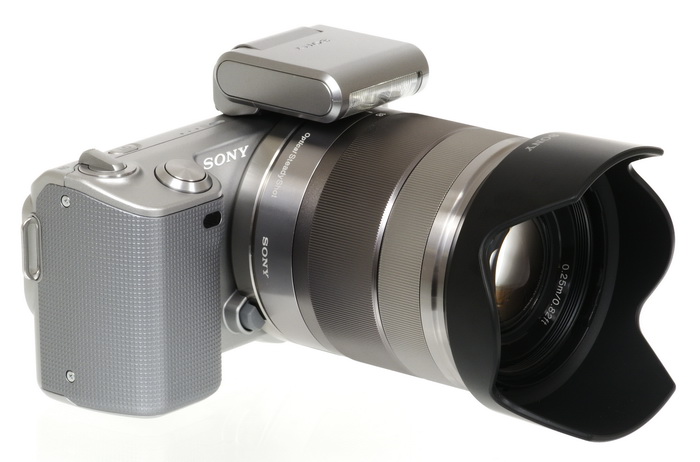
The 18-55mm comes with a hood, which can be attached in the reverse position for storage.  The 16mm doesn’t come with a hood, but the 18-55mm hood fits, (and doesn’t cause light fall-off), although it will not reverse as it does on the 18-55mm because the 16mm is too short.  Oddly, neither camera kit comes with a rear lens cap!  The build quality for both lenses is very good, and the focusing system is far superior to SAM, although see the caveat below.
The wireless remote (RMT-DSLR1) that comes with some Sony cameras like the A700-900 works properly with the NEX-5; which is surprising as Sony usually makes stuff like this incompatible with their other systems and models, remember the KM 5/7D and A100 non-memory batteries that won’t work with the newer memory enabled cameras?  The NEX-3 has no provision for the wireless remote.
When using the NEX-5 on a tripod, you need to tighten it down hard to prevent slippage as a result of the weird base plate.
Battery longevity is poor, I’m getting about 150 shots per charge without flash usage.  This may improve as the battery is cycled over time, that’s what has happened to my other DSLR batteries.
Start-up varies between 1-5 seconds, not very good in my opinion.  Also, after sitting for a couple of days, I notice when I power up the camera it sometimes makes an odd noise, and if you shut it off immediately, the shutter fires, that’s odd.
Manual focusing is difficult, but is precise in my opinion if you have some level of appropriate detail (and light) to gauge focus.  The screen is sharp enough to allow this.
Both models have an excellent fit and finish, and the buttons and switches are smooth, although the control wheel seems too easy to move for me.
High ISO noise reduction is much better than on the A700, probably about a full stop better in the area of 3200-6400.
File sizes averge around 4.4mb in large/fine mode.
Full HD movies in AVCHD are a pain to try and watch, because they’re only viewable when you use the included software and download from the camera.
When using the “street sweeper panorama” mode, the camera will only count one shutter actuation, not all that were used to stitch the photo, which will be approximately 40 shots in 9 seconds.  One can imagine a person that uses this feature on a regular basis will cause premature wear on the shutter mechanism.
Focusing hit rate is below par when used in multi-area mode.  I’m experiencing a rate of approximately ten percent of missed focused shots.  These were not front/back focus issues, they were totally blown shots.  I mostly have been using multi-area with the 18-55mm lens, so I’m not sure if the other lenses and focusing modes have the same problems.  I suspect it’s only in the camera, and maybe a firmware update might be able to fix it.
Exposures are dead-on in program mode, in which I’ve been using the cameras.  Highlight blow-out is very low, and is as good as the A700/900, at least in program mode.  Some reviewers are reporting over-exposures in auto mode, but I haven’t been using that mode much, and when I do, I’m not seeing that problem with my pictures.
ISO comparisons between A700 and NEX-5 using the kit lenses for each
Sony A 700
NEX-5
July2010/a700iso200.jpg
ISO 200
July2010/nexiso200.jpg
ISO 200
July2010/a700iso400.jpg
ISO 400
July2010/nexiso400.jpg
ISO 400
July2010/a700iso800.jpg
ISO 800
July2010/nexiso800.jpg
ISO 800
July2010/a700iso1600.jpg
ISO 1600
July2010/nexiso1600.jpg
ISO 1600
July2010/a700iso3200.jpg
ISO 3200
July2010/nexiso3200.jpg
ISO 3200
July2010/a700iso6400.jpg
ISO 6400
July2010/nexiso6400.jpg
ISO 6400


Here I’ve compared the A700 and NEX-5 in noise reduction capabilities.  The comps are straight-up, meaning I didn’t try to adjust for the lesser resolution on the A700, that’s why the crops are smaller.  Everything looks about equal up to ISO 1600, at that point the Sony A700 starts to fall apart, and shows it at ISO 3200, where as the NEX looks pretty good yet.  ISO 6400 is rough with the A700, but not too bad with the NEX.  If you’re having trouble seeing the differences between the two, look at the texture in the camera strap, (lower band with Sony logo), which gets wiped out with aggressive noise reduction.


Next up are some crops from the NEX-5 with 18-55mm lens and the A700 with 18-55mm lens.


Center crops from each lens at 18mm.


July2010/nex18mmcp.jpg
NEX-5 with 18-55mm lens @18mm, F/8, center
July2010/a70018mmcp.jpg
A700 with 18-55mm lens @18mm, F/8, center


Both centers are pretty sharp, but the NEX seems just a bit sharper, even when allowing for the higher resolution of the NEX.  The gravel area across the middle shows more detail in the NEX crop.


Left side crops at F/8, 18mm.


July2010/nex18mmcp2.jpg
NEX-5 with 18-55mm lens @18mm, F/8, left side
July2010/a70018mmcp2.jpg
A700 with 18-55mm lens @18mm, F/8, left side


The crops above where taken from the far left side of the image, about half way to the top, not the extreme corners.  The Sony SAM 18-55mm kit lens is much sharper along the sides, even at F/8, that’s surprising!  Also rather surprising is the color fringing on the NEX lens.  The crops look a little different because the light was changing as a result of fast moving clouds this day, but that doesn’t invalidate the results here.


Now let’s check out the 55mm crops from each lens.


Below are crops from the centers at 55mm, F/8.


July2010/nex55mmcp.jpg
NEX-5 with 18-55mm lens @55mm, F/8, center
July2010/a70055mmcp.jpg
A700 with 18-55mm lens @55mm, F/8, center


The center crop differences appear to be about the same at 55mm as they do at 18mm.


Left side crops at F/8, 55mm.


July2010/nex55mmcp2.jpg
NEX-5 with 18-55mm lens @55mm, F/8, left side
July2010/a70055mmcp2.jpg
A700 with 18-55mm lens @55mm, F/8, left side


The area along the sides is much sharper with the NEX lens at 55mm, just the opposite as we saw at 18mm.


In a nut-shell, the two kit lenses are about the same in optical quality, it all depends on what area of the image you’re looking at, and the focal length and aperture you’re using.  I used F/8 for this comparison because that’s the aperture in which everything should be about as sharp as it gets.


Conclusion.


The NEX 3 and 5 cameras perform wonderfully right out of the box.  Exposure levels are dead-on, the colors are rich, but not too punchy, and the high ISO noise reduction looks very good to 3200.  I used program mode for almost all my shots.  Program mode allows you to set exposure compensation if needed, (usually when indoors or low light situations), but will automatically control the aperture and shutter speed, so you don’t have to worry about that.  iAuto mode works fine too, but you’re not able to access exposure compensation.  The screen is very bright and sharp, and easy to see outdoors.


People looking for a small camera that takes great pictures, and aren’t interested in fussing with manual controls will love the NEX 3 and 5.  Based on my use, there’s no reason to mess with any manual controls except for some occasional positive exposure compensation, so feel free to leave the camera in “iAuto” or more preferably, “Program” mode.   I also think the street sweeper panorama feature works very well, and does a great job of stitching the images together.  Movie mode is also excellent, but the full HD setting requires you to download the movie file from the camera, and be content using Sony’s supplied software, then viewing the movies on your computer screen.  You can also view the movies with AVCHD devices, or use the lesser 1440×1080 size which is saved as an MP4 file; a much more popular format.


A couple of problem areas are; when in manual or priority mode like “A” or “S” it’s real easy to bump the control wheel by simple sliding the camera in a pouch or pocket, and that will throw off the settings, so you may find yourself shooting images using an aperture of F/32!  I found that focusing in multi-area mode results in a blown shot rate of about 10 percent, that’s pretty high, so you’ll need to check your shots on a regular basis, which is easy to do with the sharp screen.  Additionally, the menu system is quirky to say the least, and probably could use an update immediately, but we’ll more than likely have to wait for the second generation of NEX cameras to see any changes.


Even though the cameras suffer from a few minor flaws, It should be clear by now that I really like the NEX cameras as a whole.  I appreciate the fact that you can just point and shoot and get excellent image quality, without worrying about aperture, shutter speed and all that baloney that confuses people and could cause you to miss a shot.  However, the NEX system will not replace a DSLR, although some photography snobs—and reviewers (including on-line experts) expect it to, and will not tolerate the “made for beginners” menu system, lack of phase detection AF, and dedicated buttons for essential settings, like ISO, eV etc.


That’s it for this quick review, stay tuned for the next NEX cameras!

Here’s a brief look at the Sony NEX 16mm F/2.8 lens.  Scroll down for the main review.

Lens
Box contents
Front and rear caps and a user’s manual.
Cost
$250, or an extra $100 with camera as a kit.
Build quality
Very good, but super light-weight.
Additional information
Introduced in 2010.  Has a focus motor inside similar to SSM, not the cheaper SAM.
Specifications below
Optical configuration
5 elements in 5 groups
Angle of view
83° APS-C
Aperture
7 blades, almost straight
Full frame and APS-C
APS-C only, and will only mount on E body cameras.  Equivalent to 24mm of coverage due to APS-C crop factor of 1.5x.
Depth of field and focus scales?
Nothing.
Minimum focus, image plane to subject
9.4″  (0.24m)
Minimum focus, end of lens barrel to subject
7.25″  (184mm)
Hard stop at infinity focus?
No
Length changes when focusing?
No
Focus ring turns in AF?
No
Filter size
49mm
Filter ring rotates?
No
Distance encoder?
Yes
Max magnification
0.078x, or 1:13
Min. F/stop
F/22
Sony teleconverter compatible?
No
Length changes when zooming?
N/A
Dimensions WxL  (my measurements)
2.45″ x 0.89″   62mm x 22.5mm.
Maximum  extended length (my measurements)
0.89″  (22.5mm)
Weight bare (my scale)
2.3oz  (65g)
Requisite product shots.
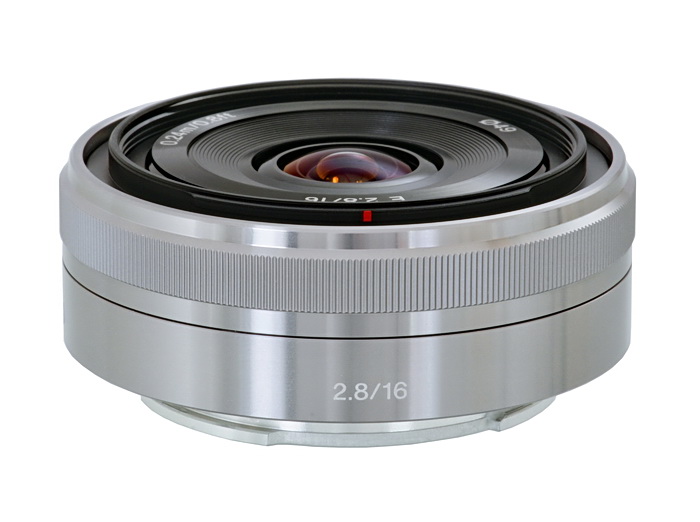
July2010/nex16ft2.jpg
Front element
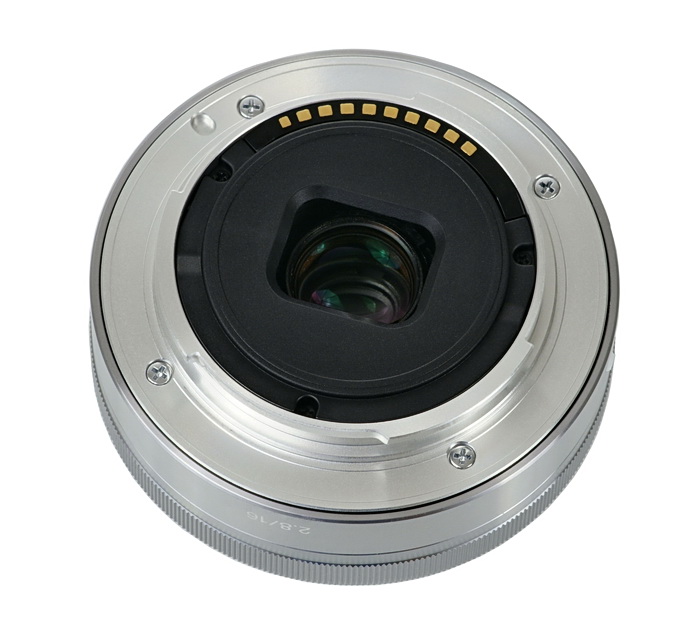
July2010/nex16bk.jpg
Backside mount
July2010/nex16sd.jpg
side shot
2012/nex16mmmtf.jpg
Sony MTF chart and X-ray view
Only the Sony NEX 5 was used for this review.
For a better understanding of terms and methods used in this review, go here.
The new NEX camera kits are currently being offered with two lens choices, an 18-55mm F/3.5-5.6, and 16mm F/2.8.  The NEX 16mm F/2.8 is a pancake-type design, which means a compact size with a budget price, and not necessarily an optical masterpiece.  Design considerations more than likely were small size, low cost, and a platform for a fish-eye and super-wide converter.  Don’t forget to figure the crop factor of 1.5x for this APS-C lens, which is 24mm of coverage.

Accessories for this lens.  The wide-angle converter will give an equivalent coverage of 18mm.  There is quite a difference between 18mm and 24mm!  The fish-eye converter turns the lens into a 10mm (16mm equivalent) fish-eye lens.  One last accessory to mention is the all glass, multi-coated (5 elements in 4 groups) optical viewfinder built specifically for the NEX 16mm F/2.8 lens.

The NEX 16mm F/2.8 lens has five elements in five groups, including one surface aspherical element.  It’s build solidly, has a smooth manual focus action and a silent auto-focus motor which is great for keeping focusing noise out of movies.  Due note this lens does not have OSS or built-in optical steady shot.  Being a wide-angle lens, the benefits of image stabilization are not as pronounced as they are on a longer lens because the stabilization system doesn’t sense all that much movement with such a large area of coverage.  Sony marketing probably opted for less cost, and possibly less size when they decided to leave out OSS.  Also noticeable in the backside product shot above is the new NEX 10 pin contact patch, instead of the normal 8 (or 5 before distance integration and SSM) used on the Sony alpha system.  The increase in connections allows the camera and lens to communicate more information.

Fit and finish are very good.  The lens appears to be clad in metal, and has a metal mount, but is extremely light-weight and almost seems like it could be a mock-up, with no glass or internals.  It uses 49mm filters, just like the NEX 18-55mm.  The color is silver, like stainless steel, but seems to turn color slightly with a different angle of light, see product shots above.  Sony claims this lens has a circular aperture, but due to the tiny physical aperture opening, the out-of-focus highlights or background blur is rendered seven-sided, not circular, unless the lens is wide open.  Check out the Bokeh crops to see what I’m talking about.

In the box: Sony says it comes with front and rear caps, and an owner’s manual.  There is no hood for this lens, but the NEX 18-55mm hood will fit without causing additional vignetting.
Focusing.  This lens auto-focuses quickly, accurately, and without a peep.  It’s much smoother and quieter than the SAM or slot-screw drive devices Sony uses on it’s Alpha system.  The front filter ring doesn’t turn when focusing, so your polarizers and grads will work great.  The focusing ring is easy to turn, and is dampened about right.
Lens flare/ghosting.  About average control for a prime lens by today’s standards, but it could be better in my opinion.
Color fringing (CA).  About average, to below average control for a prime lens.  Ok, so it’s a pancake lens, then it’s average.  You’ll see plenty of red and cyan along the sides of the image, at all apertures, and a little center or axial color fringing between F2.8-4.  Check out the crops below.
Bokeh.  Rather harsh overall, but looks slightly better stopped down some.  Look below for sample crops.
Color.   Same as other Sony lenses.
Close up filter.  A 49mm close up filter doesn’t work very well (image plane is messed up) and causes some light fall-off.
Coma.  Very minor to almost no coma at the largest aperture in the extreme corners.  See crops below.
Regular filters cause no additional light fall-off when the aperture is fully open at close or infinity focus.
Filter size is 49mm.  This size is not widely used by Sony, but is commonly available.  Current Sony lenses that use this size are the NEX 18-55mm, and the Sony 30mm F/2.8 macro and 28mm F/2.8.
Distortion.  You’ll notice weird, wave-type pincushion distortion when straight lines are near the image edges, and this type is hard to correct in standard image correction software.  The distortion pattern is a slight center rise, then remaining fairly straight as it gets closer to the edges, and finally, just before reaching the edges, there’s a quick turn up.  Close focus through infinity focus seems to show about the same amount of distortion.  Check out the cropped samples below.
Distortion examples directly below.

July2010/nex16dis.jpg
Weird wave distortion
Bokeh crops next.
           16mm F/2.8
             16mm F/4
July2010/nex16bok28.jpg
July2010/nex16bok40.jpg
           16mm F/5.6
             16mm F/8
July2010/nex16bok56.jpg
July2010/nex16bok80.jpg

Bokeh is somewhat harsh, producing a noticeable ring around highlights, but looks a little better stopped down.  Starting in the F/4 crop, you can clearly begin to see heptagons, indicating the aperture isn’t round.  Usually, a circular aperture is round at least one stop down from maximum, or wide open, but here the aperture is so small, the blades don’t have enough curve built-in.  Crops are from the center of the image, about 10′ (3m) behind the focus point.


Coma crops next.
           16mm F/2.8
             16mm F/4
July2010/nex16cmaf28.jpg
July2010/nex16cmaf40.jpg

Coma is barely visible in this 100% corner crop, and then only when using the largest aperture.


Flare and ghosting.
           16mm F/5.6 sun out of image
             16mm F/11
July2010/nex16gstf56b.jpg
July2010/nex16gstf11b.jpg
           16mm F/5.6
             16mm F/11
July2010/nex16gstf56.jpg
July2010/nex16gstf11.jpg

I see some green ghosts when the sun or very bright lights are inside the image.  I also see some flare from the sun, (washed out area) noticeable in the top left shot, on the left side, the sun is well away from the edge of the frame.  Use of a hood probably would’ve eliminated this issue, or holding your hand out to block the sun.


Light fall-off or corner shading is medium at F/2.8, and light at F/4.  Regular filters don’t cause any additional light fall-off, even when using a wide aperture.
           16mm F/2.8
             16mm F/4
July2010/nex16vigf28.jpg
July2010/nex16vigf40.jpg

Below are crops from the image centers.
         F/2.8
          F/4
July2010/nex16ctr28.jpg
July2010/nex16ctr40.jpg
         F/5.6
          F/8
July2010/nex16ctr56.jpg
July2010/nex16ctr80.jpg
         F/11
          
July2010/nex16ctr11.jpg
Intentionally left blank
Center sharpness is pretty good, even with the aperture wide open.  Look at the mountain and tree limb detail between the top F/2.8 crop and the F/5.6 crop directly below.  It seems F/5.6-8 are optimal apertures for sharpness in the centers.  Diffraction causes softening at F/11.
Below, crops from the mid-sections.
         F/2.8
          F/4
July2010/nex16mid28.jpg
July2010/nex16mid40.jpg
         F/5.6
          F/8
July2010/nex16mid56.jpg
July2010/nex16mid80.jpg
         F/11
          
July2010/nex16mid11.jpg
Intentionally left blank

At the mid-section, (about halfway between the center and corner area) sharpness suffers compared to the centers.  The crops above show a soft mid-section unless stopped down to F/5.6.  The image periphery is noticeably soft at normal viewing sizes when the lens is set to F/2.8, even when used in low light, such as night time street shooting.  You may ultimately get better shots by raising the ISO and using a smaller aperture like F/4.

Below are the corners.

         F/2.8
          F/4
July2010/nex16cn28.jpg
July2010/nex16cn40.jpg
         F/5.6
          F/8
July2010/nex16cn56.jpg
July2010/nex16cn80.jpg
         F/11
          
July2010/nex16cn11.jpg
Intentionally left blank
The extreme corners look rough at F/2.8, but sharpen up dramatically by closing the aperture down to F/4.  The corners are almost as sharp as the mid-section when stopped down, meaning there isn’t much improvement after you move away from the center of the image.  I notice a slight lack of contrast with this lens, especially off-center, but considering the design, it does a good job.  All crops above were taken at infinity focus, about 400′ (120m) away.
Lateral color fringing.
July2010/nex16cf.jpg
F/8 color fringing on left side of image, about 1000 pixels in from the edge
Here’s the rather strong color fringing I was talking about at the top of the page.  This image crop was taken from the left side-middle, about 1000 pixels from the edge at F/8.  You’ll see the red and cyan fringing along the trees.  This type of color fringing doesn’t go away by stopping down.

Let’s check out the macro capabilities of this lens.

Below, check out the 100% cropped portion of the full image.  The sample shot was taken with the NEX 5 14.2MP camera.  The subject is a standard US stamp, 0.87″x 1.0″ or 22mm x 25mm.  Also, note the macro shot was taken as close to the subject as focusing allowed; in this case a short 7.25″ (184mm), measured from the front of the lens barrel to the subject.
This lens has a small reproduction size of 0.078x, and is poor at producing images of small items up close.  At close focus, F/5.6-8 were the sharpest, but there was little difference between F/4-11 due to the fact that there isn’t much detail to see this far from the stamp.  As a side note; the “1996” on the bottom left of the stamp measures a mere 1mm wide.
July2010/19216mmac2.jpg
As close as you can get. F/5.6. No larger image


Now for the conclusion.

This lens was designed for the purpose of being pocketable, inexpensive, and a platform for a couple of add-on converters, like a fish-eye and ultra wide.  Sony did a good overall job with this lens, and I would consider the optical results good, but not great.  Let’s ponder the good things; sharp in the centers, even wide open; very compact, and able to fit in the front pockets of relaxed fit jeans, or in a womens purse; and very low noise when focusing, which is great when shooting video.  A few things that could be changed for the better, say in version II, is color fringing control, mid-section sharpness, and ghosting control.

If you have the NEX 18-55mm lens, and size is not a consideration, I’d forget about buying this 16mm, as it provides a mere 2mm of wider coverage, and is only 2/3 of a stop faster.  Optical quality is probably similar, however, I didn’t test them directly.  The Sigma 19mm F/2.8 is much sharper than this lens, although larger in size.
Currently, the NEX 16mm F/2.8 lens sells for about $100 when you buy the camera and lens as a “kit,” or $250 when purchased separately.  If you want maximum portability, and don’t mind the 16mm fixed focal length, this is your lens.  Finicky landscape shooters looking for a sharp prime lens will want to look elsewhere, like the superb CZ 24mm F/1.8, or Sony 50mm F/1.8 OSS, although neither one will provide coverage as wide as the 16mm.  Adding a crop factor of 1.5x, the NEX 16mm has the equivalent coverage of 24mm in 35mm camera terms.
If you’re thinking of purchasing the Sony NEX 16mm F/2.8 lens, please shop at B&H Photo and help support this site!  Thanks.
Here’s a brief look at the Sony NEX 18-55mm F/3.5-5.6 zoom lens.  Scroll down for the main review.

Lens
Box contents
Hood, front and rear caps and a user’s manual.
Cost
$300, or an extra $100 with camera as a kit.
Build quality
Very good.
Additional information
Introduced in 2010.  Has built-in optical image stabilization or OSS, and a focus motor inside similar to SSM, not the cheaper SAM.
Specifications below
Optical configuration
11 elements in 9 groups
Angle of view
76°-29° APS-C
Aperture
7 blades, almost straight
Full frame and APS-C
APS-C only, and will only mount on E body cameras.  With crop factor of 1.5x the coverage equals 27-82.5mm.
Depth of field and focus scales?
Nothing.
Min. focus distance, image plane to subject @ max reproduction ratio
9.8″  (0.25m)
Min. focus distance, end of lens barrel to subject @ max reproduction ratio
5.5″  (140mm)
Hard stop at infinity focus?
No
Length changes when focusing?
No
Focus ring turns in AF?
No
Filter size
49mm
Filter ring rotates?
No
Distance encoder?
Yes
Max magnification
0.30x, or 1:3.33
Min. F/stop
F/22-32
Sony teleconverter compatible?
No
Length changes when zooming?
Yes
Dimensions WxL  (my measurements)
2.45″ x 2.37″   62mm x 60mm.
Maximum  extended length (my measurements)
3.3″  (83.5mm)
Weight bare (my scale)
6.8oz  (194g)
Requisite product shots.

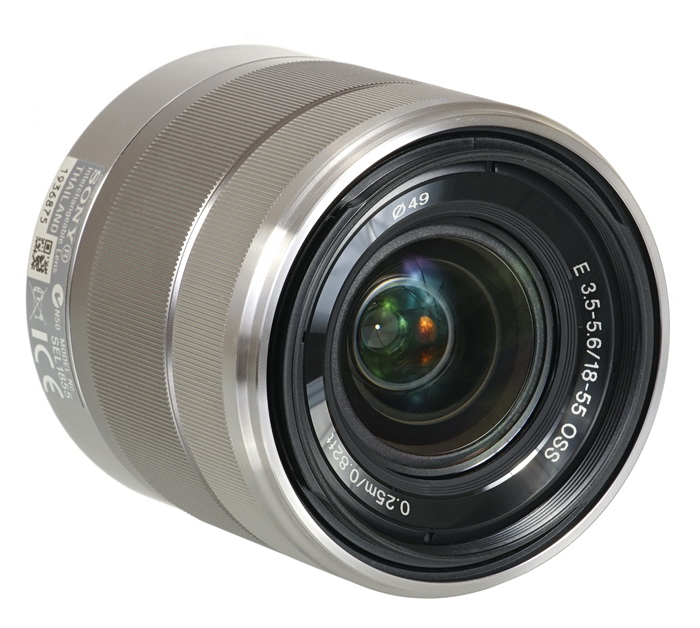
July2010/nex1855ft.jpg
Front element
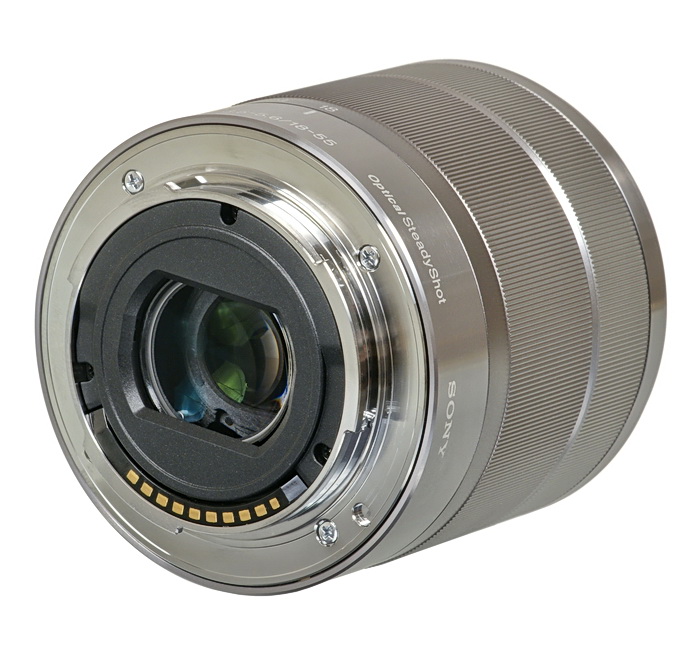
July2010/nex1855bk.jpg
Backside mount
July2010/nex5whood.jpg
NEX 5 with 18-55mm lens and included hood
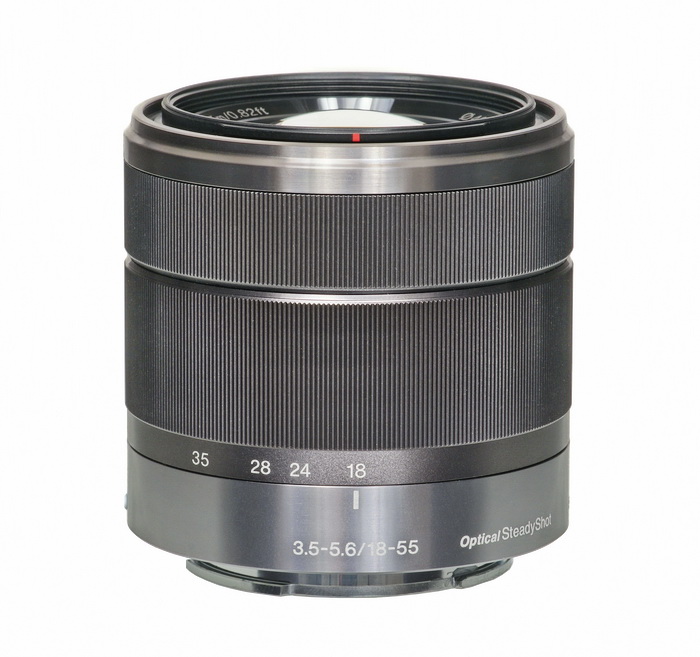
July2010/nex1855sd.jpg
Fully drawn in
July2010/nex1855sdex.jpg
Fully extended
2012/nex1855mtf.jpg
X-ray view and MTF chart
Only the Sony NEX 5 was used for this review.
For a better understanding of terms and methods used in this review, go here.

The new NEX cameras are currently offered with two lens choices (as of 9/10), a pancake 16mm, and our review lens, the NEX e-mount 18-55mm F/3.5-5.6.  This zoom lens is very similar in optical performance to theSony DT 18-55mm SAM lens but outwardly is very different.  There is no mistaking the build quality and materials used in the construction of this lens with the cheap plastic DT 18-55mm lens.  The NEX 18-55mm F/3.5-5.6 (Made in Thailand) is build solidly, has a nice smooth zoom and manual focus action, along with a silent auto-focus motor which is great for keeping focus noise out of movies.  You’ll also notice the OSS, or optical steady shot, built into the lens, a first for Sony.  Sony and Minolta AF (a-mount) lenses have no image stabilization, instead, Sony uses in-camera body sensor-shift type image stabilization.


Fit and finish are very good.  The lens appears to be clad in metal, although it does have a plastic extension tube and filter ring.  It also has a metal mount and the ability to use 49mm filters.  The color is silver, like stainless steel, but seems to turn color slightly with a different angle of light, see product shots above.  Strange, but true; the specs say circular aperture, but I start to see heptagons less than one stop down in background highlight blur, which means it’s not a true circular aperture.  that’s no big deal, I’m just pointing it out.

The zoom action is smooth and dampened properly in my opinion, and holds its position well, so there is no zoom creep.  Focal length index marks come at 18mm, 24mm, 28mm, 35mm, and 55mm, and the EXIF data matches those lengths.  As a side note; this lens shows EXIF data for every focal length possible, everything between 18-55mm!
In the box: Sony says it comes with front and rear caps, a hood, and an owner’s manual.
Focusing.  This lens auto-focuses quickly, mostly accurately—and without a peep.  It’s much smoother and quieter than the loud and obnoxious focusing Sony 18-55mm SAM lens.  The front filter ring doesn’t turn when focusing, so your polarizers and grads will work great.  Added later—focusing using multi-area has about a ten percent miss rate for some reason.  I’ve used spot and center (but not nearly as much as multi) without any problems.
Lens flare/ghosting.  Above average control for a telephoto zoom by today’s standards, and similar in performance to the 18-55mm SAM kit lens.
Color fringing (CA).  Below average control at the wide end where you’ll see plenty of red and cyan along the sides of the image, at all apertures.  The long end has excellent control of lateral color fringing, with almost none visible.
Bokeh.  Rather harsh overall, especially at the wide end, but is somewhat smooth as you near 55mm.  Look below for sample crops.
Color.   Same as other Minolta AF lenses.
Close up filter.  N/A
Coma.  Very minor coma at the widest focal lengths and largest aperture in the extreme corners.  One stop down eliminates coma.
Regular filters cause no additional light fall-off when the aperture is fully open at either end of the focal length.
Filter size is 49mm.  This size is not widely used by Sony, but is commonly available.  Current Sony lenses that use this size are the 30mm F/2.8 macro and 28mm F/2.8.
Distortion.  You’ll notice strong barrel distortion at 18mm, becoming flat around 22mm, then turning to moderate pincushion distortion at 55mm.  Close focus through infinity focus seems to show about the same amount of distortion.  Check out the cropped samples below.
Distortion examples directly below.
July2010/nex1855wdis.jpg
18mm, strong barrel distortion
July2010/nex1855tdis.jpg
55mm, moderate pincushion distortion.


Aperture/focal length guide.


Maximum aperture
          F/3.5
       F/4
       F/4.5
       F/5
       F/5.6
Range
18mm-19mm
19mm – 30mm
30mm – 42mm
42mm – 51mm
52mm – 55mm
Focal length numbers carry through between apertures, which is normal.  Interestingly, the 18-55mm lens has focal length EXIF data recorded for every number, 18 through 55.
Bokeh crops next.
           18mm F/3.5
             18mm F/5.6
July2010/nex1855bokw35.jpg
July2010/nex1855bok56.jpg
           55mm F/5.6
             55mm F/8
July2010/nex1855bokt56.jpg
July2010/nex1855bokt80.jpg


Bokeh is harsh at 18mm, producing a noticeable ring around highlights, that’s typical for kit lenses.  Towards the long end, the out of focus background highlights are rendered a little smoother.  Crops are from the center of the image, about 10′ to 20′ (3m-6m) behind the focus point.


Coma crops next.
           18mm F/3.5
             18mm F/5.6
July2010/1855cma35.jpg
July2010/1855cma56.jpg


Coma is only barely visible in this 100% corner crop at 18mm, and then only when using the largest aperture.


Flare and ghosting.
           18mm F/5.6
             36mm F/5.6
July2010/nex1855wgst18mm.jpg
July2010/nex1855wgst36mm.jpg
           55mm F/5.6
             18mm F/5.6
July2010/nex1855tgst55mm.jpg
July2010/nex1855wgst218mm.jpg


Ghosting control is very good, and these images show very little in the way of colored dots or blurred circles.  I see just a few spots (middle of palm trees) in the 18mm, F/5.6 vertical image, bottom right, and a minor smudge at 36mm, F/5.6, (no hood was used), top right, which is just off to the left of the image.  Using my hand to shade the lens would’ve eliminated that smudge.


Light fall-off.
Light fall-off or corner shading is very light at both ends, and really isn’t noticeable in actual images.  Regular filters don’t cause any additional light fall-off at either end, or when using a wide aperture.

           18mm F/3.5
             18mm F/5.6
July2010/1855wvig35.jpg
July2010/1855wvig56.jpg
           55mm F/5.6
             55mm F/8
July2010/1855tvig56.jpg
July2010/1855tvig80.jpg
Center sharpness.

Below are crops from the image centers at 18mm.

         F/3.5
          F/5.6
July2010/n5kitwctr35.jpg
July2010/n5kitwctr56.jpg
         F/8
          F/11
July2010/n5kitwctr80.jpg
July2010/n5kitwctr11.jpg
Center sharpness is very good even with the lens wide open.  I think F/5.6-8 is probably the optimal aperture in the centers at this focal length.  Diffraction causes softening at F/11.  The fuzzy stuff under the cactus is a spider web.
Below, crops from the 18mm mid-section.
         F/3.5
          F/5.6
July2010/n5kitwmid35.jpg
July2010/n5kitwmid56.jpg
         F/8
          F/11
July2010/n5kitwmid80.jpg
July2010/n5kitwmid11.jpg


At the mid-section, sharpness is best at F/5.6-8, and there is a noticeable change in sharpness as you stop down.  Diffraction sets in at F/11.


Below are the corners at 18mm.


         F/3.5
          F/5.6
July2010/n5kitwcn35.jpg
July2010/n5kitwcn56.jpg
         F/8
          F/11
July2010/n5kitwcn80.jpg
July2010/n5kitwcn11.jpg
Again, the F/5.6-8 crops look pretty good, especially for the extreme corners.  Some light fall-off is visible in the corners when the crops are presented like this, that’s why they’re a little darker than the center crops.  This particular image crop doesn’t show the color fringing that takes place at the wide end, look below for a good example.
Lateral color fringing.
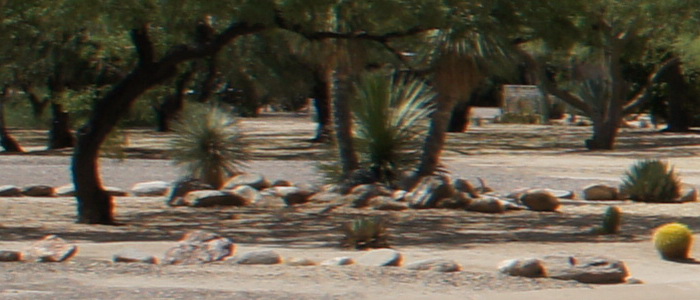
July2010/nex18mmcp2.jpg
18mm, F/8 extreme left side at middle of image
Here’s the rather strong color fringing I was talking about at the top of the page.  This image crop was taken from the extreme left side at 18mm, F/8.  You’ll see the red and cyan fringing along the tree trunk at middle left, and the rocks at the bottom.
Center sharpness at 55mm.

Below are crops from the image centers at 55mm.

         F/5.6
          F/8
July2010/n5kittctr56.jpg
July2010/n5kittctr80.jpg
         F/11
          F/16
July2010/n5kittctr11.jpg
July2010/n5kittctr16.jpg
Center sharpness at full telephoto is just a hair soft at F/5.6, (mostly noticeable in the tree limbs on the upper right side), but closing the aperture to F/8 sharpens things up nicely.
Below, crops from the 55mm mid-section.
         F/5.6
          F/8
July2010/n5kittmid56.jpg
July2010/n5kittmid80.jpg
         F/11
          F/16
July2010/n5kittmid11.jpg
July2010/n5kittmid16.jpg


At the mid-section, things look very similar to the center crops.


Below are the corners at 55mm.


         F/5.6
          F/8
July2010/n5kittcn56.jpg
July2010/n5kittcn80.jpg
         F/11
          F/16
July2010/n5kittcn11.jpg
July2010/n5kittcn16.jpg
The extreme corners are soft, with low contrast, and need an aperture adjustment to sharpen them up.  Fortunately, just a stop down and things look much better.  All crops in each section have the same exposure values.
Let’s check out the macro capabilities of this lens.

Below, check out the 100% cropped portion of the full image.  The sample shot was taken with the NEX 5 14.2MP camera.  The subject is a standard US stamp, 0.87″x 1.0″ or 22mm x 25mm.  Also, note the macro shot was taken as close to the subject as focusing allowed; in this case a short 5.5″ (140mm), measured from the front of the lens barrel to the subject.
This lens has a large reproduction size of 0.30x, and shows a nicely detailed stamp shot.  At close focus, F/8 was the sharpest, but there was little difference between F/5.6-11.  Don’t try to compare this shot with other lens macro shots that were taken with the A700, as this NEX system shot was taken with a higher pixel sensor.   As a side note; the “1996” on the bottom left of the stamp measures a mere 1mm wide.
As close as you can get. F/8. click for larger image


Now for the conclusion.


This kit zoom lens turned in a pretty good performance overall, and works best at F/5.6-8, which is good news too.  The long end has some good qualities, like smooth bokeh or background highlight blur, lack of color fringing, and very good overall sharpness, although a little soft at F/5.6 in the extreme corners.  The wide end is very sharp in the centers and mid-section, but the extreme corners need to be stopped down; and of course don’t forget the strong color fringing and distortion that occurs at and near 18mm.  There is a slight lack of contrast with the lens towards the long end, (noticeable in the macro shot), but that’s normal for an inexpensive kit type lens, you can’t have everything.  None of these things are a big deal unless you stare at your images all day blown way up on your computer screen, or have a high megapixel camera like the NEX-7.


This lens is similar in optical performance to the Sony 18-55mm A-mount lens, but there are some noticeable differences other than optical qualities, like the fact that this NEX e-mount lens is built much better, and is smoother when zooming and manually focusing.  Also, the NEX 18-55mm silent, and pretty fast focusing motor is light years ahead of Sony’s poorly implemented SAM focusing system, just be aware of the focusing issue as mentioned at the top.  Bottom line; check your shots using the LCD!


The NEX e-mount 18-55mm makes a good lens to keep permanently on your NEX camera (unless you have the NEX-7), it’s not so big and heavy to become burdensome, and just small and light enough to be pocket-able, well, maybe not your jeans pocket, but a jacket pocket definitely!

Below you’ll find specifications for all Sony ‘E’ mount cameras, from the most recent at the top, to the oldest at the bottom.

Model A6400
Price $900 body only 1-19.  Available Feb, 2019.
Effective megapixels 24.2
LCD monitor 3.0″ 921,600 pixels, TFT TruBlack™ has tilt-out screen and live view, Vlogger touch screen.
Lens
Zoom
Recording media Memory stick, SD
Image stabilization No, uses OSS, or optical steady shot in the lens.
ISO range 100/200/400/800/1600/3200/6400/12800/25600, 32000
expandable to 102,400.
Manual controls Absolutely
Shutter speed 30 sec – 1/4000 sec
Optical viewfinder No
Sensor size 23.5mm x 15.6mm APS-C
AF assist lamp Yes
Timer 10 sec – 2 sec delay
Flash Yes, pop up type.
Movie mode 4k and lesser modes.
Power source NP-FW50
Dimensions 4.7″ x 2.6″ x 1.9″ 120mm x 67h x 49d
Weight 15.98oz 453g with battery and card
Additional info upgraded heavily from 6300 model in the video and AF performance.  No IBIS.


Model A7 III
Price $1999 body only, Feb 2018.
Effective megapixels 24.2
LCD monitor 3.0″ 921,600 pixels, touch screen, tilt-up/down only.
Lens  N/A
Zoom  N/A
Recording media Two slots, SD, and combo slot for Memory stick/SD
Image stabilization Yes, 5 axis sensor shift.
ISO range 100-51200.
50 and 204800 in expanded mode.
Manual controls Absolutely
Shutter speed 30 sec – 1/8000 sec mechanical.
Flash sync 1/250 sec
Optical viewfinder No, uses 0.5″ 2.36m electronic type.
Sensor size 35.6mm x 23.8mm full frame.
AF assist lamp Yes
Timer 10 -5- 2 sec delay; plus other options
Flash No
Movie mode 4K 30fps
Power source NP-FZ100
Dimensions 5″ x 3.8″ x 2.9″ 126.9mm x 95.6h x 73.7d
Weight 23.2oz, 650g with battery.
Additional info Serious upgrade from original A7, but same sensor pixel count.

Model A7R III
Price $3199 body only, Oct 2017.
Effective megapixels 42.4
LCD monitor 3.0″ 1.440,000 pixels, touch screen, tilt-up/down only.
Lens  N/A
Zoom  N/A
Recording media Two slots, SD, and combo slot for Memory stick/SD
Image stabilization Yes, 5 axis sensor shift.
ISO range 100-32000.
50 and 102400 in expanded mode.
Manual controls Absolutely
Shutter speed 30 sec – 1/8000 sec mechanical.
Flash sync 1/250 sec
Optical viewfinder No, uses 0.5″ 3.7m electronic type.
Sensor size 35.9mm x 24mm full frame.
AF assist lamp Yes
Timer 10 -5- 2 sec delay; plus other options
Flash No
Movie mode 4K 30fps
Power source NP-FZ100
Dimensions 5″ x 3.9″ x 3.0″ 126.9mm x 95.6h x 73.7d
Weight 23.2oz, 657g with battery.
Additional info Serious upgrade from original A7R.

Model A9
Price $4499 body only, April 2017.
Effective megapixels 24.2
LCD monitor 3.0″ 1.440,000 pixels, touch screen, tilt-up/down only.
Lens  N/A
Zoom  N/A
Recording media Two slots, Memory stick, SD
Image stabilization Yes, 5 axis sensor shift.
ISO range 100-51200.
50 and 204800 in extended mode.
Manual controls Absolutely
Shutter speed 30 sec – 1/8000 sec mechanical, 30 sec-32,000 electronic.
Flash sync 1/250 sec
Optical viewfinder No, uses 0.5″ 3.7m electronic type.
Sensor size 35.6mm x 23.8mm full frame.
AF assist lamp Yes
Timer 10 -5- 2 sec delay
Flash No
Movie mode 4K 30fps
Power source NP-FZ100
Dimensions 5″ x 3.9″ x 2.5″ 126.9mm x 95.6h x 63.0d
Weight 23.7oz, 673g with battery.
Additional info All new series, aimed at pro fast action and video shooters.

s6500sm
Model A6500
Price $1399 body only 10-16.
Effective megapixels 24.2
LCD monitor 3.0″ 921,600 pixels, TFT TruBlack™ has tilt-out touch screen.
Lens
Zoom
Recording media Memory stick, all SD
Image stabilization Yes, 5-axis type.
ISO range 100/200/400/800/1600/3200/6400/12800/25600,
expandable to 51200.
Manual controls Absolutely
Shutter speed 30 sec – 1/4000 sec
Optical viewfinder No
Sensor size 23.5mm x 15.6mm APS-C
AF assist lamp Yes
Timer 10, 5, 2 sec delay
Flash Yes, pop up type.
Movie mode 4k and lesser modes.
Power source NP-FW50
Dimensions 4.7″ x 2.6″ x 2.1″ 120mm x 67h x 53d
Weight 15.98oz 453g with battery and card
Additional info Successor to a6300, with touch screen, 5-axis sensor shift stabilization, and much improved video and AF.

2016/sonya6300.jpg
Model A6300
Price $998 body only 3-16.
Effective megapixels 24.2
LCD monitor 3.0″ 921,600 pixels, TFT TruBlack™ has tilt-out screen and live view.
Lens
Zoom
Recording media Memory stick, SD
Image stabilization No, uses OSS, or optical steady shot in the lens.
ISO range 100/200/400/800/1600/3200/6400/12800/25600, expandable to 51200.
Manual controls Absolutely
Shutter speed 30 sec – 1/4000 sec
Optical viewfinder No
Sensor size 23.5mm x 15.6mm APS-C
AF assist lamp Yes
Timer 10 sec – 2 sec delay
Flash Yes, pop up type.
Movie mode 4k and lesser modes.
Power source NP-FW50
Dimensions 4.7″ x 2.6″ x 1.9″ 120mm x 67h x 49d
Weight 14.25oz 404g with battery
Additional info Successor to a6000, but a little larger and heavier. .

2015/sa7sII.jpg
Model A7SII
Price $2999 body only, September 2015.
Effective megapixels 12.2
LCD monitor 3.0″ 1.228,800 pixels, tilt-up/down only.
Lens
Zoom
Recording media Memory stick, SD
Image stabilization Yes, 5 axis sensor shift.
ISO range 100/200/400/800/1600/3200/6400/12800/25600/51200/102400.
50 and 204800/409600 in extended mode.
Manual controls Absolutely
Shutter speed 30 sec – 1/8000 sec
Flash sync 1/250 sec
Optical viewfinder No, uses 2.4m electronic type.
Sensor size 35.8mm x 23.9mm full frame.
AF assist lamp Yes
Timer 10 -5- 2 sec delay
Flash No
Movie mode Full HD
Power source NP-FW50
Dimensions 5″ x 3.7″ x 1.9″ 126.9mm x 94.4h x 48.2d
Weight 22.12oz 627g with battery.
Additional info Upgrades include internal 4k video, and image stabilization.

2015/sa7r2.jpg
Model A7RII
Price $3199 body only, August 2015.
Effective megapixels 42.4
LCD monitor 3.0″ 1,228,800 pixels, tilt-up/down only.
Lens
Zoom
Recording media Memory stick, SD
Image stabilization sensor shift, 5 way.
ISO range 100/200/400/800/1600/3200/6400/12800/25600
/51200/102,400. 50 in extended mode.
Manual controls Absolutely
Shutter speed 30 sec – 1/8000 sec
Flash sync 1/250 sec
Optical viewfinder No, uses 2.36m electronic type.
Sensor size 35.8mm x 23.9mm full frame.
AF assist lamp Yes
Timer 10 sec – 2 sec delay
Flash No
Movie mode Internal 4K
Power source NP-FW50
Dimensions 5″ x 3.8″ x 2.4″ 126.9mm x 95.7h x 59.7d
Weight 22oz 625g with battery.
Additional info Big new features (among others) include sensor based image stabilization and improved grip, internal 4k recording, and new back illuminated 42mp sensor.

2015/sonya7IIsm.jpg
Model A7II
Price $1699 body only, December 2014.
Effective megapixels 24.3
LCD monitor 3.0″ 1,228,800 pixels, tilt-up/down only.
Lens
Zoom
Recording media Memory stick, SD
Image stabilization sensor shift, 5 way.
ISO range 100/200/400/800/1600/3200/6400/12800/25600.
50 in extended mode.
Manual controls Absolutely
Shutter speed 30 sec – 1/8000 sec
Flash sync 1/250 sec
Optical viewfinder No, uses 2.36m electronic type.
Sensor size 35.8mm x 23.9mm full frame.
AF assist lamp Yes
Timer 10 sec – 2 sec delay
Flash No
Movie mode Full HD
Power source NP-FW50
Dimensions 5″ x 3.8″ x 2.4″ 126.9mm x 95.7h x 59.7d
Weight 21.1oz 599g with battery.
Additional info Big new features (among others) include sensor based image stabilization and improved grip over A7.

2014/sa7s.jpg
Model A7S
Price $2499 body only, summer of 2014.
Effective megapixels 12.2
LCD monitor 3.0″ 921,600 pixels, tilt-up/down only.
Lens
Zoom
Recording media Memory stick, SD
Image stabilization No, uses OSS, or optical steady shot in the lens.
ISO range 100/200/400/800/1600/3200/6400/12800/25600/51200
/102400.
50 and 204800/409600 in extended mode.
Manual controls Absolutely
Shutter speed 30 sec – 1/8000 sec
Flash sync 1/250 sec
Optical viewfinder No, uses 2.4m electronic type.
Sensor size 35.8mm x 23.9mm full frame.
AF assist lamp Yes
Timer 10 sec – 2 sec delay
Flash No
Movie mode Full HD
Power source NP-FW50
Dimensions 5″ x 3.7″ x 1.9″ 126.9mm x 94.4h x 48.2d
Weight 16.1oz 489g with battery.
Additional info Apparently designed for Video nuts that like to work in low light.

2014/1076396.jpg
Model A5100
Price $549 body only 8-14.
Effective megapixels 24.3
LCD monitor 3.0″ 921,600 pixels, tilt-out touch screen.
Lens
Zoom
Recording media Memory stick, SD
Image stabilization No, uses OSS, or optical steady shot in the lens. .
ISO range 100/200/400/800/1600/3200/6400/12800/25600
Manual controls Absolutely
Shutter speed 30 sec – 1/4000 sec
Optical viewfinder No
Sensor size 23.5mm x 15.6mm APS-C
AF assist lamp Yes
Timer 10 sec – 2 sec delay
Flash Yes, pop up type.
Movie mode Full HD
Power source NP-FW50
Dimensions 4.3″ x 2.5″ x 1.4″ 110mm x 63h x 36d
Weight 9.98oz 283g with battery
Additional info Slightly downgraded A6000.

2014/a6000.jpg
Model A6000
Price $648 body only 4-14.
Effective megapixels 24.3
LCD monitor 3.0″ 921,600 pixels, TFT TruBlack™ has tilt-out screen and live view.
Lens
Zoom
Recording media Memory stick, SD
Image stabilization No, uses OSS, or optical steady shot in the lens.
ISO range 100/200/400/800/1600/3200/6400/12800/25600
Manual controls Absolutely
Shutter speed 30 sec – 1/4000 sec
Optical viewfinder No
Sensor size 23.5mm x 15.6mm APS-C
AF assist lamp Yes
Timer 10 sec – 2 sec delay
Flash Yes, pop up type.
Movie mode Full HD
Power source NP-FW50
Dimensions 4.7″ x 2.6″ x 1.8″ 120mm x 67h x 45d
Weight 12.13oz 344g with battery
Additional info Sucessor to NEX-7.

2014/A5000campage.jpg
Model A5000
Price $598 with 16-50mm PZ lens, 3/14.
Effective megapixels 20.1
LCD monitor 3.0″ 460,000 pixels, tilt-up only touch screen.
Lens
Zoom
Recording media Memory stick, SD
Image stabilization No, uses OSS, or optical steady shot in the lens. .
ISO range 100/200/400/800/1600/3200/6400/12800/16000
Manual controls Absolutely
Shutter speed 30 sec – 1/4000 sec
Flash sync 1/160 sec
Optical viewfinder No
Sensor size 23.5mm x 15.6mm APS-C
AF assist lamp Yes
Timer 10 sec – 2 sec delay
Flash Yes, pop up type, GN4 at ISO 100.
Movie mode Full HD
Power source NP-FW50
Dimensions 4.4″ x 2.6″ x 1.2″ 110mm x 63h x 36d
Weight 7.4oz 210g without battery and lens.
Additional info New touch screen for low end model.

2014/A7Rcampage.jpg
Model A7R
Price $2298 body only, 12/2013.
Effective megapixels 36.3
LCD monitor 3.0″ 921,600 pixels, tilt-up/down only.
Lens
Zoom
Recording media Memory stick, SD
Image stabilization No, uses OSS, or optical steady shot in the lens.
ISO range 50/100/200/400/800/1600/3200/6400/12800/25600
selectable in 1/3 or 1/2 stop increments.
Base ISO is 100, below that uses trick mode.
Manual controls Absolutely
Shutter speed 30 sec – 1/8000 sec
Flash sync 1/160 sec
Optical viewfinder No, uses 2.4m electronic type.
Sensor size 35.9mm x 24mm full frame.
AF assist lamp Yes
Timer 10 sec – 2 sec delay
Flash No
Movie mode Full HD
Power source NP-FW50
Dimensions 5″ x 3.7″ x 1.9″ 127mm x 94h x 48d
Weight 14.4oz 407g without battery and lens.
Additional info Highest megapixel Sony camera thus far. No Low pass filter.

2014/A7campage.jpg
Model A7
Price $1698 body only, 12/2013.
Effective megapixels 24.3
LCD monitor 3.0″ 921,600 pixels, tilt-up/down only.
Lens
Zoom
Recording media Memory stick, SD
Image stabilization No, uses OSS, or optical steady shot in the lens.
ISO range 50/100/200/400/800/1600/3200/6400/12800/25600
selectable in 1/3 or 1/2 stop increments. Base ISO
is 100, below that uses trick mode.
Manual controls Absolutely
Shutter speed 30 sec – 1/8000 sec
Flash sync 1/250 sec
Optical viewfinder No, uses XGA OLED electronic type.
Sensor size 35.8mm x 23.9mm full frame.
AF assist lamp Yes
Timer 10 sec – 2 sec delay
Flash No
Movie mode Full HD
Power source NP-FW50
Dimensions 5″ x 3.7″ x 1.9″ 127mm x 94h x 48d
Weight 16.7oz 474g without battery and lens.
Additional info Has both phase and contrast detect for AF.

1stof2013/NEX-3Nsm.jpg
Model NEX-3N
Price $498 with 16-50mm PZ lens, 4/13.
Effective megapixels 16.1
LCD monitor 3.0″ 460,000 pixels, has tilt-out and up 180° screen. .
Lens
Zoom
Recording media Memory stick, SD
Image stabilization No, uses OSS, or optical steady shot in the lens.
ISO range 200/400/800/1600/3200/6400/12800/16000
Manual controls Absolutely
Shutter speed 30 sec – 1/4000 sec
Optical viewfinder No
Sensor size 23.5mm x 15.6mm APS-C
AF assist lamp Yes
Timer 10 sec – 2 sec delay
Flash Yes, pop up type, GN6 at ISO 200.
Movie mode Full HD
Power source NP-FW50
Dimensions 4.4″ x 2.4″ x 1.4″ 110mm x 62h x 35d
Weight 7.4oz 210g without battery
Additional info New low resolution screen.

Late2012/NEX-6.jpg
Model NEX-6
Price $849 body only, 11/12.
Effective megapixels 16.1
LCD monitor 3.0″ 921,600 pixels, TFT TruBlack™ has tilt-out screen.
Lens
Zoom
Recording media Memory stick, SD
Image stabilization No, uses OSS, or optical steady shot in the lens.
ISO range 100/200/400/800/1600/3200/6400/12800/25600
Manual controls Absolutely
Shutter speed 30 sec – 1/4000 sec
Optical viewfinder No, uses electronic viewfinder, 2.4m dot resolution.
Sensor size 23.5mm x 15.6mm APS-C
AF assist lamp Yes
Timer 10 sec – 2 sec delay
Flash Yes, pop up type.
Movie mode Full HD and lesser modes.
Power source NP-FW50
Dimensions 4.7″ x 2.6″ x 1.7″ 120mm x 67h x 43d
Weight 10.1oz 287g without battery
Additional info New hybrid focusing system like the NEX-5R has. Also has new ISO standard hotshoe.

2014/nex5rpg.jpg
Model NEX-5R
Price $649 body only, 9/12.
Effective megapixels 16.1
LCD monitor 3.0″ 921,600 pixels, TFT TruBlack™ has tilt-out and up 180° screen, and live view.
Lens
Zoom
Recording media Memory stick, SD
Image stabilization No, uses OSS, or optical steady shot in the lens.
ISO range 100/200/400/800/1600/3200/6400/12800/25600
Manual controls Absolutely
Shutter speed 30 sec – 1/4000 sec
Optical viewfinder No
Sensor size 23.5mm x 15.6mm APS-C
AF assist lamp Yes
Timer 10 sec – 2 sec delay
Flash Yes, pop up type.
Movie mode Full HD
Power source NP-FW50
Dimensions 4.4″ x 2.4″ x 1.6″ 111mm x 59h x 38d
Weight 7.4oz 210g without battery
Additional info New hybrid focusing system. Beginner to Intermediate model, replaces NEX-5N.

2012/snexcp2.jpg
Model NEX-F3
Price $599 with kit lens, 6/12.
Effective megapixels 16.2
LCD monitor 3.0″ 921,600 pixels, TFT TruBlack™ has tilt-out and up 180° screen, and live view.
Lens
Zoom
Recording media Memory stick, SD
Image stabilization No, uses OSS, or optical steady shot in the lens.
ISO range 200/400/800/1600/3200/6400/12800/16000
Manual controls Absolutely
Shutter speed 30 sec – 1/4000 sec
Optical viewfinder No
Sensor size 23.5mm x 15.6mm APS-C
AF assist lamp Yes
Timer 10 sec – 2 sec delay
Flash Yes, pop up type.
Movie mode Full HD
Power source NP-FW50
Dimensions 4.7″ x 2.6″ x 1.7″ 117mm x 67h x 41d
Weight 9.0oz 255g without battery
Additional info Beginners model, replaces NEX-C3.

endof2011/NEX7.jpg
Model NEX-7
Price $1199 body only 10-11. Production problems (flooding of facilities) caused very limited stock until mid-2012.
Effective megapixels 24.3
LCD monitor 3.0″ 921,600 pixels, TFT TruBlack™ has tilt-out screen and live view.
Lens
Zoom
Recording media Memory stick, SD
Image stabilization No, uses OSS, or optical steady shot in the lens.
ISO range 100/200/400/800/1600/3200/6400/12800/16000
Manual controls Absolutely
Shutter speed 30 sec – 1/4000 sec
Optical viewfinder No
Sensor size 23.5mm x 15.6mm APS-C
AF assist lamp Yes
Timer 10 sec – 2 sec delay
Flash Yes, pop up type.
Movie mode Full HD
Power source NP-FW50
Dimensions 4.7″ x 2.6″ x 1.7″ 120mm x 67h x 43d
Weight 10.3oz 291g without battery
Additional info First intermediate level NEX camera. Uses same sensor as A77.

endof2011/NEX5n.jpg
Model NEX-5N
Price $599 body only 9-11
Effective megapixels 16.2
LCD monitor 3.0″ 921,600 pixels, TFT TruBlack™ has tilt-out screen and live view.
Lens
Zoom
Recording media Memory stick, SD
Image stabilization No, uses OSS, or optical steady shot in the lens.
ISO range 100/200/400/800/1600/3200/6400/12800/25600
Manual controls Absolutely
Shutter speed 30 sec – 1/4000 sec
Optical viewfinder No
Sensor size 23.4mm x 15.6mm APS-C
AF assist lamp Yes
Timer 10 sec – 2 sec delay
Flash Yes, comes with camera, but has to be attached to top
Movie mode Full HD
Power source NP-FW50
Dimensions 4.4″ x 2.4″ x 1.5″ 111mm x 62h x 38d excluding grip and lens mount
Weight 9.5oz 269g without battery
Additional info Minor upgrade to NEX-5. Uses new 16.2mp sensor.

JUNE2011/NEX-C3hp.jpg
Model NEX-C3
Price $599 with 16mm lens 8-11
Effective megapixels 16.2
LCD monitor 3.0″ 921,600 pixels, TFT TruBlack™ has tilt-out screen and live view.
Lens
Zoom
Recording media Memory stick, SD
Image stabilization No, uses OSS, or optical steady shot in the lens.
ISO range 200/400/800/1600/3200/6400/12800
Manual controls Absolutely
Shutter speed 30 sec – 1/4000 sec
Optical viewfinder No
Sensor size 23.4mm x 15.6mm APS-C
AF assist lamp Yes
Timer 10 sec – 2 sec delay
Flash Yes, comes with camera, but has to be attached to top
Movie mode Yes, 1280x720p 30fps, and 640×480 30fps using MPEG-4
Power source NP-FW50
Dimensions 4.4″ x 2.4″ x 1.3″ 110mm x 60h x 33d excluding grip and lens mount
Weight 7.9oz 225g without battery
Additional info Very minor upgrade to NEX-3. Smaller body, and a 16.2mp sensor.

July2010/5NEX-5.jpg
Model NEX-5
Price $699 with lens 7-10
Effective megapixels 14.2
LCD monitor 3.0″ 921,600 pixels, TFT TruBlack™ has tilt-out screen and live view.
Lens
Zoom
Recording media Memory stick, SD
Image stabilization No, uses OSS, or optical steady shot in the lens.
ISO range 200/400/800/1600/3200/6400/12800
Manual controls Absolutely
Shutter speed 30 sec – 1/4000 sec
Optical viewfinder No
Sensor size 23.4mm x 15.6mm APS-C
AF assist lamp Yes
Timer 10 sec – 2 sec delay
Flash Yes, comes with camera, but has to be attached to top
Movie mode Yes, up to full HD (1920×1080 60i) using AVCHD, or lower using MPEG-4
Power source NP-FW50
Dimensions 4.4″ x 2.4″ x 1.6″ 111mm x 59h x 38d excluding grip and lens mount
Weight 8.1oz 229g without battery
Additional info Comes in silver or black.

July2010/3NEX-3.jpg
Model NEX-3
Price $599 with lens 7-10
Effective megapixels 14.2
LCD monitor 3.0″ 921,600 pixels, TFT TruBlack™ has tilt-out screen and live view.
Lens
Zoom
Recording media Memory stick, SD
Image stabilization No, uses OSS, or optical steady shot in the lens.
ISO range 200/400/800/1600/3200/6400/12800
Manual controls Absolutely
Shutter speed 30 sec – 1/4000 sec
Optical viewfinder No
Sensor size 23.4mm x 15.6mm APS-C
AF assist lamp Yes
Timer 10 sec – 2 sec delay
Flash Yes, comes with camera, but has to be attached to top
Movie mode Yes, 1440×1080 30p using MPEG-4
Power source NP-FW50
Dimensions 4.6″ x 2.5″ x 1.4″ 117mm x 63h x 33d excluding grip and lens mount
Weight 8.4oz 239g without battery
Additional info Down-grade to NEX-5; no full HD movies, slightly larger size and lesser build quality, and no wireless remote support. Comes in silver, red and black.


Go here for an up-to-date list of all lenses that will fit this mount.  The chart below does not have the newest lenses listed, and I don’t plan on updating it as the list of native ‘E’ mount system lenses is becoming quite large and a bit overwhelming to display this way.  This chart is from the old site, and won’t display well with photojottings.
Please note; the specifications given here are probably more accurate than the official manufacturers website. Most of the discrepancies involve aperture, weight and dimensions, not a big deal.  On the lenses I have, I’ve been able to corroborate my information below-which may be different from the manufacturer.
Note on MSRP’s.  I’ve listed the MSRP prices for when the lens was introduced.  I think it’s more fun to know what the lens was offered at years ago.  Go to the review for current prices.
For full specifications, go to the review if available.
Full frame lenses directly below, APS-C immediately following. I believe I’ve listed all lenses that fit the Sony E, and FE systems; that is, with the correct mount.  You can mount almost any brand lens on these cameras without it having the correct mount; meaning Canon, Nikon, Pentax lenses etc, however, you must use an adapter, and so far, performance results are mixed, and adapter quality varies.
Remember; all ‘a’ mount lenses work properly on the ‘E’ mount, you just need an adapter, either the Sony LA-EA4 which supports auto focus, and the LA-EA3, which is manual focus only.

All FE (full frame) lenses
Check price
Make
Model number
Lens description

Original MSRP

Review?

Image stabilization?
Magnification
Groups-Elements
Min. Aperture
Aspherics? Aperture blades Weight Dimensions Filter diameter Box contents Entered market

Additional information

2015/zb25f2sm.jpg
Zeiss
ZE2520BFE
Zeiss (Batis) Distagon T* 25mm F/2
$1300
No
No
0.19x
8-10
F/22
Yes, 4
9
11.8oz  (335g)
3 1/8″ x 3″  (81 x 78mm)
67mm
Front-rear lens caps, and hood.
2015
Has organic light emitting diode display for focusing and DOF
2015/sfe28f2sm.jpg
Sony
SEL28F20
Sony FE 28mm F/2
$450
No
No
0.13x
8-9
F/22
Yes, 2+
9
7.05oz  (200g)
2 1/2″ x 2 3/8″  (64 x 60mm)
49mm
Front-rear lens caps, and hood.
2015
Attachments can be added to this lens
2015/sfe35f14sm.jpg
Sony
SEL35F14Z
Sony Distagon T* FE 35mm F/1.4 ZA
$1600
No
No
0.18x
8-12
F/22
Yes, 4
9
22.3oz  (630g)
3 1/8″ x 4 3/8″  (78.5 x 112mm)
72mm
Front-rear lens caps, case and hood.
2015
Sony’s first fast 35mm lens.
2014/sfe3528sm.jpg
Sony
SEL35F28Z
Sony Sonnar T* FE 35mm F/2.8 ZA
$800
No
0.12x
5-7
F/22
Yes, 3
7
4.3oz  (120g)
2 3/8″ x 1 1/2″  (61.5 x 36.5mm)
49mm
Front-rear lens caps, and hood.
2013
First ‘FE’ prime lens.
2014/zl352.jpg
Zeiss
2103-749
Zeiss Loxia 35mm F/2 Biogon T*
$1300
No
No
0.17x
6-9
F/22
No
10
12oz  (340g)
2 7/16″ x 2 5/16″  (62 x 59mm)
52mm
Front-rear lens caps, and hood.
2014
First Loxia wide angle lens for Sony FE. Manual Focus only.
2015/vogt4028sm.jpg
Voigtlander
BA428B
Voigtlander VM 40mm F/2.8 Heliar
$399+
$309
No
No
0.12x ?
3-5
F/22
Yes, 1
10
4.7oz  (132g)
2″ x 5/8″  (52 x 21.4mm)
37mm
Front-rear lens caps, and hood.
2014
Need to buy adapter to work. Manual only. Collapsible design.
2015/mit50095sm.jpg
Mitakon
MTK50MF095BK
Mitakon Zhongyi 50mm F/0.95
$900
No
No
0.14x
7-10
F/16
No
9
25oz  (720g)
2 5/8″ x 3 3/8″  (68.5 x 87mm)
67mm
Front-rear lens caps, case and hood.
2014
So far, the fastest lens for the FE system. Manual focus only.
2014/zl502.jpg
Zeiss
2103-748
Zeiss Loxia 50mm F/2 Planar T*
$950
No
No
0.14x
4-6
F/22
No
10
11.3oz  (320g)
2 7/16″ x 2 5/16″  (62 x 59mm)
52mm
Front-rear lens caps, and hood.
2014
First Loxia normal lens for FE Sony.  Manual focus only.
2014/SEL55f18Zsm.jpg
Sony
SEL55F18Z
Sony Sonnar T* FE 55mm F/1.8 ZA
$1000
No
0.14x
5-7
F/22
N/A
9
9.9oz  (281g)
2 1/2″ x 2 3/4″  (64.5 x 70.5mm)
49mm
Front-rear lens caps, softcase and hood.
2013
First ‘FE’ ‘normal’ prime lens.
2015/m85f12sm.jpg
Mitakon
MTK85MF12SE
Mitakon Zhongyi Speedmaster 85mm F/1.2
$800
No
No
0.12x
6-9
F/16
No
11
32.5oz  (921g)
Unknown at introduction.
77mm
Front-rear lens caps, case and hood.
2015
De-clicked aperture ring for video shooters.
2015/zbfe85f18sm.jpg
Zeiss
ZE8518B
Zeiss (Batis) Sonnar T* 85mm F/1.8
$1200
No
Yes
0.13x
8-11
F/22
N/A
9
16oz  (475g)
3 1/8″ x 3 5/8″  (81×92)
67mm
Front-rear lens caps, and hood.
2015
Has organic light emitting diode display for focusing and DOF.
2015/sfe90macsm.jpg
Sony
SEL90M28G
Sony FE 90mm F/2.8 Macro G OSS
$1100
No
Yes
1.0x
11-15
F/22
Yes, 1
9
21.3oz  (602g)
3 1/8″ x 5 1/4″  (79×130.5)
62mm
Front-rear lens caps, case and hood.
2015
First FE macro, internal focus.
2014/sfe1635.jpg
Sony
SEL1635Z
Sony Vario-Tessar T* FE 16-35mm F/4 ZA OSS
$1350
Yes
0.19x
10-12
F/22
Yes, 5
7
18.2oz  (518g)
3 1/8″ x 4″  (78 x 98.5mm)
72mm
Front-rear lens caps, softcase and hood.
2014
First ‘FE’ Zeiss wide-zoom.
2014/SEL2470Zsm.jpg
Sony
SEL2470Z
Sony Vario-Tessar T* FE 24-70mm F/4 ZA OSS
$1200
Yes
0.20x
10-12
F/22
Yes, 5
7
15.2oz  (430g)
2 7/8″ x 3 3/4″  (73 x 94.5mm)
67mm
Front-rear lens caps, softcase and hood.
2014
First ‘FE’ Zeiss mid-zoom.
2015/s24240sm.jpg
Sony
SEL24240
Sony FE 24-240mm F/3.5-6.3 OSS
$1000
No
Yes
0.27x
12-17
F/40
Yes, 5
7
27.6oz  (780g)
3 1/4″ x 4 3/4″  (80.5 x 118.5mm)
72mm
Front-rear lens caps, and hood.
2015
First FE travel zoom.
2014/SEL2870sm.jpg
Sony
SEL2870
Sony FE 28-70mm F/3.5-5.6 OSS
$500
Yes
0.19x
8-9
F/22-36
Yes, 4
7
10.5oz  (295g)
2 7/8″ x 3 3/8″  (72.5 x 83mm)
55mm
Front-rear lens caps, and hood.
2013
First available ‘FE’ zoom lens.
2014/28135pz.jpg
Sony
SELP28135G
Sony FE 28-135mm F/4 OSS G PZ
$2500
No
Yes
0.15x
12-18
F/22
Yes, 5
9
43oz  (1215g)
4″ x 6 1/2″  (102 x 165mm)
95mm
Front-rear lens caps, case and hood.
2014
First hobbyist ‘cinema’ lens for Sony.
2014/s70200f4fesm.jpg
Sony
SEL70200G
Sony FE 70-200mm F/4 G OSS
$1500
Yes
0.13x
15-21
F/22
Yes, ?
9
29.7oz  (840g)
3 1/4″ x 7″  (80 x 175mm)
72mm
Front-rear lens caps, vinyl case and hood.
2014
First available ‘FE’ telephoto constant aperture zoom lens.


APS-C lenses.


Fixed length Wide to medium
Check price
Make
Model number
Lens description

Original MSRP

Review?

Equiv focal length in 135 format
Image Stabilization?
Magnification
Groups-Elements
Min. Aperture
Aspherics? Aperture blades Weight Dimensions Filter diameter Box contents Entered market

Additional information

2012summer/rok8mmfesm.jpg
Rokinon
28FE8S-SE
Rokinon 8mm F/2.8 fisheye E-mount
$349
18mm
No
N/A
8-10
F/22
Yes, 1
6
7.65oz  (217g)
2 3/8″ x 2 1/8″  (60 x 56mm)
None
Front and rear lens caps, and cheap carrying case.
2012
Manual focus and aperture.  Comes in silver or black.
summer2013/touit12mmsm.jpg
Zeiss
2030-526
Zeiss Touit 12mm F/2.8
$1250
18mm
No
0.11x
8-11
F/22
Yes, 2
9
9.2oz  (260g)
2 1/2″ x 3 3/16″  (65 x 81mm)
67mm
Front and rear lens caps, and hood.
2013
New super wide Zeiss branded E-mount prime with AF.
2014/r12f2e.jpg
Rokinon
RK12M-E
Rokinon 12mm F/2
$400
Yes
18mm
No
0.10x
10-12
F/22
Yes, 2
6
8.6oz  (245g)
2 7/8″ x 2 5/16″  (72.5 x 59mm)
67mm
Front and rear lens caps, fabric carrying bag and hood.
2014
New super wide Rokinon or Samyang with fast aperture and manual focusing.
July2010/E16mm.jpg
Sony
SEL-16F28
Sony NEX 16mm F/2.8
$250
24mm
No
0.078x
5-5
F/22
Yes, 1
7
2.3oz  (65g)
2 3/8″ x 7/8″  (62 x 22.5mm)
49mm
Front and rear lens caps.
2010
New Sony NEX E-mount pancake lens; also branded as a Hasselblad.
2012/signex19cht.jpg
Sigma
400
Sigma 19mm F/2.8 EX DN E-mount
$199
28.5mm
No
0.135x
6-8
F/22
Yes, 3
7
5.0oz  (143g)
2 7/16″ x 1 3/4″  (61 x 46mm)
46mm
Front and rear lens caps, hood and padded softcase.
2012
New Sigma EX DN for E-mount.  Restyled for 2013.  Black or silver.
2015/sig1928sm.jpg
Sigma
400
Sigma 19mm F/2.8 EX DN E-mount
$199
28.5mm
No
0.135x
6-8
F/22
Yes, 3
7
5.0oz  (143g)
2 7/16″ x 1 3/4″  (61 x 46mm)
46mm
Front and rear lens caps, hood and padded softcase.
2013
Restyled version of above.  Black or silver.
1stof2013/s20nexcht.jpg
Sony
SEL-20F28
Sony NEX 20mm F/2.8
$350
30mm
No
0.083x
6-6
F/16
Yes, 3
7
2.4oz  (69g)
2 1/2″ x 13/16″  (62.6 x 20.4mm)
49mm
Front and rear lens caps.
2013
New Sony NEX E-mount pancake lens
2012/czn24sm.jpg
B&H
Sony
SEL-24F18Z
Carl Zeiss T* Sonnar E 24mm F/1.8 ZA
$999
36mm
No
0.25x
7-8
F/22
Yes, 2
7
7.8oz  (220g)
2 5/8″ x 2 11/16″  (63 x 66mm)
49mm
Front and rear lens caps, hood and softcase.
2011
New Carl Zeiss design for Sony NEX system.
2012/signex30cht.jpg
Sigma
330
Sigma 30mm F/2.8 EX DN E-mount
$199
45mm
No
0.12x
5-7
F/22
Yes, 2
7
4.8oz  (135g)
2 3/8″ x 1 1/2″  (61 x 39mm)
46mm
Front and rear lens caps, and padded softcase.
2012
New Sigma EX DN for E-mount.  Restyled for 2013.  Black or silver.
2015/sig30f28sm.jpg
Sigma
330
Sigma 30mm F/2.8 EX DN E-mount
$199
45mm
No
0.12x
5-7
F/22
Yes, 2
7
4.8oz  (135g)
2 3/8″ x 1 1/2″  (61 x 39mm)
46mm
Front and rear lens caps, and padded softcase.
2013
Restyled version of above. Black or silver.
summer2013/touit32mmsm.jpg
Zeiss
2030-678
Zeiss Touit 32mm F/1.8
$900
48mm
No
0.11x
5-8
F/22
No
9
7.8oz  (220g)
2 1/2″ x 2 13/16″  (65 x 72mm)
52mm
Front and rear lens caps, and hood.
2013
New Zeiss branded E-mount prime with AF.
2015/m35f095sm.jpg
Mitakon
MTK35MMBKFSA
Mitakon Zhongyi 35mm F/0.95
$800
No
52.5mm
No
0.15x
7-10
F/16
N/A
10
24oz  (680g)
2 1/2″ x 3 1/4″  (64 x 82mm)
58mm
Front and rear lens caps, and hood.
2013
Fastest prime for the ‘E’ system.
Late2012/SEL-35F18sm.jpg
Sony
SEL-35F18
Sony NEX 35mm F/1.8 OSS
$450
52.5mm
Yes
0.15x
6-8
F/22
N/A
7
7.05oz  (200g)
2 1/2″ x 1 13/16″  (63 x 45mm)
49mm
Front and rear lens caps, and hood.
2013
New Sony OSS prime.
2012/nex5018cht.jpg
Sony
SEL-5018
Sony NEX 50mm F/1.8 OSS
$300
75mm
Yes
0.16x
8-9
F/22
No
7
7.1oz  (202g)
2 1/2″ x 2 1/2″  (62 x 62mm)
49mm
Front and rear lens caps, and hood.
2011
New Sony design with OSS.
summer2013/s6028nlc.jpg
Sigma
350965
Sigma 60mm F/2.8 DN A
$240
90mm
No
0.14x
6-8
F/22
Yes
7
6.5oz  (185g)
2 5/16″ x 2 1/4″  (61 x 57mm)
46mm
Front and rear lens caps, padded case and hood.
2013
New Sigma ‘Art’ series lens for NEX and MFT.  Black or Silver.

Macro
Check price
Make
Model number
Lens description

Original MSRP

Review?

APS-C equivalent
Image stabilization?
Magnification
Groups-Elements
Min. Aperture
Aspherics? Aperture blades Weight Dimensions Filter diameter Box contents Entered market

Additional information

2012/nex30maccht.jpg
Sony
SEL-30M35
Sony NEX 30mm F/3.5 Macro
$250
45mm
No
1.0x
6-7
F/22
Yes, 3
7
4.9oz  (138g)
2 3/16″ x 2 1/2″  (55 x 62mm)
49mm
Front and rear lens caps and small hood.
2011
New Sony design with odd shaped hood and no OSS
2014/zt50mac.jpg
Zeiss
2030-680
Zeiss Touit 50mm F/2.8 Macro
$1000
No
75mm
No
1.0x
11-14
F/22
Yes
9
10.2oz  (290g)
2 9/16″ x 4 1/16″  (65 x 104mm)
52mm
Front and rear lens caps, and hood.
2014
New Zeiss branded E-mount macro with AF.

Zooms
Check price
Make
Model number
Lens description

Original MSRP

Review?

APS-C equivalent
Image stabilization?
Magnification
Groups-Elements
Min. Aperture
Aspherics? Aperture blades Weight Dimensions Filter diameter Box contents Entered market

Additional information

Late2012/SEL-1018sm.jpg
Sony
SEL-1018
Sony NEX 10-18mm F/4 zoom OSS
$850
15-27mm
Yes
0.10x
8-10
F/22
Yes, 3
7
8.0oz  (225g)
2 1/2″ x 2 7/8″  (63 x 70mm)
62mm
Front-rear lens caps, and hood.
2012
First super-wide Sony NEX zoom lens with OSS.
Late2012/SELP-1650sm.jpg
Sony
SELP-1650
Sony NEX 16-50mm F/3.5-5.6 retractable zoom OSS
$350
24-75mm
Yes
0.215x
8-9
F/22-36
Yes, 4
7
4.1oz  (116g)
2 5/8″ x 1 3/16″  (65 x 30mm)
40.5mm
Front-rear lens caps, and hood.
2013
New Sony NEX kit retractable power zoom lens with OSS
2014/se1670sm.jpg
Sony
SEL-1670Z
Sony E mount 16-70mm F/4 zoom OSS
$1000
24-105mm
Yes
0.23x
12-16
F/22
Yes, 4
7
10.8oz  (307g)
2 5/8″ x 2 7/8″  (66 x 75mm)
55mm
Front-rear lens caps, softcase and hood.
2013
First E Mount constant aperture mid-range zoom lens, has OSS; also branded as a Hasselblad.
July2010/E1855mm.jpg
Sony
SEL-1855
Sony NEX 18-55mm F/3.5-5.6 zoom OSS
$300
27-82.5mm
Yes
0.30x
9-11
F/22-32
Yes, 3
7
6.8oz  (194g)
2 3/8″ x 2 5/16″  (62 x 60mm)
49mm
Front-rear lens caps, and hood.
2010
Original Sony NEX kit zoom lens with OSS
2014/se18105pzsm.jpg
Sony
SELP-18105G
Sony E mount 18-105mm F/4 G power zoom OSS
$600
No
27-157mm
Yes
0.11x
12-16
F/22
Yes, 3
7
17oz  (482g)
3 1/16″ x 4 5/16″  (78 x110mm)
72mm
Front-rear lens caps, and hood.
2013
Power zoom feature with contant F4 aperture, and OSS too!
september2010/E18200.jpg
Sony
SEL-18200
Sony NEX 18-200mm F/3.5-6.3 zoom OSS
$800
27-300mm
Yes
0.35x
12-17
F/22-40
Yes, 4
7
18.5oz  (524g)
3″ x 3 15/16″  (76 x 99mm)
67mm
Front-rear lens caps, and hood.
2010
New Sony NEX super-zoom lens with OSS, also branded as a Hasselblad.
2015/sony18200nexlc.jpg
B&H
Sony
SEL-18200LE
Sony NEX 18-200mm F/3.5-6.3  ‘LE’ zoom
$850
No
27-300mm
Yes
0.27x
13-17
F/22-40
Yes, 4
7
16.3oz  (460g)
2 3/4″ x 3 3/4″  (68 x 97mm)
62mm
Front-rear lens caps, and hood.
2012
Rebadged Tamron B011 model below.
2015/s18200pznlc.jpg
B&H
Sony
SELP-18200
Sony NEX 18-200mm F/3.5-6.3  OSS power zoom
$1200
No
27-300mm
Yes
0.35x
12-17
F/22-40
Yes, 4
7
22.9oz  (649g)
3 3/4″ x 3 7/8″  (93 x 99mm)
67mm
Front-rear lens caps, and hood.
2011
Optically the same as the Sony 18-200mm, but with ‘Power zooming’.
2015/t18200nexcht.jpg
B&H
Tamron
B011
Tamron NEX 18-200mm F/3.5-6.3  Di lll VC
$740
27-300mm
Yes
0.27x
13-17
F/22-40
Yes, 4
7
16oz  (459g)
2 3/4″ x 3 3/4″  (68 x 97mm)
62mm
Front-rear lens caps, and hood.
2011
First aftermarket lens for Sony NEX system
2015/nex55210cht.jpg
B&H
Sony
SEL-55210
Sony NEX 55-210mm F/4.5-6.3  OSS
$350
82-315mm
Yes
0.22x
9-13
F/22-32
Yes, 2
7
12.2oz  (345g)
2 1/2″ x 4 1/4″  (64 x 108mm)
49mm
Front-rear lens caps, and hood.
2011
New Sony NEX telephoto zoom lens with OSS


NEX 3-5 Review

NEX camera quick review


Below is a running review of the new Sony NEX 3-5 cameras.  I’m not going to bore you with a normal review, (which is similar to writing an owner’s manual), and would rather pontificate on the actual image quality, handling, performance and value.  Below the photo is a general thoughts section which I’ll be updating …

Read more »

Sony NEX 18-55mm F/3.5-5.6 OSS Review

Here’s a brief look at the Sony NEX 18-55mm F/3.5-5.6 zoom lens.  Scroll down for the main review. Lens Sony NEX E-mount 18-55mm F/3.5-5.6   SEL1855 Box contents
Hood, front and rear caps and a user’s manual. Cost $300, or an extra $100 with camera as a kit. Build quality Very good. Additional information
Introduced in 2010.  Has built-in optical…

Read more »

Sony E Mount Cameras

Below you’ll find specifications for all Sony ‘E’ mount cameras, from the most recent at the top, to the oldest at the bottom.

Model A6400 Price $900 body only 1-19.  Available Feb, 2019. Effective megapixels 24.2 LCD monitor 3.0″ 921,600 pixels, TFT TruBlack™ has tilt-out screen and live view, Vlogger touch screen. Lens Zoom Recording media Memory stick, SD Image…

Read more »

‘E’ Mount Lens Chart

Go here for an up-to-date list of all lenses that will fit this mount.  The chart below does not have the newest lenses listed, and I don’t plan on updating it as the list of native ‘E’ mount system lenses is becoming quite large and a bit overwhelming to display this way.  This chart is from the old site, and…

Read more »

Scroll to Top