Photo Jottings - Page 43 of 127 - Photography equipment expertise

Here’s a brief look at the Sony 35mm F/1.4 G lens.  Scroll down for the review.

Lens
SAL-35F14G  Sony 35mm F/1.4
Box contents
Front and rear caps, hood, soft case and users manual.
Cost
$1498 retail
Build quality
Very good
Additional information
Re-badged and slightly upgraded Minolta lens from the late 1990s.  Optical design dates back to the late 80s.
Specifications below
Optical configuration
10 elements in 8 groups
Angle of view
63° (full frame)  42° (APS-C)
Aperture
9 blades, circular
Full frame and APS-C
Yes, made for full frame.   APS-C equivalent, 52mm
Depth of field and focus scales?
Yes
Minimum focus, image plane to subject
12″  (305mm)
Minimum focus, end of lens barrel to subject
7″  (178mm)
Hard stop at infinity focus?
Yes
Length changes when focusing?
No
Focus ring turns in AF?
No
Filter size
55mm
Filter ring rotates?
No
Distance encoder?
Yes
Max magnification
0.20x
Min. F/stop
F/22
Sony teleconverter compatible?
No
Dimensions W x L (my measurements)
2.72″ x 3.01″   69mm x 76.5mm.  Focus hold button protrusion adds 2.5mm to maximum width, not listed.
Maximum  extended length (my measurements)
3.01″  (76.5mm)
Weight bare (my scale)
17.7oz  (502g)  18.6oz (526g) with caps
Requisite product shots.

march2009/3514kit3.jpg
Box contents with no box
march2009/3514a700ft.jpg
Front on A700
march2009/3514bk.jpg
Backside
march2009/3514sdup3.jpg
Side shot
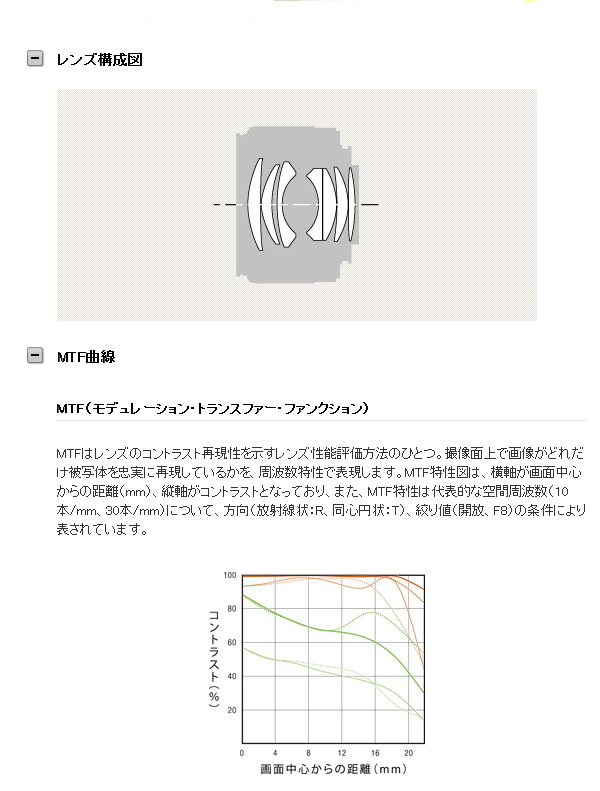
march2009/3514mtf.jpg
MTF chart
march2009/3514xray.jpg
X-ray view, Sony screen grab.
All testing done with the Sony A 700 and A900.  For full frame results, go to the bottom of the page.  For a better understanding of the methods and terms used in this review, go here.

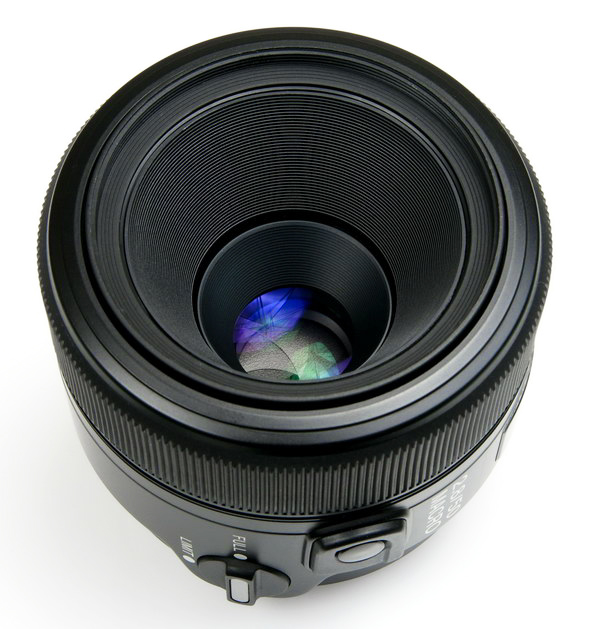
The Sony 35mm F/1.4 G is a compact, heavy, well-built, and expensive lens aimed at Photojournalists and people who shoot primarily in hand-held, available light conditions, such as street scenes at night or indoors.  Build quality is very good.  It has a course spatter paint finish unlike any other Sony or Minolta lens I’ve seen, which leads me to believe at least part of it is built at a different plant from the rest of the Sony lenses.  It has a focus distance window with ft and m in different colors along with DOF hash marks, plus a handy focus hold button, which can be changed to DOF on select camera bodies.  The focus ring is covered in rubber and wide enough for easy manipulating.  The lens is made in Japan.  To give you and idea as to the size of the lens, it’s about the same and weight as the Sony CZ 16-80mm F/3.5-4.5.  One item to mention about interior build is a glass-molded aspherical element, which helps control Coma in the corners.

This lens has a fairly long focus throw, but focuses quickly and very accurately using the A700.  There’s a tiny bit of slop on the focus ring if you wiggle it by hand when engaged, and also in actual MF use, it doesn’t hinder focusing though.  Manually, the ring is easy to manipulate with a finger and thumb.  It takes more than a third of a turn to get from close focus to infinity.  This lens uses a focus clutch to stop the ring from turning in AF mode; you can also turn the focusing ring manually in AF mode, though I don’t think you’re supposed to do this.
The lens has a green/magenta multi-coating which is common for Sony/Minolta from the 1990s on up.  It also resists flare and ghosting, with average results; you’ll see a few small blue/red blobs opposite the sun when the sun is in the frame at an angle, similar to the Sony 50mm F/1.4.  With the sun centered in the image, there’s no problem.  Veiling glare is about average, and only occurs when the sun is very close around the outside of the frame.  The supplied hood ($50 to replace–rip off!) doesn’t seem to make much difference.  I normally use my hand if I think the sun or a reflection will cause problems.
Filter size is 55mm.  This is Sony’s most popular filter size, other Sony lenses sharing this size are: 50mm F/1.4, 50mm F/2.8 macro, 100mm F/2.8 macro, 18-55mm kit lens, 55-200mm and the 75-300mm.
Filter use.  No additional vignetting when using a regular filter on an APS-C camera, thought full frame will show slightly darker corners at F/1.4.
Coma is almost mild at F/1.4, and nearly gone at F/2.0.  Full frame results are different.  See crops below.
Color looks the same as other Sony lenses.
Close up filter.  Works good, +4 tested.
Bokeh is neutral to good.  F/1.4 is a little busy looking, but F/2 is much better. See sample crops below.
Color fringing is strong wide open.  This type goes away as you stop down the aperture, see samples below.  It’s mostly purple/red, but stopped down to F/2, it’s negligible, and not noticeable in regular photographs.  Overall, good results here.  Lateral color fringing (occurring along the sides of the image, and doesn’t go away as you stop down) can be seen when looking at a huge enlargement, but isn’t noticeable in regular shots.


Random samples below.
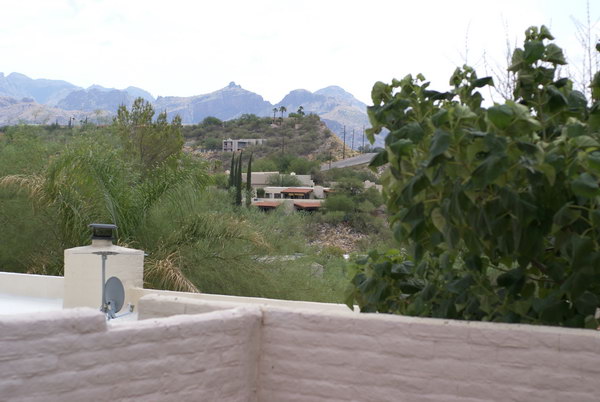
Sun in shot, F/5.6
Sun centered, F/5.6
october08/5014sunoff.jpg october08/5014sunctr.jpg
Bokeh, F/1.4
Bokeh, F/2
march2009/351414bok.jpg march2009/351420bok.jpg
Bokeh, F/2.8
Bokeh, F/4
march2009/351428bok.jpg march2009/351440bok.jpg
Foreground bokeh, F/1.4
Foreground bokeh, F/4
march2009/fb14.jpg march2009/fb28.jpg


When the sun is in the frame at an angle, some ghosting shows up, mostly blue/magenta blobs, seen in the lower right of the first image.  When the sun is centered, everything is fine.  Overall, flare and ghosting are on par with the Sony 50mm F/1.4 lens.  The included hood is typical in the fact that it doesn’t work very well, I use my hand to shield the sun when possible.


Bokeh is a little harsh at F/1.4, but smooths out nicely at F/2 and beyond.  Background blur (middle rows) is much more pleasing than foreground blur, as you can see in the last row.


Coma samples below.


F/1.4
F/2.0
march2009/3514cma14.jpg march2009/3514cma20.jpg


Coma is moderate at F/1.4, but goes away quickly with the cropped sensor camera.


Example of veiling haze cropped from the center.


F/1.4
F/1.6
march2009/x14.jpg march2009/x16.jpg
F/1.7
F/2.0
march2009/x17.jpg march2009/x20.jpg
It’s tough to look past the veiling haze and color fringing here.  It improves much at F/1.7, and is nearly gone at F/2.  Here’s some advice; don’t shoot at F/1.4 in daylight!
Distortion below.
march2009/3514dis.jpg
Barrel distortion.


Distortion is almost flat, and barely noticeable in real shots.  For those of you who look at your images with a grid overlay, there is slight barrel distortion.


Light fall-off.


F/1.4
F/2.0
march2009/3514vig14.jpg march2009/3514vig20.jpg
Light fall-off or corner darkening is mild, even wide open.


I wonder how sharp the corners are?


         F/1.4
          F/1.4 from center
march2009/3514cn14.jpg march2009/3514cnctr142.jpg
         F/2.0
          F/2.8
march2009/3514cn20.jpg march2009/3514cn28.jpg
         F/4.0
          F/5.6
march2009/3514cn40.jpg
march2009/3514cn56.jpg
         F/8
          F/11
march2009/3514cn80.jpg
march2009/3514cn11.jpg


These crops are from the extreme bottom left corner.  Things look fuzzy here at F/1.4, but it’s dumb to shoot like this is broad daylight.  The corners sharpen up gradually to F/5.6.  I threw in a center crop from F/1.4 for comparison.


How sharp are the centers if the image is enlarged to a staggering size?


F/1.4
march2009/3514ctrb14.jpg
F/2.0
march2009/3514ctrb20.jpg
F/2.8
march2009/3514ctrb28.jpg
F/4
march2009/3514ctrb40.jpg
F/5.6
march2009/3514ctrb56.jpg
F/8
march2009/3514ctrb80.jpg
F/11
march2009/3514ctrb11.jpg
When shooting wide open at F/1.4  the frame is very soft, due to veiling haze, which nearly disappears one stop down at F/2.0.  At F/2.8 things look pretty sharp, and are almost indistinguishable from the slightly sharper F/4 shot below it (check out the trees).  Remember, you’re looking at a 100% cropped portion of the full image.  In a low-light situation, you would have a hard time seeing any veiling haze or softness at F/1.4 unless enlarged to staggering sizes like you see above.  The above shots were taken at infinity focus.
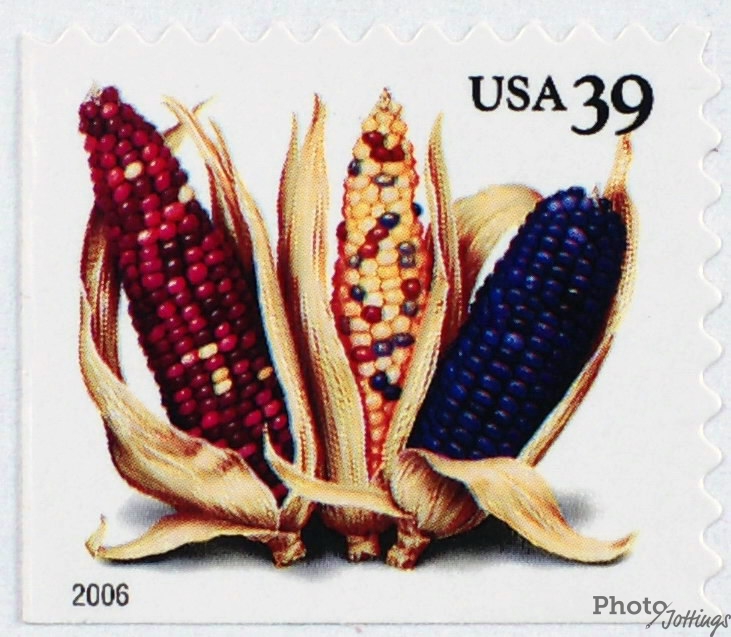
Close focus sample.
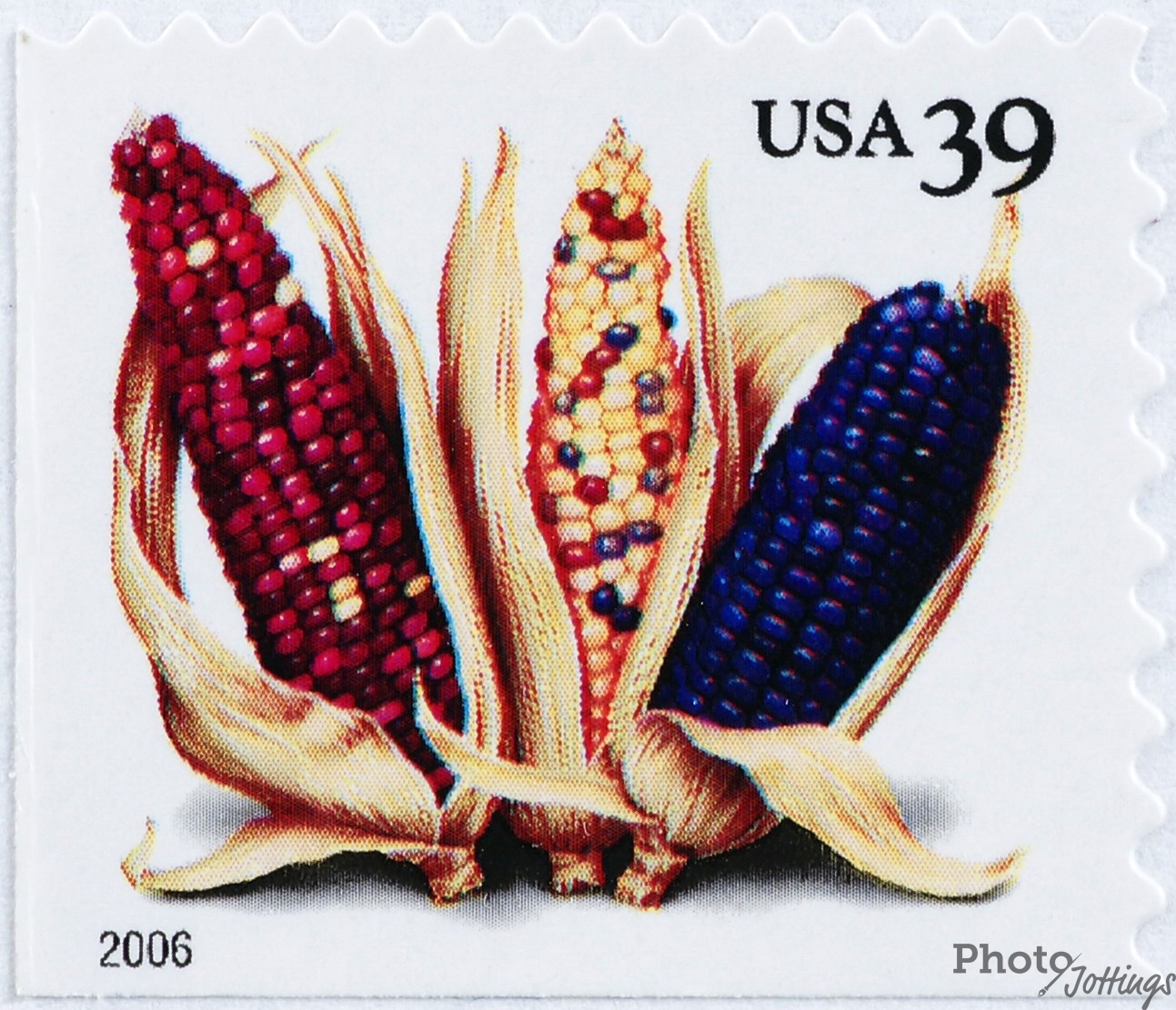
Below, check out the close focus shot, a 100% cropped portion of the full image, click for a larger image.  The sample shot was taken with the Sony A 700 12.2mp camera.  The subject is a standard US stamp, 1″x 3/4″ or 25.4mm x 19mm.  Also, note the macro shot was taken as close to the subject as focusing allowed; In this case, 7″ or 178mm, measured from the front of the lens barrel to the subject.
Click for larger image (214kb) F/4
This maximum magnification shot is sharp, and fairly large at 0.20x.  The sharpest close focus aperture was F/4, but F/5.6-8 were nearly as good!

Full frame results using the Sony A900 below.


Check out the differences when using a film or full frame camera below.  I’m only pointing out the noticeable issues as compared to the APS-C bodies, so if I don’t show it here, the results are not significantly different enough to warrant posting an additional set of images in this section.


Light fall-off


         F/1.4
          F/2
march2009/3514ffvig14.jpg march2009/3514ffvig20.jpg
         F/2.8
          F/4
march2009/3514ffvig28.jpg
march2009/3514ffvig40.jpg


Light fall-off is worse than the APS-C crops shown earlier.  At F/1.4 it’s heavy, and noticeable in real shots, but don’t shoot at this aperture in daylight.


Full image from A900 below.


march2009/3514ffvig4.jpg


The dark corners are noticeable here, but this is the wrong thing to do with a F/1.4 aperture.  Save the fast part of the lens for low-light shots where this kind of stuff isn’t noticeable.


Corner samples next.


         F/1.4
          F/2
march2009/3514ffcn14.jpg march2009/3514ffcn20.jpg
         F/2.8
          F/4
march2009/3514ffcn28.jpg
march2009/3514ffcn40.jpg
         F/5.6
          F/5.6 from center
march2009/3514ffcn56.jpg
march2009/3514ffcnctr56.jpg
         F/8
          F/11
march2009/3514ffbok80.jpg
march2009/3514ffcn11.jpg


The corners are softer than the APS-C crops show, but not by much, F/5.6 looks good judging by the center shot right next to it.  The corner shots and the center shot look different because of the way the corners stretch the image, it’s not because I was at a different location etc.  The exposure differences are from light fall-off.


march2009/3514ffdis.jpg
Barrel distortion on A900


There’s slightly more barrel distortion using the full frame A900 than an APS-C camera, though I wouldn’t worry about this small amount at all.


Coma results with full frame.


F/1.4
F/2.8
march2009/3514ffbok14.jpg march2009/3514ffbok28.jpg


This is coma on the A900.  At F/1.4 it’s a little strong, but better than the Sony 50mm F/1.4, most likely due to the use of an aspheric element in the 35mm F/1.4.  One stop down at F/2 things looked the same, but at F/2.8 there’s not much of a problem.  Don’t try and make direct comparisons to the crops above and the APS-C crops at the top of the page as they were taken at different distances and slightly different angles.


My final thoughts.
The Sony 35mm F/1.4 G lens performed very well, and nearly the same as the Sony 50mm F/1.4, which costs far less.  On a cropped sensor camera, the 35mm ‘sees’ about the same view as the 50mm lens does on a full frame camera.
The 35mm F/1.4 G sports a glass-molded aspherical element, which was expensive back when this lens was designed, the Sony 50mm F/1.4 has none, which may explain the better Coma control of the 35mm F/1.4, I’d say about a stop better.  This is important if you take pictures in low light with sharp pointed lights near the image periphery, such as street scenes at night.  All other qualities are about the same as the 50mm F/1.4, such as light fall-off, distortion, color fringing, corner and center sharpness etc.  On a minor note; the 35mm F/1.4 G has a higher reproduction ratio if you take close-up pictures.

For better wide open performance, and less cost, check out the manual Rokinon 35mm F/1.4 lens, it’s really good!

APS-C users; get the much better performing Sony DT 35/1.8 reviewed here.

Here’s a brief look at the Sony 50mm F/1.4 lens.  Scroll down for the review.

Lens
SAL-50F14  Sony 50mm F/1.4
Box contents
Front and rear caps, hood, and users manual.
Cost
$450 retail
Build quality
Very good
Additional information
Check out the great performing, but more expensive Sigma 50mm F/1.4 HSM.
Specifications below
Optical configuration
7 elements in 6 groups
Angle of view
47° (full frame)  32° (APS-C)
Aperture
7 blades, circular
Full frame and APS-C
Yes, made for full frame.   APS-C equivalent, 75mm
Depth of field and focus scales?
Yes and yes
Minimum focus, image plane to subject
18″  (450mm)
Minimum focus, end of lens barrel to subject
13.5″  (343mm)
Hard stop at infinity focus?
Yes
Length changes when focusing?
Yes
Focus ring turns in AF?
Yes
Filter size
55mm
Filter ring rotates?
No
Distance encoder?
Yes
Max magnification
0.15x
Min. F/stop
F/22
Sony teleconverter compatible?
No
Dimensions W x L (my measurements)
2.58″ x 1.7″   65.5mm x 43mm
Maximum  extended length (my measurements)
1.96″  (50mm)
Weight bare (my scale)
7.8oz  (221g)  8.6oz (245g) with caps
Requisite product shots.
Aug08/s50mmft.jpg
Front glamour shot
Aug08/s50mmbox.jpg
Box and lens
Aug08/s50mmcam.jpg
Front on A700
Aug08/s50mmbk.jpg
Backside
Aug08/s50mmsdba.jpg
Side shot
2012/s5014mtf2.jpg
Sony X-ray view and MTF chart
All testing done with the Sony A 700 and A900.  For full frame results, go to the bottom of the page.  For a better understanding of my review methods and terminology, go here.The Sony 50mm F/1.4 is a compact lens, just a little larger and heavier than the Sony DT 50mm F/1.8 SAM.  Build quality is very good.  It has a satin black finish with rubber inserts around most of the circumference.  It has a focus distance window with ft and m in different colors along with DOF hash marks. The lens is made in China.  This lens has a fairly short focus throw, and focuses very quickly and very accurately using the A700.  There’s a tiny bit of slop on the focus ring if you wiggle it by hand when engaged, and none in actual MF use.  Manually, the ring is easy to manipulate with a finger and thumb.  Less than a third of a turn gets you from close focus to infinity.  The focus ring turns in auto-focus mode.

This lens was designed by Minolta in the mid 1980s, and updated with newer coatings, larger focusing ring and rounded aperture blades in the late 1990s.  It was re-introduced by Sony with a new focusing ring in 2006.
The lens has a green/magenta multi-coating which lends itself beautifully for product shots.
Filter size is 55mm.  This is Sony’s most popular filter size, other Sony lenses sharing this size are: 35mm F/1.4, 50mm F/1.4, 50mm F/2.8 macro, 100mm F/2.8 macro, 18-70mm kit lens, 55-200mm and the 75-300mm.
Filter use.  No additional vignetting when using a regular filter, even with full frame.
Coma is strong at F/1.4, much better at F/2.0 and gone at F/2.8.   See crops below.
Color looks the same as other Sony lenses.
Close up filter.  Works good, +4 tested.
Bokeh is neutral to good.  In other words, F/1.4 has stylized ovals (occurring off-center), which don’t look so good, they’re properly round and even at F/2, so close background to subject distances look better at F/2.  If the background is a little busy The bokeh is so-so at F/1.4, F/2 is good.  More even backgrounds and more distant backgrounds look fine (no surprise) wide open or stopped down.  See sample crops below.
Color fringing is strong wide open and exacerbated by spherical aberration.  It’s mostly purple/red, but stopped down to F/2, it’s negligible, and not noticeable in regular photographs.  Overall, good to very good results here.


Random samples below.
Sun in shot, F/5.6
Sun centered, F/5.6
october08/5014sunoff.jpg october08/5014sunctr.jpg
Bokeh, F/1.4
Bokeh, F/2.0
october08/5014ffbok14.jpg october08/5014ffbok20.jpg
Swirling bokeh, F/1.4
gone at F/2.0
october08/s50f14bok1.4.jpg october08/s50f14bok2.jpg


When the sun is in the frame at an angle, some ghosting shows up, mostly a purplish/green blob seen in the lower right of the first image.  When the sun is centered, everything is fine.  This lens has an updated multi-coating and has much better resistance to flare and ghosting than the older Minolta AF 50mm F/1.7Bokeh is a little harsh at F/1.4, but smooths out at F/2.  At F/2.8 the aperture shape starts to show up.  The bottom shot shows an example of large aperture “swirling bokeh,” which some people like, and some people don’t.  These (bottom row) shots were taken with the A900, but it still shows up in cropped sensor cameras.  In the F/1.4 crop it looks like the background is spinning.  I hate it, but that’s just me.  By F/2 it looks better.


Coma samples below.


F/1.4
F/2.0
october08/s50comf1.4700.jpg october08/s50comf2700.jpg


Coma is strong at F/1.4, but goes away quickly with the cropped sensor camera.  If this looks bad to you, don’t scroll down and check out the full frame results!


Example of veiling haze cropped from the center.


F/1.4
F/2.0
Aug08/s50mm14ca.jpg Aug08/s50mm20ca.jpg
It’s tough to look past the veiling haze and color fringing here.  It improves much at F/1.6, and is nearly gone at F/2.  Don’t shoot at F/1.4 in daylight.
Distortion below.
Aug08/s50mmdisb.jpg
Barrel distortion.


Distortion is almost flat, and isn’t noticeable in real shots.  For those of you who look at your images with a grid overlay, there is slight barrel distortion.


Light fall-off.


F/1.4
F/2.0
Aug08/s50mmlf14a.jpg Aug08/s50mmlf20.jpg
Light fall-off or corner darkening is very mild, even wide open.
Aug08/s50mmover14.jpg


Shot at F/1.4, no adjustments.  Light fall-off in real images is not noticeable on a cropped sensor camera.  You’ll only see natural light fall-off from the sun position and your shooting angle in the sky.


I wonder how sharp the corners are?


         F/1.4
          F/2.0
Aug08/s50mm14cn.jpg Aug08/s50mm20cn.jpg
         F/2.8
          F/4.0
Aug08/s50mm28cn.jpg
Aug08/s50mm40cn.jpg
         F/5.6
          F/8.0
Aug08/s50mm56cn.jpg
Aug08/s50mm80cn.jpg


These crops are from the extreme bottom left corner.  Things look fuzzy here at F/1.4, but it’s dumb to shoot like this.  Things sharpen up gradually to F/5.6.  The corners aren’t really much different from the centers as far as sharpness goes.


How sharp are the centers if the image is enlarged to a staggering size?


c50mm28pcspl.jpg
This is the full shot, below are the center crops.
F/1.4
a50mm14pc1.jpg
F/2.0
b50mm20pc1.jpg
F/2.8
c50mm28pc1.jpg
F/4
d50mm40pc1.jpg
F/5.6
e50mm56pc1.jpg
F/8
f50mm80pc1.jpg
F/11
g50mm11pc1.jpg
F/16 h50mm16pc1.jpg
When shooting wide open at F/1.4  the frame is very soft, due to veiling haze, which nearly disappears one stop down at F/2.0.  At F/2.8 things sharpen up nicely and from F/4.0 to F/8.0 the whole frame is very sharp.  The results at F/11 to F/16 aren’t too bad, that’s quite a high sharpness range (F/2.8 to F/11) I think.  The above shots are from the Sony A100.
Look at a dark shot below.
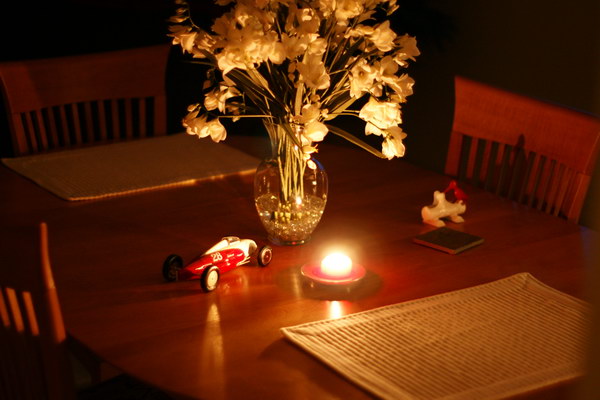
Aug08/s50mm14nite.jpg
Hand held one candle shot in otherwise totally dark room,
I played around for a while and took some candlelight pictures in otherwise total darkness, check out the one above, F/1.4, ISO 800 at 0.4″ sec, hand-held and fairly repeatable as nothing is really sharp at this aperture.  Low light is the proper use for this lens at wider than F/2.8.  This isn’t the the most interesting of shots, but it shows you that softness doesn’t necessarily show up in low light, especially with small prints.  You don’t see any low contrast haze here, just the slim DOF at F/1.4.  A more realistic shutter speed would be two stops faster, at 1/10 sec, which would put the ISO at 3200, if you used an F/2.8 lens for another two stops difference, you’d be looking at either a tripod or ISO 12800.
If you need to stop motion, use a faster shutter speed, Image Stabilization doesn’t stop motion, it only lessens the severity of blur on the image caused by camera movement.
Close focus sample.
Below, check out the close focus shot, a 100% cropped portion of the full image.  The sample shot was taken with the Sony A 700 12.2mp camera.  The subject is a standard US stamp, 1″x 3/4″ or 25.4mm x 19mm.  Also, note the macro shot was taken as close to the subject as focusing allowed; In this case, 13.5″ or 343mm, measured from the front of the lens barrel to the subject.
Click for larger image (143kb) F/8
This maximum magnification shot is sharp, but it’s small.  I chose the F/8 example, but it’s the same at F/5.6.  If you want to get a little closer to a small subject, add a +4 close-up filter, like I did in this review.

Full frame results using the Sony A900 below.


Check out the differences when using a film or full frame camera below.  I’m only pointing out the noticeable issues as compared to the APS-C bodies, so if I don’t show it here, the results are not significantly different enough to warrant posting an additional set of images in this section.


Light fall-off


         F/1.4
          F/2
october08/s50cnvig14.jpg october08/s50cnvig2.jpg
         F/2.8
          F/4
october08/s50cnvig28.jpg
october08/s50cnvig4.jpg


Light fall-off is worse than the APS-C crops shown earlier.  At F/1.4 it’s heavy, and noticeable in real shots, but don’t shoot at this aperture in daylight.


Full image from A900 below.


october08/s50over14b.jpg


The dark corners are noticeable here, but this is the wrong thing to do with a F/1.4 aperture.  Save the fast part of the lens for low-light shots where this kind of stuff isn’t noticeable.  This picture was F/1.4 at 1/8000sec.


Corner samples next.


         F/1.4
          F/2
october08/s50cn14.jpg october08/s50cn2.jpg
         F/2.8
          F/4
october08/s50cn28.jpg
october08/s50cn4.jpg
         F/8
          F/11
october08/s50cn8.jpg
october08/s50cn11.jpg


The corners are softer than the APS-C crops show.   Don’t worry about this too much as a normal landscape shot would be at least F/5.6, and low light shots would probably hide soft corners depending on subject matter.  It appears that F/11 produces the sharpest corners, but F/4 is acceptable.  I left out the F/5.6 crop because there’s little difference in that step, and I can save a row.  The exposure differences are from light fall-off.


october08/s50cnbrldis.jpg
Barrel distortion on A900


There’s slightly more barrel distortion using the A900.  It looks very similar to the Minolta 28mm F/2 distortion.


Coma results with full frame.


F/1.4
F/2
october08/s50cmaf1.4900.jpg october08/s50cmaf2900.jpg
F/2.8
F/4
october08/s50cmaf2.8900.jpg october08/s50cmaf4900.jpg


This is coma on the A900.  At F/1.4 it looks like birds coming in for a landing, ya think?  You need an extra stop and a half to get rid of it with the A900 as opposed to an APS-C body.  F/2.8 looks OK in real images.  The crops are taken from near the edge of the image but coma can be seen over 2000 pixels in from the corners towards the center at F/1.4, 600 pixels at F/2, and about 300 pixels at F/2.8.  This lens performs nearly the same in this category as theMinolta AF 28mm F/2 reviewed here.  Don’t try and make direct comparisons to the crops above and the APS-C crops at the top of the page as they were taken at different distances and slightly different angles.


My final thoughts.
The Sony 50mm F/1.4 lens turned in an good performance overall.  It’s nice and light, compact, and very fast.  Performance wise it’s a little soft with low contrast at F/1.4-2.0 though F/2.8 is perfectly acceptable, then hits max sharpness at F/4-8.  This is a good lens to have if you really need shutter speed in poor lighting and don’t want to ramp up the ISO-or you’re out of ISO(!)  It’s also two plus stops faster than a regular zoom or prime lens.  If you don’t need a fast shutter speed, use your regular slow lens and a tripod for the best results.  On a cropped sensor camera, it’s equivalent to a lengthy 75mm, not so useful indoors or in confined areas.  For APS-C users, get the spectacular Sony 35/1.8 SAM, it’s much sharper at large apertures than the 50/1.4.
Full frame users will want to watch the night time street scenes where coma will mess up a shot wide open.  Also, you need to stop down more to get sharp corners, but that’s no big deal in regular light.  For the best performance at large apertures, check out the sensational Sigma 50mm F/1.4 HSM.
Reality check; the Sony 50/1.4 is becoming dated, meaning it needs to be replaced with a more modern optical formula, and SSM focusing.  Both alternative lenses listed above perform much better at large apertures, and are either much less expensive, or about the same in price as the Sony 50/1.4.
Here’s a brief look at the Sony 55-200mm F/4-5.6 telephoto lens.  Scroll down for the main review.
Lens
SAL-55200  Sony 55-200mm F/4-5.6
Box contents
Front and rear caps, hood and users manual.
Cost
$200 retail
Build quality
Good, but plastic mount.
Additional information
Similar to the more versatile Sony 75-300mm but less expensive.
Specifications below
Optical configuration
13 elements in 9 groups
Angle of view
29°- 8°
Aperture
9 blades, circular
Full frame and APS-C
APS-C only.  Equivalent to 82.55-300mm.  Not for full frame, but will work, see note under performance.
Depth of field and focus scales?
No and no
Minimum focus, image plane to subject
37″  (940mm)
Minimum focus, end of lens barrel to subject
29.75″  (756mm)
Hard stop at infinity focus?
No
Length changes when focusing?
Yes
Focus ring turns in AF?
Yes
Filter size
55mm
Filter ring rotates?
Yes
Distance encoder?
Yes
Max magnification
0.29x
Min. F/stop
F/32-45  listed wrong on Sony’s website
Sony teleconverter compatible?
No
Length changes when zooming?
Yes
Dimensions WxL  (my measurements)
2.8″ x 3.3″   71mm x 84mm
Maximum  extended length (my measurements)
5.3″  (135mm)
Weight bare (my scale)
10.5oz  (297g)  11.3oz (321g) with caps
Requisite product shots.

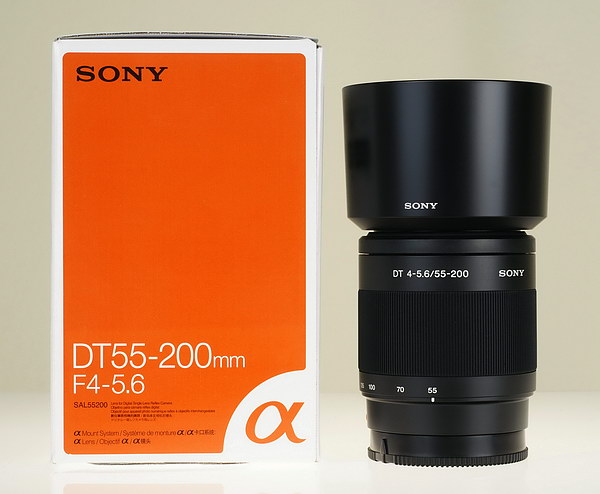
Aug08/55200box.jpg
Box and contents.
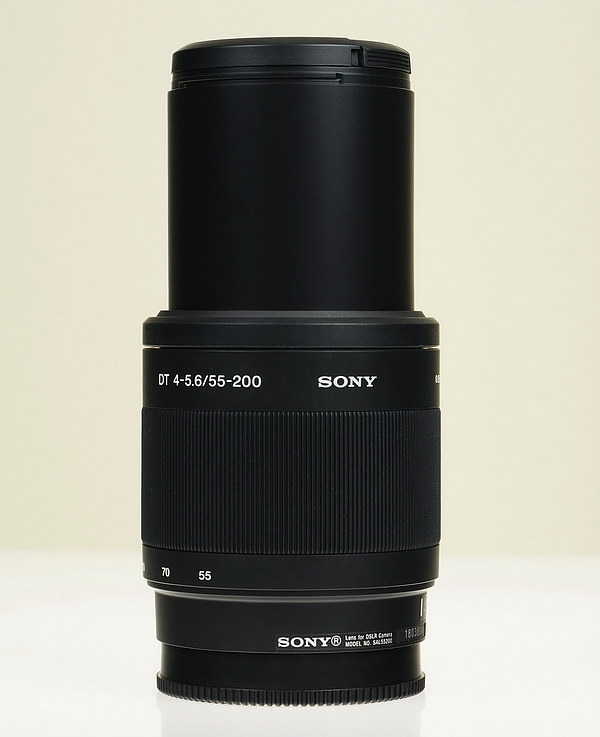
Aug08/55200sdex.jpg
Fully extended
Aug08/55200sd.jpg
Drawn in.
Aug08/55200bk.jpg
Rear, plastic lens mount.
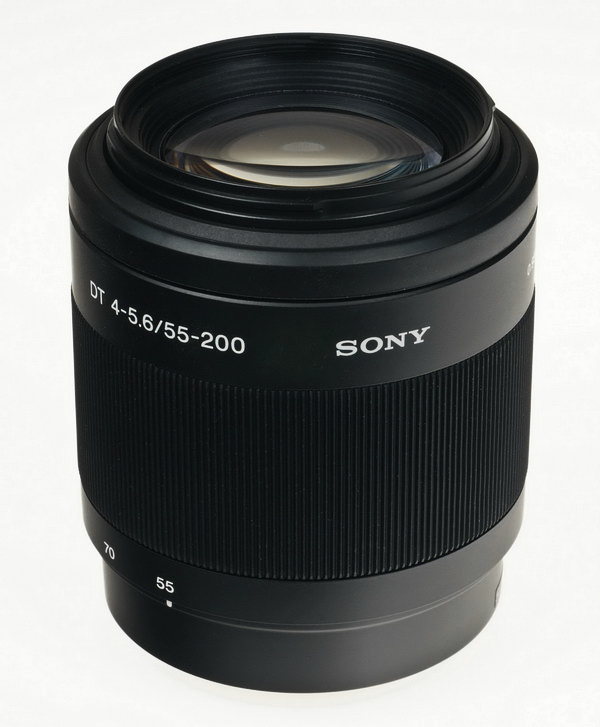
Aug08/55200ft.jpg
Front element.
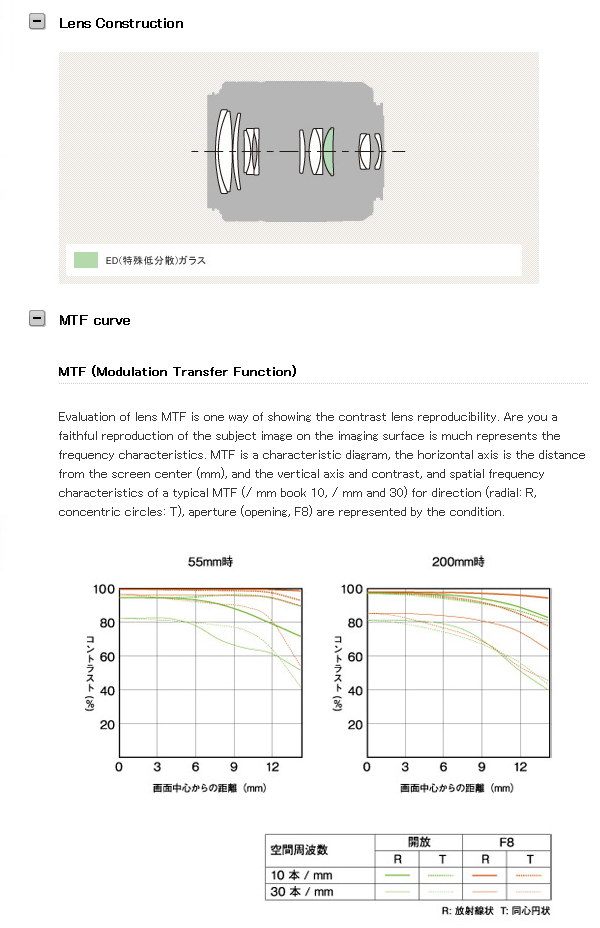
2012/s55200mtf.jpg
Sony X-ray view and MTF chart
The Sony A700 was used for this review.  For a better understanding of my review methods and terminology, go here.
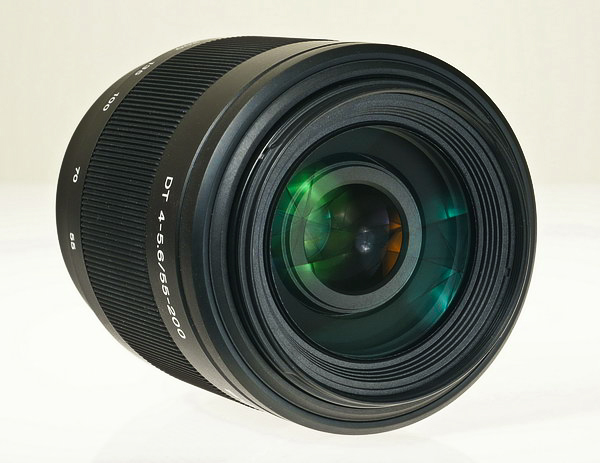
The Sony 55-200mm makes a good companion to the “kit” lens offered by Sony on the latest models.  With a 3.6x zoom and focal length equivalent of 82.5-300mm, you can bring your subject up pretty close, though this isn’t the only telephoto lens offered in this price range, also consider the Sony 75-300mm F/4.5-5.6, which can be a more versatile lens.  More on that later.
The lens has a matte black finish, with white numbers to indicate focal length.  They come at 55mm, 70mm, 100mm, 135mm and 200mm.  The EXIF data matches up with the lens focal length marks.  Size-wise, the lens is about 3-1/2″ long closed, and 5-1/2 fully extended at 200mm, including the half inch for the focus extension.  This lens says “China” so I assume it’s made in China.  Construction is mostly plastic, as expected, and also has a plastic mount, but the fit and finish are good.  The zoom effort is about right, it doesn’t seem to want to “creep” out as you walk, and there’s no zoom lock if it did.  Sony claims it has 1 ED glass element inside.
The chart below shows the focal length and corresponding maximum apertures.  You go all the way to 100mm at F/4, which is good, then hit F/4.5 up to 160mm.  You’ll get F/5 up to 180mm, then it’s F/5.6 to 200mm.
Aperture chart for the Sony 55-200mm F/4-5.6
Maximum aperture
          F/4
             F/4.5
         F/5
F/5.6
Range
55mm-100mm
105mm-150mm
160mm
180mm-200mm
Performance.  The lens focuses quickly and accurately, especially with the A700.  The manual focus ring located at the end of the lens works ok, but it’s typical of inexpensive lenses, meaning the window of sharp focus can be hard to get, with the slightest movement  throwing it one way or the other.  The filter ring turns as you focus which can be a pain in the behind if you have a polarizer or graduated filter mounted.  From close-in to infinity takes a 1/4 turn, very common for Sony lenses.  The lens is pretty light for a telephoto.  It weights about the same as the Sony 50mm F/2.8 macro lens.
This lens gives full coverage on a full frame camera, though there’s some heavy vignetting at close focus between 55-110mm.  Unfortunately, you cannot turn off the auto-crop using a Sony DT lens with the A900.


Bokeh, or background blur samples below.


Bokeh, 55mm @ F/4
Bokeh, 55mm @ F/5.6
october08/55200bokw40.jpg october08/55200bokw56.jpg
Bokeh, 200mm @ F/5.6
Bokeh, 200mm @ F/8
october08/55200boktel56.jpg october08/55200boktel80.jpg
Bokeh.  The Sony 55-200mm F/4-5.6 has harsh bokeh at F/4 around 55mm, then smoothing out some at F/5.6.  Towards the long end, it’s just ok, and not quite as smooth as the other Sony zooms in this range.
Distortion.

october08/55200dis.jpg
55mm, no problems here.
october08/55200pinc.jpg
200mm, moderate to heavy pincushion.
Distortion is very low At 55mm and basically flat, but pincushion shows moderate to heavy levels towards the end of the zoom.

Lens flare and ghosting is not much of a problem, at 55mm there’re one or two small green blobs that show up, then towards 200mm, there’s almost nothing.  Veiling glare can be strong towards the long end.  Use your hand to block stray light and solve the problem.  The included lens hood is adequate for 55mm-100mm.  Overall, good control here.  If you lose the hood, plan on spending $25 to replace it.

Color is the same as other Sony lenses.
Filter size is 55mm.  This is the most popular filter size in the Sony lineup.  Other lenses using this size are: 35mm F/1.4, 50mm F/1.4, 50mm macro, 100mm macro, 18-70mm, and the 75-300mm.
Filter use.  Normal filters cause no additional vignetting on this lens.
Close up filter use.  Good results at 55mm using a +4, don’t use it at the longer lengths or it turns into a mess.
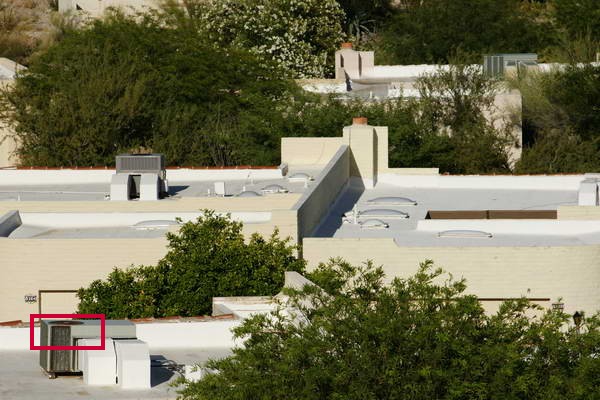
Lateral color fringing.  Average here.  In normal situations it’s not very noticeable, but high contrast areas like white rooftops against dark A/C units can show quite a bit of old fashioned purple fringing, which is the dominant color.  At 55mm, it’s not nearly as noticeable as it is at the long end.  Stopping down doesn’t do any good with this type of color fringing.  See corner crops down the page for an example.
Light fall-off.

As you can see, light fall-off or corner shading is not much of a problem on the Sony 55-200mm lens.  Wide open, you’ll notice a small amount at 55mm and F/4, but it clears up nicely one stop down at F/5.6.  At the long end, there’s no problem.   Real photos show no dark corners.

           55mm  @F/4
          55mm  @ F/5.6
october08/55200vigw40.jpg
october08/55200vigw56.jpg
           200mm  @F/5.6
          200mm  @ F/8
october08/55200vigtel56.jpg
october08/55200vigtel80.jpg
Center and corner sharpness.

Below are crops from the centers at 200mm.

F/5.6
2008/2002794f56.jpg
F/8
2008/2002791f80gd.jpg
F/11
2008/2002792f11.jpg


200mm corner crops below.


           200mm  @F/5.6
          200mm  @ F/8
october08/55200cntel56.jpg
october08/55200cntel80.jpg
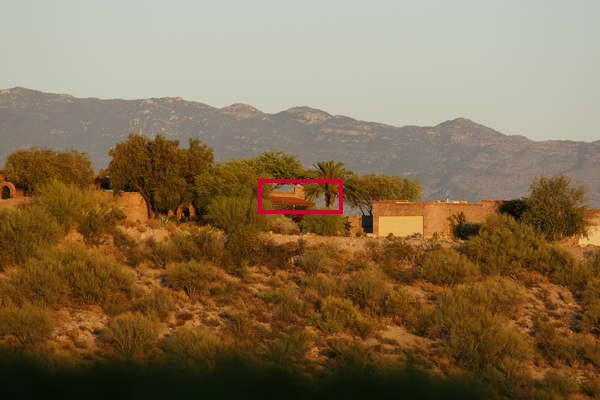
Stopping the lens down at 200mm really doesn’t do anything for long telephoto shots like this, at shorter distances without the atmosphere and heat shimmer you see sharper results by stopping down to F/8.  In the case of the photo crops above, F/5.6 looks as good as F/8, then by F/11 it softens up a bit.  These images aren’t the greatest, but they show real life.  Look at the vent in the roof at the right, you can tell it’s sharper at F/5.6 than F/11.  The two corner crops (directly above) show some sharpening at F/8, but that’s it, stopping down to F/11 makes no difference.  Notice the purple fringing too.
55-200mm @ 200mm F/8
2008/2002791f80gd.jpg
75-300mm @ 200mm F/8
2008/3002805f80gd.jpg
Comparisons with the Sony 75-300mm F/4.5-5.6.

The top image is not as sharp as the 75-300mm is at 200mm.  Again, look at the roof vent on the right side.

55-200mm @ upsampled to 300mm F/8
2008/DSC02791us.jpg
75-300mm @ 300mm F/8
2008/DSC02800a3.jpg
Just for fun I thought I’d compare the two lenses at their maximum lengths, so I upsampled the 55-200mm to match that of the 75-300mm.  Both are equal to 300mm.  As you can see, there isn’t all that much difference, but the 75-300mm does do a slightly better job.

Sony 55-200mm @  200mm F/8
2008/280855agd.jpg
Sony 18-200mm @ 200mm F/11
2008/281318agd.jpg


Above I’ve compared the 55-200mm with the 18-200mm lens.  They both look the same, but the 55-200mm is sharper at a wider aperture, the 18-200mm needs F/11 for best results.
Centers at 55mm below.


           55mm  @F/4
          55mm  @ F/5.6
october08/55200ctrw40.jpg
october08/55200ctrw56.jpg
           55mm  @F/8
          55mm  @ F/11
october08/55200ctrw80.jpg
october08/55200ctrw11.jpg


The centers at 55mm are pretty sharp with the aperture wide open.  One stop down at F/5.6 looks the sharpest, barely.  F/11 looks a little soft due to diffraction.  Notice the small amount of color fringing in the centers around the bright reflections, this isn’t noticeable unless blown way up on a computer screen.


55mm corners below.


           55mm bottom left corner @F/4
          55mm bottom left corner @ F/5.6
Aug08/552005540cn.jpg
Aug08/552005556cn.jpg
The corners (above) look slightly sharper from F/4 to F/5.6 at 55mm, the darker left shot is from light fall-off.

Let’s check out the macro capabilities of this lens.

Below, check out the sample and click the picture to see a 100% cropped portion of the full image (383kb file).  The sample shot was taken with the Sony A 700 12.2MP camera.  The subject is a standard US stamp, 1″x 3/4″ or 25.4mm x 19mm.  Also, note the macro shot was taken as close to the subject as focusing allowed; in this case a whopping 29.75″ or (756mm), measured from the front of the lens barrel to the subject.

The 0.29x macro is very sharp at the long end, coming at F/8, which is unusual for Sony less-expensive lenses, a good job here.

As close as you can get macro, at F/8.
Here are my final thoughts on the small 55-200mm F/4-5.6 telephoto lens.  The lens is sharp, even at maximum apertures, and the corners look fine about one stop down.  This lens will give good results when used wide open, contrary to the Sony super zooms, which need to be stopped down hard at the long end to look sharp.  As with most telephoto zoom lenses, there is some color fringing, but it’s about average for Sony, and has the same or slightly better control than the 75-300mm I’ve been comparing it to here.  Distortion and light fall-off are average and match that of the 75-300mm.  Bokeh is good to just ok depending on aperture and zoom length.  The macro shot is much better than the 75-300mm.  Overall, I like this lens.  Check out the Sony 75-300mm and see if it meets your needs better than this one.
Who would be in the market to buy this lens?  The typical purchaser is someone who wants convenience and low price.  If you have the Sony 18-70mm kit lens only, and want a nice light zoom, but don’t think you’ll ever use over 200mm in focal length, I’d highly recommend this lens.  This is a great lens to take with you when you want to travel light.  On the other hand, if you already have an 18-200mm or the 75-300mm, I think I would pass on this lens, as it isn’t much different at the telephoto end, and not quite as sharp at 200mm as the 75-300mm.
Here’s a brief look at the Sony 50mm F/2.8 macro lens.  Scroll down for the review.

2594-kurtmunger-banner.gif

.

Lens
Box contents
Front and rear caps, and a users manual.
Cost
$624 retail
Build quality
Very good
Additional information
Has focus hold button and focus limiter switch.  Less money, smaller and lighter than the 100mm macro, but has a shorter working distance, which some folks may not like.
Specifications below
Optical configuration
7 elements in 6 groups
Angle of view
47° (full frame)  32° (APS-C)
Aperture
7 blades, circular
Full frame and APS-C
Yes, made for full frame.   APS-C equivalent, 75mm
Depth of field and focus scales?
Yes and yes
Minimum focus, image plane to subject
7.8″  (198mm)
Minimum focus, end of lens barrel to subject
1.9″  (48mm)
Hard stop at infinity focus?
No
Length changes when focusing?
Yes
Focus ring turns in AF?
Yes, but has clutch.
Filter size
55mm
Filter ring rotates?
No
Distance encoder?
Yes
Max magnification
1:1
Min. F/stop
F/32
Sony teleconverter compatible?
No
Dimensions W x L (my measurements)
2.9″ x 2.4″   73mm x 60mm, protrusions add an extra 2mm to width
Maximum  extended length (my measurements)
4.2″  (106mm)
Weight bare (my scale)
10.1oz  (288g)  11oz (312g) with caps

Requisite product shots.

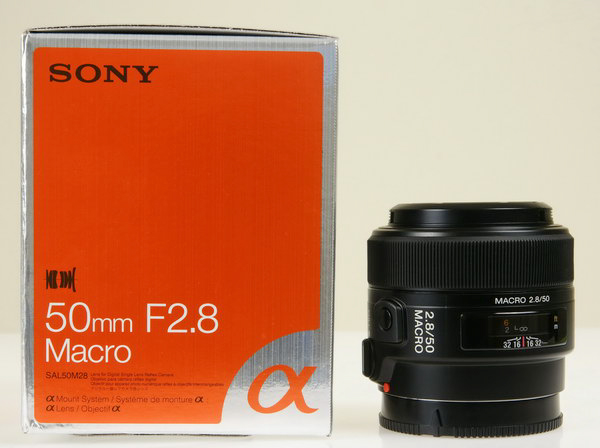
Aug08/50macbox.jpg
Box and contents.
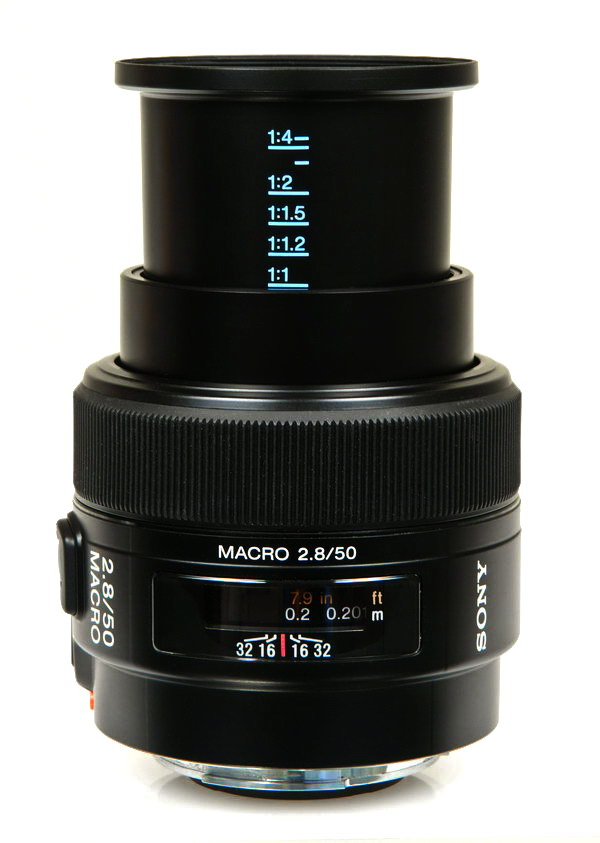
Aug08/50macsdex.jpg
Fully extended.
Aug08/50macft.jpg
Deep front element.
Aug08/50macbk2.jpg
Backside.
Aug08/50macsdsw.jpg
Focus limiter and focus hold buttons.
2012/s50macmtf.jpg
Sony X-ray view and MTF chart
The Sony A700, and A900 were used for this review.  For full frame results, go to the bottom of the pageFor a better understanding of my review methods and terminology, go here.
The Sony 50mm F/2.8 macro lens (made in Japan) is very compact, but extends out another 1.9″ (46mm) at full macro.  It’s nicely made, but lots of plastic.  The finish is satin black.  Filters are 55mm.  The lens is multi-coated, with the usual green/magenta look.  It has a 7 blade circular aperture as opposed to the 9 blades of the Sony 100mm macro lens.

The lens has the focus distance window with standard markings for FT/M, and DOF marks at F/16-32.  It has magnification levels from 1:1 to 1:4 written on the extended lens barrel.  Other useful items include a focus hold button, which can be changed to DOF preview on select Sony camera bodies, and a focus limiter switch, full, for focusing over the full range, and limited, which has two ranges: close range is about 2″ to 5.5″ (51mm-140mm), far range is about 6″ (152mm) to infinity.  This helps speed up focus, but don’t use auto focus for extreme close ups, manually focus on the subject and move the camera back and forth until you’ve got a sharp subject.  The figures above are for end of lens barrel to subject distances.

The Sony focuses quickly and accurately, though plan on using manual focus for super macros, read above.  The lens has a focus ring clutch, which means the ring turns as it focuses, but if you hold it, it won’t turn.  It takes about a manual half turn from close-in to infinity focus. It has the usual loud focusing sound typical of Minolta/Sony which has the focus motor in the camera body, unless it’s an SSM, this one isn’t.  The Sony 50mm macro has a short 1.9″ (48mm) distance from the front of the lens barrel to the subject at close macro.  That’s about 4.2″ (105mm) closer than the Sony 100mm macro.  The extra distance is good to keep shadows out of the frame, but that’s at maximum macro, and not everyone will need to be that close.

Lens flare/ghosting.  No real problems here, although there is a pesky green blob that shows up when the sun is in the image, but not in the center.  Center shots look fine.  There’s an average amount of veiling glare when the sun is just outside the frame.  Use your hand to eliminate this.  Additionally, the lens has plenty of recess for the front element, acting as a built-in hood.

Color.  Looks the same as other Sony lenses.
Coma.  None.
Filter size 55mm.  This is the most popular size for Sony, other lenses using it are: 35mm F/1.4, 50mm F/1.4, 100mm F/2.8 macro, 18-70mm, 75-300mm and the 55-200mm.
Filter use.  No additional vignetting using a regular filter, even on full frame.
Color fringing is very light, and poses no real problems.  At F/2.8 in very harsh dark/bright flanking conditions, it has some purple color fringing at F/2.8, but that goes away about one stop down.  This lens is one of Sony’s best for controlling color fringing.
Bokeh.  Nice and smooth, and very similar to the Sony 100mm F/2.8 macro.
Random samples below.
        Sun in shot, F/5.6
         Sun centered, F/5.6
october08/50macffsunoffb.jpg
october08/50macffsunctr.jpg
        Bokeh,  F/2.8
         Bokeh,  F/4
September2009/s5028bok28k.jpg
September2009/s5028bok40k.jpg
On top we have some ghosting, but it’s very light, with a green blob showing up at certain angles.  With the sun centered, everything looks fine.
Lower crops show bokeh, which looks decent here, and seems about the same at both apertures.
Distortion.  Very good job, so there’s nothing here.  If you like to look at your pictures with a grid overlay, you’ll see very slight pincushion distortion.
Aug08/50macpin2.jpg
Very minor pincushion distortion.

Light fall-off,
(directly below) is not noticeable with APS-C sensor cameras.
            F/2.8
            F/4
Aug08/50mac28lf.jpg Aug08/50mac40lf.jpg


Light loss at high magnification.


Here are the approximate F-numbers you will get as you increase the magnification, the table below is from the Sigma 105mm F/2.8 DG macro, but is close to the Sony model.  I modified it slightly for this lens.  Sony lists exposure compensation in the owners manual, but it’s not nearly as clear as the Sigma table.  These numbers will not be indicated on the camera, and will still read F/2.8 even at 1:1 magnification, but look at your shutter speeds and you’ll notice the loss.  This is for your information only, so just shoot away, the camera will adjust your exposure automatically.  I’m simply providing this in case you’re wondering why your shutter speeds are so low when the LCD says F/2.8.


Magnification
F-number
1:22
2.8
1:4
3.3
1:3
3.8
1:2 4.2
1:1.5 4.7
1:1.2 5.1
1:1 5.5
Below, check out the corner softness, lower left.

You’ll see a little corner softness at wide apertures, but it’s doesn’t show in regular pictures.  It gradually sharpens up ’till F/8.

            F/2.8
            F/4
Aug08/50mac28cn.jpg Aug08/50mac40cn.jpg
            F/5.6
            F/8
Aug08/50mac56cn.jpg Aug08/50mac80cn.jpg
Here are some center crops for comparison.  Look below for an explanation.

            F/2.8
            F/4
Aug08/50mac28ctr.jpg Aug08/50mac40ctr.jpg
The two shots above are from the center of the image.  The Sony 50mm F/2.8 macro is darn sharp, even at F/2.8.  It does sharpen up at F/4, but it’s no sharper at F/5.6 or F/8 when looking at regular pictures.  It softens at F/11 due to diffraction.  Look at the dumb shot at F/2.8 in broad daylight, 1/1250s ISO 100!  In low light F/2.8 looks great.   Maximum sharpness for close objects like the stamp below is F/8.

Requisite macro paragraph.  As with all 1:1 life size macros, sometimes it can be a little tough to focus, and a tripod is highly recommended, especially if you go full size.  Hand held macro field shooting is limited to 1:2 in my opinion, any more and you’ll likely fill up a 16GB memory card trying to get a decent shot.  At F/4 the depth of field is razor thin, at F/16 you  lose your shutter speed, so some extra though is required before your photo session begins.  I often have to bump up the ISO to get a sharp picture with hand-held shooting.  Even on a bright sunny day you’ll be surprised at how low your shutter speeds are, and with jittery hands it’s all the worse.  If you like to compare shots from other lenses and cameras, don’t be too critical about it at 100% screen size.  Getting a uniformly sharp image from a flat object like my stamp is very difficult, especially when it’s a full 1:1 macro.  I use the stamp so you will know about how big an area is covered, and get an idea of the sharpness.  Keep this in mind when viewing the macros.

Macro shot.

Below, check out the sample and click the picture to see it full size (1.9mb, large file) it may have been cropped or straightened to reduce size.  The sample shot was taken with the Sony A 700 12.2mp camera.  The subject is a standard US stamp, 1″x 3/4″ or 25.4mm x 19mm.  Also, note the macro shot was taken as close to the subject as focusing allowed; In this case, about 1.9″ or about 48mm, measured from the front of the lens barrel to the subject.

Full 1:1 macro shot 1.9mb F/8


The Sony 50mm F/2.8 macro produced a very nice macro shot, coming in sharpest at F/8, but there was little difference between F/5.6-11.


Full frame results using the Sony A900 below.


Check out the differences when using a film or full frame camera below.  I’m only pointing out the noticeable issues as compared to the APS-C bodies, so if I don’t show it here, the results are not significantly different enough to warrant posting an additional set of images in this section.


Light fall-off


         F/2.8
          F/4
october08/50macvigff28.jpg october08/50macvigff40.jpg


Light fall-off is a reality with full frame coverage.  At F/2.8 it’s heavy, and noticeable in real shots, but one stop down and things change dramatically for the better.  The corners don’t lighten up any further by stopping down past F/5.6.


Full image from A900 below.


october08/50macffover.jpg


The dark corners are noticeable here, and as usual, the perceived severity depends on subject placement and background.  This shot was F2.8, ISO 200, 1/5000sec.  As always, don’t shoot normal landscape scenes at F/2.8.  I think this scene looks just fine as it is, even though it isn’t all that interesting.


Corner samples next.


         F/2.8
          F/4
october08/50macffcn28.jpg october08/50macffcn40.jpg
         F/5.6
          F/8
october08/50macffcn56.jpg
october08/50macffcn80.jpg


The corner sharpness is about the same as the APS-C crops show.  The corners are their absolute best at F/8, but look fine wide open.  The exposure differences are from light fall-off.


Distortion.


october08/50macffdisb.jpg
Mild pincushion distortion on A900


This lens produces a small amount of pincushion distortion, and results are similar to the APS-C image.


 .

2594-kurtmunger-banner.gif


Conclusion.
The Sony 50mm F/2.8 macro is a very good lens.  It’s sharp through F/2.8 to F/11, very sharp from F/4-8.  Color fringing is basically non-existent.  It focuses good, though keep it on manual up close.  The main differences in the Sony 100mm F/2.8 macro and the Sony 50mm F/2.8 macro are; the 50mm is smaller, lighter, less expensive, sharper at F/2.8 and has much better CA control.  The 50mm has a lens barrel to subject distance at maximum macro of only 1.9″ (48mm) as opposed to the 100mm macro at 6.2″ (157mm) distance.  Normally, close working distances will bring you problems with shadows on your subject from the lens, although some people won’t get that close so they won’t be bothered by this.  If you shoot a lot of really close macros, you might want to get the 100mm.  In my opinion, for most people, the 50mm macro makes more sense when factoring in all the previously mentioned items, and considering you’ll save a lot of money over the 100mm macro.  The Sony 50mm F/2.8 macro is a good lens to put in a bag or your pocket when you’re on a hike or vacation.


APS-C users;  also consider the Tamron 60mm F/2 macro, which offers more working distance (4″ or 101mm), and a wider aperture for hand-held available light shots.  If you want something real small for your pocket, check out the Sony DT 30mm Macro lens.


For full frame users; this lens performs about the same as APS-C coverage, just factor in more light fall-off wide open.

Here’s a brief look at the Sony 70-200mm F/2.8 G  telephoto lens.  Scroll down for the main review.

Lens
SAL-70200G  Sony 70-200mm F/2.8
Box contents
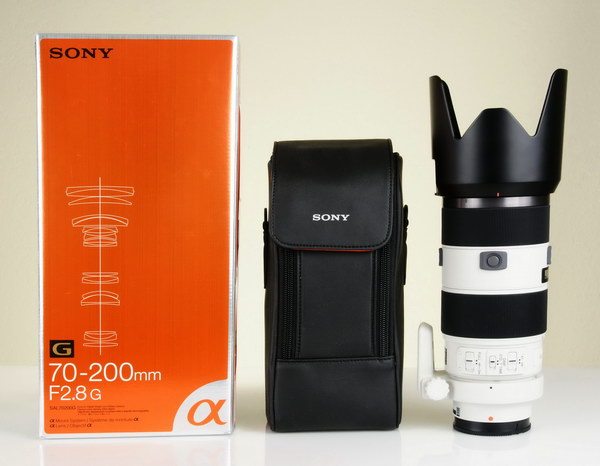
Front and rear caps, hood, carrying case and users manual.
Cost
$1998 retail
Build quality
Excellent
Additional information
One of only five Sony lenses compatible with Sony TCs.
Specifications below
Optical configuration
19 elements in 16 groups
Angle of view
34°-12° full frame, 23°-8° APS-C.
Aperture
9 blades, circular
Full frame and APS-C
Yes, made for full frame.   APS-C equivalent, 105-300mm
Depth of field and focus scales?
Focus distance window
Minimum focus, image plane to subject
48″  (1.2m)
Minimum focus, end of lens barrel to subject
36″  (910mm)
Hard stop at infinity focus?
No
Length changes when focusing?
No
Focus ring turns in AF?
No
Filter size
77mm
Filter ring rotates?
No
Distance encoder?
Yes
Max magnification
0.21x
Min. F/stop
F/32
Sony teleconverter compatible?
Yes
Length changes when zooming?
No
Dimensions WxL  (my measurements)
3.4″ x 7.8″   87mm x 198mm
Maximum  extended length (my measurements)
7.8″  (198mm)
Weight bare (my scale)
48oz (1350g),  49oz (1385g) with caps, tripod collar 5oz (142g), hood 2.5oz (70g)  everything, 3lbs 8oz (1598g)
Requisite product shots.

Aug08/70200gbox.jpg
Box and contents.
Aug08/70200gtop.jpg
Birds eye view.
Aug08/70200gft.jpg
Frontal offset.
Aug08/70200gunder.jpg
Underneath
Aug08/70200gbk.jpg
Rear mount.
June2009/70200gswtchxz.jpg
Switches.
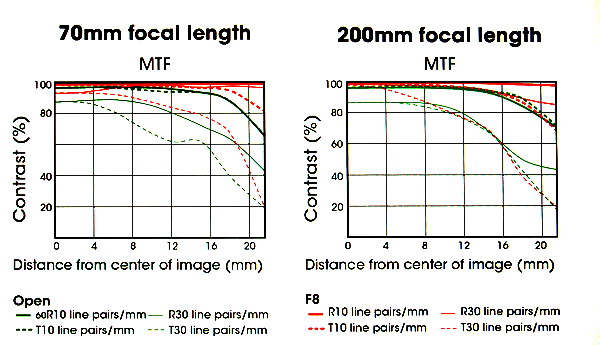
october08/70200xraymtfdata.jpg
MTF data, Sony screen grab.
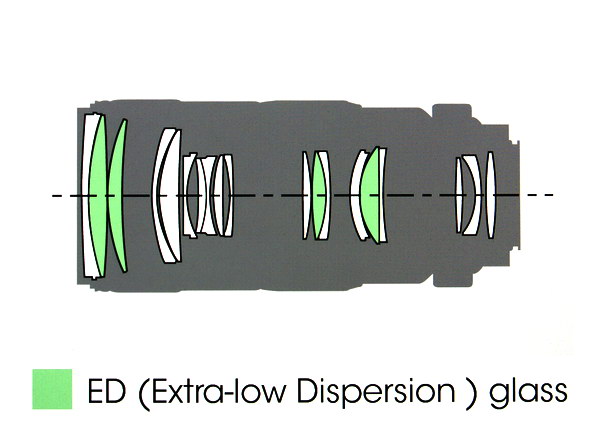
october08/70200xray.jpg
X-ray view, Sony screen grab.
The Sony A700 and A900 were used for this review.  For full frame results, go to the bottom of the page.  For a better understanding of my review methods and terminology, go hereCheck out the differences between this lens and three other similar lenses.
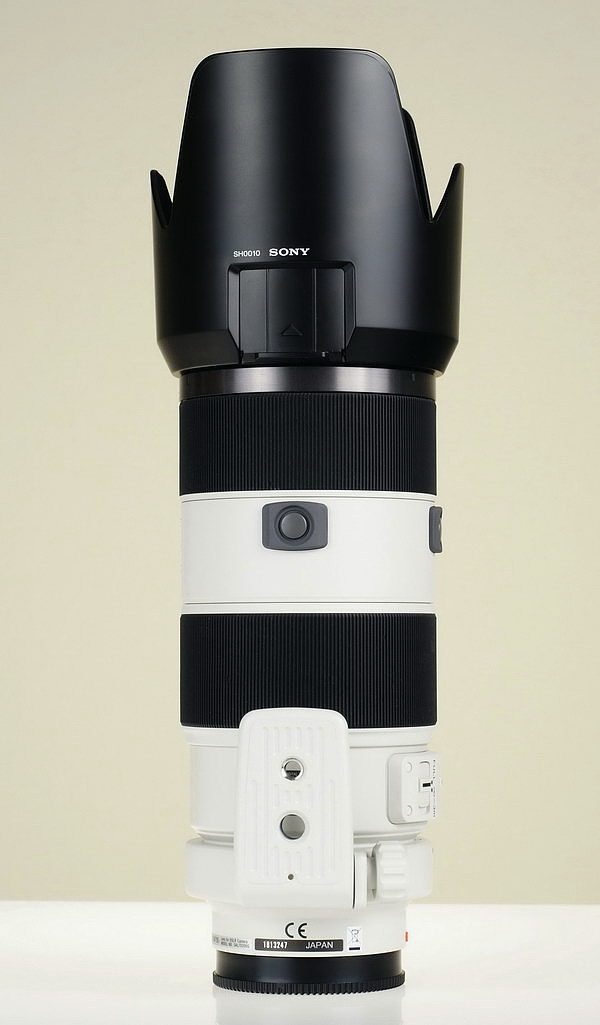
The Sony 70-200mm F/2.8 G is a very expensive, well built lens designed for the discriminating advanced amateur and professional photographer.

The lens is off-white in color with black rubber non-slip grip areas on the focus and zoom rings.  The lens has a few features that some other Sony lenses don’t have, like three focus hold buttons, which can be changed to DOF in the camera menu on select bodies.  SSM, or Super Sonic Wave motor that’s built into the lens, which is very accurate, smooth and quiet.  Also, there are three switches on the left side.  On top is A/F M/F, in the middle is a very handy direct manual focus switch offering standard or full time instant auto-focus over-ride.  On the bottom is a focus limiter switch, full, or 3 meters to infinity.  You also have the standard focus distance window, and the focal length numbers coming at 70mm, 100mm, 135mm and 200mm.  The EXIF data matches the marks.  Filter size is a handy 77mm, the same as most wide angle lenses.  Sony says they use 4 ED glass elements in the construction of the lens.

Focusing is very accurate and smooth.  Manual focusing is simply adjusting the focus while in auto-focus mode, it’s instant, and overrides the AF, so no switches have to be thrown.  It takes over 1/2 turn from close-in to infinity focus, almost too much.
In the box you get a carrying case that attaches to your belt loop—You’ve got to be kidding!  But on the other hand, some people would love to steal this from you.  Keep that in mind when changing lenses amongst a group of people or throwing it in a car in full view.
My initial thoughts are: the focus ring is a bit tight for one finger turning, but it may loosen up a little after more use.  Also, it’s a 180° turn from close-in to infinity, but it does offer excellent control of focus as a result.  Zooming takes about the same effort as focusing manually.  I’d like it a bit more loose, again, that may come with more use.
Bokeh.  The Sony 70-200mm F/2.8 has excellent bokeh, and doesn’t seem to vary from different focal lengths.  Very pleasing even stopped down.  See samples below.

Distortion.

Aug08/70200brl.jpg
70mm, slight barrel distortion, but not an issue.
2008/S70200pin.jpg
200mm, a tiny amount of pincushion, again, not an issue.
Distortion is almost non existent at 70mm, and 200mm.  If you like looking at your pictures with a grid overlay, there’s some very mild barrel and pincushion distortion.   Barrel distortion ends around 100mm, then pincushion starts.  See full frame results at the bottom of the page.
Color is the same as other Sony lenses, but slightly warmer than Minolta lenses.
Filter size is 77mm.  Other lenses in the Sony lineup using this size are: 11-18mm, CZ 135mm, CZ 24-70mm, CZ 16-35mm and the 70-400mm G.
Filter use.  There’s some slight additional vignetting when using a regular filter at the 200mm end, F/2.8.  None on an APS-C camera.
Lens flare/ghosting.  There is an issue here, the lens has a lot of groups and elements, so it’s easy to guess you’ll get a lot of ghosting close to the sun, but only when the sun is in, or close to the image.  Small multi-colored blobs show up at 70mm to 100mm or so, then much more muted arcs are seen towards the long end of the zoom.  Veiling glare is heavy towards the long end, but only when the sun is close.  Shooting directly at a setting (or rising) sun produces no ghosts.  The hood really doesn’t do much, your hand is better if you can hold the camera and lens with the other hand, not very easy.  In normal situations, you aren’t going to be shooting in the sun anyways, plus the field of vision is limited, allowing careful scene selection.  The included hood is very big, and plastic.  There’s a door at the bottom for turning a polarizing or grad filter.  There’s also a textured (velvet) type finish on the inside of the lens hood to reduce reflections, and it’s a dirt magnet.  Sony will drain your wallet of $100 to replace this hood.  This is a massive profit generator.
Lateral color fringing.  Average control here.  In normal viewing situations, you probably won’t see any.  For the most part, you’ll see red/purple fringing at edges of extreme contrast, like white roof tops against dark A/C units.  This type of color fringing doesn’t get better by stopping down.  Check out the macro shot at the bottom, and the black letters in the corners.
Random shots below.
Sun centered, 70mm @ F/5.6
Sun in shot, 70mm @  F/5.6
october08/70200ffsunctr3.jpg october08/70200ffsunoff3.jpg
Bokeh, 70mm @ F/2.8
Bokeh, 70mm @ F/4
September2009/26w70200f28bokz.jpg September2009/27w70200f40bokz.jpg
Bokeh, 200mm @ F/2.8
Bokeh, 200mm @ F/4
September2009/1770200f28telz.jpg September2009/1670200f40telz.jpg
With the sun in the center of the shot, things look good.  At an angle, (right top shot), you’ll see multi-colored blobs extending in a line from the sun.
Bokeh looks smooth at F/2.8 or F/4, and seems very similar in appearance at 70mm through 200mm, but I think the absolute smoothest is around 70mm.
Light fall-off.  As you can see, light fall-off or corner shading is moderate at F/2.8 and 200mm, though it blends nicely towards the middle so I wouldn’t consider it a problem.  If you’re using F/2.8, this will probably not matter anyways.  At 70mm, there’s nothing to worry about.

           200mm @ F/2.8
          200mm @ f/4
          70mm @ F/2.8
2008/20028viga.jpg
2008/20040viga.jpg
2008/7028viga.jpg
Corner and center sharpness.

Below are crops from the centers at 200mm.

2008/ctr80a.jpg
This is the overall view of the crops below.
F/2.8
2008/7020079a28.jpg
F/4
2008/7020080a40.jpg
F/5.6
2008/7020081a56.jpg
F/8
2008/7020082a80.jpg
F/11
2008/7020083a11.jpg
These real-world images show a slightly soft F/2.8, sharpening up nicely at F/4.  Maximum sharpness comes at F/5.6, which is more evident in the test chart centers below.  Also, in real-world shots you wouldn’t be using F/2.8 in this light and scene.  Here, near sunset, F/2.8 was 1/1250s at ISO 200.
F/2.8
2008/7020017a28.jpg
F/4
2008/7020016a40.jpg
F/5.6
2008/7020015a56.jpg
If you like taking pictures of stamps, use F/5.6.  The detail here is extreme, and wouldn’t necessarily show up in normal use, as in the first set of shots.

Below are some corner samples for you to enjoy.

2008/cor74a.jpg
This is the overall view for the corner crops below.
F/2.8
2008/7020070a28cor.jpg
F/4
2008/7020071a40cor.jpg
F/5.6
2008/7020072a56cor.jpg
The 200mm corners are the same as the centers, I’m showing these for people who don’t believe what I say.  Again, soft at F/2.8, but the same as the centers, and sharp by F/5.6.  It’s really tough to get the best sharp focus at F/2.8, in the centers or corners.  I burned a lot of frames for this!  Spot focusing works well though.

The 70mm to mid-range center and corner shots were the same as the 200mm, so I didn’t post another set of ridiculously boring pictures.  Most people will probably use this at or near 200mm anyways.  If you want 70mm or 100mm, go buy an excellent Sony 100mm F/2.8 macro lens and save yourself $1200.

Below check out some center comparisons I’ve made using much less expensive lenses.

Sony 70-200mm F/2.8 G lens at 200mm F/8
2008/7020040a80.jpg
Minolta AF 70-210mm F/4 lens, at 210mm f/8
2008/7021051a80.jpg
Sony 75-300mm F/4.5-5.6 lens at 200mm F/8
2008/7530058a80.jpg
Above are centers from the lenses listed, all taken at F/8.  The Sony 70-200mm is the sharpest, but not by much, and remember, these are 100% crops.  Least sharp, but not by much is the Minolta 70-210mm.  If you’re shooting in normal daylight like here, you don’t need to spend $1700 for a good lens, get the other ones for about $200 each.

Let’s check out the macro capabilities of this lens.

Below, check out the sample and click the picture to see a 100% cropped portion of the full image (256kb file).  The sample shot was taken with the Sony A 700 12.2MP camera.  The subject is a standard US stamp, 1″x 3/4″ or 25.4mm x 19mm.  Also, note the macro shot was taken as close to the subject as focusing allowed; in this case a lengthy 36″ or .91m, measured from the front of the lens barrel to the subject.

The macro is very sharp and detailed for .21x magnification, and it should be.  This shot was taken at F/8, but looked the same at F/5.6, the F/5.6 shot gave me an exposure dip so I used the F/8.

As close as you can get macro, at F/8.


End of regular review, now on to the full frame results.


Full frame results using the Sony A900 below.


Check out the differences when using a film or full frame camera below.  I’m only pointing out the noticeable issues as compared to the APS-C bodies, so if I don’t show it here, the results are not significantly different enough to warrant posting an additional set of images in this section.


Light fall-off


         70mm F/2.8
          70mm F/4
october08/70200ffvigw28.jpg october08/70200ffvigw40b.jpg
         200mm F/2.8
          200mm F/4
october08/70200ffvigtel28.jpg
october08/70200ffvigtel40.jpg


Light fall-off is worse than the APS-C crops shown earlier.  At 200mm, F/2.8 shows heavy, but isn’t all that noticeable in real shots, see image below.


Full image from A900 below.


october08/70200ffover3.jpg


This full scene shows how the light fall-off from 200mm, F/2.8 isn’t so noticeable in real shots as opposed to the gray crops above.


70mm corner samples next.


         F/2.8
          F/4
october08/ff28cn.jpg october08/ff40cn.jpg
         F/5.6
          F/8
october08/ff56cn.jpg
october08/ff80cn.jpg
         F/11
          F/8 at center
october08/ff11cn.jpg
october08/ff80cnctr.jpg


The 70mm corners suffer from low contrast, and have an overall soft look.  They don’t seem to sharpen up too much by closing down the aperture, and the contrast never seems to catch up to the centers, as I show in the bottom right shot.  F/8-11 looks the sharpest.  These crops were taken from the extreme corners, about 250 pixels in.  Things sharpen up nicely around 700 pixels from the corners.  Color fringing is very noticeable in these 100% crops along the sides, but none in the centers, as you can tell in the bottom right image.  It’s shows up more with full frame coverage.


200mm corners below.


         F/2.8
          F/4
october08/70200ffcntel28w2.jpg october08/70200ffcntel40w2.jpg
         F/5.6
          F/5.6 at center
october08/70200ffcntel56w2.jpg
october08/70200ffcntel56wctr.jpg


The 200mm corners don’t change much as you stop down, but look sharper than the 70mm crops.  I put the center crop at F/5.6 in the lower right.  You also notice the elimination of light fall-off at F/4.


Distortion next.


october08/70200ffbrl.jpg
Barrel distortion @70mm on A900
october08/70200ffpin.jpg
Pincushion distortion @ 200mm on A900


There is moderate barrel distortion at wide angle, and moderate pincushion distortion as you zoom out.  The results above are exacerbated by full frame coverage, and noticeably different from the APS-C crops shown earlier.


Conclusion.
The 70-200mm F/2.8 G telephoto lens performs very well overall.  In real world shots, F/2.8 is perfectly acceptable, with F/4 becoming very sharp at all zoom lengths, see above crops.  The mid-sections and corners sharpen up reasonably well at the short end, (although never close to being as sharp as the centers), and become quite sharp as you approach 200mm.  This lens is sharpest across the frame at the long end where is performs very well from F/4-5.6.  The 70-200mm F/2.8 is great for portrait work, where there is no concern about soft sides and corners.
Who would be in the market to buy this lens?  The 70-200/2.8 SSM is marketed at advanced amateurs and professional photographers; it’s also very large, heavy and expensive.  Do you shoot in normal daylight like most people?  You probably don’t need this lens.  If you really need the extra stop or two, say for low light sports or hand-held wildlife shooting, then it may be worth the money.  Do you need to use a teleconverter?  This is one of five lenses in the Sony lineup (as of this review) that will accept Sony teleconverters.  For 90% of us, this lens isn’t necessary.  There are other options available for much less money.
Here’s a brief look at the Sony 70-300mm F/4.5-5.6 G SSM telephoto lens.  Scroll down for the main review.

Lens
Box contents
Front and rear caps, hood, carrying case and users manual.
Cost
$998 retail
Build quality
Good, to very good.
Additional information
Huge upgrade optically and mechanically from the cheap Sony 75-300mm.
Specifications below
Optical configuration
16 elements in 11 groups
Angle of view
34°-8° full frame, 23°-5° APS-C.
Aperture
9 blades, circular
Full frame and APS-C
Yes, made for full frame.   APS-C equivalent, 105-450mm
Depth of field and focus scales?
Focus distance window.
Minimum focus, image plane to subject
48″  (1.2m)
Minimum focus, end of lens barrel to subject
33.5″  (851mm)
Hard stop at infinity focus?
No
Length changes when focusing?
No
Focus ring turns in AF?
No
Filter size
62mm
Filter ring rotates?
No
Distance encoder?
Yes
Max magnification
0.25x
Min. F/stop
F/22-29
Sony teleconverter compatible?
No
Length changes when zooming?
Yes
Dimensions WxL  (my measurements)
3.2″ x 5.3″   82mm x 135mm
Maximum  extended length (my measurements)
7.8″  (197mm)
Weight bare (my scale)
27oz  (767g)  28oz (795g) with caps, hood 2.2oz (61g)
Requisite product shots.

Aug08/70300box.jpg
Box and lens
Aug08/70300ft.jpg
Small front element.
June2009/70300sdxz.jpg
Side view.
Aug08/70300sdex.jpg
Fully extended
Aug08/70300cap.jpg
Inconsistent cap designs.
Aug08/70300bk.jpg
Backside mount.
Aug08/70300comp.jpg
Compared to Sony 75-300mm F/4.5-5.6 lens.
2012/70300mmmtf.jpg
Sony X-ray view and MTF chart
The Sony A700 and A900 were used for this review.  For full frame results, go to the bottom of the page.
For a better understanding of my review methods and terminology, go here.
The Sony 70-300mm F/4.5-5.6 G SSM is a somewhat expensive and well built lens designed for hobbyists and advanced amateurs that are looking for a little better color and contrast from what the entry level zoom offers (75-300mm).
The lens is matte to almost flat black, different than most other Sony lenses.  It has rubber ribbed non-slip grip areas on the focus and zoom rings.  It says “made in Japan” so I’m assuming it’s made in Japan.  The lens has a few features that some other Sony lenses don’t have, like a focus hold button, which can be changed to DOF in the camera menu on select bodies.  SSM, or Super Sonic Wave motor that’s built into the lens, which is very smooth and quiet.  Also, there is a switch on the left side with three different positions.  On top is auto-focus full range, in the middle is an auto-focus range limiter, 3 meters to infinity, and the bottom position is Manual focus.  You have simple direct manual focus, though there are no options as on the 70-200mm F/2.8.  You also have the standard focus distance window, and the focal length marks coming at 70mm, 100mm, 135mm, 200mm and 300mm, they match up with the EXIF data thankfully.  Sony claims they use an “ED” glass element in the lens.
In the box you get a carrying case, a large hood and the normal front and rear caps.  One thing that doesn’t make sense is Sony’s use of cap logos for identification.  On the 70-200mm F/2.8 G lens, you get the standard front cap with no “G” or orange “α” logo like you get on this lens.

The zoom and focus rings are reversed on this lens as compared to most other Sony lenses, but I like the focus ring close to the camera, it just seems to be a more natural position for me.  I tend to manual focus more so than zooming on-the-fly.  The focus ring rotates a little over 1/4 turn, and that’s a nice easy range in my opinion.  The zoom ring is pretty tight, and isn’t likely to creep out as you walk.  Hopefully, It’ll loosen up a bit as it wears in.  Extended all the way out to 300mm adds another 2.5″ (63mm) to the overall length of the lens.  No length is added for focusing.

Aperture/focal length guide below.
Sony 70-300mm G SSM F/4.5-5.6
Maximum aperture
          F/4.5
       F/5
        F/5.6
Range
70mm – 85mm
90mm – 130mm
135mm – 300mm
Sony 75-300mm F/4.5-5.6
Maximum aperture
          F/4.5
       F/5
        F/5.6
Range
70mm – 85mm
90mm – 110mm
120mm – 300mm
Lens flare/ghosting.  Very good control, and much better than the Sony 75-300mm.  Check out the goofy shots below where the sun is just at the corner.  I used no lens hood for either shot, and it wouldn’t have helped anyways.  If you use a hood or your hand, there wouldn’t be anything to worry about if the sun is just out of the frame.  Surprisingly good control.  You don’t need to use the big hood on the 70-300mm F/4.5-5.6.  Also, it has no window for filter adjustments or velvet like anti-reflective finish on the inside like the one on the 70-200mm F/2.8 G.  Replacement hood cost is $49.
Lateral color fringing.  Good control here, I see very little when I’m staring at white roof tops against dark A/C units at 100% on my computer screen.  Much better control than the Sony 75-300mm.   See comparison below.
Bokeh.  pretty smooth over the full range, much the same as the Sony 75-300mm.
Color.  The same as the rest of Sony lenses.
Filter size is 62mm.  Other Sony lenses with this size are: CZ 16-80mm, 16-105mm, 18-200mm, 18-250mm, 24-105mm.
Filter use.  Regular filters cause no additional vignetting on APS-C or full frame.
Distortion is mild at 70mm, and 300mm.  If you like looking at your pictures with a grid overlay, there’s some mild pincushion distortion from 70mm to 300mm.  It’s not a problem for me and you don’t see it in regular pictures.  Distortion performance is nearly the same as the Sony 75-300mm F/4.5-5.6.
Distortion examples
Aug08/70300pin4.jpg
70mm, mild pincushion.
Aug08/70300pin2.jpg
300mm, some mild pincushion, again, not much of an issue.


Lens flare/ghosting examples


Sony 70-300mm G SSM @ 70mm F/4.5 
Sony 75-300mm @ 75mm F/4.5
2008/70300flgh.jpg
2008/75300flgh.jpg


Above is a comparison between the less expensive Sony 75-300mm and our review lens.  The Sony 70-300mm handles flare and ghosting much better, and it should for three times the price.


Random shots below.


Sun centered, 70mm @ F/5.6
Sun in shot, 70mm @  F/5.6
october08/70300sunctr.jpg october08/70300sunoff.jpg
Bokeh, 70mm @ F/4.5
Bokeh, 70mm @ F/5.6
october08/70300ffbokw45.jpg october08/70300ffbokw56.jpg
Bokeh, 300mm @ F/5.6
Bokeh, 300mm @ F/8
September2009/70300f56bokb.jpg September2009/70300f80bokb.jpg
Ghosting is very well controlled with the sun centered, as in sunset or sunrise type shots.  At 70mm, when the sun is at an angle in the image, there are one or two small green and red blobs, though not really visible in the top right shot above.  At 300mm, things look good too.  Overall, very good control.
Bokeh looks good around 70mm at wide open apertures, but gets a little busy stopped down in my opinion.  Towards the long end, the background blur seems a little busy at F/8, but smoother wide open.
Below are color fringing examples for each lens.  100% crops.
Sony 70-300mm F/4.5-5.6 G SSM at 300mm F/5.6
2008/70300mca.jpg
Sony 75-300mm F/4.5-5.6 at 300mm F/5.6
2008/75300mca.jpg
As you can see, color fringing is controlled very well on the 70-300mm, not so with the less expensive 75-300mm.
Light fall-off.

As you can see, light fall-off or corner shading is mild at F/4.5 and 70mm, what little there is blends nicely towards the middle so I wouldn’t consider it a problem by any stretch.  One stop down and it’s clear.  At the other end, 300mm, there really isn’t any.  In actual use, you won’t notice any problems at any aperture.  This lens performed about the same in light fall-off as the Sony 75-300mm F/4.5-5.6.

           70mm @ F/4.5
          70mm @ f/8
          300mm @ F/5.6
2008/7045a.jpg
2008/7080a.jpg
2008/30056a.jpg
Center sharpness.

Below are crops from the centers at 300mm.

           F/5.6 
              F/8
Aug08/83a70300562.jpg
Aug08/84a70300802.jpg
The photos above indicate sharpness differences at about 25′ (7.6m).  The refrigerator magnet is about 1 3/4″ x 2″ (44-51mm).

Below are macro examples from the Sony 70-300mm G SSM at 300mm.  100% crops.

F/5.6
Aug08/70300mca562.jpg
 F/8
Aug08/70300mca802.jpg
If you like taking pictures of stamps with this lens, use F/8.  The detail here is extreme, and probably wouldn’t be noticeable in normal use outside.  There is very little difference between F/5.6 and F/8.  There’re no image examples from shorter focal lengths, simply because there aren’t any real differences from the 300mm shots, plus I don’t want to bore you silly with endless cropped images.
The corners are nearly the same as the centers at all focal lengths and apertures, so no rediculous shots of corners.
Below, check out the same shots with the less expensive Sony 75-300mm.
F/11
Aug08/9475300mc112.jpg
 F/5.6
Aug08/9675300mc562.jpg
Obvious here is the difference in sharpness of the two lenses at F/5.6.  Interesting enough, it looks pretty bad, but it isn’t so noticeable in real life shots.  When the 75-300mm lens is at F/11, things even out pretty close to the same between the two lenses, although I think the 70-300mm G SSM is just as sharp at F/5.6, but again, not noticeable at this point in real life images.  All images were taken at 300mm, but the other focal lengths results were similar to what you see here.  Also, the above images were taken with the Sony A700 and cropped and displayed at 100%.

Let’s check out the macro capabilities of this lens.

Below, check out the sample and click the picture to see a 100% cropped portion of the full shot (333kb file).  The sample shot was taken with the Sony A 700 12.2MP camera.  The subject is a standard US stamp, 1″x 3/4″ or 25.4mm x 19mm.  Also, note the macro shot was taken as close to the subject as focusing allowed; in this case a lengthy 33 1/2″ or .85m, measured from the front of the lens barrel to the subject.

The macro is very sharp and detailed with 0.25x magnification.

As close as you can get macro, at F/8.


Moving on to full frame samples below.


Full frame results using the Sony A900 below.


Check out the differences when using a film or full frame camera below.  I’m only pointing out the noticeable issues as compared to the APS-C bodies, so if I don’t show it here, the results are not significantly different enough to warrant posting an additional set of images in this section.


Light fall-off


         70mm F/4.5
          70mm F/5.6
october08/7045ffw.jpg october08/7056ffw.jpg
         300mm F/5.6
          300mm F/8
october08/300ff56.jpg
october08/300ff80.jpg


Light fall-off is worse than the APS-C crops shown earlier.  At 70mm, F/4.5 shows moderate to heavy, but isn’t all that noticeable in real shots, see image below.  It lessens as you stop down until F/11.  At 300mm, there isn’t much to worry about.


Full image from A900 below.


october08/70300ffover.jpg


This full scene shows how the light fall-off from 70mm, F/4.5 isn’t so noticeable in real shots as opposed to the gray crops above.


70mm corner samples next.


         F/4.5
          F/5.6
october08/70300ffw45.jpg october08/70300ffw56.jpg


The 70mm corners look sharp with plenty of contrast at F/4.5, and don’t need to be stopped down.  Very good performance, and better than the much more expensive Sony 70-200mm F/2.8 G lens.  The dark shot at F/4.5 is from light fall-off.  These crops were taken from the extreme corners.


300mm corners below.


         F/5.6
          F/8
october08/70300fftel56.jpg october08/70300fftel80.jpg


The 300mm corners don’t change much (if at all) as you stop down.  They look sharper than the Sony 70-200mm F/2.8 G crops, which is real good news if you don’t need the extra light.  You’ll also notice the lateral color fringing in the crops, stopping down doesn’t help.  The exposure differences are from light fall-off.


Distortion next.


october08/70300ffwdis.jpg
Pincushion distortion @70mm on A900
october08/70300ffteldis.jpg
Pincushion distortion @ 300mm on A900


There is moderate to strong pincushion distortion at both ends.  The results above are exacerbated by full frame coverage, and noticeably different from the APS-C crops shown earlier.


Conclusion.
The Sony 70-300mm F/4.5-5.6 G SSM telephoto lens is surprisingly sharp wide open, (at all focal lengths), sharpening up just a bit more one stop down.  In normal shooting, you’ll never notice the difference.  I wouldn’t hesitate to shoot wide open at any length on this lens, in fact, you will never notice any sharpness variations from different apertures unless you look at your images enlarged 100%.

This is what I like about the lens: Nice color rendition, sharp wide open at any length, instant auto-focus over-ride, very quiet and accurate focusing.  I also like the reversed Focus/zoom rings, it’s more natural for me.

The differences between the Sony 75-300mm F/4.5-5.6 and the Sony 70-300mm F/4.5-5.6 G SSM.  The 70-300mm has better control of; CA, flare and ghosting, contrast, and is sharper wide open.  It also has more accurate (especially at the long end) and potentially quicker focusing with the SSM and is better built than the 75-300mm.  The 70-300mm is $750 more.  If you’re a casual type weekend photographer, you can get similar results with the much less expensive 75-300mm, though you will need to stop it down to F/8-11.  The Sony 70-300mm F/4.5-5.6 is a little better all the way around, and will give you more confidence in your abilities by way of being more predictable at getting the shot in focus, and the fact that it’s sharp wide open, So you can maintain higher shutter speeds for those telephoto shots, especially at 300mm.

For full frame users; this lens performs very well on a full frame camera, in fact, you’re only giving up a little more distortion and light fall-off as compared to the APS-C results in the main review.  This lens gives better results in light fall-off, ghosting and corner sharpness than the much more expensive Sony 70-200mm F/2.8 G, as I’ve mentioned earlier.  If you don’t need the extra two stops, this lens will save you about $1000.
If you don’t have a whole lot of money, be sure and check out the highly recommended Tamron 70-300mm F/4-5.6 USD lens, (check price here), it’s very similar to the Sony, but less than half the price.
Here’s a brief look at the Sony 70-400mm F/4-5.6 G SSM super zoom lens.  Scroll down for the main review.

Lens
Box contents
Front and rear caps, hood, softcase and users manual.
Cost
$1998  retail, updated version II here for more money.
Build quality
Very good
Additional information
Works with Sony Tele-converters.  Also consider the Sony 70-300mm F/4.5-5.6 G SSM for much less money.
Specifications below
Optical configuration
18 elements in 12 groups
Angle of view
34°-6.2° full frame, 23°-4.2° APS-C.
Aperture
9 blades, circular
Full frame and APS-C
Yes, full frame and APS-C.   APS-C equivalent, 105-600mm
Depth of field and focus scales?
Distance window.
Minimum focus, image plane to subject
60″ (1.5m)  actual use; 53.5″  (1359mm)
Minimum focus, end of lens barrel to subject
40.5″  (1029mm)
Hard stop at infinity focus?
No
Length changes when focusing?
No
Focus ring turns in AF?
No
Filter size
77mm
Filter ring rotates?
No
Distance encoder?
Yes
Max magnification
0.27x
Min. F/stop
F/22, 32
Sony teleconverter compatible?
Yes, but manual focus only
Length changes when zooming?
Yes
Dimensions WxL  (my measurements)
3.7″ x 7.7″   95mm x 196mm
Maximum  extended length (my measurements)
11.1″  (282mm)     15.2″  (386mm) with hood!!
Weight bare (my scale)
52.2oz  (1481g) bare.   57.1oz (1618g) with tripod collar, and 61oz  (1731g) with hood, collar and caps.
Requisite product shots.

April2009/400kitz.jpg
Contents of box.
April2009/400bkz.jpg
Backside, and compatible with Sony tele-converters
April2009/400sdcam2z.jpg
Mounted on Sony A700.
April2009/400ftz.jpg
Front element with double light baffles in back
April2009/400detz.jpg
Silver color detail with switches and one of three focus hold buttons
April2009/400compz.jpg
Comparison to the Sony 70-200mm F/2.8 G on left
April2009/400doorzzz.jpg
Underneath showing tripod collar and hood window
April2009/400sdexzx.jpg
Fully extended
April2009/400sdinzx.jpg
Fully drawn in.
2012/70400mtf.jpg
Sony X-ray view and MTF chart
The Sony A700 and Sony A900 were used for this review.  For full frame results, go to the bottom of the page.  To better understand the review methods and terminology, go here.
The (made in Japan) Sony 70-400mm F/4-5.6 super zoom is a professional grade lens (large, heavy and expensive) aimed squarely at people with plenty of cash, and want convenience.  Amateurs may consider selling a couple of lenses they purchased, like the 70-300mm G and 500mm F/8 reflex so they can carry only one lens that will be better than both combined.  Is it possible?  Read on.
This super zoom sports the new SonySilver® paint job, resembling the finish on a $29 DVD player at Walmart.  That should tell you how much I like the new color, and finish, oh well.  I thought Sony may have just copied the old silver that Minolta used in the late 90s, early 2000s on their cheap lenses, but it’s not.  The new SonySilver® is brighter and less gold or Champagne looking.  Aside from the new color and slightly rough finish, the lens keeps the standard Sony rubber ribbed grip areas; they’re easy to grip when your hands are sweaty, but they also hold dirt and it’s hard to clean off.  In the box you get the standard front and rear caps, a nice soft-case, a hood and an owners manual.
On the outside, there’s a focus distance window along with three focus hold buttons, which can be changed to DOF on select camera bodies.  It also has an AF/MF switch with a focus limiter, ∞-3m in the middle, see picture above.  This lens doesn’t have a DMF switch.  Up front, the filter ring is thick, with plenty of threads to chew up if you like to force things on.  I also see two light baffles inside looking through the front.  These are used to control flare and ghosting.  The smaller sibling to this lens (70-300mm G) has only one.  This is one of a few Sony lenses that will work with Sony tele-converters, and they work OK (see full frame section) with this lens, but there is no auto-focus.
The EXIF data matches up with the focal length marks, which come at 70mm, 100mm, 135mm, 200mm, 300mm, and 400mm.   The lens is multi-coated with a mild magenta/green look typical for Sony lenses.  Sony claims the use of two “ED” glass elements in the construction of the lens.
Build quality is very good, and similar to the 70-200mm F/2.8 G.  It looks like it has some ABS around the barrel, and a plastic barrel extension tube.  The area around the tripod collar is metal, as is the collar itself.  The zoom ring is a little stiff in my opinion, but my copy is brand new, so it may free up some in the future.  No worries about zoom creep, which is good, as there is no zoom lock.  The included hood is plastic and flimsy, but does the job.  It sports a velvet like anti-reflective coating on the inside, and a little door underneath so you can open it and adjust your polarizer or grads.  I don’t like the somewhat loose fit of the hood, but it doesn’t seem to want to fall off during normal use.
Auto-focusing is very fast, accurate and silent.  Spot focusing is nearly perfect at all lengths using my A700 or A900!!  Manual focusing takes a little over 1/4 turn from Close-in to infinity, with no back slop.  All the Sony SSM units (so far) have an over-drive manual focusing system, that is, if you turn the focusing ring a certain amount, the distance numbers in the window will turn a lesser amount.  This allows for more precise manual focusing.
Lens flare/ghosting.  Control is very good.  There’s a small orange blob that shows up when the sun is in the shot, off center.  It’s very small and wouldn’t necessarily show up at all–depending on background content and exposure values.  There’s the usual veiling glare as you zoom in, but if you use the included hood, or your hand, the problem is easily reduced, but only when the sun is outside of the frame.  Check out the samples below.  This lens has excellent control of ghosting, and is a class leader among zooms!!
Lateral color fringing.  Very good control, and among the best of all the fast mid-zooms I’ve tested.  I see a small amount in the corners at long focal lengths, see the 400mm  full frame corner crops.
Bokeh.  Good at 70mm or so, then it gets progressively busy as you move out towards 400mm.  See samples below.
Color.  Similar to other Sony lenses, maybe slightly blue.
Coma.  None on a full frame or APS-C camera.
Close-up filter.  N/A.
Filter size is 77mm. This size is becoming more popular every year for Sony.  They also use it on the CZ 16-35mm F/2.8, CZ 24-70mm F/2.8, 70-200mm F/2.8 G, CZ 135mm F/1.8, and the DT 11-18mm F/4.5-5.6.
Normal filters cause no additional vignetting on APS-C or full frame cameras.
Sony tele-converters work just OK, and there is no AF.
Distortion.  See below.  Mild pincushion at all focal lengths, except towards the end of the zoom on full frame which shows moderate pincushion.  Overall, very good control.
Distortion examples
April2009/70400dis.jpg
70mm, mild pincushion distortion.
April2009/70400dis2.jpg
Mild pincushion at 400mm.
Aperture/focal length guide below.
Sony 70-400mm G SSM F/4-5.6
Maximum aperture
          F/4
       F/4.5
        F/5
        F/5.6
Range
70mm – 90mm
90mm – 140mm
150mm – 210mm
230mm – 400mm
Sony 70-300mm G SSM F/4.5-5.6
Maximum aperture
          F/4.5
       F/5
        F/5.6
Range
70mm – 85mm
90mm – 130mm
135mm – 300mm


The overlapping numbers are normal, and depend on tiny rotational movements of the zoom ring.  The 70-400mm drops to F/5.6 at 230mm, where as the 70-300mm changes to F/5.6 at 135mm.


Random samples

Small orange blob, 70mm F/5.6
Glare at 400mm F/5.6, sun out of image
April2009/400mmght1.jpg
April2009/400mmght2.jpg
Bokeh,  70mm F/4
Bokeh,  70mm F/5.6
April2009/70400mmf2ffbokw40.jpg
April2009/70400mmf2ffbokw56.jpg
Bokeh,  400mm F/5.6
Bokeh,  400mm F/8
April2009/400bokfff56b.jpg April2009/400bokfff8b.jpg
Full resized images with samples of flare/ghosting above.  Excellent ghosting control at all focal lengths.   I see a very small orange blob whenever the sun is in the image and off-center, usually at the short end, below 100mm.  When centered, there’s no problem.  Zooming in shows a normal amount of veiling glare, the hood helps, but you’ll still need to use your hand to block any bright lights (especially the sun) from hitting the front element.   Also, don’t lose the hood that came with this lens, as it will set you back $100 for a new one–Sony rip-off!!  In a nut-shell, this lens has about the best control of any Sony zoom when shooting with the sun close to, or inside the image.
Bokeh examples above, look pretty good at 70mm, but as you zoom out, things can get a bit busy.  I originally thought the smaller sibling (70-300mm G) had a better zoomed out bokeh, but upon further examination, found both had different bokeh characteristics, but neither one being “better” than the other.   Also like its smaller sibling, bokeh can look busy when highlights are just barely out of focus, but with a little more distance or blur, it quickly becomes very pleasing, which is true for most telephotos, as it’s easy to pick a different background.
Light fall-off.
Light fall-off or corner shading is non-existent on a cropped sensor camera, but see full frame results at the bottom of the page.

           70mm F/4
             400mm F/5.6
April2009/70400vigw.jpg
April2009/70400vigtel.jpg
Center and corner sharpness.

Below are crops from the 400mm image centers on the left, and the corners on the right.

           400mm F/5.6 center
              400mm F/5.6 corner
April2009/400mmctrf5.6tel.jpg
April2009/400mmcnf5.6tel.jpg
           400mm F/8 center
              400mm F/8 corner
April2009/400mmctrf8tel.jpg
April2009/400mmcnf8tel.jpg
The 400mm center crops show improvement by stopping down to F/8, where they look very sharp, F/11 looks the same, (not shown) so no need to stop down further for sharp shots.  The corners (on right) show a little contrast loss wide open, but look fine one stop down, and are the same at two stops down, not shown.   All crops were taken at infinity focus, at about 250 meters/yards.
Below, look at the 70mm centers on the left, and corners on the right.
           70mm F/4 center
              70mm F/4 corner
April2009/400mmctrf4w.jpg
April2009/400mmcnf4w.jpg
           70mm F/5.6 center
              70mm F/5.6 corner
April2009/400mmctrf5.6w.jpg
April2009/400mmcnf5.6w.jpg
On to the 70mm centers, where the results are pretty much the same as the 400mm shots, pretty sharp wide open at F/4, then maybe a hair sharper one stop down, but only visible blown way up on a computer screen.  I see a tiny bit of contrast loss at the corners wide open, but again, one stop down and things look better.  Remember, you’re looking at 100% cropped portions of the original images, at normal viewing sizes, there is no noticeable image softness at any aperture or focal length.
Let’s check out the macro capabilities of this lens.

Below, check out the sample and click (412kb) for a 100% cropped portion of the full image.  The sample shot was taken with the Sony A 700 12.2MP camera.  The subject is a standard US stamp, 1″x 3/4″ or 25.4mm x 19mm.  Also, note the macro shot was taken as close to the subject as focusing allowed; in this case a rather long 40.5″ (1029mm), measured from the front of the lens barrel to the subject.
As close as you can get, F/5.6.
The Sony 70-400mm G SSM has a rather large reproduction ratio of 0.27x, and turned in a great close focus shot, taken at F/5.6, it doesn’t get any sharper by stopping down when focused this close.

Full frame results using the Sony A900 below.

Check out the differences when using a film or full frame camera below.  I’m only pointing out the noticeable issues as compared to the APS-C bodies, so if I don’t show it here, the results are not significantly different enough to warrant posting an additional set of images in this section.


Light fall-off

         70mm F/4
          70mm F/5.6
April2009/70400vigwf4.jpg April2009/70400vigwf56.jpg
         400mm F/5.6
          400mm F/8
April2009/70400vigtelf56.jpg
April2009/70400vigtelf8.jpg


Light fall-off is moderate at 70mm, F/4, but it isn’t all that noticeable in real shots, see image below.  One stop down and everything looks good.  No real problems at 400mm F/5.6.


Full image from A900 below.

April2009/400mmvigwf4.jpg


Here’s a 70mm F/4 shot highlighting the worst of the light fall-off.  It’s hardly noticeable even against a uniform blue sky.  The picture almost looks like an oil painting, why is that?


70mm corner samples next.

         F/4
          F/5.6
April2009/400mmffwcnf4.jpg April2009/400mmffwcf56.jpg
         F/8
          F/4 from center
April2009/400mmffwcf8.jpg
April2009/400mmffwcnctrf4.jpg


The 70mm corners show very gradual improvement up to F/8.  I threw in a center crop for comparison.  Obviously there isn’t as much contrast in the corners, but the results here are still good for full frame, and wouldn’t be noticeable unless greatly enlarged, like I’m doing here.  These crops were taken from the extreme corners, exposure differences are from light fall-off.


400mm corners below.

         F/5.6
          F/8
April2009/400mmfff56cn.jpg April2009/400mmfff80cn.jpg


The 400mm corners sharpen up a little as you stop down, but not much, and there isn’t much difference between the sharpness changes above, and the APS-C shots.  The corners aren’t as sharp as the centers, but they still hold up well, and don’t forget you’re looking at 100% crops of the full image, at normal enlargements or viewing sizes, you’d never see any difference.  You can see the lateral color fringing in the crops above, this type is seen along the edges of the image, and doesn’t go away by stopping down the aperture.


Distortion next.

April2009/70400mmf2disffw.jpg
Pincushion distortion @ 70mm on A900
April2009/70400mmf2disfftel.jpg
Pincushion distortion @ 400mm on A900


There is very mild pincushion distortion at the short end, and moderate pincushion as you reach 400mm on the A900.  At full zoom, the distortion looks to be about the same as the Sony 70-300mm G, but less around 70mm.  I’d say this lens does a real good job at controlling distortion.

_________________________________________________________________

Bonus section with comparisons to other Sony lenses!


First, a look at the area covered by 400mm, then 300mm.

Sony 70-400mm, @400mm F/5.6
Sony 70-400mm, @300mm F/5.6
April2009/400mm651cmp.jpg April2009/400300cmp654.jpg
Sony 70-400mm, @400mm F/5.6
Sony 70-400mm, @300mm F/5.6 upsized to match 400mm image
April2009/400mm651cmp.jpg
April2009/400300cmp654a.jpg


Here we see what the difference is between 400mm, and 300mm.  The top row shows 100% crops from the business card taken from 50′ (15m) away.  The second row shows the sharpness difference if you greatly enlarged your shot, say for instance, using your 70-300mm G at 300mm, as opposed to using the extra 100mm length with the 70-400mm.  The texture of bird feathers will really show this difference when you’re up close.  If you don’t enlarge your images, or look at them blown way up on a computer screen, the differences you see above wouldn’t be noticeable.  Both left side images are the same.


Sony 70-400mm G, @300mm F/8 using A900
Sony 70-300mm G, @ 300mm, F/8 using A900
April2009/400notc300f8663.jpg April2009/70300at300f8668.jpg
Sony 70-400mm G, @300mm F/5.6 using A700
Sony 70-300mm G, @ 300mm, F/5.6 using A700
April2009/400at267.jpg April2009/70300at262.jpg
Sony 70-400mm, @400mm,  upsized to match 500mm reflex
Sony 500mm F/8 reflex
April2009/651400up500.jpg
April2009/500mmf8.jpg


The subject above, and below, is a standard sized business card, taken at a distance of about 50′ or  15 meters.


The top row shows the difference between the Sony 70-400mm G lens, and the Sony 70-300mm G, taken at 300mm, F/8 with the A900.


You’ll notice the sharper shots in the middle row when using an APS-C camera, (A700 here) due to the crop factor and pixel density.


The last row shows a big difference when comparing the 70-400mm G with the 500mm F/8 reflex lens.  The huge difference is not as apparent with real subjects at long distances through atmosphere, but the contrast on the 500mm reflex is obviously lower when compared to the 70-400mm @400mm, see larger real-life crops farther down the page.

Sony tele-converter results and recommendations.


No TC, upsampled to match 1.4X.
Using the 1.4X TC
April2009/400mm651aa.jpg April2009/400mm647aa.jpg
using 1.4x TC, upsampled to match 2.0X.
Using the 2.0X TC
April2009/40014tc647ups.jpg
April2009/40020tc640.jpg


The Sony tele-converters seem to provide only a slightly sharper image when compared to an upsized shot with no tele-converter used.  I do this so the image sizes match up and are easier to directly compare.  The difference using the 1.4x is noticeable, but only upon very close inspection, and the same for the 2.0x.  The differences you see here will not be noticeable unless you look at 100% crops, or print huge enlargements.  All images above were taken at 400mm, using the A900.


Please note; the Sony tele-converters are not compatible with auto-focusing on this lens, so you’ll be focusing manually, no easy task, especially without the “type M” screen in your camera.   You’ll also be getting F/8 with a 1.4x, and F/11 using the 2.0x at 400mm.  EXIF data shows the tele-converter used, and the corresponding focal length.  Don’t use the tele-converters much below 400mm, it makes no sense.


Comparison of the Sony 70-400mm G, and the Sony 500mm F/8 reflex below.


April2009/699a500cmp.jpg
Sony 500mm F/8 reflex
April2009/707400cmp.jpg
Sony 70-400mm G @400mm, unpsized to match 500mm reach


Th two 100% crops show the difference between sharpness of the two lenses, even though the 70-400mm G lacks the reach of the 500mm reflex lens.   The 70-400mm G image was upsized to match the 500mm reflex lens image.  The 70-400mm shows more contrast, (check the rock out at lower right) even upsized, which shows either this lens is really good, or the 500mm reflex isn’t so good, or a combination of both.  If I used a 1.4x tele-converter, the 70-400mm would be slightly sharper yet.  People who own the 500mm reflex and purchase the 70-400mm should consider getting rid of their 500mm reflex in my opinion.  The A900 was used in the crops above.  Heat shimmer was present, and the crops above are indicative of the average shot.


Conclusion. 

I initially thought the Sony 70-400mm F/4-5.6 G SSM would be about the same optically as the smaller, and much less expensive Sony 70-300mm F/4.5-5.6 G SSM, but with a little more reach.  My initial thoughts were wrong; I can say now this lens is a little better all the way around, and performs very well at 400mm, even giving a sharper image than the longer Sony 500mm F/8 reflex.


The build quality is very good, though there are some plastics used, (I’m sure it helps keep the weight down).  Focusing accuracy is spot-on with my cameras, I think this is an exception, or not?  sharpness wide open is very good, with best results coming only one stop down.  Color fringing and light fall-off are not noticeable unless you’re looking for it.


The only real negative I can think of is quite often the long end bokeh looks harsh.  I fired off a lot of shots, in a lot of different situations.  Sometimes background blur looked harsh, sometimes it looked very smooth, it depends mostly on focus and distance, and not much by aperture.  I like a smooth bokeh, but I wouldn’t let a harsh bokeh stand in the way of owning this lens.  One other thought, and not really a negative; this is no walk-around lens, it’s slightly bigger and heavier than the Sony 70-200mm F/2.8 G lens, something you might want to consider if you like to pack light.


Bird shooters will want to eBay their 500mm reflex and 70-300mm G SSM lenses and buy this one, it’s that good.  Be warned though; tele-converter use without a tripod is foolish, and the extra detail is marginal as I show above.  Hand jitter at 800mm is crazy, so don’t expect the steady shot system to compensate for it.  Manual focusing is a pot-luck affair at 400mm hand-held, much less at 560mm or 800mm full frame, APS-C cameras equal 600mm at full zoom, 840mm with a 1.4x, and 1200mm with the 2.0x.  I had a hard time getting the best focus on a tripod—and bracket focusing.  In a nut-shell, tele-converter use is probably not a good idea with this lens, considering the loss of auto-focus, and light gathering power.


The highly recommended Sony 70-400mm F/4-5.6 is an all-around winner and worthy of the fairly hefty price tag.  If you have the cash, get this lens!

Here’s a brief look at the Sony 75-300mm F/4.5-5.6 telephoto zoom lens.  Scroll down for the main review.

Lens
SAL-75300  Sony 75-300mm F/4.5-5.6
Box contents
Front and rear caps, hood, and users manual.
Cost
$250 retail, hundreds available on eBay for much less.
Build quality
Good
Additional information
Don’t confuse this lens with the 70-300 G SSM, which is a big upgrade optically and mechanically-but costs more money.
Specifications below
Optical configuration
13 elements in 10 groups
Angle of view
32°-8° full frame, 21°-5° APS-C.
Aperture
7 blades, circular
Full frame and APS-C
Yes, full frame and APS-C.   APS-C equivalent, 112.5-450mm
Depth of field and focus scales?
Nothing
Minimum focus, image plane to subject
59″  (1.5m)
Minimum focus, end of lens barrel to subject
49.5″  (1.26m)
Hard stop at infinity focus?
No
Length changes when focusing?
Yes
Focus ring turns in AF?
Yes
Filter size
55mm
Filter ring rotates?
Yes
Distance encoder?
Yes
Max magnification
0.25x
Min. F/stop
F/32-40, listed wrong on Sony’s site, and users manual.
Sony teleconverter compatible?
No
Length changes when zooming?
Yes
Dimensions WxL  (my measurements)
2.8″ x 4.8″   71mm x 122mm
Maximum  extended length (my measurements)
7.5″  (191mm)
Weight bare (my scale)
16.1oz  (457g)  17oz (481g) with caps
Requisite product shots.

Aug08/75300box.jpg
Box and lens
Aug08/75300ft.jpg
Front element.
Aug08/75300sdex.jpg
Side view, fully extended
Aug08/75300bk.jpg
Backside mount.
Aug08/70300comp.jpg
Compared to the much better and more expensive Sony 70-300mm F/4.5-5.6 G SSM lens.
2012/s75300mmmtf.jpg
Sony X-ray view and MTF chart
The Sony A700 and A900 were used for this review.  For full frame results, go to the bottom of the page.  For a better understanding of my review methods and terminology, go here.
The Sony 75-300mm F/4.5-5.6 is the least expensive full frame compatible telephoto zoom lens Sony has to offer.  Sony has a similar lens, called the 70-300mm F/4.5-5.6 G, which is much better, and much more expensive than this one.  I’ll be making some comparisons occasionally between the two, so don’t get ’em mixed up.
The lens is Sony matte black, with a black rubber ribbed non-slip grip area on the zoom ring.  The focus ring is just plastic.  It says “China” so I’m assuming it’s made there, you never really know.  There is no distance scale, and the focus ring turns in AF, the front element turns also, so watch your grads and polarizers.  Fit and finish are pretty good, and the zoom action is smooth and doesn’t seem to want to creep out while you walk, but it will if you hike or run.  You have the focal length marks coming at 75mm, 100mm, 135mm, 200mm and 300mm, they match up with the EXIF data thankfully.  Sony literature indicates this lens has no fancy elements inside, like “ED” or whatever.  That’s why it’s cheap.
Auto-focusing is a little slow at the long end, but seems mostly accurate.  Manual focusing works surprisingly well, with about 1/3 turn from Close-in to infinity.  This lens is noisy when focusing, because the focus drive motor is in the camera body, and it couples with a screw to turn the focusing mechanism, like most Sony lenses.  That’s just the way it is.  It doesn’t have the high-tech silent focusing motor built in the lens like it’s more expensive brother, the 70-300mm G SSM.
Aperture/focal length guide below.
Sony 75-300mm F/4.5-5.6
Maximum aperture
          F/4.5
       F/5
        F/5.6
Range
70mm – 85mm
90mm – 110mm
120mm – 300mm
Lens flare/ghosting.  Average to below average control, not nearly as good as the Sony 70-300mm G.  Check out the goofy shots below.  There are colored blobs when the sun is in the image.  See photos below.  The supplied hood doesn’t work in this application, and only works so-so when the sun in near, or outside the edge of the frame.  You normally don’t need to shoot into the sun with a telephoto lens, unless taking pictures of the (rising or setting) sun, in which case if it’s dead center, there’s no problem.  The hood replacement cost is $25.
Color fringing.  Strong near the end of the zoom looking at white roof tops against dark A/C units enlarged on my computer screen.  Less at 70mm.  Much worse control than the Sony 70-300mm G, see comparisons below.  I see some color fringing at the center sometimes, stopping down will help, but if it’s near the image edge, stopping down doesn’t help.
Bokeh.  Very smooth over the full range, much the same as the Sony 70-300mm G.
Color.  The same as the rest of Sony lenses.
Close-up filter use is limited to 75mm or slightly longer with a +4.
Filter size is 55mm.  Other Sony lenses with this size are: 50mm F/2.8 macro, 100mm F/2.8 macro, 35mm F/1.4, 50mm F/1.4, 18-70mm kit lens and the 55-200mm zoom.
Filter use.  There’s some slight additional vignetting when using a regular filter at 75mm, F/4.5 on a full frame camera, none on APS-C.
Distortion is pincushion, and it’s very mild from 75mm to 300mm.  If you like looking at your pictures with a grid overlay you might see it on the outer portions with straight lines.  It’s not a problem for me and you don’t see it in regular pictures.  Distortion performance is nearly the same as the Sony 70-300mm F/4.5-5.6 G.  Look below for examples.
Distortion examples
Aug08/75300pincl.jpg
75mm, straight to very mild pincushion.
Aug08/75300pinfa.jpg
300mm, mild pincushion.


Random samples below.

Sun in shot, 70mm @ F/5.6
Sun in shot, 300mm @  F/5.6
october08/75300ffsunoff.jpg october08/75300ffsunofftel.jpg
Bokeh, 70mm @ F/4.5
Bokeh, 70mm @ F/5.6
August09/s75300bokw45.jpg August09/s75300bokw56.jpg
Bokeh, 300mm @ F/5.6
Bokeh, 300mm @ F/8
August09/s75300bokt56.jpg August09/s75300bokt80.jpg
Ghosting at 75mm is strong when the sun is in the image, look for a string of blobs heading for the sun.  At 300mm, there is a persistent red blob in the image, depending on how hard the angle is.  When the sun is in the center of the frame, there’s no problem.
Lower samples show bokeh, which looks harsh at the wide end at all apertures, at the long end, things smooth out some at F/8.
Below are color fringing examples for each lens.  100% crops.
Sony 70-300mm F/4.5-5.6 G SSM at 300mm F/5.6
2008/70300mca.jpg
Sony 75-300mm F/4.5-5.6 at 300mm F/5.6
2008/75300mca.jpg
The color fringing is strong at the long end.  These are 100% crops from the corners of the image, the centers are usually good.  The more expensive 70-300mm (top image) controls lateral color fringing much better.  This kind of color fringing doesn’t get better by stopping down.
Light fall-off.

As you can see, light fall-off or corner shading is mild at F/4.5 and 70mm, what little there is blends nicely towards the middle so I wouldn’t worry yourself sick about this.  One stop down and it’s clear, same goes for the 300mm shots.  This lens performed about equally in light fall-off as the Sony 70-300mm F/4.5-5.6.

           75mm F/4.5 
             75mm F/8
Aug08/7545c.JPG
Aug08/7580c.JPG
           300mm F/5.6 
             300mm F/8
Aug08/30056c.JPG
Aug08/30080c.JPG
Center sharpness.

Below are fruitless crops from the centers at 75mm.

           75mm F/4.5
              75mm F/5.6
Aug08/75mm45ctr.jpg
Aug08/75mm56ctr.jpg


Now the 300mm center crops.

           300mm F/5.6
              300mm F/8
Aug08/30056ctr.jpg
Aug08/30080ctr.jpg
The 70mm crops show very little improvement by stopping down, that’s good.  Out towards 300mm, stopping down helps much, but there’s no improvement past F/8 for long telephoto shots through loads of atmosphere.  This changes for close macro shooting though, see below.
Below, check out the maximum magnification stamp crops.
 F/5.6
2008/9675300mc56.jpg
F/11
2008/9475300mc11.jpg
Obvious here is the difference in sharpness between F/5.6 and F/11.  The F/8 shot is not too bad, but doesn’t show as good as F/11.  Note: while shooting the macro, I had to bracket my focusing, as I found out the sharpest shots came when the image in the viewfinder looked soft—odd.  This would be tough to do in the field.
Let’s check out the macro capabilities of this lens.

Below, check out the sample and click the picture to see a 100% cropped portion of the full image, (283kb file).  The sample shot was taken with the Sony A 700 12.2MP camera.  The subject is a standard US stamp, 1″x 3/4″ or 25.4mm x 19mm.  Also, note the macro shot was taken as close to the subject as focusing allowed; in this case a horrendously long 49.5″ (1.26m), measured from the front of the lens barrel to the subject.  Sometimes distance can be a good thing!
The macro is pretty sharp and detailed with 0.25x magnification.  It isn’t as sharp as the 70-300mm G shot though.

As close as you can get macro, at F/11.


On to the full frame section below.

Full frame results using the Sony A900 below.


Check out the differences when using a film or full frame camera below.  I’m only pointing out the noticeable issues as compared to the APS-C bodies, so if I don’t show it here, the results are not significantly different enough to warrant posting an additional set of images in this section.


Light fall-off

         75mm F/4.5
          75mm F/5.6
october08/75300ffvigf45w.jpg october08/75300ffvigf56w.jpg
         300mm F/5.6
          300mm F/8
october08/75300ffvigf56tel.jpg
october08/75300ffvigf8tel.jpg


Light fall-off is worse than the APS-C crops shown earlier.  At 75mm, F/4.5 shows heavy, but isn’t all that noticeable in real shots, see image below.  It lessens as you stop down until F/11.  At 300mm, there isn’t much to worry about.  Very similar results to the Sony 70-300mm F/4.5-5.6 SSM.


Full image from A900 below.

october08/75300ffover.jpg

This full scene shows how the light fall-off from 75mm, F/4.5 isn’t so noticeable in real shots as opposed to the gray crops above.


75mm corner samples next.

         F/4.5
          F/5.6, from center
october08/75300ffcnw45.jpg october08/75300ffctrw80.jpg


The 75mm corners look fairly sharp with decent contrast at F/4.5, and don’t need to be stopped down.  Good performance here, there isn’t much difference in these crops and that of the much more expensive Sony 70-200mm F/2.8 G lens, though the centers are very different.  The right shot shows the center at F/5.6 for comparison.  The exposure differences are from light fall-off.


300mm corners below.

         F/5.6
          F/8, from center
october08/75300ffcntel56.jpg october08/75300ffctr80tel.jpg


The 300mm corners don’t change any as you stop down.  I threw in a center crop (right) at F/8 to show what I’m talking about.  You’ll also notice the sometimes harsh color fringing in the corner crops, and also noticeable sometimes in the centers, though just barely.  The exposure differences are from light fall-off.


Distortion next.

october08/75300ffdisw.jpg
Pincushion distortion @75mm on A900
october08/75300ffdistel.jpg
Pincushion distortion @ 300mm on A900


There is very light pincushion distortion at 75mm, and moderate to strong pincushion at 300mm.  The results above are nearly the same as the APS-C crops shown earlier.  Good to very good distortion control.

Conclusion.
Final thoughts on the 75-300mm F/4.5-5.6 telephoto zoom lens: this lens is pretty sharp wide open, at 75mm up to 100mm or so.  Near, and at the long end, you’ll need to stop down to F/8 to make everything nice and sharp.  If you like shooting stamps up close, use F/11.  There are no issues with soft corners at any focal length.  Color fringing can be strong, but I went out of my way to make things look bad in this review, it won’t look like that in most pictures, but it does stand out occasionally.  Use Photo imaging software to get rid of it.   Light fall-off and distortion are very well controlled, so no problems here.
On a side note; the Sony 75-300mm is sharper at 200mm than the Sony 55-200mm is at 200mm.  Additionally, the 55-200mm is smaller, lighter, and has a sharper macro than the 75-300mm-that’s odd.  If portability is very important, and you won’t be upgrading to a full frame camera, I’d get the 55-200mm.  Also check out my review of the Minolta AF 75-300mm F/4.5-5.6 big beercan, which is built much better than the Sony version, but performs about the same.
The differences between the Sony 75-300mm F/4.5-5.6 and the Sony 70-300mm F/4.5-5.6 G SSM.  The 70-300mm G has better control of; color fringing, flare and ghosting, nicer color and contrast, (barely), is sharper wide open and has a sharper close macro shot.  It also has more accurate (especially at the long end) and potentially quicker focusing with the SSM and is better built than the 75-300mm.  The 70-300mm is $750 more.  If you’re a casual type weekend photographer, you can get similar results with the much less expensive 75-300mm, though you will need to stop it down to F/8-11 on the long end.
Full frame users;  This lens works very well on a full frame body, you’ll encounter more light fall-off, but that’s about the only difference between the APS-C crops shown earlier.
If money is a concern, I’d highly recommend the Tamron 70-300mm F/4-5.6 USD, (over the Sony 70-300mm G too), it’s better overall, and not much more expensive.

Sony 35mm F/1.4 G Lens Review

Here’s a brief look at the Sony 35mm F/1.4 G lens.  Scroll down for the review. Lens SAL-35F14G  Sony 35mm F/1.4 Box contents
Front and rear caps, hood, soft case and users manual. Cost $1498 retail Build quality Very good Additional information
Re-badged and slightly upgraded Minolta lens from the late 1990s.  Optical design dates back to the late 80s.…

Read more »

Sony DT 55-200mm F/4-5.6 Review

Here’s a brief look at the Sony 55-200mm F/4-5.6 telephoto lens.  Scroll down for the main review.
Lens SAL-55200  Sony 55-200mm F/4-5.6 Box contents
Front and rear caps, hood and users manual. Cost $200 retail Build quality Good, but plastic mount. Additional information
Similar to the more versatile Sony 75-300mm but less expensive. Specifications below
Optical configuration 13 elements in…

Read more »

Sony 70-200mm F/2.8 G Review

Here’s a brief look at the Sony 70-200mm F/2.8 G  telephoto lens.  Scroll down for the main review. Lens SAL-70200G  Sony 70-200mm F/2.8 Box contents
Front and rear caps, hood, carrying case and users manual. Cost $1998 retail Build quality Excellent Additional information
One of only five Sony lenses compatible with Sony TCs. Specifications below
Optical configuration 19 elements…

Read more »

Sony 70-300mm F/4.5-5.6 G SSM Review

Here’s a brief look at the Sony 70-300mm F/4.5-5.6 G SSM telephoto lens.  Scroll down for the main review. Lens SAL-70300G  Sony 70-300mm F/4.5-5.6 G SSM Box contents
Front and rear caps, hood, carrying case and users manual. Cost $998 retail Build quality Good, to very good. Additional information
Huge upgrade optically and mechanically from the cheap Sony 75-300mm. Specifications

Read more »

Sony 70-400mm F/4-5.6 G SSM Review

Here’s a brief look at the Sony 70-400mm F/4-5.6 G SSM super zoom lens.  Scroll down for the main review. Lens SAL-70400G  Sony 70-400mm F/4-5.6 G SSM Box contents
Front and rear caps, hood, softcase and users manual. Cost $1998  retail, updated version II here for more money. Build quality Very good Additional information
Works with Sony Tele-converters.  Also consider…

Read more »

Sony 75-300mm F/4.5-5.6 Review

Here’s a brief look at the Sony 75-300mm F/4.5-5.6 telephoto zoom lens.  Scroll down for the main review. Lens SAL-75300  Sony 75-300mm F/4.5-5.6 Box contents
Front and rear caps, hood, and users manual. Cost $250 retail, hundreds available on eBay for much less. Build quality Good Additional information
Don’t confuse this lens with the 70-300 G SSM, which is a…

Read more »

Scroll to Top