Photo Jottings - Page 80 of 127 - Photography equipment expertise

4/25/11

Will cheap APS-C only lenses handle 24mp resolution?

Some people are asking if the fictitious A700 replacement camera, (announced well over a year ago, and now known as the A77) which uses a new 24mp APS-C sensor, will be too much for the older APS-C only lenses, which were designed for 6mp, 10mp, and 12mp sensors, depending on how far back you want to go.

The answer, based on some simple tests with the 24mp Sony A900 is yes, most lenses should be able to show more resolution. Obviously, all the lens’ optical faults will be more noticeable, but that’s just the way it is.  I find the newer APS-C lenses seem better than the rebadged Sony full frame lenses, and much cheaper.  Look at the newest Sony “DT” lenses, like the excellent 35/1.8; its performance in some ways is superior to the (equivalent FF coverage) 50/1.4, which is better built, but a little outdated and more expensive.  So what I’m trying to say here is; just because a lens was designed for a smaller sensor, doesn’t mean it’s inferior to a full frame compatible lens.

Below are two crops from full size images, the top crop is from the Sony 16.2mp A580 and the bottom crop from the Sony 24mp A900. The lens used is the Tamron 60mm F/2 macro, which is for APS-C cameras only.  Note; I also tested the Sigma 10-20mm F/4-5.6, which responded about the same way as the Tamron.  I matched both APS-C and full frame capture areas by moving the camera and tripod, that’s why the perspective is different, and done this way replicates a 24mp APS-C sensor.  Bracket focusing (focus point is the “Grand Canyon” dream catcher on the cap) was used until the sharpest image was produced for each camera.  The A900 APS-C size capture feature is turned off of course.  Both images are from RAW.  The A580 crop has been upsized to match the A900 size, which makes it easy to see the differences.  The A900 has a slight disadvantage here, as the final capture area was a little smaller than the A580, but not really enough to be noticeable. It may look like there is a depth of field issue at the top of the cap, but that’s not the case, it’s the smaller detail in that areas that’s more apparent with the 24mp sensor, that’s why I used the cap with a fine weave.  I used F/5.6, 1/4 sec, WB 3100k trimmed to M3, ISO 200.

APRIL2011/tamtesta580.jpg
A580 with Tamron 60mm F/2 macro.
APRIL2011/tamtesta900.jpg
A900 with Tamron 60mm F/2 macro

4/22/11

Nothing much that’s newsworthy, so another file photo from the A700.

Here’s another sample image using the old and crummy Sony A700, now with a broken mirror.  The lens used for this architectural shot was the (also old and crummy) Sigma 10-20mm lens, which I still use and love.

This image was taken using five off-camera flashes, which wasn’t really enough, but that’s all I had at the time.  I placed one flash overhead, close to the camera side, and aimed it over the foliage towards the curved soffit above.  The next flash was placed on the lower patio area, fairly close to the ground by the wall, and pointed towards the foliage to bring out the tile texture and plants.  Also in this same general spot, but farther back (still out of view by the wall) is another flash that’s placed higher up, and pointed up to the curved soffit. On the next level down there’s another flash close to the wall by the spa, and pointed at the house wall with the stairs, you can see the shadows created by this in the larger version, click the image to check it out.  The final flash unit is to the right of the patio table on the lower level, out of view, and pointed at a tree and some foliage, but I ended up cropping this out as the wind was very strong causing too much blur, and I ended up not liking the composition, so that flash was wasted.  I darkened the area from the flash to match the light value of the rest of the right side.

I could’ve used a couple more flashes, or some powerful strobes.  I almost missed this shot as I was running back and forth trying to adjust the lighting placement and intensity while the best light was quickly going away, that’s the problem with doing a shoot without an assistant.

For the interior, I re-shot the living room area, firing a flash though the windows to light the backs of the chairs etc, and using two more inside the house, you can see the shadows from this set-up.

To finalize the image, I replaced the windows in the living room with the properly lit set and did the usual shadows, highlights, rotation and perspective (key-stoning) adjustments and some heavy noise reduction (the original image was a little underexposed, so raising the exposure in post processing increased the noise level). That issue isn’t the fault of the camera because it doesn’t have good high ISO ability, it’s because the camera operator didn’t
do his job.  The full image is a little soft, but shows well in my opinion.

Specs for the shot are; F/7.1, ISO 200 1/1 sec, about 14mm (21mm equiv) focal length after crop, and I think all flashes were at half or full power.

APRIL2011/celofinalhp.jpg
Click for larger version

4/20/11

Don’t wait for a phantom camera or lens.

It should be clear by now that Japan’s camera (and related accessories) manufacturing is going to be very slow to recover, but it will recover and be prosperous again, just not right away.

This brings up a good question, and one that I’ve been asked many times recently; do you delay buying a camera or lens that’s currently available, and simply try to wait it out, and hope that Sony comes out with the latest and greatest cameras and lenses this summer or fall, or do you just buy what’s on the shelf now?  For me, it’s an easy answer; you buy what’s available now!  Who knows, due to the current demand, and the inability of retailers to restock items, there may be shortages coming up this summer, (not to mention later on this fall and holiday season), which could drive prices up and over the suggested retail prices, and on top of that, you worry about the pent-up demand for the new stuff that will eventually come out, and the shortages that will result from it, so no matter what, you’re probably in for trouble in a few months if you wait.
Again, my advise it to either keep what you have and enjoy it, or buy something now.  I’ve been using the Sony A580 for a couple of months now, and find the image quality is very impressive, especially when recording in RAW.  It has a great feature set, like HDR and panorama, both are very well implemented.  High ISO noise reduction is very good, and easily beats the A700/A900 above ISO 1600.  The A580 also uses the same battery as the A900/A700 and some other Sony DSLR cameras, so you don’t need to buy a spare if you already have the NP-FM500H, that’s why I bought it over the A55, which is basically the same but has no optical viewfinder, and uses a different battery.
Of course, the A900/A850 are super good, even though they’re two years old.  If you’re in to pixel peeping, and want the best image quality at the best price, get the A850.
In my opinion, camera image quality hasn’t improved much from the last few years, and probably won’t in the near future.  Yes, mirror-less NEX and translucent cameras are cool, because they’re smaller and offer gimmicks.  Good high ISO performance, HDR, Pan, and some trick modes are nice, but are not a necessity, and can still be done in advanced image editing software.
 

4/19/11

Famous photo house flirts with disaster.

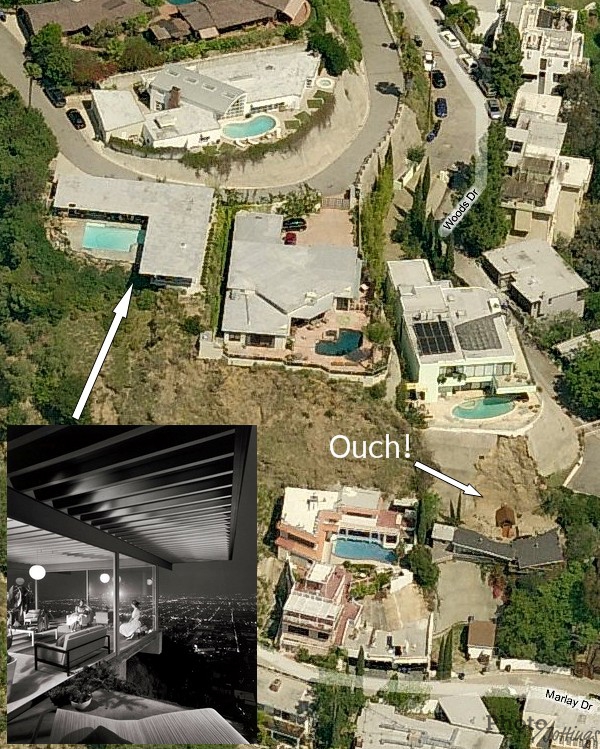
Since I enjoy photographing homes and architecture in general, and reading about great photographers, I thought I’d put together a little background information on one of the most famous house photographs ever taken, the Case Study house #22, (Stahl house).  What really made this house famous was Julius Shulman’s 1960 photograph, shown in B&W, inset.

Although the article is not yet finished, I thought I’d share this Google Earth image I came across while doing some research.  The larger image below shows the Hollywood hills Stahl house position in relation to the scary results of a typical California landslide, and how close they are; can you imagine if the ground under the Stahl house just gave way, and the whole thing tumbled down the steep hillside? What a loss that would be!
Ironically, Julius Shulman’s own Hollywood hills home suffered extensive damage from a landslide just a couple of miles from this location, before the Stahl house was built.  I guess when you build on top of one another like they do in California, eventually you’ll get wiped out, like the dude’s house in this picture.
 
APRIL2011/csh22bhp.jpg
Aerial view of Case study house #22, (Stahl house) made famous by Photographer Julius Shulman

4/17/11

All four 70-200mm F/2.8 lenses compared, and Sony DSLR news.

I posted the final version of the 70-200mm comp using the same crops as I have in each review, but now put side-by-side to see the differences between them.  There are some random observations added at the top also.  In a nut-shell, I’d say if you’re looking for the best image quality at the best price, the Tamron would be your top pick.  The Sigma HSM II is very good in both optical and build quality, but the dreaded Sigma quality control makes me not want to recommend it.  If money is not a huge issue, the Sony easily wins, especially if you buy a good used copy.  The Sigma OS isn’t all that great, and is too much money in my opinion.

Paul from Canada pointed out Sonystyle.ca has no APS-C DSLRs listed on the site, the only mirrored cameras are the full frame A900/A850.  Apparently, the end has come for traditional APS-C cameras from Sony, at least in Canada! I’m guessing the tragedy in Japan and the continuing manufacturing problems has Sony reassessing product priorities, and only the newer stuff will be advanced.

APRIL2011/4lenscomphp3.jpg
Click for 70-200mm comparison page

4/16/11

Sony A390 soon to be obsolete, and thoughts on other stuff.

Sonyalpharumors is reporting the Sony A390 may soon be added to the list of Sony products that are no longer available.  If true, the A560-A580 will be the only APS-C cameras with an optical viewfinder, and it wouldn’t surprise me to see those phased out soon too.

I liked the Vivitar 7mm fisheye I reviewed so much, I bought the loaner!  It’s wider than the Sony 16mm fisheye, but it’s made for a smaller APS-C camera.  Don’t worry about manual focusing and aperture, most of your daylight shots will be in the range of F/8-11 at infinity focus, with some exposure compensation dialed in when needed.

I’m starting to check out the Sigma 50mm F/1.4 HSM right now, let’s hope this copy is good!  I also have a Tamron 60mm F/2 macro lens.  If everything goes well, I’ll have those reviews posted by the end of the month or the first week of May.  Look for a quick review of the CLM-V55 Sony monitor next month.  I’m using it right now, and it’s pretty cool!

4/14/11

New ultra wide-angle lens from Sony coming soon?

Sony re-introduces the HVL-F43AM ($350) flash from a couple of months ago, not sure why though as the press release says it won’t be available until later this summer, at which time they’ll re-re-introduce it I guess.  What’s notable is the flash power levels are switchable in 22 increments, from modeling flash, 1/1 through to 1/128 level in 1/3 steps, it’s about time Sony!!  The current low 1/32 level is too much sometimes.  It also says it can detect white balance, and adjust, so can it detect when a gel is placed in front of the strobe?

Really interesting is the spec sheet for the new flash.  If you look carefully, (which apparently most people don’t) you’ll find the built-in diffuser will cover 15mm!  The last time Sony came out with a new full size flash it covered 16mm with the diffuser, and Sony didn’t have a 16mm lens at the time, but a couple months later the CZ 16-35mm appeared. So what do you think, a 15mm full frame prime, or maybe a 10-20mm APS-C lens like Sigma’s, which covers the equivalent of 15-30mm.  Anyhow, I just thought it was something to point out.
I see Sony has the hoods coming for the Sony 35/1.8 and 85/2.8, although they are both the same, and come with the lenses, so unless you lost your hood, this isn’t useful news.  The last item, and the only one that’s really new is the VCT-55LH bracket for mounting a light, or the new CLM-V55″ LCD, it’s a cold shoe mount, so it won’t carry any power, it just provides an additional place to stick something if your hotshoe is in use.

One last item; if you are looking to buy some camera stuff from B&H Photo very soon, make sure you order by 12pm this Sunday, otherwise you’ll be waiting for April 28th as a ship date. There are still hot deals on the NEX system.  Buying your goodies at B&H Photo allows me to review the latest camera gear.  Without your support, there won’t be any new reviews!!

4/13/11

Check out the review of the Sigma 70-200mm F/2.8 OS HSM lens.

The Sigma 70-200mm F/2.8 APO EX DG OS HSM (optically stabilized) is the final lens (thankfully) to be reviewed in the 70-200mm F/2.8 group of four, and also the most expensive after-market model.

Just like the last Sigma (see 4/6/11 post) lens reviewed, I used three lenses for this review, and all three seemed about the same in image quality, so I’m thinking the quality control for this lens is ok.

The Sigma 70-200mm OS build quality is good, (but not as good as the Sony), and it offers the same type of fast, almost silent focusing system that Sony uses (SSM).  Unfortunately, there are a couple of things missing on the lens that should be included in this price range; like some focus hold buttons and a focus limiter option to speed up focusing in certain situations.

The Sigma 70-200mm F/2.8 OS is pretty sharp from F/4 and up near the short end, however, as you zoom out near 200mm, the image sides are not as sharp as the Sony or Tamron equivalents. There are a few impressive qualities to this lens, like the stunningly sharp centers at F/2.8, 200mm, and the very smooth out of focus highlight blur (bokeh).  The lens based optical stabilization works well, and offers a little more practical advantage than Sony’s Steadyshot, see that comparison here.

Overall, I think the Sigma 70-200mm F/2.8 HSM telephoto zoom lens with optical stabilization is not all that impressive considering the price tag is in the neighborhood of the excellent Sony 70-200mm F/2.8 G.

APRIL2011/sigos70200sdhp.jpg
Go to review.

April 25 2011

4/25/11

Will cheap APS-C only lenses handle 24mp resolution?

Some people are asking if the fictitious A700 replacement camera, (announced well over a year ago, and now known as the A77) which uses a new 24mp APS-C sensor, will be too much for the older APS-C only lenses, which were designed for 6mp, 10mp, and 12mp sensors, depending on how …

Read more »

April 22 2011

4/22/11

Nothing much that’s newsworthy, so another file photo from the A700.

Here’s another sample image using the old and crummy Sony A700, now with a broken mirror.  The lens used for this architectural shot was the (also old and crummy) Sigma 10-20mm lens, which I still use and love.

This image was taken using five off-camera flashes, …

Read more »

April 20 2011

4/20/11

Don’t wait for a phantom camera or lens.

It should be clear by now that Japan’s camera (and related accessories) manufacturing is going to be very slow to recover, but it will recover and be prosperous again, just not right away.

This brings up a good question, and one that I’ve been asked many times recently; do you delay…

Read more »

April 19 2011

4/19/11

Famous photo house flirts with disaster.

Since I enjoy photographing homes and architecture in general, and reading about great photographers, I thought I’d put together a little background information on one of the most famous house photographs ever taken, the Case Study house #22, (Stahl house).  What really made this house famous was Julius Shulman’s 1960 photograph, …

Read more »

April 17 2011

4/17/11

All four 70-200mm F/2.8 lenses compared, and Sony DSLR news.

I posted the final version of the 70-200mm comp using the same crops as I have in each review, but now put side-by-side to see the differences between them.  There are some random observations added at the top also.  In a nut-shell, I’d say if you’re looking for the …

Read more »

April 16 2011

4/16/11

Sony A390 soon to be obsolete, and thoughts on other stuff.

Sonyalpharumors is reporting the Sony A390 may soon be added to the list of Sony products that are no longer available.  If true, the A560-A580 will be the only APS-C cameras with an optical viewfinder, and it wouldn’t surprise me to see those phased out soon too.

I …

Read more »

April 14 2011

4/14/11

New ultra wide-angle lens from Sony coming soon?

Sony re-introduces the HVL-F43AM ($350) flash from a couple of months ago, not sure why though as the press release says it won’t be available until later this summer, at which time they’ll re-re-introduce it I guess.  What’s notable is the flash power levels are switchable in 22 increments, from modeling …

Read more »

Scroll to Top