Photo Jottings - Page 13 of 127 - Photography equipment expertise

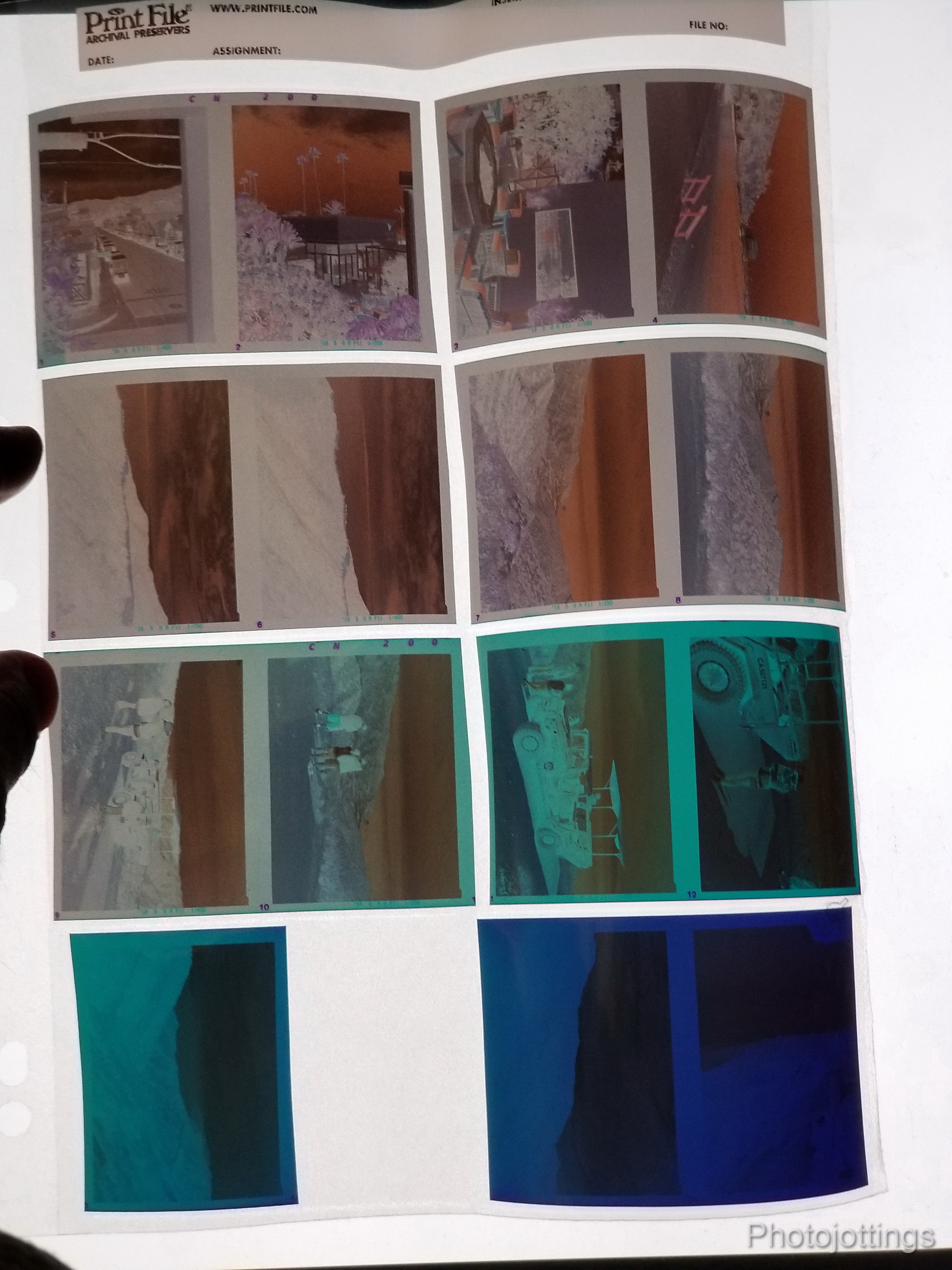
Either I got a bad roll of film, or this is the most pathetic film ever manufactured.  If you look at the picture of the Rollei Digibase CN200 negatives in the film preserver, you can see the color goes from a somewhat normal orange look, to cyan/greenish, and then totally blue.  Obviously, something must be wrong with the quality control, I don’t think it was with the developing, as my local lab did it in standard C-41 chemistry, which is what the film calls for.

Similarly named Rollie CR200 is a warm toned E-6 transparency film, which I thought had some nice qualities, even though I didn’t like the grain and resolution, I posted some samples here.  So I decided to try a roll of Rollei CN200, which is C-41 print film that has no mask, (can be processed using E-6 with a shift in color),and is supposed to scan well because it dries flat, has fine grain, high sharpness and vivid colors.  Unfortunately, this roll has none of those qualities, so I guess I received a bad roll.  Oh well, with processing that’s about $15 down the drain, plus a few hours of picture taking and scanning.  I’m quite sure that the exposures are appropriate, as that information is burned on the edge of the film with the Fuji GA645.  I’m also sure it was processed in C-41 as my lab no longer does E-6.

I may try the film out again, I’ll just try to remind myself to not take vacation pictures with film I know nothing about.

Go here for a pdf about the film.

Samples below, click for larger versions.

A fairly normal image from the first four pictures.  The shadows are very red/orange with a color shift of the sky.  It looks like film gone bad from the 1970s.

In this image, the color shift is ugly, and upon closer inspection, you can see red spots all over the film.  This will look ok when converted to black and white.

An image from the end of the roll, there is no saving this shot, it’s very dark but not underexposed based on the exposure data.

That’s it for this post.

equals a typical digital camera in 2018.  At least in resolution, but ok, maybe not in ease of use.  Click image for large version.

I took this shot while testing a folding pocket Kodak 3A camera out a couple of years ago.  I used Kodak (Verichrome Pan ASA 80) 122 Roll film that expired in 1971, but probably made in 1969, almost 50 years ago!  You get six 3¼” x 5½” pictures on a roll, (the same area as a 4×5!!), and I bracketed the shots so I’d be sure and get a good one, however, that wasn’t really necessary as all the images turned out pretty good.  The shot above was made at F/32, with a one second exposure time.  The sunny 16 rule puts my exposure about four stops longer than normal, and ‘normal’ being about 1/15s at F/32 with ASA 80 film.

I think I used Ilfosol 3 developer around 4-5 minutes in a tank.  It’s expensive to do just one roll at a time, with the film about $25 a roll (a few years ago, now it’s around $50-100 a roll depending on age), and developer, stop bath and fixer about half that, so about $5 a picture; save money and get the kodak combination back and use fresh 8×10 sheet film.  After cutting you’ll get three shots, (which allows small try developing), that’s what I’m doing now, and costs about $3 per shot.

I’ll be doing a review of the Kodak 3A in the near future; it’s quite a camera, especially when you get one with a good lens like the (Zeiss) Kodak Anastigmat, or Tessar types.

The image above was scanned on a Epson V700, which does a pretty good job, but there is more detail in the original.  Unfortunately, I don’t have a good scanner that will accommodate the large 3¼” x 5½” negative.  I could cut it in half, or take a partial using a digital camera and macro lens, but I think I’ll wait and show that in the review.

The resolution in the long expired film negative is about what you’d get with a good 24mp digital camera and top quality prime lens today, not bad for a camera from the silent film era.

Anyhow, just a quick post today, thanks for stopping by.

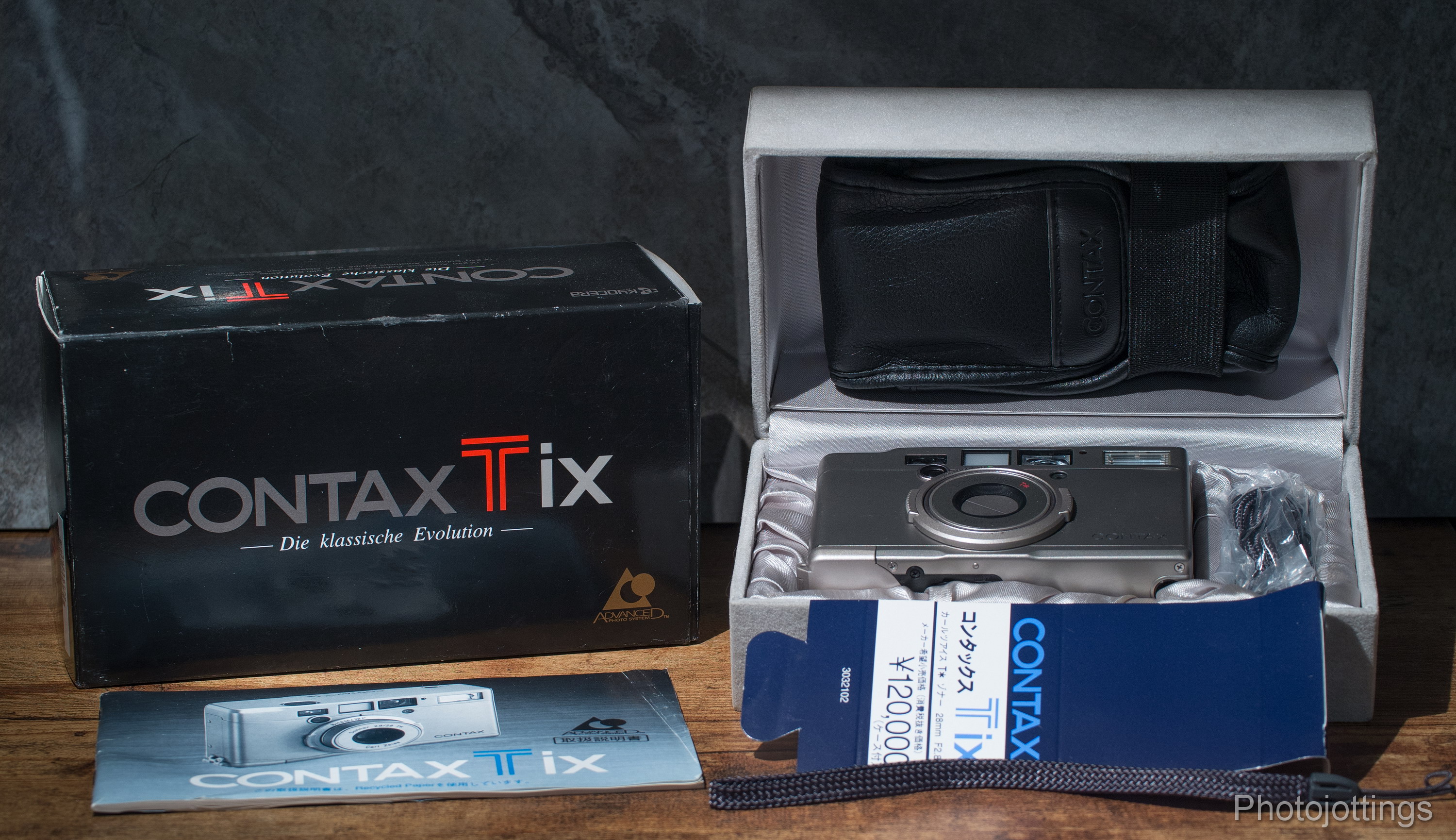
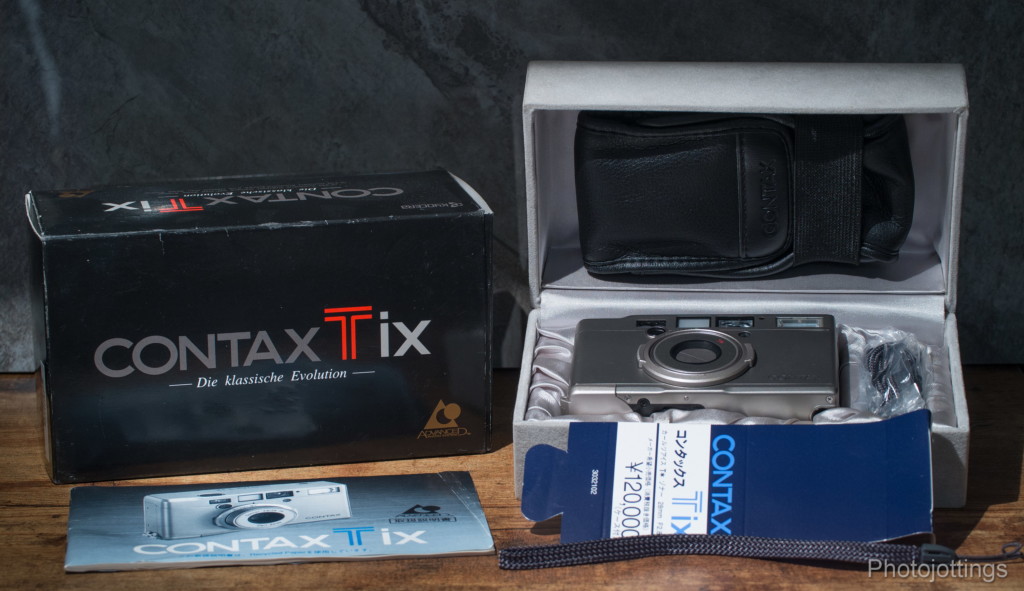
The Contax Tix was a super expensive “boutique” APS film camera that came out around 1997.  I doubt there were many, (or any other) APS cameras that were more expensive than this one.   Based on the hang tag of 120,000; street cost would have probably been about $999.   A premium 35mm camera would’ve cost about the same amount, like this one.

The presentation case for the Contax Tix is so nice you would think it contained the Hope diamond.  Rich people bought this camera for vacation snaps when it first came out.  Starting around 2000 and later, digital cameras started taking a serious bite out of the film business , and the price dropped enough so middle class folks could afford a very nice sub-compact film camera.  Unfortunately, a few years later, the film would no longer be made, and you wound up with a nice paper weight for your desk.  It’s too bad because the Contax Tix is very small and convenient, with a lot of premium features and a really sharp Carl Zeiss Sonnar lens.

The Contax Tix is a sub-compact film camera, and uses APS film which has not been manufactured since around 2010-11.  However, there is a bright spot for those that want to experiment with this state of the art film system.  Currently, Amazon and eBay have some ‘cold stored’ film available here Amazon, eBay, and that’s mostly what I’ve used for this review.  Note: do not buy color film with an expiration date unless you’re sure it has been frozen, otherwise it probably won’t turn out; B&W seems to be good based on a couple of rolls I purchased in 2017.  When shopping online, be sure you buy film that says something similar to ‘cold stored’ or ‘bulk rolled from refrigerated stock’ and guaranteed etc.  I’ve had good luck lately from a dealer called 21supply using Fuji Nexia A200 15 exposure rolls.  Currently available Kodak film turns out too red.

With the introduction out of the way, let’s check out the Contax Tix specs.


Name; Contax Tix, silver or black.

Manufactured by; Kyocera Corporation, Japan.

Date of manufacture; ca1997, made in Japan.

Price; originally around $999 new, or 120,000 yen.  Current eBay prices range anywhere from $150 to $250 depending on condition.

Build material; appears to be a mix of mostly metal, and a small amount of plastic.

Box contents; Plush presentation case, Neck strap, wrist strap, instruction manual in multiple languages, lens hood, and a vinyl softcase.

Weight; camera only, 8.0oz (225g).

Dimensions;  4.0″ (100.5mm) wide, 2.4″ (60.5mm) tall, and 1.3″ (33mm) deep.

Focal length; 28mm.  In the ‘C’ mode, the camera ‘sees’ horizontally about the same as a 42mm lens in 135 format, and about 34mm in ‘H’ mode.

Aperture;  F/2.8-F/16 automatically set in ‘P’ mode, or manually set by turning the front ring around the lens.

ISO; 25-10,000 automatically set in 1/3 stops.

Focusing distance; 14″ (.35m) to infinity.  You can’t manually focus the lens, except in ‘landscape’ mode, which sets the focus to infinity.

Prints; you could set the camera to any crop mode at any time, even mid-roll. So whatever setting  you chose, like ‘C’ or ‘H’ for instance; the shop would print your photos in that aspect ratio, even though the whole image, (‘H’) was on the negative.

Approximate resolution; good film will make very sharp 8×10″ prints in all modes.  See sample images farther down the page.

Lens; 28mm F/2.8 Carl Zeiss T* Six element in four group Sonnar design.

Viewfinder; pretty bright with info along the bottom.  The changes in aspect ratio for C, H and P only moves the guide lines, not the viewfinder coverage.  Reverse galileo type, externally illuminated bright-frame viewfinder with automatic LED illumination under low-light conditions.  Focusing frame; close-up parallax correction frame; picture area frame, (switchable in accordance with selected C, H, P aspect ratio); focus indicator, exposure compensation indicator; flash indicator, program display.  Magnification 0.5x and print coverage field of view, 85%

Shutter and speed; double “between type” shutter, 15 seconds and 1/1000 sec, automatically set; and only 1/500s at F/2.8.

Features; Fill flash, Red eye reduction, slow sync, auto, and flash off options.  Mid-roll rewind only, there is no mid-roll change option.  Ten second self timer. Date imprinting to year 2029, goofy title selections like happy birthday, I love you and all that baloney.

Film;  30.2×16.7mm native picture size, IX240 APS leaderless thrust cartridge film available in 15, 25, or 40 exposures, Amazon, eBay

Flash; recharge in about 3 seconds, range of about 6.9′ (2.1m) with ISO 100 speed film.  Operates at 1/60s in auto flash mode.

Magnetic data recording; basic information: date; time; C-H-P print aspect ratio, Print quality improvement Information (PQI): exposure information: f stop; shutter speed; exposure compensation value, title recording: selectable from a total of 54 titles (9 title items in 6 languages).

Power; CR2 3V lithium.  Manual states the battery will last for 20 rolls of 25 exposure film.

Accessories for this model;  A lens ring adapter with a few filters like an L39 UV, A2, B2, 81A,  82B, and a  lens cap.  Also a CC-67 semi hardcase.

Crippling features and omissions; nothing gets in the way, and nothing is missing that would be important.

Good features; shutter speed indicator, spot focusing mode and infinity focus lock.  Exposure compensation is the most important feature on any APS camera because you’ll be using expired film, which requires about two extra stops of light as opposed to fresh film.  The Contax Tix can go up to +2.0 in continuous mode, or +1.5 in single.

Product shots with descriptions.

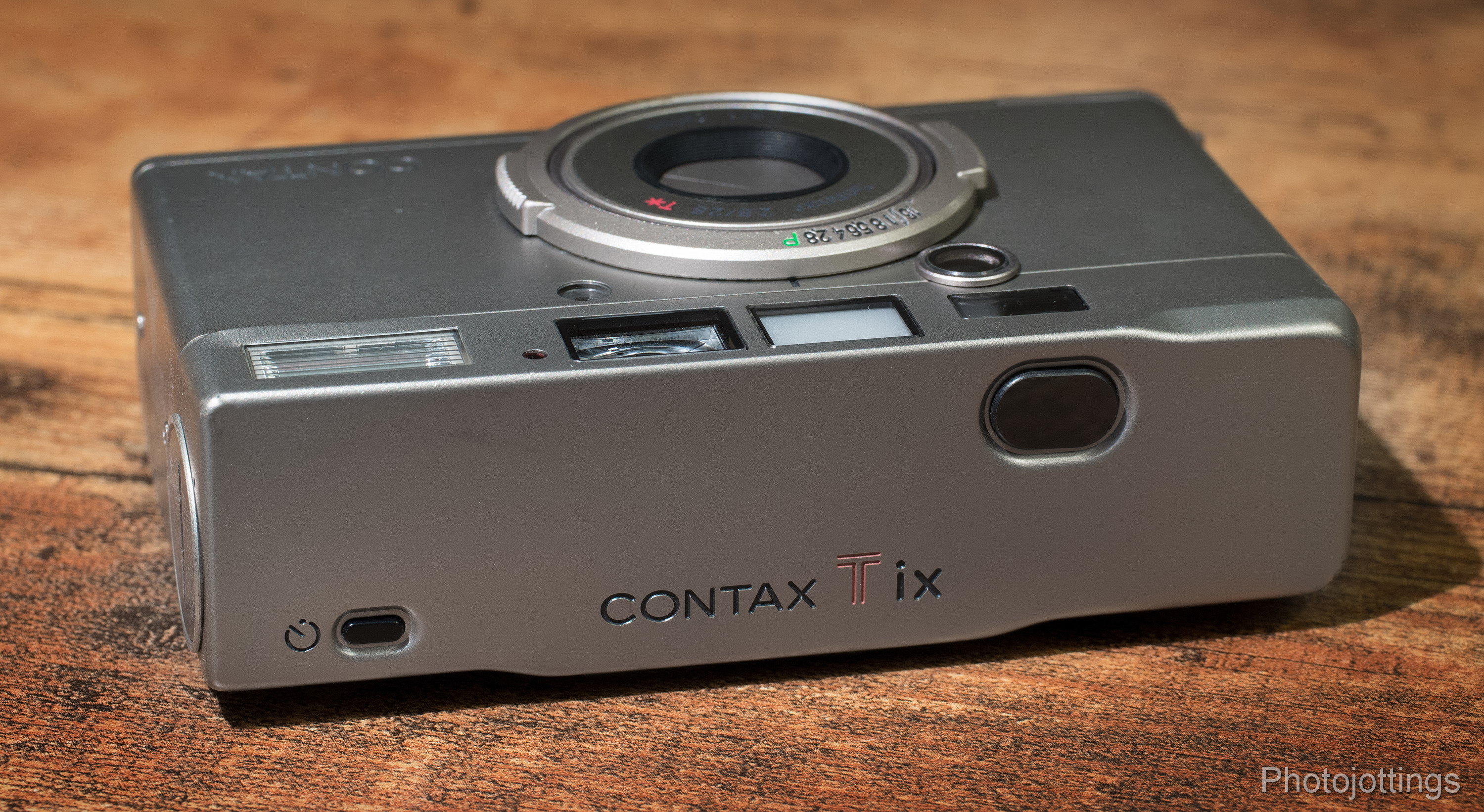
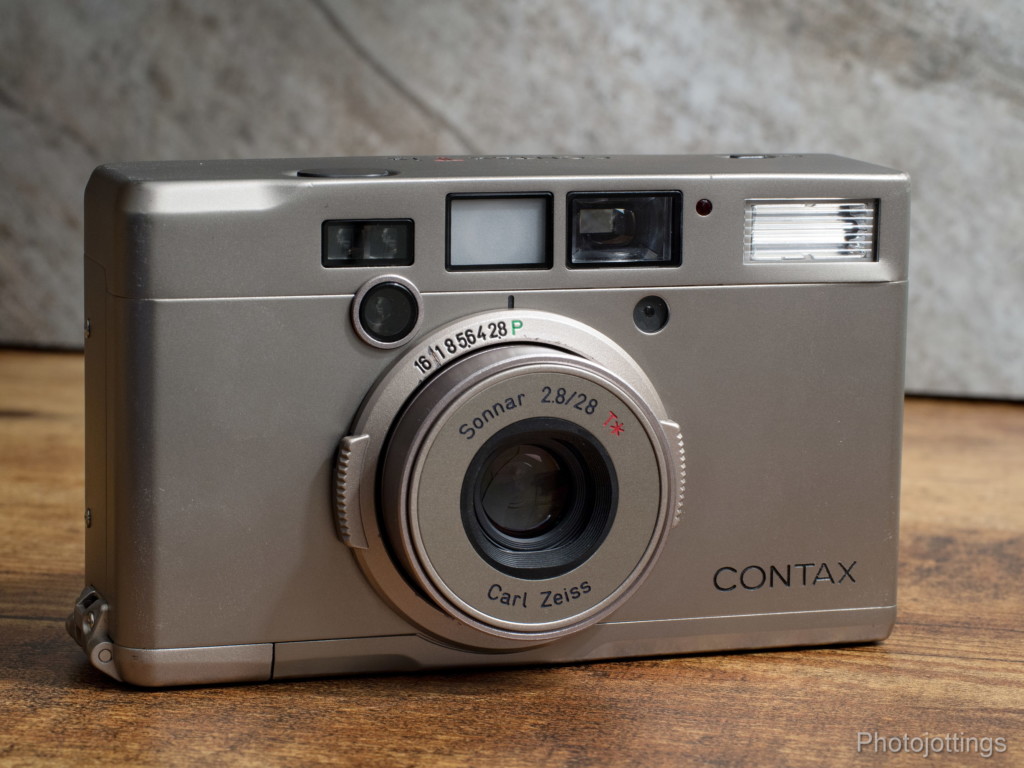
The front of the camera has quite a few things to point out.  The lens has a built in protective cover that opens and closes when powering the lens on or off.  The grips on the sides are for setting the aperture by turning the ring.  The large round button on the left is the AF infrared assist beam, the smaller one on the right is a light meter.  There are four rectangular openings along the top of the camera.  The left most one is an autofocus window, the one to the right of that is the viewfinder illumination window, then comes the actual viewfinder window, and the last one to the right is the flash.  The tiny round LED between the flash and viewfinder is for the self timer indicator.
When pressing the power button the lens takes 1 second to extend and is ready to shoot.
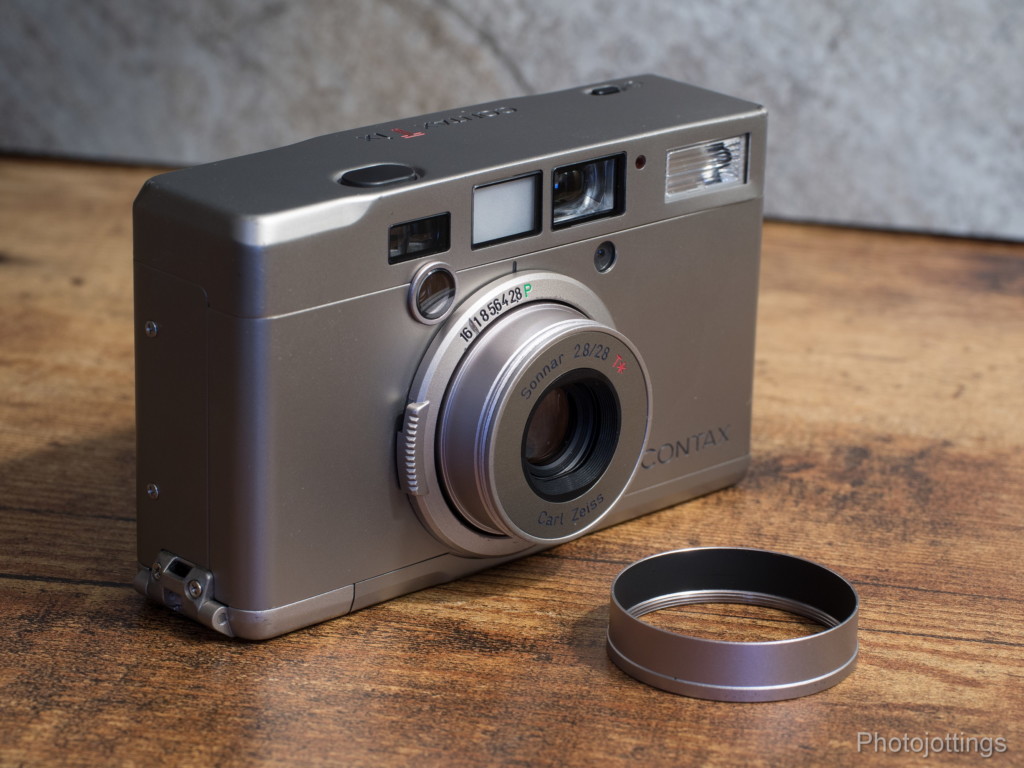
There is a lens hood that screws to the lens both ways.  Facing inwards for storage, see photo above, and outwards for taking pictures in the sun.
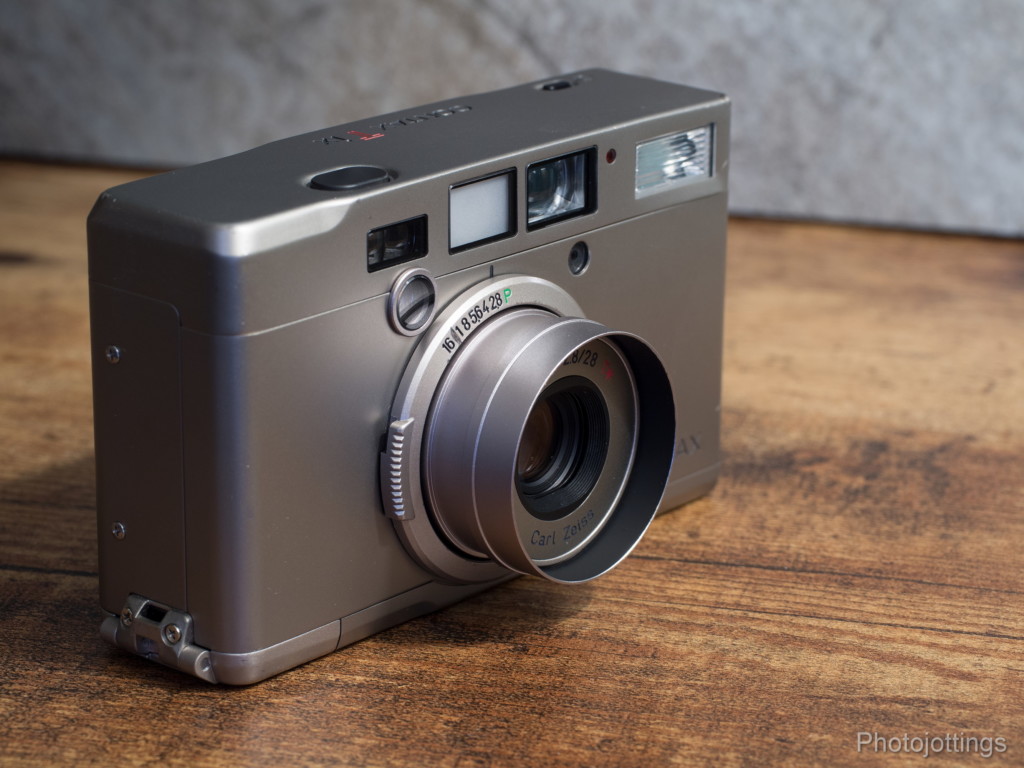
Fired up, lens hood attached, and ready to shoot!
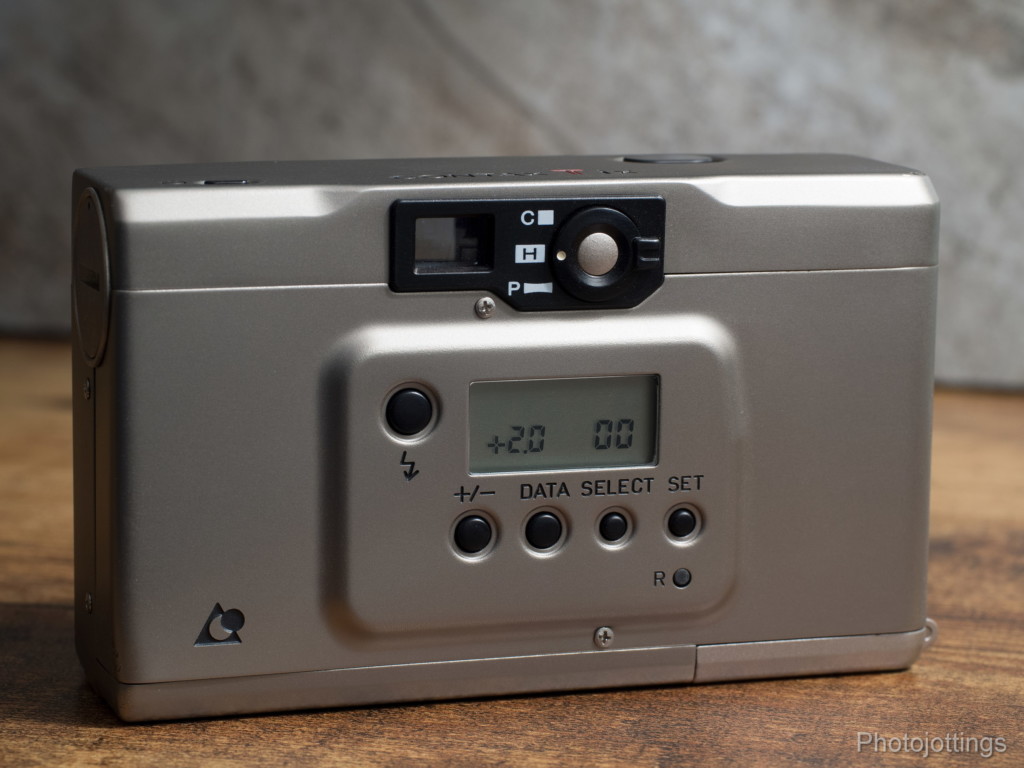
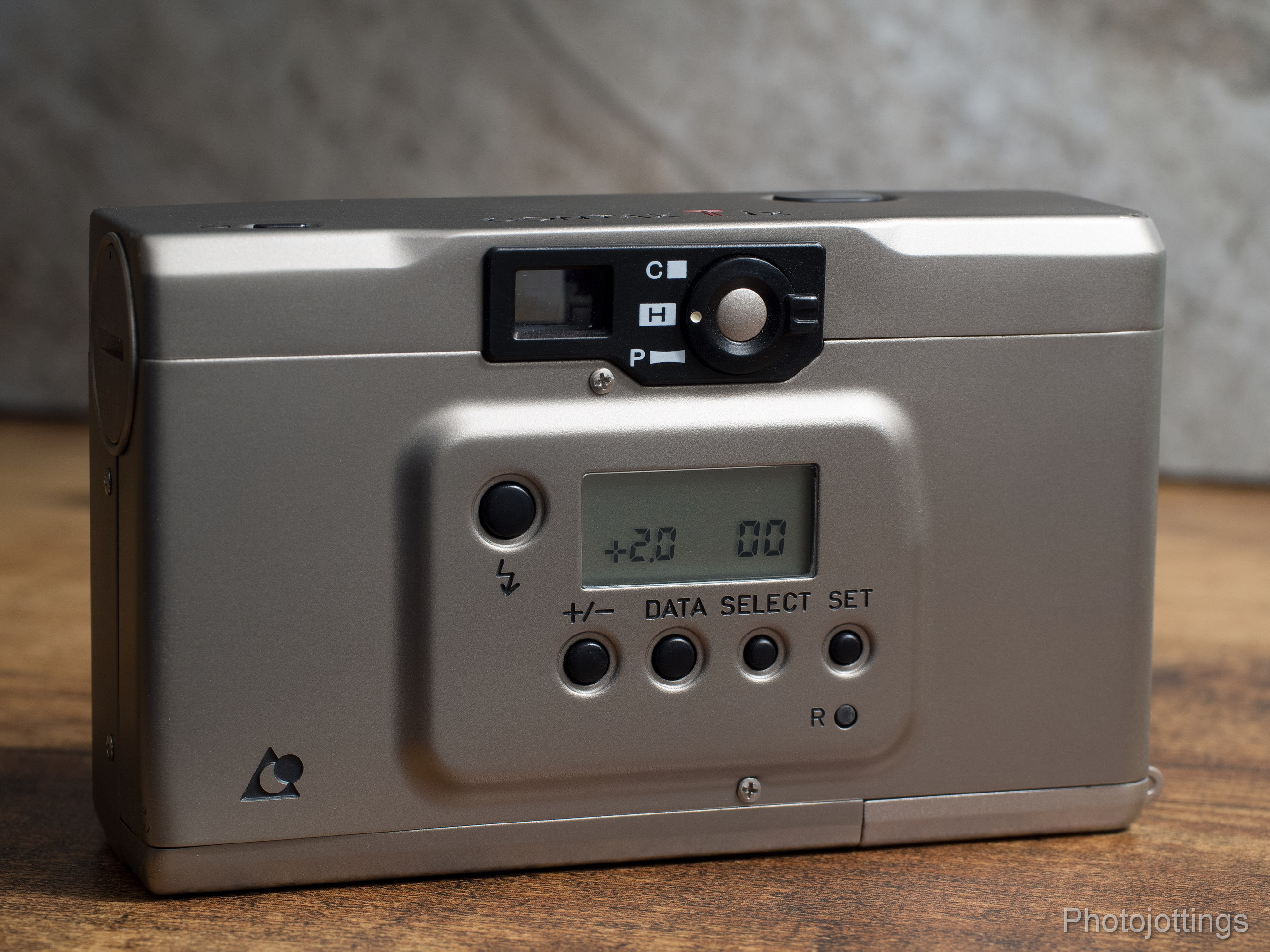
On the back we have our choices of aspect ratio (or print format), either ‘C’ ‘H’ or ‘P’ selectable using the switch.  Hidden in the middle of the switch is the power button; when I first received the camera, I actually had to refer to the camera manual to see how to turn it on, it’s the first time I ever had to do that!

Directly in the middle is the display panel and various buttons.  The large button top/left is for selecting flash options.  The +/- is for exposure compensation, notice I have it set at +2.0, that’s what you’re going to have to do when you use old film, which is your only choice as of this review.  The “Data” “Select” and “Set” buttons are for time, date, exposure info and titles.  The little button with an “R” is for manually rewinding the film.

Hard to see in this view but the single 3V CR2 battery goes inside the circular coin slot cover on the upper left side.

On top we have a small self timer button on the left, and the shutter release on the right.  There is no cable release.

The film compartment door and latch is on the bottom of the camera.  Notice the extremely offset tripod socket on the right.

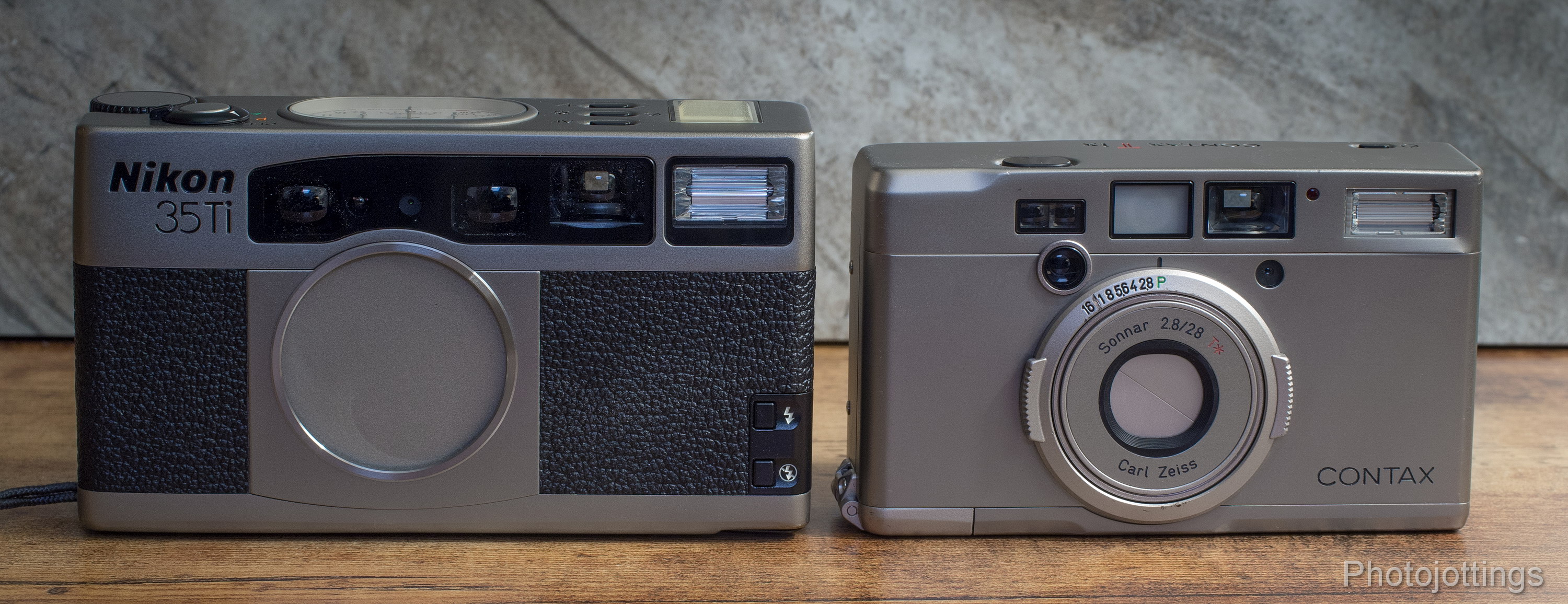
The Contax Tix is noticeably smaller than the Nikon 35Ti, and in my opinion, much easier to use, with the same basic feature set.

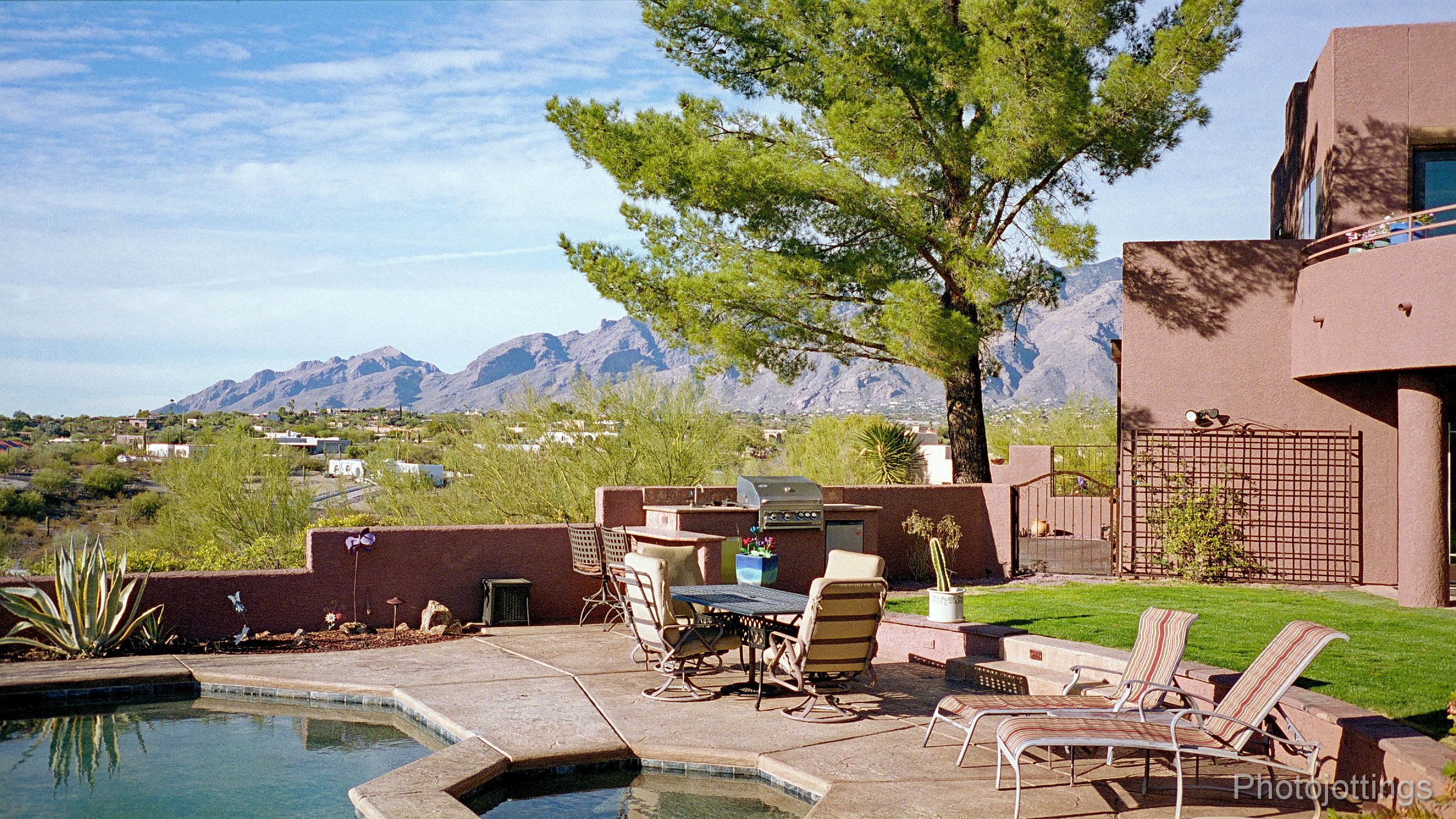
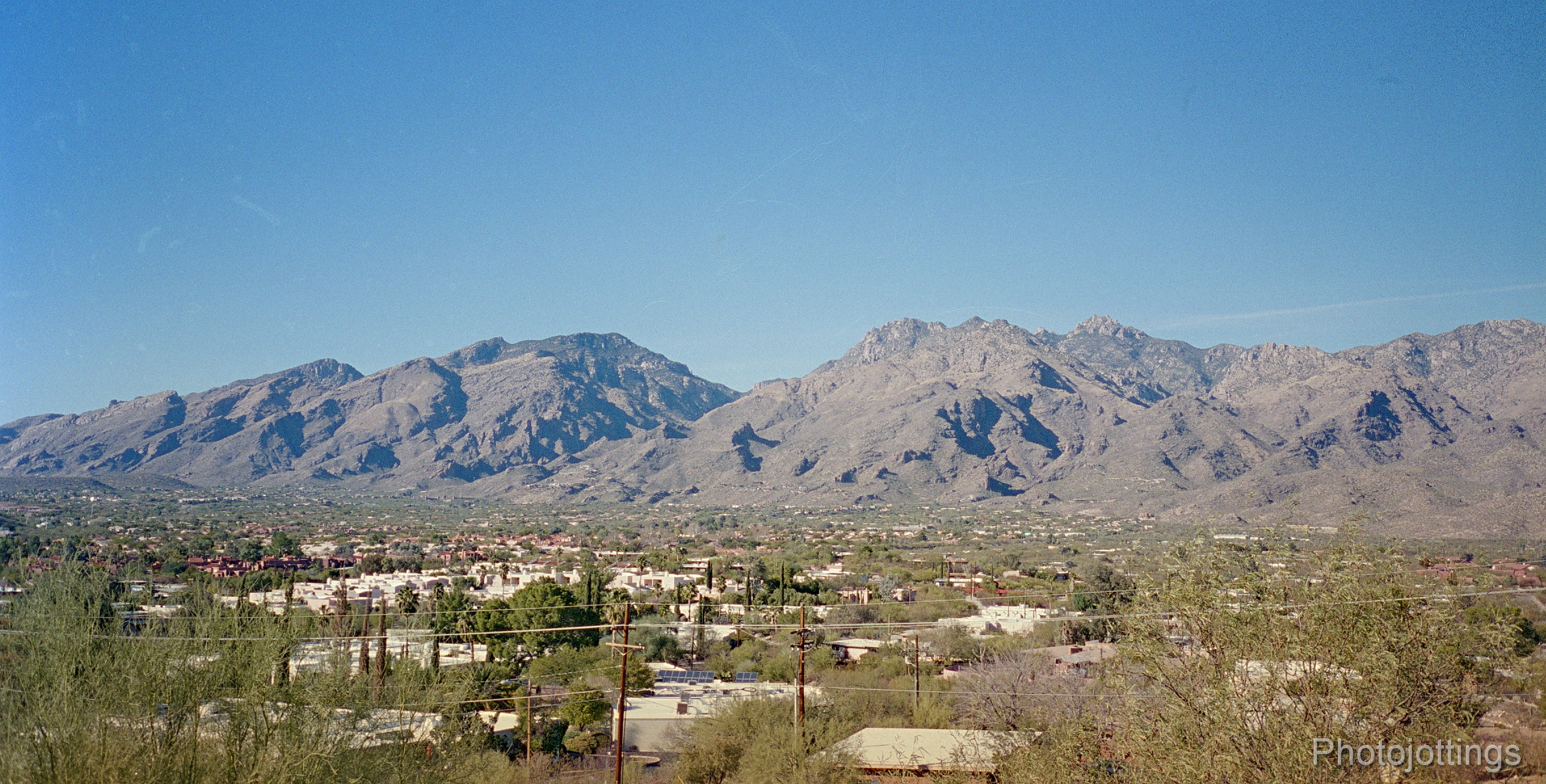
Let’s move on to some samples now.  All were taken with long expired Fuji Nexia A200 film, and some color layers have gone bad over the years, but you could always convert the pictures to B&W if you think the colors are awful.  Scanned on a Nikon Coolscan 9000 ED and presented about 2800 pixels wide, which would be about the same as showing 35mm film at 4000 pixels wide.  Click images for larger versions.

Home on the range.  It’s very sharp over the entire frame.  I see a noticeably magenta cast to the picture. Click for larger image.
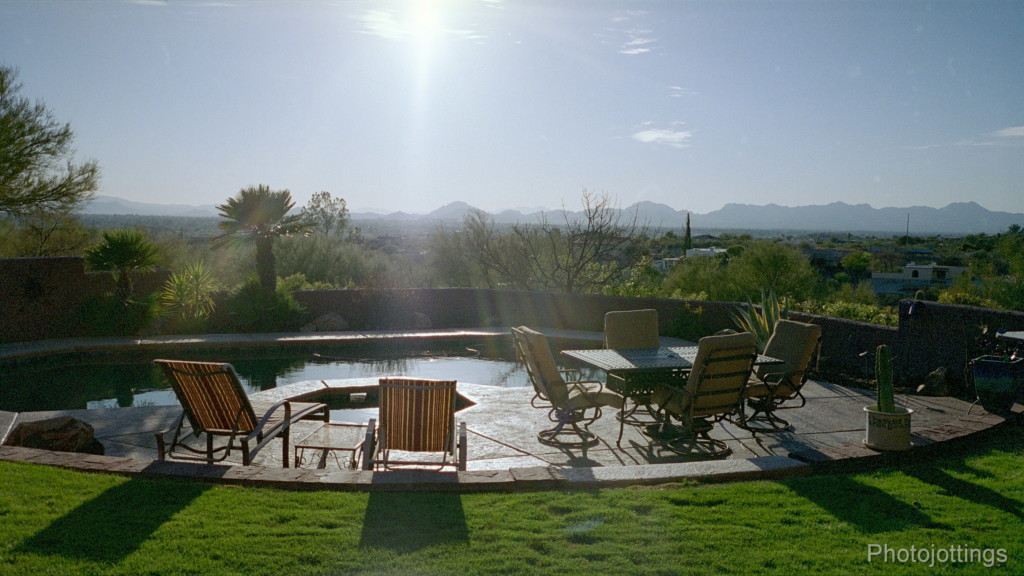
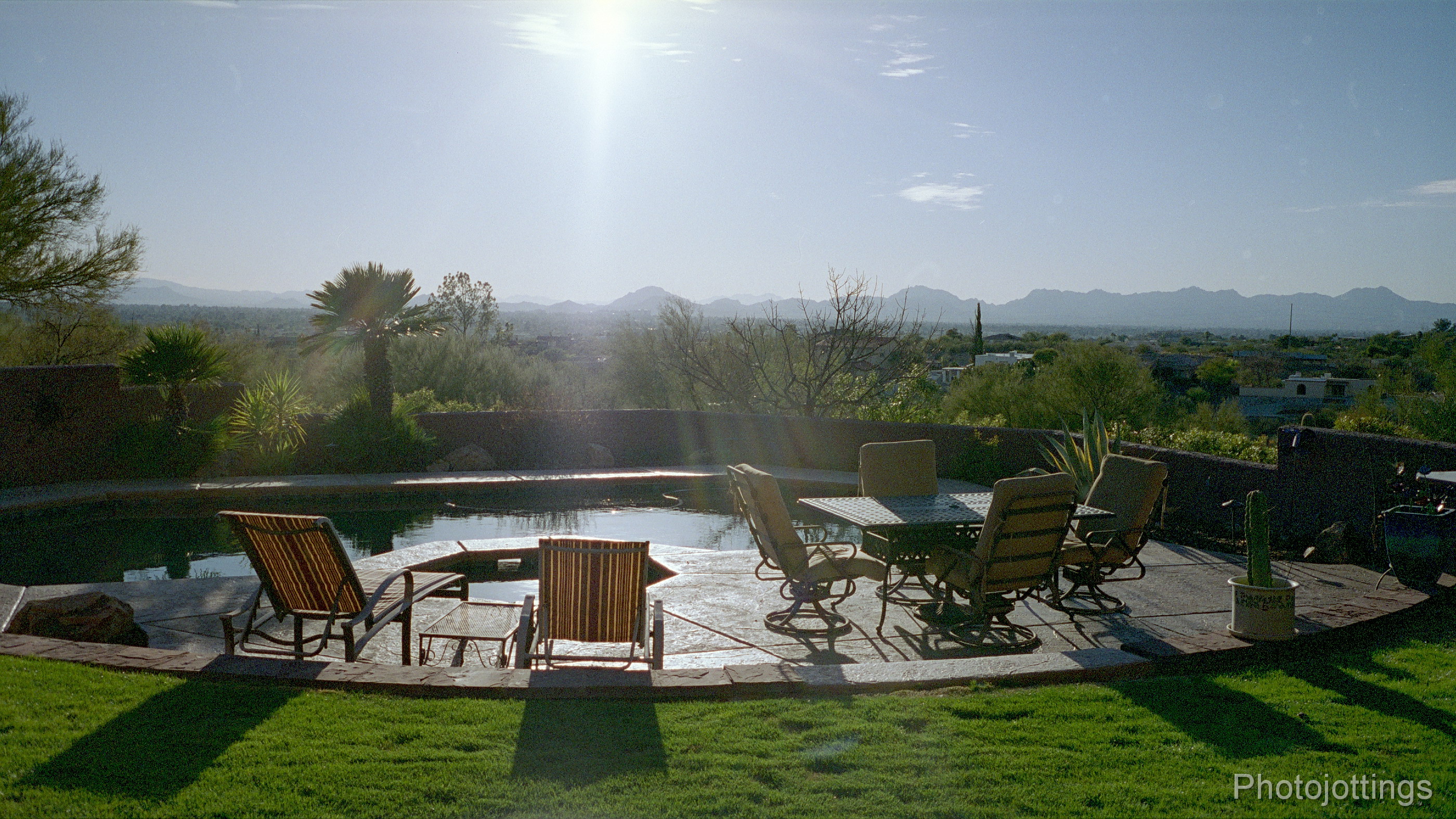
High afternoon sun in the picture, along with some flare; however, contrast is pretty good.

Here is a scan of the entire negative.  You can see the recorded read area at the top.   This is cold stored Fuji Nexia A200.

Test images next.  The film color here is not so great, and I took them mid-day, so the lighting is harsh, but I needed the shutter speeds to be high enough to hand hold at F/8-11 for sharp shots, rememeber, I had to use +2.0ev for the film to come out right.
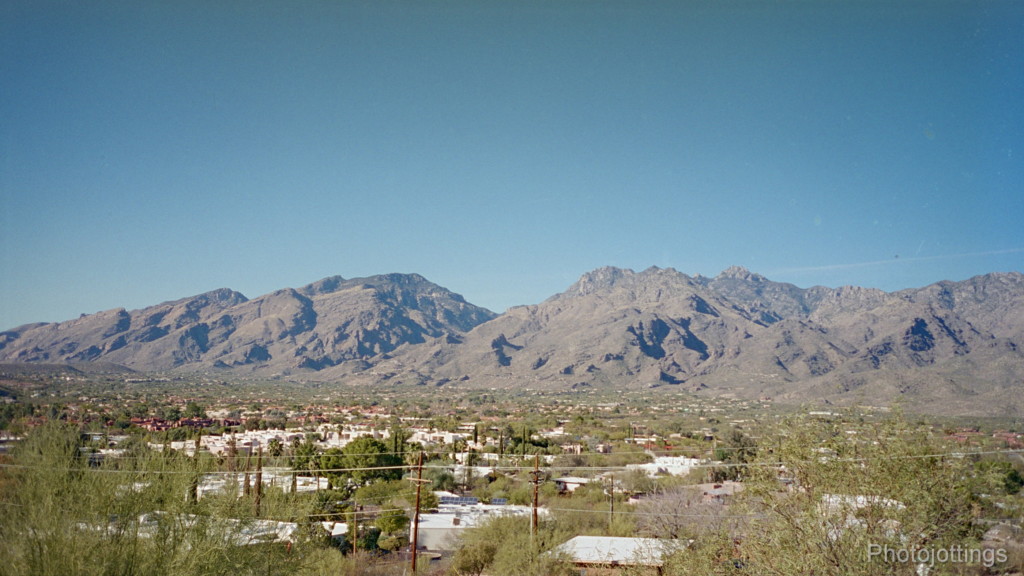
This one is at F/2.8; it’s just a bit soft, but totally usable.  Click these for larger size.

Moving to F/4 sharpens up the entire frame, at which point the centers are maxed out in resolution.

Stopping down to F/5.6 sharpens up the extreme sides.  The lens gets no sharper anywhere in the frame by stopping down, so F/5.6 is your best landscape aperture; depth of field may be another issue though.

This one is at F/8, which looks almost identical to F/5.6.
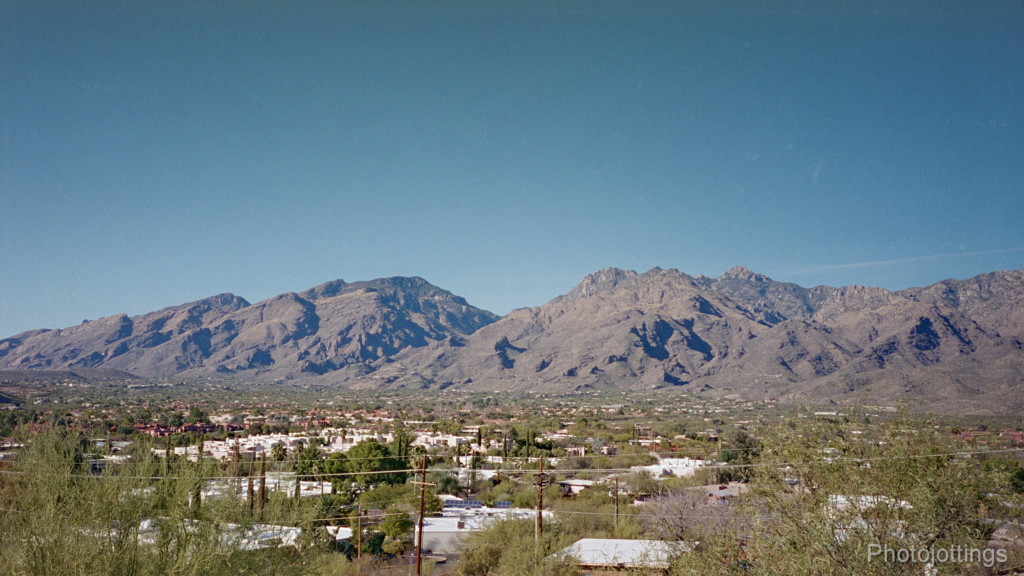
At F/11 the image starts to soften up a bit.

Conclusion.

The Contax Tix is certainly one of, if not the best sub-compact film camera ever available, in any format. Ergonomics are surprisingly good for a small camera; maybe a little ‘slippery’ in the hand but it slides in and out of your pocket quite easily.  Of course, the Carl Zeiss Sonnar lens is first rate, and one of the best lenses I’ve every used.  It also has an excellent feature set; including manual aperture settings; a shutter speed indicator on the display panel; exposure compensation, an abundance of flash modes, and a built in reversible hood, which also facilitated the adapter for filter use; unheard of in a sub-compact camera.  Rounding out the most notable features is the very accurate, and fully automatic “P” program exposure mode.

It really is a shame that film is no longer being freshly made for the APS format.  The Contax Tix is a dream come true for film lovers looking for a small pocket camera that delivers high end results; It’ll give you nice 8×10 prints, and who really displays anything much larger?  In fact, this camera will easily out resolve all the cheaper 35mm cameras with 3 element anastigmats,  4 element tessar type lenses, and even some of the 6×6 box cameras like this one.

Oh well, the best sub-compact film camera ever now serves really just as a paper weight or display item.  I had fun running a half dozen rolls through it, but I’ll probably put it back in the box after this review is finished and dream about what could have been were it not for digital cameras coming out about the same time.  If you feel adventurous, by all means get one yourself and give it a try with some cold stored film.

A sad side note; I dropped this mint condition camera twice within 30 seconds shortly after I received it while taking test pictures, and man did it hit the ground hard.  Other than a few scratched, it worked just fine.  This is the first camera in my life I’ve every put a mark on or dropped!!  I was out walking the dog on a leash with one hand, and taking pictures with my other hand, and of course the dog saw a rabbit or bird and jerked the chain while I had the camera up to my face; twice!!

That’s it for this review, thanks for stopping by!


Go here for the English users manual, and be sure and tip the site owner.

Below is the same information from the Canon Elph Jr review.

Cold stored film available here, Amazon, eBay.  I’ve used Fuji Nexia 200 for the color pics here, but have also successfully used Kodak Advantix 200, (but not lately).  Kodak B&W (C-41) long expired film seems to work well, even if it wasn’t cold stored.

Note: do not buy color film with an expiration date, it probably won’t turn out.  Be sure you buy film that says something similar to ‘cold stored’ or ‘bulk rolled from refrigerated stock’ and guaranteed etc.  I’ve had good luck lately from a dealer called 21supply using Fuji Nexia A200 15 exposure rolls.  Currently available Kodak film turns out too red.

Developing; your local photo developer may not want to process your APS film because they don’t have the proper scanning masks or holders, and can’t print properly from the film data.  Fortunately, you can tell them to just develop and sleeve the film, the same as they would do with 35mm film, and then use your flatbed scanner to digitize your negatives.  In the past I’ve used an Epson V700/V750/V800/V850 scanner (B&H, Amazon, eBay) with this holder.

A little info on the APS film format.

The Advanced photo system was a completely new type of film format that came out in 1996; it was smaller than 135 type, (typically called ’35mm’), and larger than 110 film, which was popular in the 1980s.

The film was stored in a cartridge, and had no leader, so there was no threading or laying the film across the sprockets in hopes of it catching and moving forward as you did with 135 film type. You just inserted the cartridge, closed the door, and the camera would advance the film as you took pictures, and rewind it when the last picture was taken.  All APS cameras had automatic film winding and ISO settings.

Neat features include visual exposure indicators on the top of the cartridge; see the picture above: an optical strip, (cheap models), or magnetic IX strip (better models), along the film bottom would include certain settings like print type, C, H or P for example, and maybe camera settings on more advanced models.  When you were done shooting, the film was automatically wound back inside the cartridge, and you took it to the shop for development and prints. The APS film format also incorporated  a protective feature that stored the negatives inside the original cartridge. So when you got your negatives back, they were inside the cartridge; if you wanted to know what pictures were inside, you looked at the index print provided by the developer, which included a number that matched the cartridge to the index print.

The Advanced Photo System was very innovative, and actually pretty cool; it was a nice try; however, it was also too little, too late as they say.  By the late 1990s, digital was starting to become affordable, and quality was quickly improving each year.  By the mid 2000s, the APS format had one foot in the grave.
 

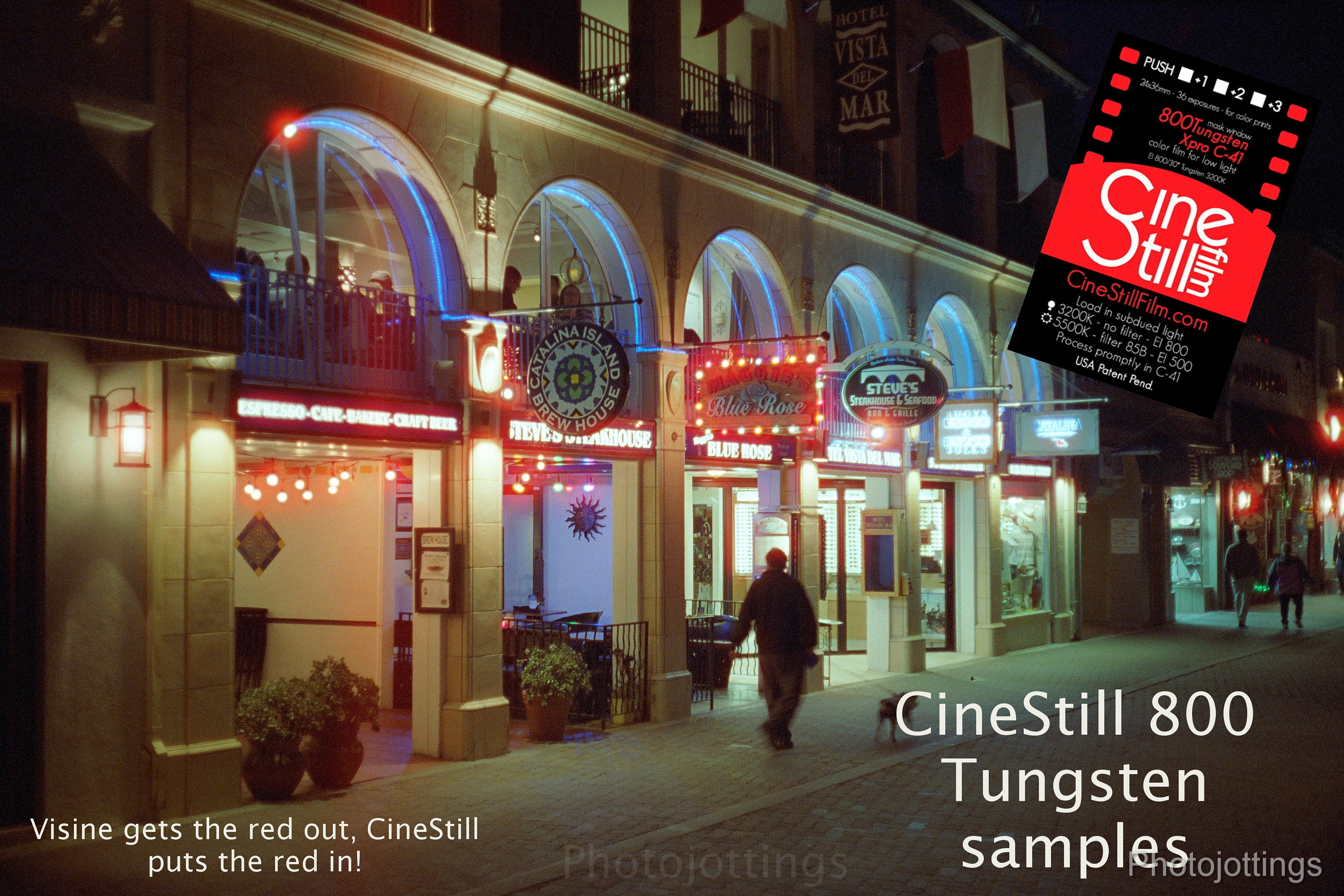
I purchased this roll of CineStill 800T Xpro quite a while back, and finally found a good time to use it, which is at night with a lot of lights.  It’s tungsten balanced film, with a color of 3200k, (same as incandescent light bulbs), so if you use it in daylight without a filter, you’ll wind up with very bluish images.  It has an odd characteristic of forming red halos and tinged borders around dark to bright transitions; check out the shots below to see what I’m talking about.

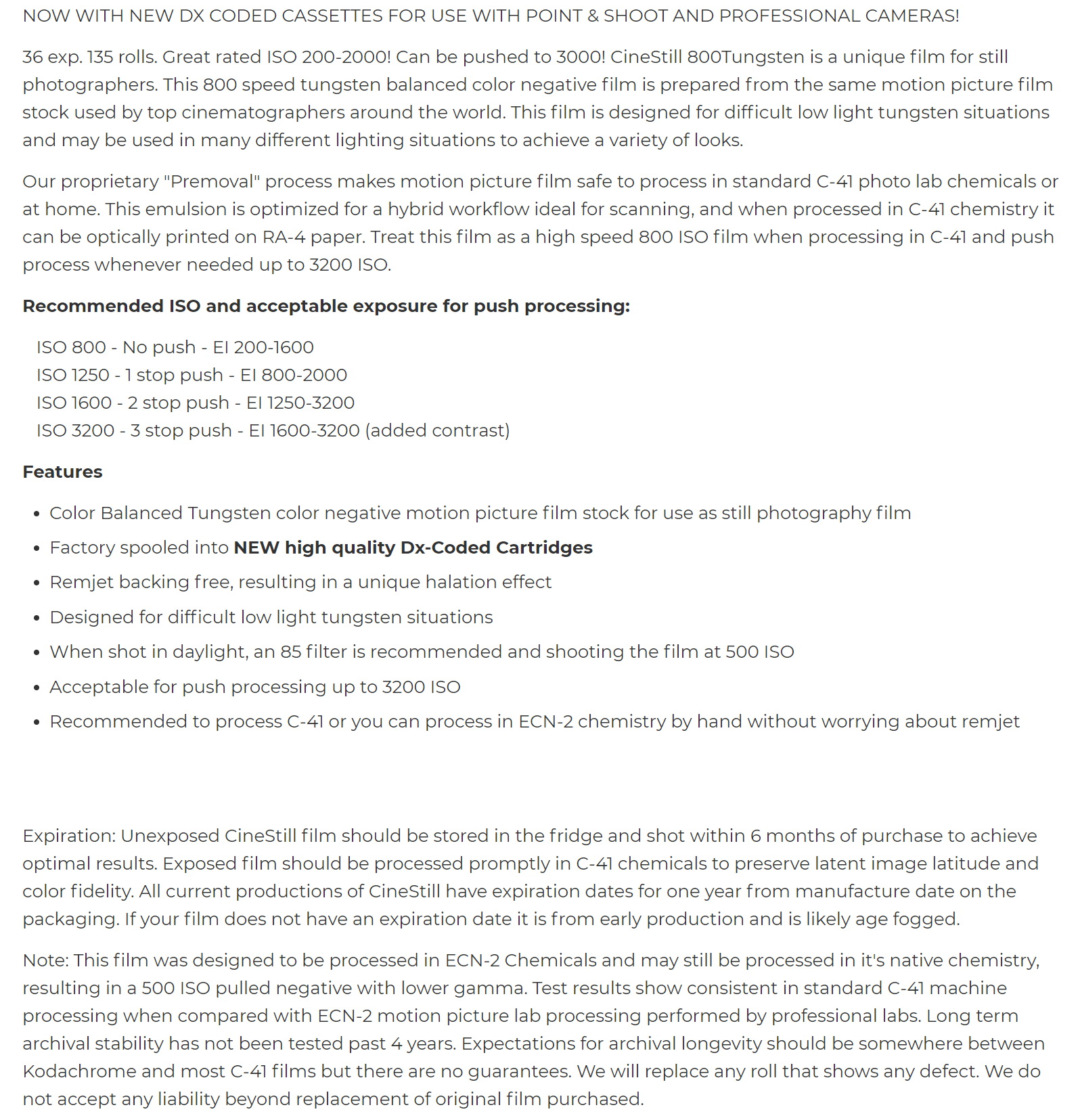
CineStill 800T Xpro is actually Kodak Vision3 500T 5219 color negative film, which has a coating called ‘remjet’ for use in motion picture cameras; however, Cinestill has removed the coating so it can be developed in standard color print C-41 chemicals, see the info below from CineStill.

Screen grab from the CineStill website:

Samples with descriptions.

All images below were taken with the Olympus 35 SP, hand-held with an aperture at F/1.7, and around 1/15 second.  Scanned on a Nikon Coolscan 9000 ED.  Pictures are sized at 3000×2000, that’s large enough so you can see all the resolution from the negative.  Remember, these were taken hand-held with a wide open aperture at a slow shutter speed, so they aren’t super sharp.  If you want to use a tripod for the ultimate in night time and low light image quality, there are better films for that.
The roll I purchased late in 2017 is non-DX coded, so you have to dial in your own ISO rating, but I didn’t do that for this roll, I just shot at the maximum aperture and at the slowest shutter speed I though I could hold steady with any degree of reliability.  The information from CineStill is that 135 cassettes are now DX coded, so I’m guessing all new 135 rolls have this.

The film you get has ‘Eastman 5219’ written on the negative edges along with a bunch of other codes.  The film is very flat, and scans well.  CineStill 800T is pricey at close to $11 per 135 roll.

This post is not a review; I’ve only shot one roll of 135, I just thought I’d show how the roll turned out.  I have a 120 roll in the fridge, and will use it when the opportunity comes up.

With all the incidentals out of the way, let’s move on to some samples.  I like the film; it has a fine grain and is quite sharp, even more so than this film, and one of the few tungsten balanced films that you can buy fresh.  With that said, you can use any daylight balanced film with an 80A filter and get the same color balance, but with a two stop light loss.

Click pictures for larger versions.

“Brighton” up your day, or night!  This brightly lit scene, with no direct harsh bulbs, shows very little in the way of the red color halos and transitions.

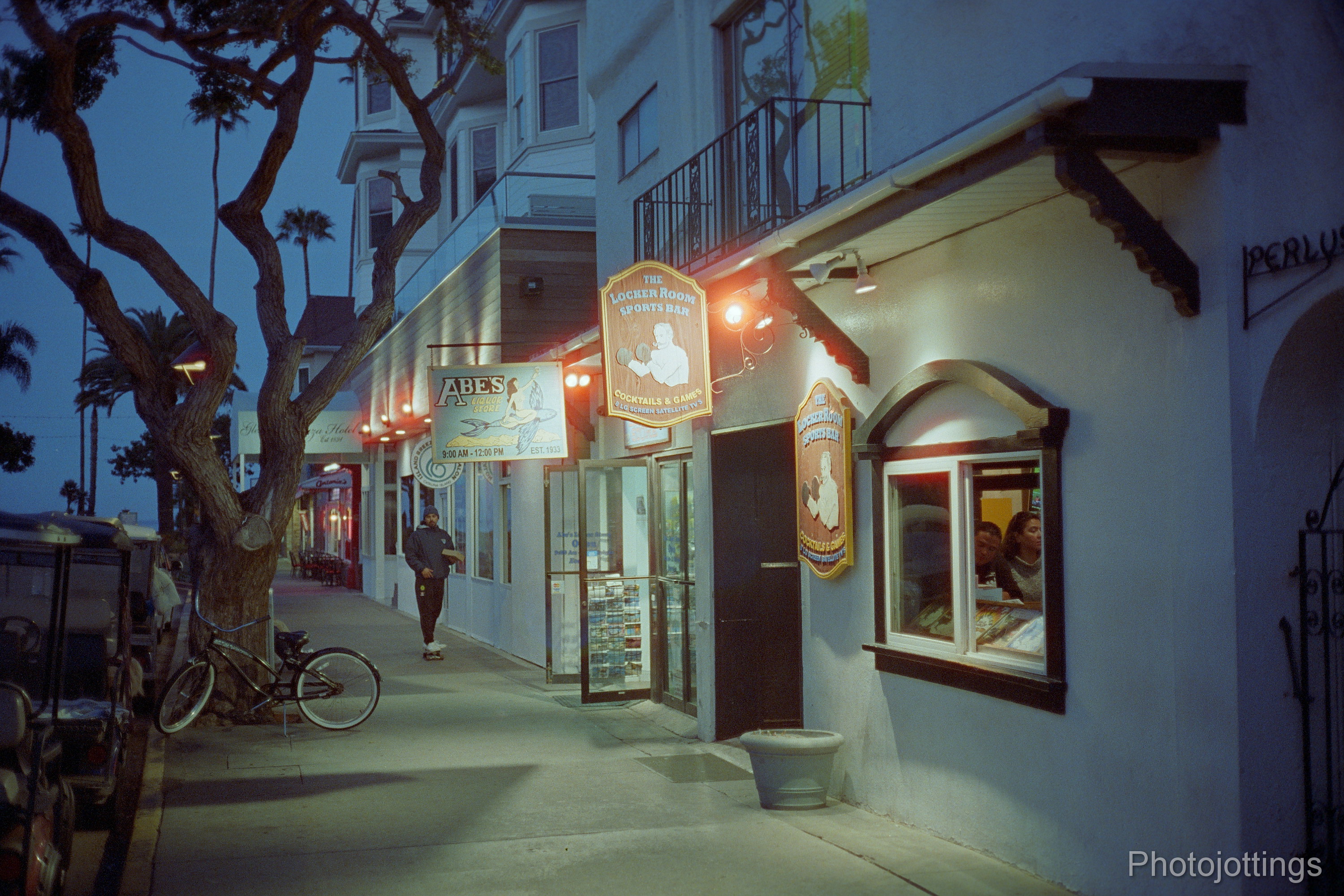
See if you can knock your buddy out cold in this neat bar; using boxing gloves of course.  Plenty of locker room talk and horrific fighting.  Here we start to see the red tinging of bright bulbs and transitions areas from bright to dark.  It’s not quite dark out, but the overall color actually looks natural from my memory, except for the red.
Sorry, we’re open.  You’ll be sorry if you eat inside this dirty restaurant, but the Pizza was great at a good price, use the “to go” window to the right to save your clothes from dirt and cigarette smoke.  Notice the purple martin house above the awning.  You don’t notice the red halos because the building is red.

Inside the dumpy Pizza joint.  It looks like Raggedy Ann and Andy are up to no good, check out the lighted picture on the extreme right side.

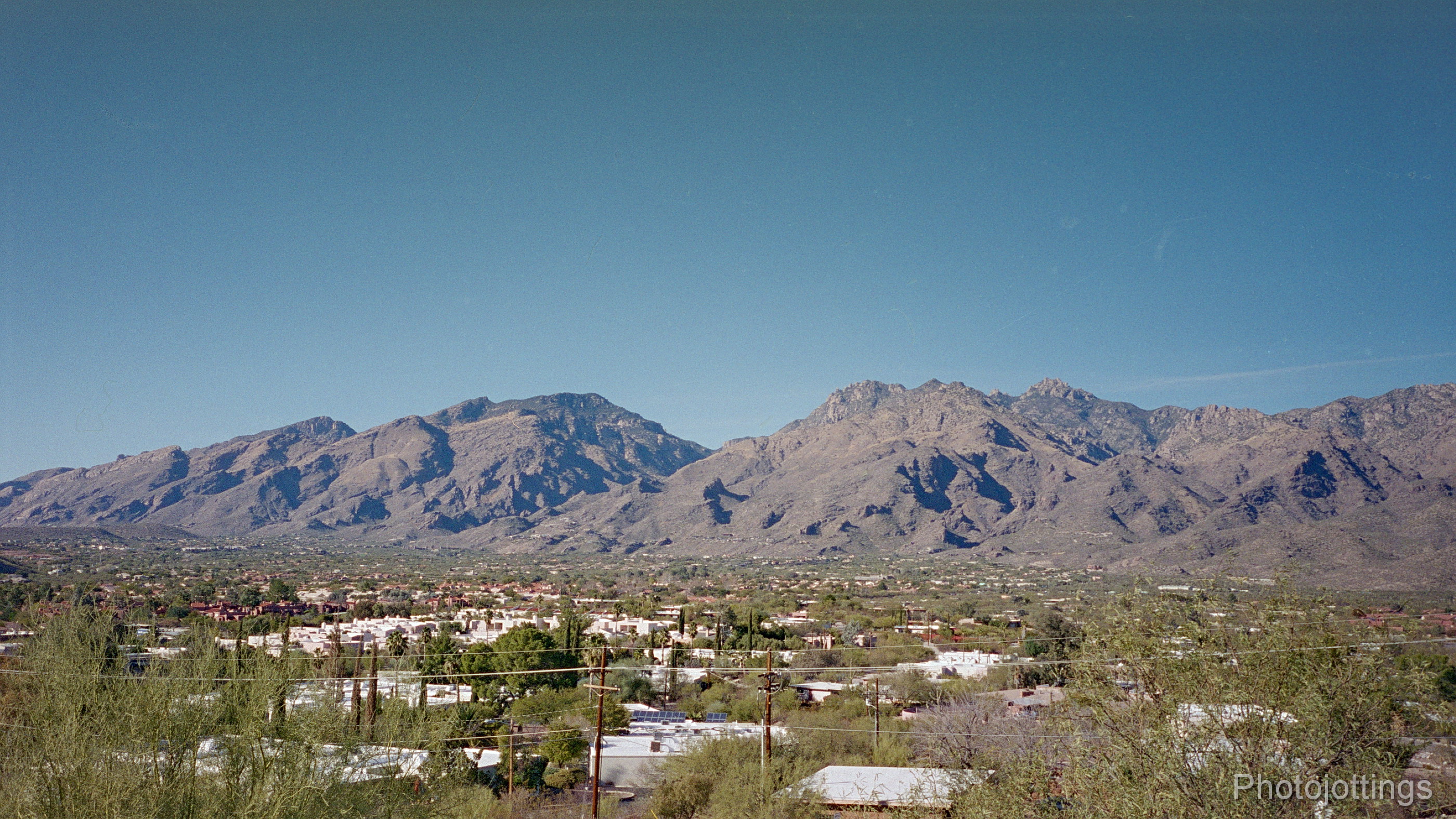
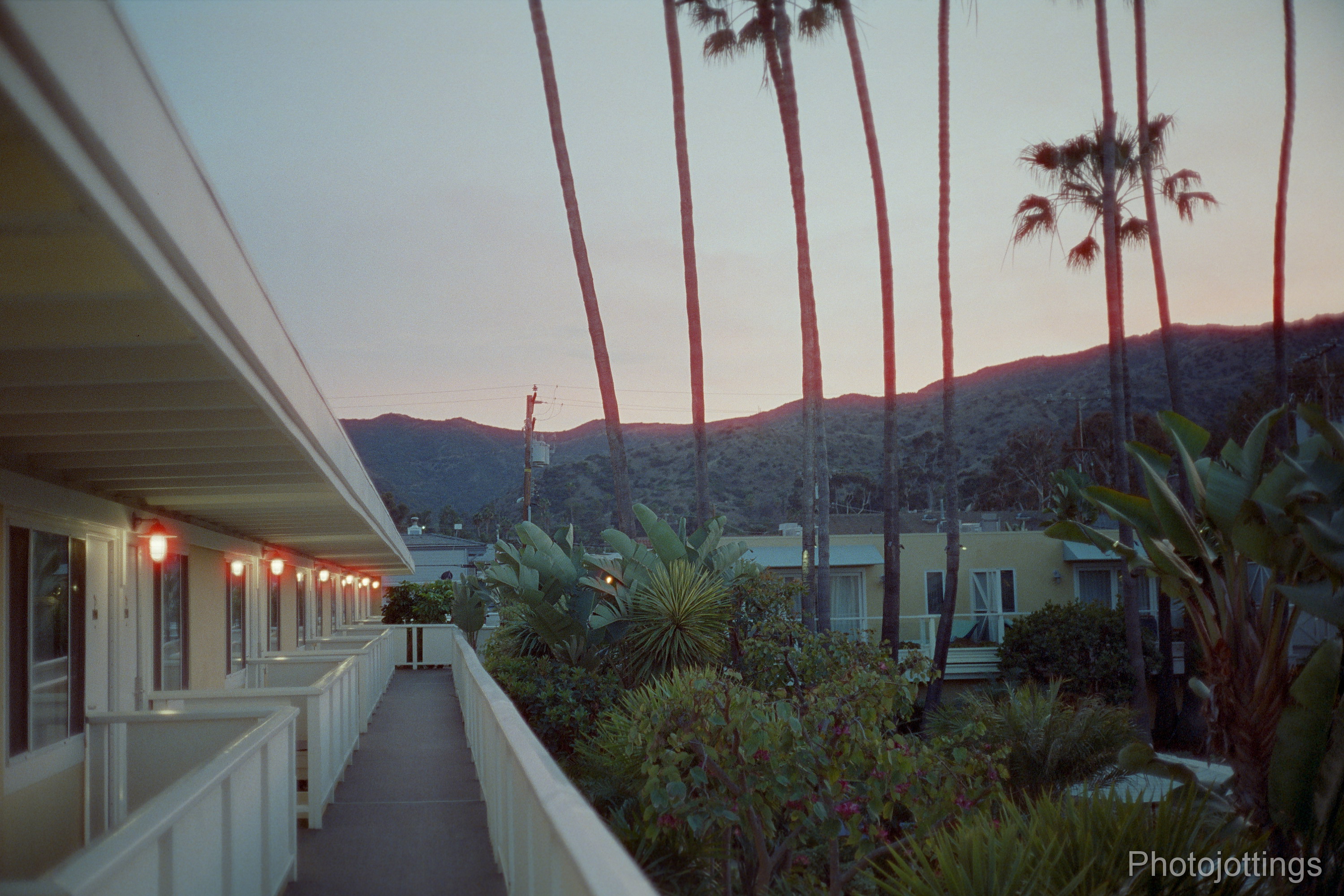
And we’ll leave the light on for ya.  Here’s a good example of the red tinging along bright to dark transitions, look at the mountain ridge line and palm trunks.

On the waterfront, this picture really defines the look for this film.

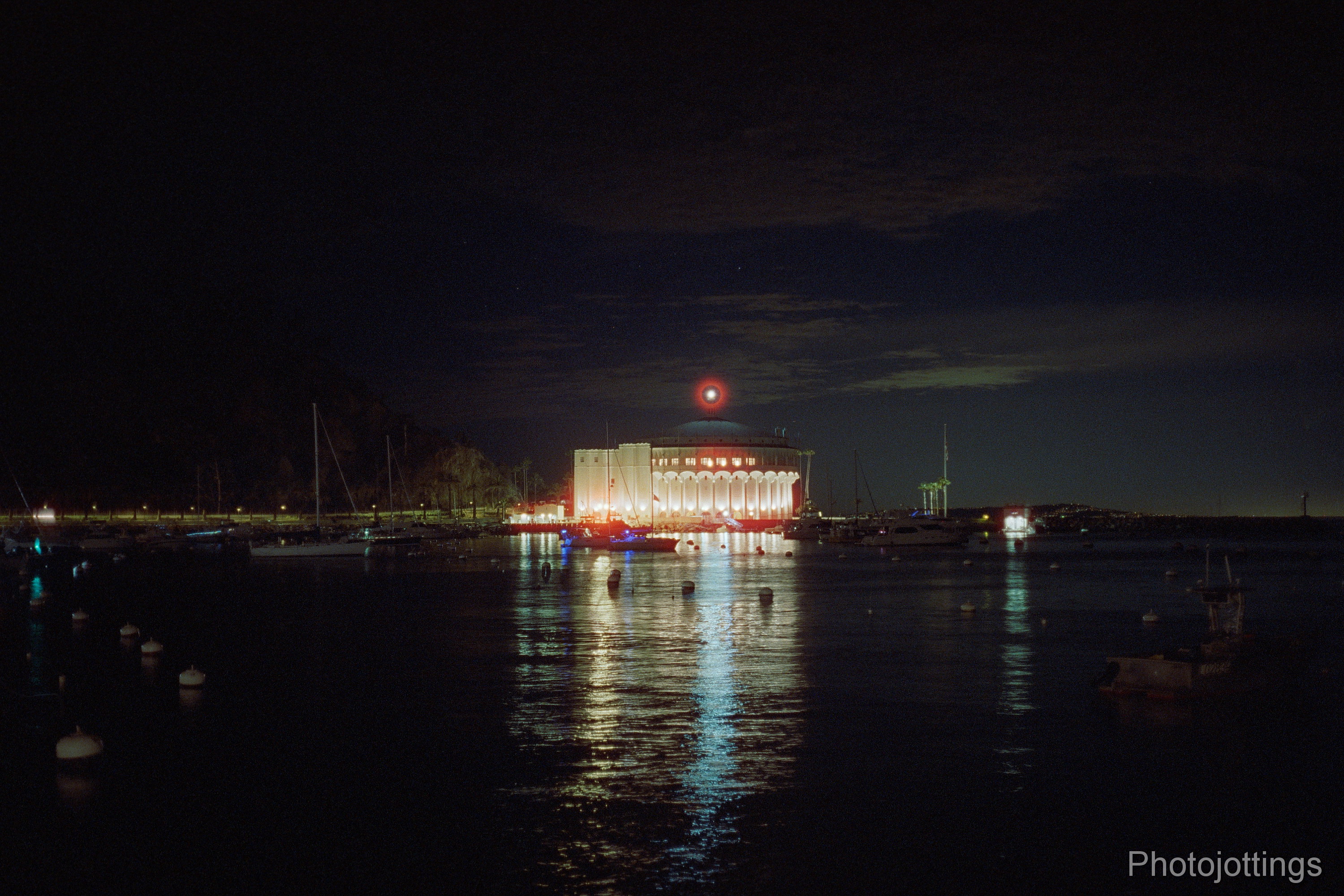
Beacon of hope; closed for the season.  The red halo on top is very noticeable, you’ll either like it, or you won’t.  A B&W conversion might look better.  Here I rested the camera on a hand rail for about 5 seconds at F/1.7.  Enlarge and check out the city lights (right side) from Los Angeles/Long Beach over 22 miles away.

View of the Sea, with a view of the Sea.  A lot of mixed lighting here, with a predominately red bias.  The green colors towards the right are from fluorescent lighting.


So in the end, I do like the potential of this film; it’s very smooth and sharp for 800 speed, but the red halos are just a bit much sometimes, so I’m not sure I’ll use it on a regular basis.  Or, I’ll get the original Kodak Vision3 500T film with the remjet coating intact, and develop it myself using ECN-2 chemistry, and avoid the red issues.

I think for low light shooting, I prefer a more traditional look to my pictures using Fuji Superia 1600.

That’s it for a quick look at CineStill 800 T film.  Help support the site by getting your goodies, and this film here.  B&H, Amazon, ebay.  Note; current Amazon and ebay prices for this film are way too high, get it at B&H photo.

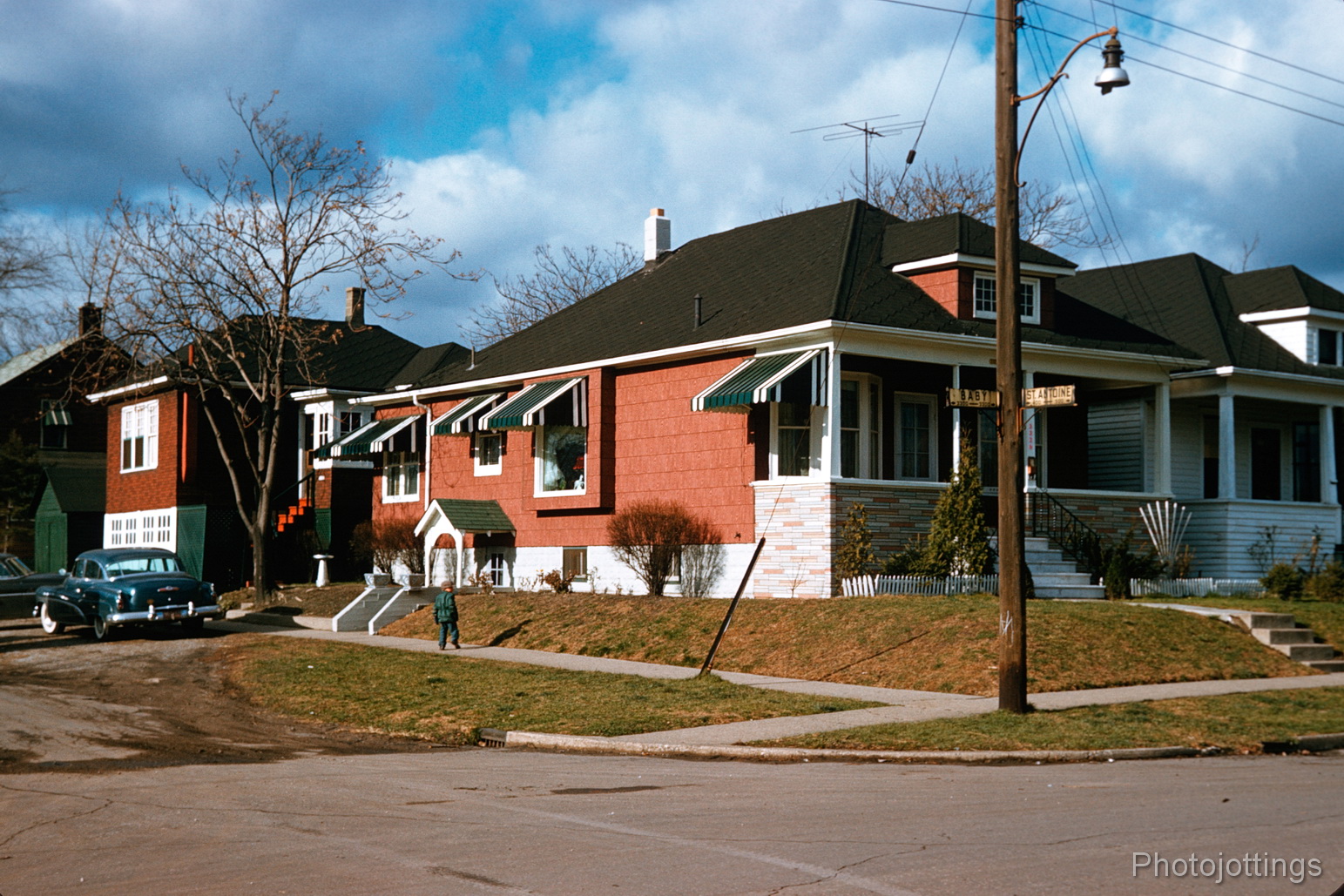
Who lives here now?  It’s on the corner of Baby St and St Antoine in Windsor, Ontario, Canada.  My great Uncle Tommy lived here a long time ago, maybe from the 1940s through the 1960s or so.  He bought a new 1957 Chevy Bel Air when they came out, and took it for a spin for all his friends to see, that’s why it isn’t in the picture, or maybe he sold it by the time the picture was taken.  I think the black car on the left is a 1952 Buick Roadmaster that belonged to my Uncle.  The youngster on the sidewalk is unknown.

My Parents made a random visit here between 1958/60, and my Dad took this Kodachrome shot with this very camera, although I’m not sure why, it doesn’t really exhibit a lot of curb appeal.

The newer version below of the home is from a Google Street view from about 2016.  Almost 60 years has passed since the picture was snapped, and the house still looks pretty darn close to what it did back then!!  It appears as though the Awnings and roofing shingles are still there, as well as the asbestos shingle siding, which apparently are still doing their job after all the years of extreme cold, heat and humidity; great siding, just don’t disturb the stuff.

The address today is 3326 Baby St, Windsor, Ontario, Canada.


Today’s review camera is the Kodak Duaflex IV, with the Kodar F/8 lens, it was the last iteration of the Duaflex line that started in 1947, and ended about 1960.  There are two basic versions of this camera, one with a standard ‘miniscus’ lens (called ‘Kodet’), and the other with a more expensive ‘Kodar’ F/8 lens with front cell focusing.

These fake twin lens reflex cameras sold like hotcakes back in the day when super expensive Rolleiflexes were all the rage for pro photographers, and everybody wanted one so they could take better pictures…sound familiar?  Instead of paying close to a grand for a Rollei, you paid 25 bucks for the Duaflex with F/8 Kodar lens.  Well, you didn’t get the image quality of the Rollei, but the Duaflex Kodar was actually pretty good, especially if you didn’t print large photos.

So let’s step back to ca1957 and take some snapshots with a cool fake TLR camera.  A time when cigarettes were actually good for you, flying cars and personal helicopters were right around the corner, and you could walk in a showroom and pick out a nice turquoise ’57 Chevy Bel Air with fuel injection!!

Name; Kodak Duaflex IV with Kodar F/8 lens.

Manufactured by; Eastman Kodak Company, Rochester, NY, USA.

Date of manufacture; 1947-60; this model, 1955-1960.  Duaflex cameras were all the same optically during this entire run, with minor changes over the years like adding a viewfinder cover, different strap lugs,  and flash syncing etc.

Price; originally around $24.50 for the camera only, and $38.50 for the deluxe outfit via a 1957 popular mechanics ad.  Current eBay prices range anywhere from $10 to $75 for the camera/outfit depending on condition.

Build material; plastic with aluminum trim; finish texture is called ‘Kodadur.’

Weight and size; camera only, 16.5oz (470g)

Dimensions; camera only, 2.85″ (73mm) wide, 4.70″ (117mm) tall, and 3.0″ (76mm) deep closed, excluding protrusions.

Focal length; 72mm.  The camera “sees” about the same horizontal view as a 35mm (135 format) camera “sees” with a 50mm lens.

Aperture; three ‘waterhouse’ wheel type stops to choose from, F/8, F/11 or F/16.

Focusing distance; scale and zone focusing, about 4′ to infinity.

Original print size; standard oversize prints 3½” x 3½,” at this size will look excellent.  Today you’ll most likely get 4″ x 4″ prints from your lab.

Approximate resolution; will make great 5×7″ prints, or good 8×10 prints.  Properly scanned images look good on a computer screen about 2400-3000 pixels wide.  See Sample images at bottom of page.

Lens; three elements, coated, Kodak uses the word ‘lumenized,’ everyone else uses ‘coated’ lens.  Construction is: achromatic doublet, and one focusing element in front.

Shutter and speed; self-cocking (as you press), spring loaded rotary shutter.  Shutter speed about 1/40th second, with instant and time setting, see shutter test screen below.

Features; three apertures to choose from, focusing front cell, bright viewfinder, and double exposure prevention with an option for creating double images.

Film; 12 6x6cm or 2¼”x2¼” exposures with 620 film, get fresh 620 film here B&H, eBay  Use 120 film by cutting down the the spool ends and sanding them down to shorten the overall length, (until the ends are paper thin), that’s what I did for the shots below.  Go here for trimming instructions.  Go here to learn how to respool 120 film on 620 spools.  Get 120 film here, B&H, Amazon, eBay

Double exposure prevention; yes, but you can push in a small lever by the shutter button to over-ride this if you want to.

Accessories for this model;  brown ‘field’ case number (possibly 62/63fc).  Kodalite flash no. 710 or others, and possibly some filters although I don’t know what size.  The ‘Kodet’ lens takes Kodak 6A filters.

Crippling features and omissions; takes 620 film, which is not widely available now.  The shutter speed is slow, so blurry shots may be a problem for jittery folks.  I usually have around two blurry shots per roll, and I consider myself a bit jittery.  Should have an F/22 option for depth of field at closer focusing distances, so F/11, F/16 and F/22 would be preferable for me.

Useful features; different apertures to choose from, double exposure prevention, very bright viewfinder window and a sharp focusing lens.

Product shots with descriptions.

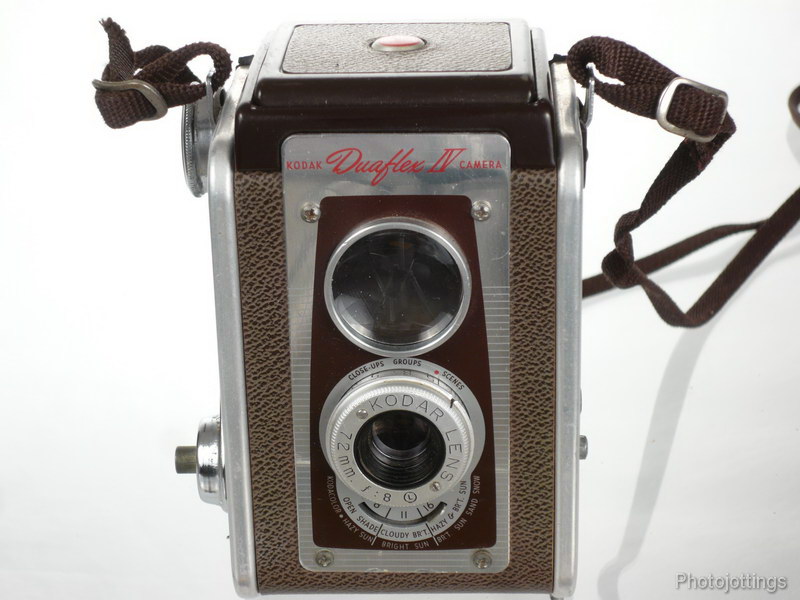
The front of the camera shows us the aperture settings below the lens.  For Kodacolor (Kodak’s color film name at the time) use F/8 for hazy sun, or open shade for B&W.  Use Kodacolor at F/11 for Bright sun, or cloudy/bright for B&W.  Use F/16 for hazy and bright sun with Verichrome pan B&W film, or bright sun, sand and snow for Kodacolor.  My advise; use F/16 for all your shots if large prints are in mind.

The large round glass viewing lens above the taking lens is simply used to frame your subject, and not for focusing, as a real twin lens reflex camera does.  However, the view is very bright and makes it easy to see and frame your subject, even in the shade.  Keep in mind the image is reversed, and it takes a bit of practice to master precise compositions.

The camera lens has a focusing from cell, and has zones like ‘close-ups,’ ‘groups and ‘scenes’ to make it easy to set the correct focus.  For the more advanced user, there is also a focus scale that is just barely visible in the picture above; it goes from 4ft, (1.3m) to infinity.

The side view shows up the winding knob on the top left, and the shutter button opposite.  The oblong decorative piece is supposed to mimic a cranking film winder like you would see on a real twin lens reflex camera.

Inside there are actual moving film guide rollers, and a fixed type ‘pressure plate’ built into the back cover, not great but better than nothing.  The side, (visible at top) shows the flash attachment area, and the ‘long’ and ‘instant’ button. The red window on the door to the left shows you where to stop when advancing the film.

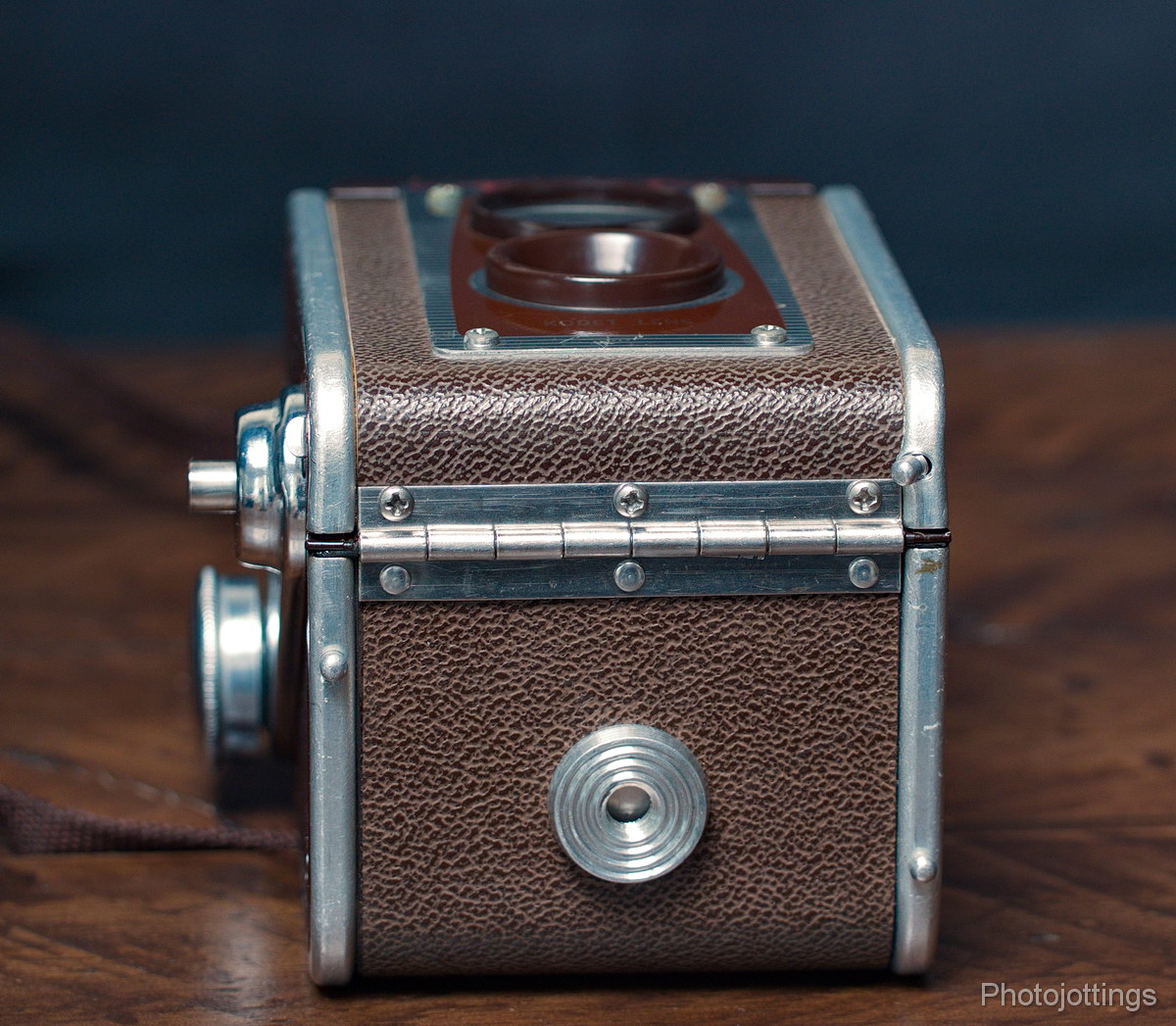
There is a tripod socket for those long exposures at night.  The hinge is where the back swings away from the body to load film.  It looks like one of the peg feet is bent, darn it.

This is a Duaflex IV with a less expensive ‘Kodet’ lens, 75mm, F/15, but everything else is the same.

The shutter speed test shows an average speed of about 1/40th second.  So with print type film, you can safely use ISO 100-400 rated film at F/16.

Here is the view through the bright viewfinder.  The scene is reversed, and always in focus; it is not connected to the focusing mechanism as is a real twin lens reflex camera, so don’t forget to set your focus before looking through the viewfinder and pressing the shutter button!


Here are some test images scanned by my local lab; they did a decent job, but not great.  All are around 2400 pixels wide; there is no additional resolution from scanning at a higher sample rate.  Click for larger images.

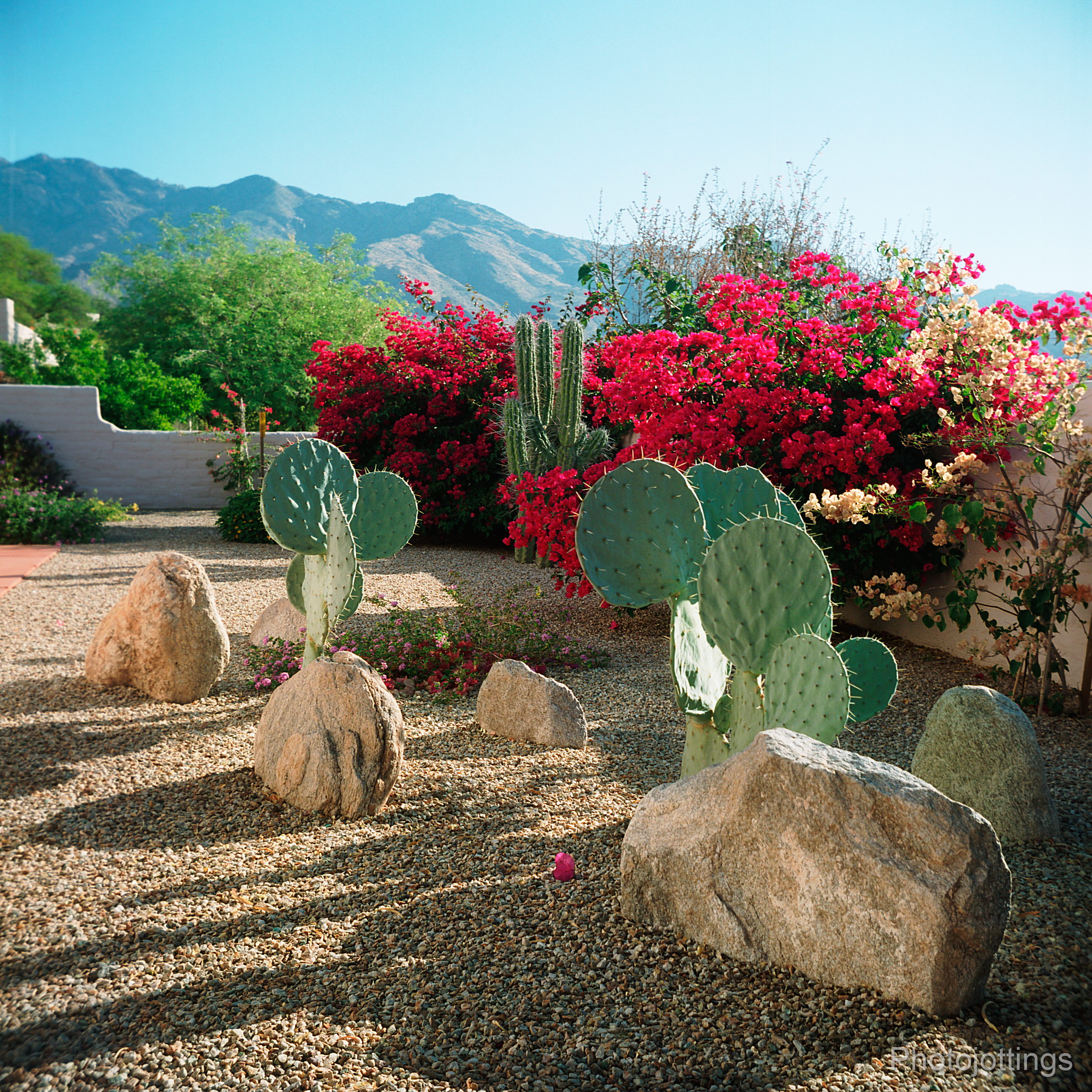
Early morning mountain scene with the focus on the cacti in the foreground.  Fuji Pro 160C.

Close focus on the flowers, F/16 using Fuji Pro 160C.

This shot I think was focused on the foreground trees.  A huge range of shadows to highlights here.  Fuji Pro 160C.

Another close focus shot at the minimum 4′ (1.3m). I see some nice background blur at F/16.  The glove in the bush is the focus point.

Bright mid-day light, and good exposure here, F/16 at infinity focus.  Quite sharp, even at the far edges. This is the whole image, there was no cropping or straightening done. This one I scanned myself and resized to 3000 pixels square, which retains all the detail of the negative.  Click for large size.  Fuji Pro 160C.


Conclusion.

The relatively small and lightweight Kodak Duaflex IV is actually capable of producing some high quality results, much more so than this very popular camera.  I like the fact that you can frame your subjects easily in the bright viewfinder, which is brighter than many of the expensive real TLR cameras of the day.  The double exposure prevention system is definitely a plus; I don’t know about you but I always seem to forget to advance the film on my cameras without this feature and ruin some shots.  The three aperture choices are nice to have, but keep F/8 for emergencies only as it is pretty soft.  I’d keep the aperture at F/16 for just about everything in bright light, and use ISO 200-400 film.  When it’s cloudy out, use some Kodak Portra 800, or Fuji Superia 800 at F/11-16 for well exposed shots.

The only downside for this camera is that it takes 620 film.  However, with a little cutting and sanding, you can use commonly available 120 film, that’s what I did here; or you can roll your own 120 film on to a 620 spool.  Even so, the Kodak Duaflex is still a pretty fun camera, and very easy to use too.  For gregarious people, using this camera in public tends to elicit comments from bystanders, and maybe you’ll even make a new friend or two!

If you buy one of these cameras, make sure it has the Kodar F/8 lens.  The cheap version has a ‘Kodet’ lens, and is not as high quality, nor does it focus like the Kodar lens.

Get fresh 620 film here B&H, eBay

Get 120 film and modify or re-spool it yourself, B&H, Amazon, eBay

Please consider buying your goodies through my links; doing so helps support the site, thanks!


Here’s a snap presumably along (what US servicemen called) US highway 1 in 1952/53, likely near Cheonan, South Korea; unfortunately the exact location has been lost forever.  My Dad took a quick picture after he came across this accident, and said it was being driven by ROK soldiers, who were really pouring the coals to the old deuce and a half.  It looks like they had a little difficulty in navigating the bend in the road.  No word on injuries, but looking at the marks, and the way it rolled over, I would be surprised if they came out with all there extremities still attached.  The US soldier on the  left walking with his back to us was named Victor; name of the little photo bomber in the right lower corner is unknown.

This Kodachrome image was taken with a Canon IVSB (or earlier model) with 50/1.8 lens, and sent to Hawaii for Kodak to develop.  Click image for larger version.

Image scanned on a Nikon Super Coolscan 9000 ED.


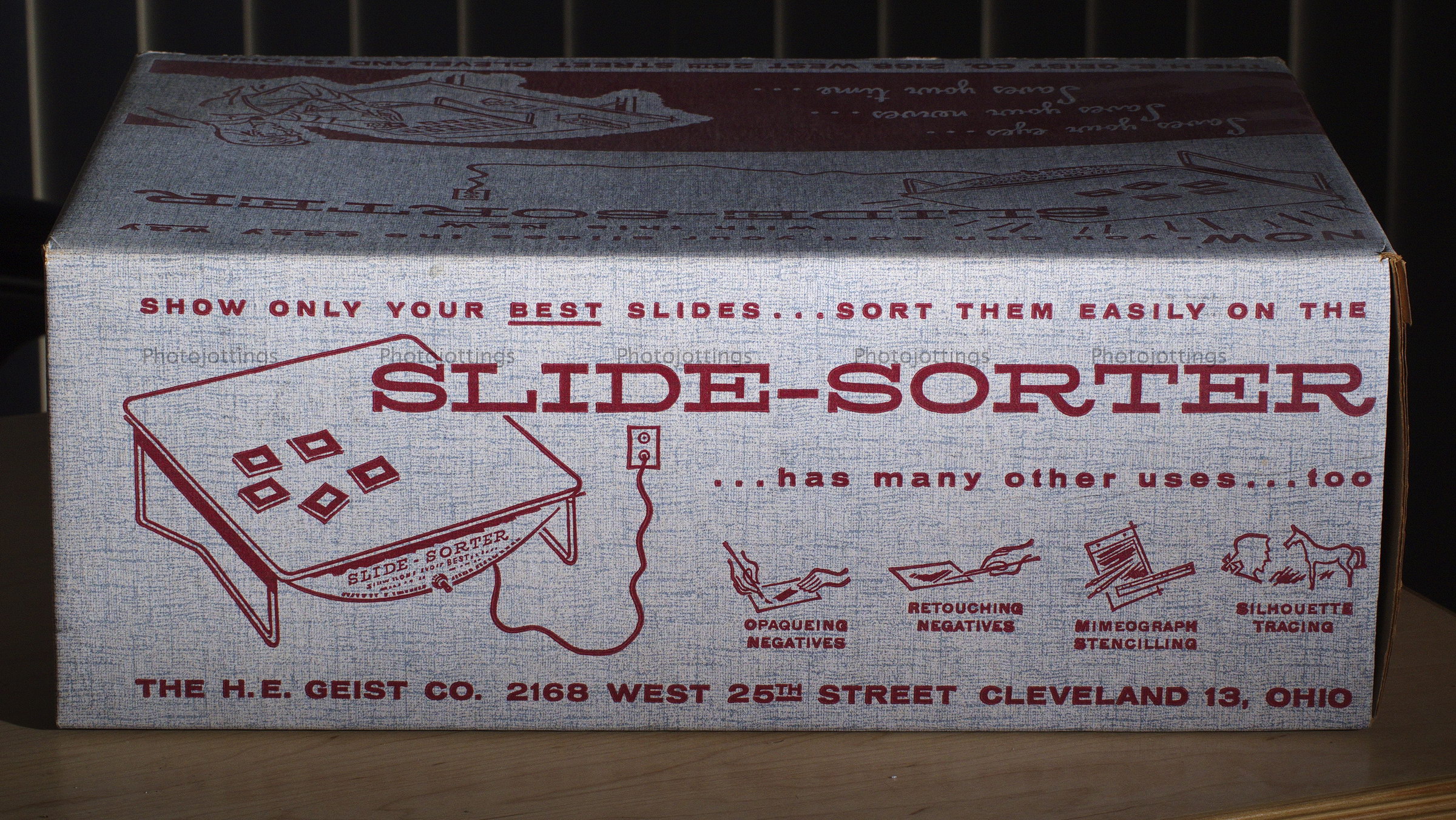
Now you can sort your slides the easy way…with the new  Slide Sorter.   Saves your eyes, saves your nerves, saves your time…Just plug into light socket!

So says the box on the Slide Sorter.  My Dad bought this in the mid 1950s for viewing his Kodachromes, and he took such good care of it you would think it was brand new.  It’s a very simple devise consisting of a rounded metal rod stand, a thin sheet aluminum underside with cardboard ends showing the branding, an acrylic translucent top, a medium base incandescent 40w frosted tube bulb underneath, with a simple on/off switch.  It really makes it easy to view your ‘slides’ or any transparencies.  The box also reminds you of other uses for the sorter such as; retouching negatives, mimeograph stenciling, silhouette tracing and opaquing negatives.

I’ve been using my computer screen for quick slide checks, but it isn’t bright enough for critical inspection.  The Slide Sorter is better, and more convenient for multiple slides.  The bulb is about 4″ long, with a six foot cord.  Both can be replace easily by going to any Home or Hardware store.  There is enough room underneath for using a regular bulb, or LED, etc.  Just remember to keep the color and brightness of the bulb to what looks natural when viewing the slides, but beware of heat generated by the bulb, if left on a long time it could ruin your top and slides.

That’s it for the Slide Sorter review.


Rollei CN200 samples—from a bad roll?

Either I got a bad roll of film, or this is the most pathetic film ever manufactured.  If you look at the picture of the Rollei Digibase CN200 negatives in the film preserver, you can see the color goes from a somewhat normal orange look, to cyan/greenish, and then totally blue.  Obviously, something must be wrong with the quality control, I don't think it was with the developing, as my local lab did it in standard C-41 chemistry, which is what the film calls for.

Rollie CR200 is a warm E-6 transparency film, which I thought had some nice qualities, even though I didn't like the grain and resolution, I posted some samples here.  So I decided to try a roll of Rollei CN200, which is C-41 print film that has no mask, (can be processed using E-6 with a shift in color),and is supposed to scan well because it dries flat, has fine grain, high sharpness and vivid colors.  Unfortunately, this roll has none of those qualities, so I guess I received a bad roll.  Oh well, with processing that's about $15 down the drain.  I'm quite sure that the exposures are appropriate, as that information is burned on the edge of the film with the Fuji GA645.  I'm also sure it was processed in C-41 as my lab no longer does E-6.

I may try the film out again...

Read more »

Fifty year old film, and a century old camera…

equals a typical digital camera in 2018.  At least in resolution, but ok, maybe not in ease of use.

I took this shot while testing a folding pocket Kodak 3A camera out a couple of years ago.  I used Kodak (Verichrome Pan ASA 80) 122 Roll film that expired in 1971, but probably made in 1969, almost 50 years ago!  You get six 3¼" x 5½" pictures on a roll, (the same area as a 4x5!!), and I bracketed the shots so I'd be sure and get a good one, however, that wasn't really necessary as all the images turned out pretty good.  The shot above was made at F/32, with a one second exposure time.  The sunny 16 rule puts my exposure about four stops longer than normal, and 'normal' being about 1/15s at F/32 with ASA 80 film.

I think I used Ilfosol 3 developer around 4-5 minutes in a tank.  It's expensive to do just one roll at a time, with the film about $25 a roll (a few years ago, now it's around $50-100 a roll depending on age), and developer, stop bath and fixer about half that, so about $5 a picture; save money and get the kodak combination back and use fresh 8x10 sheet film.  After cutting you'll get three shots, (which allows small try developing), that's what I'm doing now, and costs about $3 per shot.

I'll be doing a review of the Kodak 3A in the near future; it's quite a camera, especially when you get one with a good lens like the (Zeiss) Kodak Anastigmat, or Tessar types.

The image above was scanned on a Epson V700, which does a pretty good job, but there is more detail in the original.  Unfortunately, I don't have a good scanner that will accommodate the large 3¼" x 5½" negative.  I could cut it in half, or take a partial using a digital camera and macro lens, but I think I'll wait and show that in the review.

The resolution in the long expired film negative is about what you'd get with a good 24mp digital camera and top quality prime lens today, not bad for a camera from the silent film era.

Anyhow...

Read more »

Die Klassische Evolution, Contax Tix review

The Contax Tix was a super expensive "boutique" APS film camera that came out around 1997.  I doubt there were many, (or any other) APS cameras that were more expensive than this one.   Based on the hang tag of 120,000; street cost would have probably been about $999.   A premium 35mm camera would've cost about the same amount, like this one.

The presentation case for the Contax Tix is so nice you would think it contained the Hope diamond.  Rich people bought this camera for vacation snaps when it first came out.  Starting around 2000 and later, digital cameras started taking a serious bite out of the film business , and the price dropped enough so middle class folks could afford a very nice sub-compact film camera.  Unfortunately, a few years later, the film would no longer be made, and you wound up with a nice paper weight for your desk.  It's too bad because the Contax Tix is very small and convenient, with a lot of premium features and a really sharp Carl Zeiss Sonnar lens.

The Contax Tix is a sub-compact film camera, and uses APS film which has not been manufactured since around 2010-11...

Read more »

CineStill 800T film samples

I purchased this roll of CineStill 800T Xpro quite a while back, and finally found a good time to use it, which is at night with a lot of lights.  It's tungsten balanced film, with a color of 3200k, (same as incandescent light bulbs), so if you use it in daylight without a filter, you'll wind up with very bluish images.  It has an odd characteristic of forming red halos and tinged borders around dark to bright transitions; check out the shots below to see what I'm talking about. 

CineStill 800T Xpro is actually Kodak Vision3 500T 5219 color negative film, which has a coating called 'remjet' for use in motion picture cameras; however, Cinestill has removed the coating so it can be developed in standard color print C-41 chemicals, see the info below from CineStill...

Read more »

Kodak Moment #12 Baby St Antoine

Who lives here now?  It’s on the corner of Baby St and St Antoine in Windsor, Ontario, Canada.  My great Uncle Tommy lived here a long time ago, maybe from the 1940s through the 1960s or so.  He bought a new 1957 Chevy Bel Air when they came out, and took it for a spin for all his friends to …

Read more »

Kodak Duaflex IV camera review

Today's review camera is the Kodak Duaflex IV, with the Kodar F/8 lens, it was the last iteration of the Duaflex line that started in 1947, and ended about 1960.  There are two basic versions of this camera, one with a standard 'miniscus' lens (called 'Kodet'), and the other with a more expensive 'Kodar' F/8 lens with front cell focusing.

These fake twin lens reflex cameras sold like hotcakes back in the day when super expensive Rolleiflexes were all the rage for pro photographers, and everybody wanted one so they could take better pictures...sound familiar?  Instead of paying close to a grand for a Rollei, you paid 25 bucks for the Duaflex with F/8 Kodar lens.  Well, you didn't get the image quality of the Rollei, but the Duaflex Kodar was actually pretty good, especially if you didn't print large photos.

So let's step back to ca1957 and take some snapshots with a cool fake TLR camera.  A time when cigarettes were actually good for you, flying cars and personal helicopters were right around the corner, and you could walk in a showroom and pick out a nice turquoise '57 Chevy Bel Air with fuel injection!!

Read more »

Kodak Moment #11, ROK ‘n’ roll

Here’s a snap presumably along (what US servicemen called) US highway 1 in 1952/53, likely near Cheonan, South Korea; unfortunately the exact location has been lost forever.  My Dad took a quick picture after he came across this accident, and said it was being driven by ROK soldiers, who were really pouring the coals to the old deuce and a half.  It looks like they had a little difficulty in navigating the bend in the road.  No word on injuries, but looking at the marks, and the way it rolled over, I would be surprised if they came out with all there extremities still attached.  The US soldier on the  left walking with his back to us was named Victor; name of the little photo bomber in the right lower corner is unknown.

Read more »

Scroll to Top