Photo Jottings - Page 16 of 127 - Photography equipment expertise

The Canon ELPH Jr IX240 is the most convenient pocket camera I’ve ever used, film or digital.  Size wise, it’s similar to a pack of cigarettes, and fits in your shirt pocket just fine, see picture below. The ELPH Jr is a film camera, and uses APS film which has not been manufactured since around 2010-11.  However, there is a bright spot for those that want to experiment with this state of the art film system.  Currently, Amazon and eBay have some ‘cold stored’ film available here Amazon, eBay, and that’s mostly what I’ve used for this review.  Note: do not buy film with an expiration date, it probably won’t turn out.  Be sure you buy film that says something similar to ‘cold stored’ or ‘bulk rolled from refrigerated stock’ and guaranteed etc.  I’ve had good luck lately from a dealer called 21supply using Fuji Nexia A200 15 exposure rolls.  Currently available Kodak film turns out too red.

With the introduction out of the way, let’s check out the Canon ELPH Jr specs.


Name; Canon ELPH Jr, silver.  My copy is model C13-4036-KT1.

Manufactured by; Canon Inc, Tokyo, Japan.

Date of manufacture; 1997.

Price; originally around $99-$129 new.  Current eBay prices range anywhere from $10 to $25 for the kit above depending on condition.

Build material; appears to be a mix of plastic and metal.

Box contents; Soft case, instruction manual in multiple languages, strap, film and battery.

Weight; camera only, 4.4oz (125g),

Dimensions;  3.5″ (89.5mm) wide, 2.4″ (58.8mm) tall, and 0.9″ (23.5mm) deep.

Focal length; 26mm.  In the ‘C’ mode, the camera ‘sees’ about the same as a 40mm lens in 135 format, and about 32.5mm in ‘H’ mode.

Aperture;  F/2.8-F/18 automatically set.

ISO; 25-10000 automatically set in 1/3 stops.

Focusing distance; 18″ to infinity, or .45m to infinity.

Prints; you could set the camera to any crop mode at any time. So whatever setting  you chose, like ‘C’ or ‘H’ for instance; the shop would print your photos in that aspect ratio, even though the whole image, (‘H’) was on the negative.

Approximate resolution; good film will make very sharp 4×6″ prints in ‘C’ mode; extreme sides may be soft in ‘H’ and ‘P’ modes when printed in those formats.  See sample images farther down the page.

Lens; probably four element multi coated, it’s not stated in the manual.

Shutter and speed; combination aperture and program electomagnetic drive shutter, between 2 seconds and 1/800 sec, automatically set.  Manual claims the camera will apply +1.5 exposure compensation automatically in back lit situations. I did not notice it in real life.

Features; Fill flash, Red eye reduction, slow sync, auto, and flash off options.  Mid roll rewind only, there is no mid roll change option.  Ten second self timer. Date imprinting to year 2029, goofy title selections like happy birthday, I love you and all that. No magnetically stored-on-film camera settings option on this model, such as aperture, shutter speed etc.

Film; APS cartridge film with 15, 25, or 40 exposures, Amazon, eBay.

Flash; recharge in about 4-5 seconds, range of about 12.5′ (3.8m) with ISO 100 speed film.  Sets shutter speed of 1/60 second with flash on; up to 2 seconds with flash off.

Power; CR2 3V lithium supplied with the camera in 1997; mine was still good in 2017.  Manual states the battery will last for up to 18 rolls of 25 exposure film.

Accessories for this model;  Remote control, RC-5.

Crippling features and omissions; there is no way to adjust exposure, witch will be needed for proper exposures using outdated film, but was not needed back when they were still making fresh film.  Also, when pressing the shutter button all the way to take a picture, the camera locks focus after moving the lens back and forth, and then takes the picture, so about 2 seconds to do that which isn’t very speedy.

Good features; a lack of user options makes it a quick and no fuss camera, which is good, right?

Product shots with descriptions.

Auto focus, flash, and lens extended.

When pressing the power button the lens takes 1 second to extend and is ready to shoot.

Film compartment open, battery cover on left side.

There is no film leader, just insert the film into the camera and close the lid.

Back showing crop mode and on-off button, that’s it.

Small optical viewfinder window, with green (top) ready indicator, and below an orange slow shutter or flash charge warning. Inside is a small rectangle showing the auto focusing area and parallax frame lines.  The ‘P’ ‘H’ and ‘C’ selector is used to crop the viewfinder, but does not actually crop the negative.

Battery and shot count on LCD.

On top we have a small LCD showing frame number, battery indicator, date, cartridge loaded, flash setting, self timer and remote control. The big round button is for the shutter, and on the left is the title/date select and set feature. Frame numbers go up as you shoot, showing how many shots you’ve taken, not how many shots you have left.

Flash, timer and rewind buttons on side, title and date buttons on top.

The side has the flash setting button, mid roll rewind, and 10 second self timer.

The camera is about the same size and weight as a pack of smokes, and fits in your shirt pocket.

White dot at 1 means ready to load and shoot.

1. full circle: unexposed  2. half circle: partly exposed  3. cross sign: fully exposed but not processed  4. rectangle: processed.  Round hole to right is the film door opener to retrieve the film.

H mode.

This is a full image from the negative, and what the ‘native’ size or aspect ratio is on every shot.

C mode.

Cropped to the ‘C’ mode, the same aspect ration of 35mm film.  The sides from the ‘H’ mode are cropped off for printing.

P mode.

Here is a ‘P’ mode crop, or panoramic image.  In this mode, the top and bottom are cropped off for printing

Kodak 400 B-W C-41 film expired in 2004.

Fuji Nexia 200.

Bright scenes look pretty good with cold stored film.

This scene could’ve used about  +2 stops of exposure compensation.

I found and photographed the fountain of youth.

Wavy distortion is visible along the top, the lines should be straight.


This tiny, but innovative Canon ELPH Jr won’t replace your 35mm camera, or good cell phone for that matter, but it is fun to use, and works well with cold stored film available here, Amazon, eBay.  I’ve used Fuji Nexia 200 for the color pics here, but have also successfully used Kodak Advantix 200, but not lately.  Note: do not buy film with an expiration date, it probably won’t turn out.  Be sure you buy film that says something similar to ‘cold stored’ or ‘bulk rolled from refrigerated stock’ and guaranteed etc.  I’ve had good luck lately from a dealer called 21supply using Fuji Nexia A200 15 exposure rolls.  Currently available Kodak film turns out too red.

Developing; your local photo developer may not want to process your APS film because they don’t have the proper scanning masks or holders, and can’t print properly from the film data.  Fortunately, you can tell them to just develop and sleeve the film, the same as they would do with 35mm film, and then use your flatbed scanner to do it yourself.  I use an Epson V700/V750/V800/V850 scanner (B&H, Amazon, eBay) with this holder.

A little info on the APS film format.

The Advanced photo system was a completely new type of film format that came out in 1996; it was smaller than 135 type, (typically called ’35mm’), and larger than 110 film, which was popular in the 1980s.

The film was stored in a cartridge, and had no leader, so there was no threading or laying the film across the sprockets in hopes of it catching and moving forward as you did with 135 film type. You just inserted the cartridge, closed the door, and the camera would advance the film as you took pictures, and rewind it when the last picture was taken.  All APS cameras had automatic film winding and ISO settings.

Neat features include visual exposure indicators on the top of the cartridge; see the picture above: an optical strip, (cheap models), or magnetic IX strip (better models), along the film bottom would include certain settings like print type, C, H or P for example, and maybe camera settings on more advanced models.  When you were done shooting, the film was automatically wound back inside the cartridge, and you took it to the shop for development and prints. The APS film format also incorporated  a protective feature that stored the negatives inside the original cartridge. So when you got your negatives back, they were inside the cartridge; if you wanted to know what pictures were inside, you looked at the index print provided by the developer, which included a number that matched the cartridge to the index print.

The Advanced Photo System was very innovative, and actually pretty cool; it was a nice try; however, it was also too little, too late as they say.  By the late 1990s, digital was starting to become affordable, and quality was quickly improving each year.  By the mid 2000s, the APS format had one foot in the grave.

That’s it for this review, thanks for visiting!

Let’s fasten our seat belts, and get ready for a ride in the photojottings time machine!  Oh, and bring your jacket, it’s late October and a bit chilly!

For the journey today, we’ll head back about a hundred years and visit a quiet, leafy neighborhood in West Roxbury, Mass.  Henry A Stanley photographed the scene somewhere around 1910-1920.  Detail in this century old (undated) 5×7″ glass plate negative is stunning, (click image for larger size, shown here at 7000 pixels wide).  Check out the gas street lights, especially the close one in the upper extreme left side; the unique street sign to the right, and what looks like an early automobile way down the road.  The white blotches on the right are from the paper sleeve that stuck to the emulsion side over the years; I may try to remove it at some point, but I don’t have the skill and nerve to try it right now.

The address for the house on the right is 218 Park St at Anawan ave, (built 1869).  The American Elm trees are long gone; along with the quaintness it seems, but most of the houses appear to be still standing, and with maybe a hint of charm amidst the minor to moderate facade changes.

I purchased this 5×7″ glass plate negative from eBay a couple of years ago.

Below are screen shots from Google Earth, 2013.

Google earth shots from 2013

I’ve finally completed the comparison page for the Sony 24-70mm F/2.8 GM, and Sony Zeiss 24-70mm F/4 lenses.  With that said, there is a caveat; for some reason, the 35mm test images from the Zeiss did not look like they were focused perfectly.  Maybe the GM zoom is that much better, or maybe I didn’t nail the focus quite right; so that’s why I’m not including any 35mm comps in this post, but will try again when I get some spare time.

Also note the comparisons where taken on a different day, with slightly different weather conditions that might favor the contrast of the Sony GM lens.

There are no real surprises here, although towards the end of the zoom the Zeiss is equal or superior along the image periphery.  The GM is always sharper in the middle no matter what the focal length or aperture.

Sony A7R used for test images.

Sony Zeiss 24-70mm F/4 sets are along the top, and Sony 24-70/2.8 GM sets are on the bottom of image.

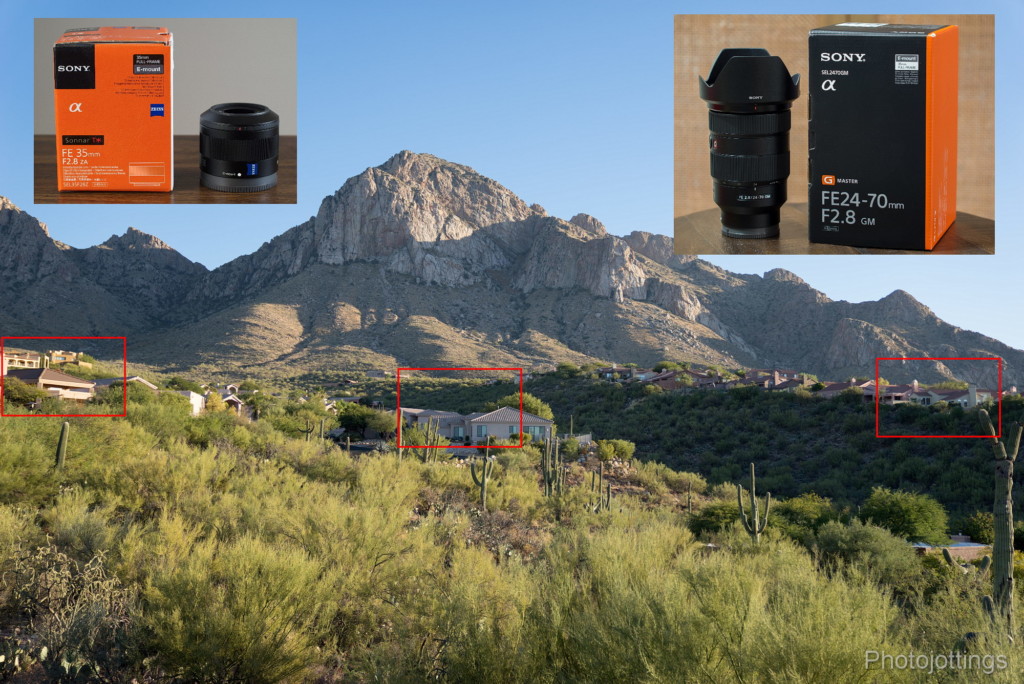
Here is the whole test scene and where the crops are taken from.

24mm

left side, center, and right side

Sony Zeiss 24-70mm F/4 on the top, Sony 24-70mm F/2.8 GM on the bottom.  Click pictures to enlarge.

F/4

Not a huge difference between lenses at 24mm, F/4, but the GM is slightly sharper throughout the frame.

F/5.6

Again, not a big difference in sharpness here at F/5.6, about the same as F/4.

F/8

The GM is looking really sharp along the sides, and the Zeiss now appears soft in comparison. The centers are always a bit sharper with the GM lens.

F/11

The results seem the same here at F/11 as F/8.  The Sony GM is a clear winner at 24mm especially along the image periphery.

50mm

left side, center, and right side

Sony Zeiss 24-70mm F/4 on the top, Sony 24-70mm F/2.8 GM on the bottom.  Click pictures to enlarge.

F/4

The two lenses look fairly close in sharpness at 50mm, F/4 along the sides, with the GM centers super sharp.

F/5.6

Similar results here at F/5.6, except along the right side, in which the Zeiss seems a little bit sharper, and the GM slightly sharper on the left side.

F/8

Diffraction shows up a bit here on the Zeiss at F/8, (the images softens a small amount), but the GM still looks super sharp across the image for the most part.

F/11

Similar results here at F/11.  The GM is sharpest at 50mm, but it’s really about the same as the Zeiss (at best) along the right side.

70mm

left side, center, and right side

Sony Zeiss 24-70mm F/4 on the top, Sony 24-70mm F/2.8 GM on the bottom.  Click pictures to enlarge.

F/4

The left sides are about the same at 70mm; the centers are sharper on the GM, and the Zeiss is noticeably sharper on the right side.

F/5.6

The GM center has a bit more contrast and sharpness, but the Zeiss actually looks better in all other areas.

F/8

F/8 is about the same as F/5.6.

F/11

The only real change that happens at F/11 is the GM right side is a bit sharper.  To sum up 70mm; the Zeiss is sharper over most of the frame at wide apertures, the GM is only as sharp as the Zeiss at small apertures; and sharper in the centers.

I’m surprised at the results at 24mm, and 70mm, the Zeiss is not really that much different at wide apertures.  The GM lens really shines in the centers at all apertures and focal lengths, and it’s very noticeable in these crops.

The Sony 24-70mm F/2.8 GM (B&H Photo, Amazon, eBay) would be great for someone (with deep pockets) that likes to shoot street scenes and landscapes, and wants near prime lens performance, but is not bothered by a large and heavy lens.

The Sony Zeiss 24-70mm F/4 (B&H Photo, Amazon, eBay.) is about half the price (and heft), of the GM, but is totally adequate for day to day shooting if you don’t plan on printing tack sharp 24×36″ posters.  I never print that big, and find the Zeiss will continue to meets my needs in the future, so I’m not going to add the GM lens to my stable at this time.  Both lenses offer a lot of performance for the money, you just have to figure out how you’re going to use the lens, and what features and qualities are important to you.

Sony 24-70mm F/2.8 GM review

Sony Zeiss 24-70mm F/4 review

That’s it for this comparison, thanks for reading!

Sony supplied MTF graph
X-ray view

Sony has come out with a new ‘E’ 18-135mm F/3.5-5.6 OSS APS-C $599 lens, the first one since 2013 if you don’t count the 18-110 OSS F/4 video lens.  Additionally, if you’ve been pining for a silver A6300, your wait is over.  I’m not sure if Sony has set aside any development resources for more APS-C cameras and lenses, your guess is as good as mine.

The new Sony ‘E’ 18-135mm lens looks like it may perform quite good judging by the Sony MTF graph, and least in resolution and contrast. The optical configuration is 16 elements in 12 groups, with one aspheric and two ‘ED’ and elements. It has a linear focusing motor, and optical stabilization.  I’ll be reviewing the lens in the coming months.

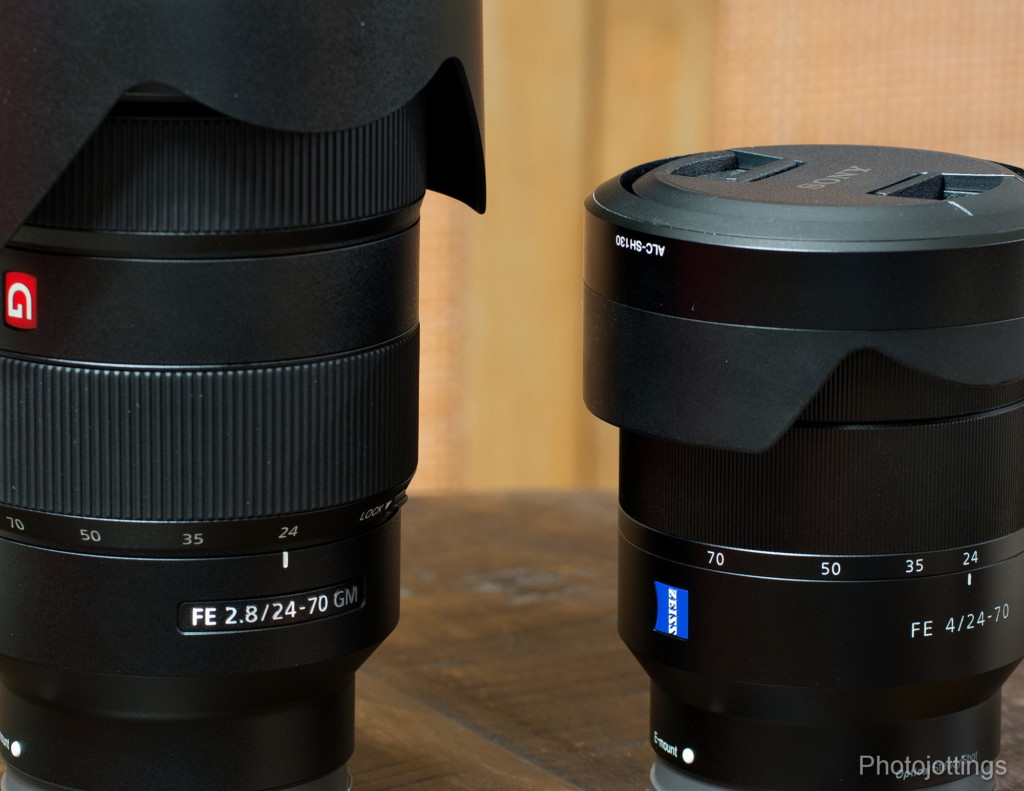
The Sony FE 24-70mm F/2.8 GM is the first pro mid-range zoom lens for use with Sony’s full frame ‘E’ system; it’s the big brother of the Zeiss 24-70mm F/4 reviewed here.  Being a ‘pro’ lens, it’s built very well, which also means it’s large and heavy, (2 lbs), and it doesn’t seem to balance very well on the small and lightweight Sony camera bodies, but that’s just me talking, it may feel fine to you.  Sony did not incorporate OSS or optical stabilization on this lens, but your camera model may have in-body stabilization.  Also included is a focus hold button, which can be customized for different uses depending on your camera model.

Fit and finish are very good.  The lens appears to be clad in metal and high quality plastic with a metal mount and front filter ring area.  There is a ribbed grip around the focus and zoom rings.

Sony claims the lens is ‘weather resistant’ for splashes etc, by way of a rubber gasket around the mount; however, if you look closely when the lens is mounted by shining a light behind the mount area, you can see the gasket doesn’t touch when the lens is hanging free; meaning just the weight of the lens against the camera causes a gap in the camera/lens mounting area, and the gasket does no good.  Oh well, better luck on the revised version.

Sony claims the use of three aspherical elements in the design, including one ‘extreme’ aspherical element, plus two ‘ED’ elements and ‘nano AR’ coatings.  Lens is made in Thailand.

Filter size is 82mm, and is so far the only ‘E’ lens that uses this size.  Unfortunately, these large filters are expensive.  With that said, and considering the very high quality optics on the lens, don’t use cheap ‘general brand’ filters; doing so will degrade the image quality.  Go here (B&H, Amazon, eBay) for a vast selection of 82mm filters.

Focusing.  This lens auto-focuses quickly and mostly accurately, (depending on your camera model), and has a very quiet linear focusing motor so it can’t be picked up when shooting video.  The front filter ring doesn’t turn when focusing, so your polarizers and grads will work great.  The manual focusing ring is easy to turn, and is damped properly in my opinion.

Zoom.  Zooming is smooth, and requires less than a quarter turn from 24mm to 70mm.  This lens has a zoom lock, and can be locked only when set to 24mm, however, I didn’t notice any zoom creep.  Not a zoom issue, but notice the front element is dead flat, which is odd, check out the x-ray view.  Other oddities include; when set to exactly 35mm, the exif data will read 34mm until turned well past the mark; same for 50mm, it will read 51mm.  This is not a big deal, I’m just pointing it out.

In the box is the lens, front and rear caps, a black cloth padded carrying case, and a plastic petal type hood.

Comparisons with other lenses:

Sony FE 24-70mm F/2.8 GM, and the Sony Zeiss FE 35mm F/2.8.

Sony FE 24-70mm F/2.8 GM and the Sony Zeiss FE 55mm F/1.8.

Sony FE 24-70mm F/2.8 GM and the Sony Zeiss FE 24-70mm F/4.

Sony FE 24-70mm F/2.8 GM and the Sony Zeiss FE 16-35mm F/4.


Check out the product shots below, and click images for larger versions.

Box and contents
Compared to Sony Zeiss FE 24-70mm F/4
Extended front
24mm, with hood.
Extended
Rear mount, black rubber ‘seal’ around outer mount.
Sony MTF graph
X-ray view

Specifications

 Official lens name and code  Sony FE 24-70mm F/2.8 GM   SEL2470GM
 Box contents  Front cap, rear cap, black cloth padded case, plastic petal type hood and user’s manual.
 Cost  $2199 as of 12/17.
 Build Quality  very good.
 Additional information  This model is made for Sony ‘E’ mount cameras, and won’t work on ‘A’ mount cameras as of this review.
 Optical configuration  18 elements in 13 groups.
 Angle of view  at 24mm; 84° diagonally, 74° horizontally, and 53° vertically.  At 70mm; 29° diagonally, 34° horizontally and 19° vertically.
 Aperture  9 blades, curved
 Coverage for  Sony E mount 24x36mm sensor.  When mounted to an APS-C camera, the focal length is equivalent to 36-105mm in 135 film format.
 Depth of field and focus scales  nothing.
Minimum focus, image plane to  subject  About 14.75″  (375mm).
Minimum focus, end of lens barrel to subject  Working distance about 7-7/16″ (192mm) from front of lens barrel, no hood.
 Infinity focus hard stop  No.
 Length changes when focusing  No.
 Focus ring turn in AF  No.
 Filter size  82mm filter.
 Filter ring rotates  No.
 Maximum reproduction ratio  1:4.2 or 0.24x.
 Minimum F/stop  F/22
 Sony Teleconverter compatible  No.
 Length changes when zooming  Yes
 Dimensions WxL  3.5″ x 5.4″    88mm x 136mm.
 Maximum extended length  6.5″(165mm) long extended to 70mm.
 Weight  31.3oz, (886g) bare.

Optical qualities summary.

 Lens flare/ghosting  overall, good control at wide apertures.
 Light fall-off  good control at all apertures and focal lengths.
 Color fringing  above average control of lateral type at wide angle, and almost nothing at longer focal lengths.
 Bokeh  Neutral at best for all focal lengths and apertures.
 Color  seems about the same as other Sony lenses.
 Close-up filter  not tested
 Coma  almost none.
 Regular filters  might not cause noticeable additional light fall-off, see vignetting below.
 Filter size  82mm.  An oddball size, not used much in Sony’s world.
 Distortion  moderate to strong through most of the zoom range uncorrected.

Distortion.

This lens has plenty of distortion, and was probably designed around in-camera digital correction, instead of optical correction.  I see the typical wavy wide angle distortion at 24mm, going flat about 29-31mm, then going to pincushion distortion at 35mm all the way to 70mm.  I did not enable in-camera correction so I could show the amount of actual distortion present, however, if you enable corrections, or use distortion sliders, most of the pincushion can be eliminated.  Even so, unfortunately a little waviness remains near 24mm.

Maximum reproduction ratio.

Click image for larger version.

This image is a US stamp, measuring 0.87″x 1.0″ or 22mm x 25mm.  The Sony FE 24-70mm F/2.8 GM has a maximum reproduction ratio of 1:4.2, which is typical for a zoom lens in this class.  The close focus shot is very sharp from F/4 through F/11; this example is F/8.

Light fall-off.

24mm

70mm

Light fall-off is well controlled; I tested 24mm, 35mm, and 70mm at F/2.8, F/4, F/5.6 and F/8, and show just the wide and long end to keep you from getting too bored.  I see slightly dark corners at all zoom settings, more noticeable towards the wide end, but it’s not something to worry about.  I do not have an 82mm filter, so I wasn’t able to test for additional light fall-off when using a filter, however, based on testing similar lenses, I doubt it will matter much even when using a thick type filter such as a polarizer etc.

Bokeh

24mm, full view

full view

Crops from central area, click image below for larger version.

70mm, full view.

Crops from central area, click image below for larger version.

Bokeh or the character of out of focus highlight blur is about the same at all focal lengths and apertures, with a neutral looking disc, to slightly harsh looking.  Distance for the 70mm samples were taken with the subject Geranium about 6′ or 2 meters from the camera.  At 24mm, the distance was only about 2′, or .7 meters.  It has obvious signs of aspheric element use, as concentric (onion) rings are visible especially towards the wide end if you view your images at their maximum size, at smaller sizes, it can look smooth.  As always, if your subject is very close to the lens, and the background is well off in the distance, everything is blurred away, but that’s not ‘bokeh’ it’s simply background blur.

Full size resolution samples.

Feel free to download these for your personal inspection.  Crop them or toggle between the images to see how sharpness changes between aperture settings.

In this Tucson, AZ mountain scene, everything is in focus, with a broad depth of field except for the very bottom of the image at wide apertures.

24mm.


F/2.8 F/4 F/5.6 F/8 F/11

Click button for full size image.

The centers are very sharp, even with the aperture wide open. The mid-sections and extreme sides look good at F/2.8, but do sharpen up noticeably at F/5.6.  Stopping down to F/8 provides just a hair more resolution along the periphery.

35mm.

F/2.8 F/4 F/5.6 F/8 F/11

Click button for full size image.

The centers are very sharp at F/2.8, and the sides are just a bit soft.  While there is little improvement along the sides at F/4, stopping down to F/5.6 maxes out the resolution across most of the image except the extreme left side, where F/8 things look very sharp.

50mm.

F/2.8  F/4  F/5.6  F/8  F/11

Click button for full size image.

The centers max out at F/4, but only if you look really close, the sides are a hair soft at F/4 too. Stopping down to F/5.6 shows a barely noticeable improvement to the sides, and finally to F/8 where the whole image is very sharp, even the extreme sides.

70mm.

F/2.8  F/4  F/5.6  F/8  F/11

Click button for full size image.

At 70mm, the whole image looks very good at F/2.8, but you need to stop down to F/5.6 for most of the image to max out in resolution. In this particular lens, the right side is a little soft until F/8 to F/11, and only noticeable by pixel peeping.

Conclusion.

The Sony FE 24-70mm F/2.8 GM is a superb lens, the best zoom lens Sony has ever put out, and I’ve reviewed almost all Sony lenses going back to the Konica Minolta days before Sony bought them.  Impressive qualities include low light fall-off at all focal lengths, flare and ghosting are minimal, especially at wide apertures, color fringing is well controlled overall; build quality is excellent, although it is a large and heavy lens, but that’s typical of other manufacturers similar lenses.  If you are looking for a smaller lens with the same focal range, check out the Sony Zeiss 24-70mm F/4, it works well also, but it’s not as sharp as the GM lens.

There are no real disappointments in either mechanical performance or optical qualities, however, I’d like to see a bit less distortion; when you correct strong distortion as this lens has especially towards the long end, it does effect the resolution when it gets fixed, although most people will never notice if you show them the final version of your image.  As I pointed out earlier, the ‘weather resistant’ claim will not hold up in the real world; the gasket doesn’t mate with the mounting surface unless the camera and lens is held straight up to the sky where gravity is helping out.  Also,  bokeh is not really smooth at any focal length or aperture, that’s the price of having a bunch of aspherical elements in the design, although they help out with coma and contrast along the sides.

The Sony 24-70/2.8 GM is an outstanding lens, and a welcome addition to the Sony FE line-up.  For those of you that don’t mind the bulk and weight of this zoom, and only want, (or can only afford) one lens, this is it!  Check out the comparisons below and feel free to rid your bag of those primes lenses you thought were so good.

Here are some comparisons with other lenses.

Sony FE 24-70mm F/2.8 GM, and the Sony Zeiss FE 35mm F/2.8.

Sony FE 24-70mm F/2.8 GM and the Sony Zeiss FE 55mm F/1.8.

Sony FE 24-70mm F/2.8 GM and the Sony Zeiss FE 24-70mm F/4.

Sony FE 24-70mm F/2.8 GM and the Sony Zeiss FE 16-35mm F/4.


That’s it for this review, check out the Sony FE 24-70mm GM F/2.8 lens and help support the site!  Thanks!

Just a quick post to broadcast my thoughts on the two websites for 2017, including most popular posts, viewers, and direction.

First off, thanks to all the visitors for checking out my ‘new’ site photojottings. It’s been around since 2012 in an abbreviated way, but I’ve been pretty serious about it in 2017, and spent a ton of money transferring all the old material from kurtmunger.com to here.  My intention is to keep the old site up for a couple more years, then give it a proper burial, hopefully before web.com pulls the plug on the old trellix sitebuilder and the whole site gets trashed instantly, that’s my fear and reason for transferring the old stuff here.

Kurtmunger.com.  I haven’t updated my old site with anything meaningful in almost three years, (3/14 last lens review); however, the site still gets nearly 109,000 visits per month, and almost 200k page views.  Top five posts include the dirty lens article, two ‘E’ mount charts, lens price guide, and the Kodak Brownie review, all of them done about 5-10 years ago.  I’m in the process of updating all the old reviews that have been transferred to photojottings, so always check here for the most current info.

Photojottings.  I didn’t post very many new reviews in 2017, but I did get rolling in September by adding two posts a week on average, and have kept that up,  however, I’d like to pick that up a bit to three posts a week soon.  My goal is to do about two full reviews a month, probably a combination of new FE lenses, film cameras and some gear related articles, along with updates and site changes and/or additions.  The top five posts include: Fuji GWS690III review, a film camera, and ironically the most popular page on the site, then ‘all lens reviews‘ page. Third is the Rokinon 12mm F/2 review, fourth is the Sony 28-70mm F/3.5-5.6 review, and the fifth most popular post is the Sony Zeiss quick comparison.  Rounding out the top ten include the Kodak Funsaver disposable camera review, the Sony 55/1.8 and Sigma 30/1.4 review, the complete lens guide page and Sony 24-70/4 review.

I use a lot of film each year, in 2017 I shot almost 40 rolls of film, and went through a 25 sheet box of Ilford 8×10 film.  Film seems to have bottomed out around 2016, and now appears to be on a recovery curve, which is great. My guess is many artistic people are looking for something different than digital, and want an ‘original’ or tangible product to show, like a Kodachrome slide for instance; there is no hard original image with digital; a RAW file or print from that file is not an original.  Some people like myself may enjoy taking the picture, developing the film, and printing it out, or even using fun direct positive paper, think of a polaroid, only much better quality.  So this year will include quite a few film camera reviews, and articles related to film processing and scanning.

Anyhow, hope you have a great year, and thanks for visiting! Kurt.

Feature image is of my dad in Korea about 1952/3 with a Canon IV SB camera, Kodachrome slide.

Here are more comparison crops for you to check out, this time it’s between the Sony 24-70mm F/2.8 GM, and the Sony Zeiss 35mm F/2.8; which is a good little lens (reviewed here), but is it as sharp as a zoom lens?  If you aren’t interested in reading the whole post, I’ll save you some time; the zoom is sharper for the most part all the way around!

Sony A7R used for test images.

Sony Zeiss 35/2.8 sets are along the top, and Sony 24-70/2.8 GM sets are on the bottom of image.

Here is the whole test scene and where the crops are taken from.

F/2.8

left side, center, and right side

Sony Zeiss 35mm F/2.8 on the top, Sony 24-70mm F/2.8 GM on the bottom.  Click pictures to enlarge.

The prime is slightly ahead of the zoom, mostly noticeable in the left side crop.

F/4

The left side of the zoom is a little soft, but other areas are just as sharp or sharper than the prime.

F/5.6

The zoom sharpens up all around at F/5.6, but the prime is maxed out at F/4, and gets no better until F/11 along the sides.

F/8

About the same results here as the F/5.6 crops.  Click pictures to enlarge.

F/11

The zoom looks sharper all the way around at F/11; a little surprising.

The Sony 24-70mm F/2.8 GM seems to have slightly better contrast at all apertures, and is noticeably sharper at small apertures.

That’s it for this mind blowing comp!


Merry Christmas from Photojottings!  I’ll be spending time here in Tucson, AZ with family.

Over the holidays, I’ll be getting some more comps ready, the next one will be between the Sony 24-70/2.8 GM, and the Sony Zeiss 35/2.8, then a couple of others before the new year.

Hope everyone has a great holiday.

Canon ELPH Jr review, featuring the Advanced Photo System.

The Canon ELPH Jr IX240 is the most convenient pocket camera I've ever used, film or digital.  Size wise, it's similar to a pack of cigarettes, and fits in your shirt pocket just fine, see picture inside. The ELPH Jr is a film camera, and uses APS film which has not been manufactured since around 2010-11.  However, there is a bright spot for those that want to experiment with this state of the art film system.  Currently, Amazon and eBay have some 'cold stored' film available here Amazon, eBay, and that's mostly what I've used for this review.  So grab yourself a beer, and let's head back to the nineties!

Read more »

West Roxbury Massachusetts time machine.

Let's fasten our seat belts, and get ready for a ride in the photojottings time machine!  Oh, and bring your jacket, it's late October and a bit chilly!

For the journey today, we'll head back about a hundred years and visit a quite, leafy neighborhood in West Roxbury, Mass.  Henry A Stanley photographed the scene somewhere around 1910-1920.  Detail in this century old (undated) 5x7" glass plate negative is stunning, (click image for larger size, shown here at 7000 pixels wide).  Check out the gas street lights, especially the close one in the upper extreme left side; the unique street sign to the right, and what looks like an early automobile way down the road.  The white blotches on the right are from the paper sleeve that stuck to the emulsion side over the years; I may try to remove it at some point, but I don't have the skill and nerve to try it right now.

The address for the house on the right is 218 Park St...

Read more »

Sony 24-70mm GM, Zeiss lens comparsions

I've finally completed the comparison page for the Sony 24-70mm F/2.8 GM, and Sony Zeiss 24-70mm F/4 lenses.

I'm surprised at the results at 24mm, and 70mm, the Zeiss is not really that much different at wide apertures.  The GM lens really shines in the centers at all apertures and focal lengths, and it's very noticeable in these crops.

The Sony 24-70mm F/2.8 GM (B&H Photo) would be great for someone (with deep pockets) that likes to shoot street scenes and landscapes, and wants near prime lens performance, but is not bothered by a large and heavy lens.

The Sony Zeiss 24-70mm F/4 (B&H Photo,) is about half the price (and heft), of the GM, but is totally adequate for day to day shooting if you don't plan on printing tack sharp 24x36" posters.  I never print that big, and find the Zeiss will continue to meets my needs in the future, so I'm not going to add the GM lens to my stable at this time.  Both lenses offer a lot of performance for the money, you just have to figure out how you're going to use the lens, and what features and qualities are important to you...

Read more »

New Sony ‘E’ lens for APS-C lovers

Sony has come out with a new 'E' 18-135mm F/3.5-5.6 OSS APS-C $599 lens, the first one since 2013 if you don't count the 18-110 OSS F/4 video lens.  Additionally, if you've been pining for a silver A6300, your wait is over.  I'm not sure if Sony has set aside any development resources for more APS-C cameras and lenses, your guess is as good as mine.

The new Sony 'E' 18-135mm lens looks like it may perform quite good judging by the Sony MTF graph, and least in resolution and contrast. The optical configuration is 16 elements in 12 groups, with one aspheric and two 'ED' and elements. It has a linear focusing motor, and optical stabilization. I'll be reviewing the lens in the coming months.

Read more »

Sony 24-70mm F/2.8 GM full review

Howdy folks, the first real post of of 2018 is ready, and I hope you'll enjoy it, even if you can't afford it.  I'm working on the comparison between this lens and the smaller 24-70mm F/4 version; that should be ready in a few days.

The Sony FE 24-70mm F/2.8 GM is a superb lens, the best zoom lens Sony has ever put out, and I've reviewed almost all Sony lenses going back to the Konica Minolta days before Sony bought them.  Impressive qualities include low light fall-off at all focal lengths, flare and ghosting are minimal, especially at wide apertures, color fringing is well controlled overall; build quality is excellent, although it is a large and heavy lens, but that's typical of other manufacturers similar lenses.  If you are looking for a smaller lens with the same focal range, check out the...

Read more »

2017 in review

Just a quick post to broadcast my thoughts on the two websites for 2017, including most popular posts, viewers, and direction.

First off, thanks to all the visitors for checking out my 'new' site photojottings. It's been around since 2012 in an abbreviated way, but I've been pretty serious about it in 2017, and spent a ton of money transferring all the old material from kurtmunger.com to here.  My intention is to keep the old site up for a couple more years, then give it a proper burial, hopefully before web.com pulls the plug on the old trellix sitebuilder and the whole site gets trashed instantly, that's my fear and reason for transferring the old stuff here.

Kurtmunger.com.  I haven't updated my old site with anything meaningful in almost three years, (3/14 last lens review); however, the site still gets nearly 109,000 visits per month, and almost 200k page views.  Top five posts include the dirty lens article, two 'E' mount charts, lens price guide, and the Kodak Brownie review, all of them done about 5-10 years ago.  I'm in the process of updating all the old reviews that have been transferred to photojottings, so always check here for the most current info.

Photojottings.  I didn't post very many new reviews in 2017, but I did get rolling in September by adding two posts a week on average, and have kept that up,  however, I'd like to pick that up a bit to three posts a week soon.  My goal is to do about two full reviews a month, probably a combination of new FE lenses, film cameras and some gear related articles, along with updates and site changes and/or additions.  The top five posts include: Fuji GWS690III review, a film camera, and ironically the most popular page on the site, then 'all lens reviews' page. Third is the Rokinon 12mm F/2 review, fourth is the Sony 28-70mm F/3.5-5.6 review, and the fifth most popular post is the Sony Zeiss quick comparison.  Rounding out the top ten include the Kodak Funsaver disposable camera review, the Sony 55/1.8 and Sigma 30/1.4 review, the complete lens guide page and Sony 24-70/4 review.

I use a lot of film each year, in 2017 I shot almost 40 rolls of film, and went through a 25 sheet box of Ilford 8x10 film...

Read more »

Zeiss 35/2.8 and Sony 24-70/2.8 GM comparisons.

Here are more comparison crops for you to check out, this time it's between the Sony 24-70mm F/2.8 GM, and the Sony Zeiss 35mm F/2.8; which is a good little lens (reviewed here), but is it as sharp as a zoom lens?  If you aren't interested in reading the whole post, I'll save you some time; the zoom is sharper for the most part all the way around!  Read more...

Read more »

Merry Christmas!

Merry Christmas from Photojottings!  I’ll be spending time here in Tucson, AZ with family.

Over the holidays, I’ll be getting some more comps ready, the next one will be between the Sony 24-70/2.8 GM, and the Sony Zeiss 35/2.8, then a couple of others before the new year.

Hope everyone has a great holiday.…

Read more »

Scroll to Top