Photo Jottings - Page 12 of 127 - Photography equipment expertise

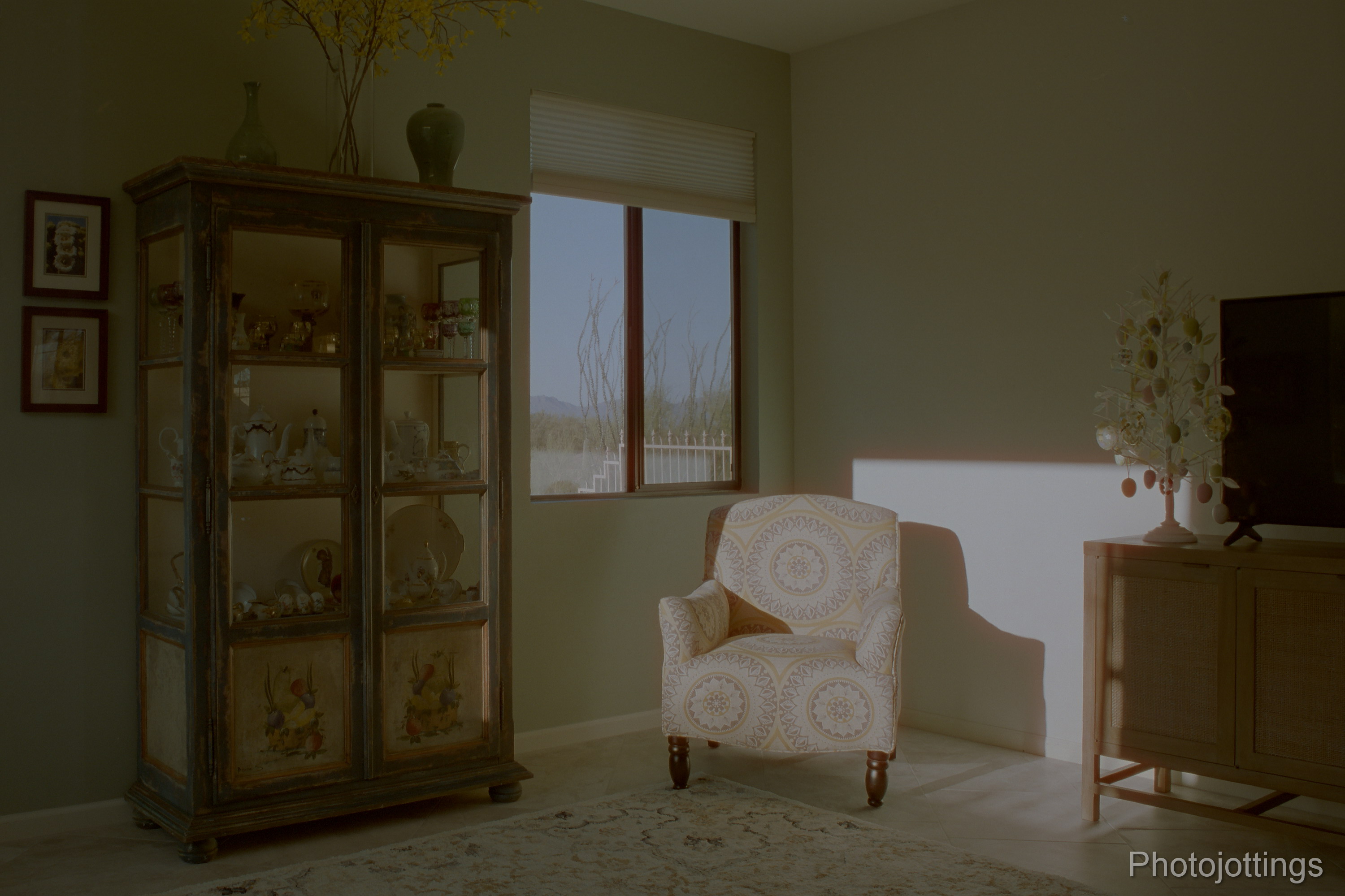
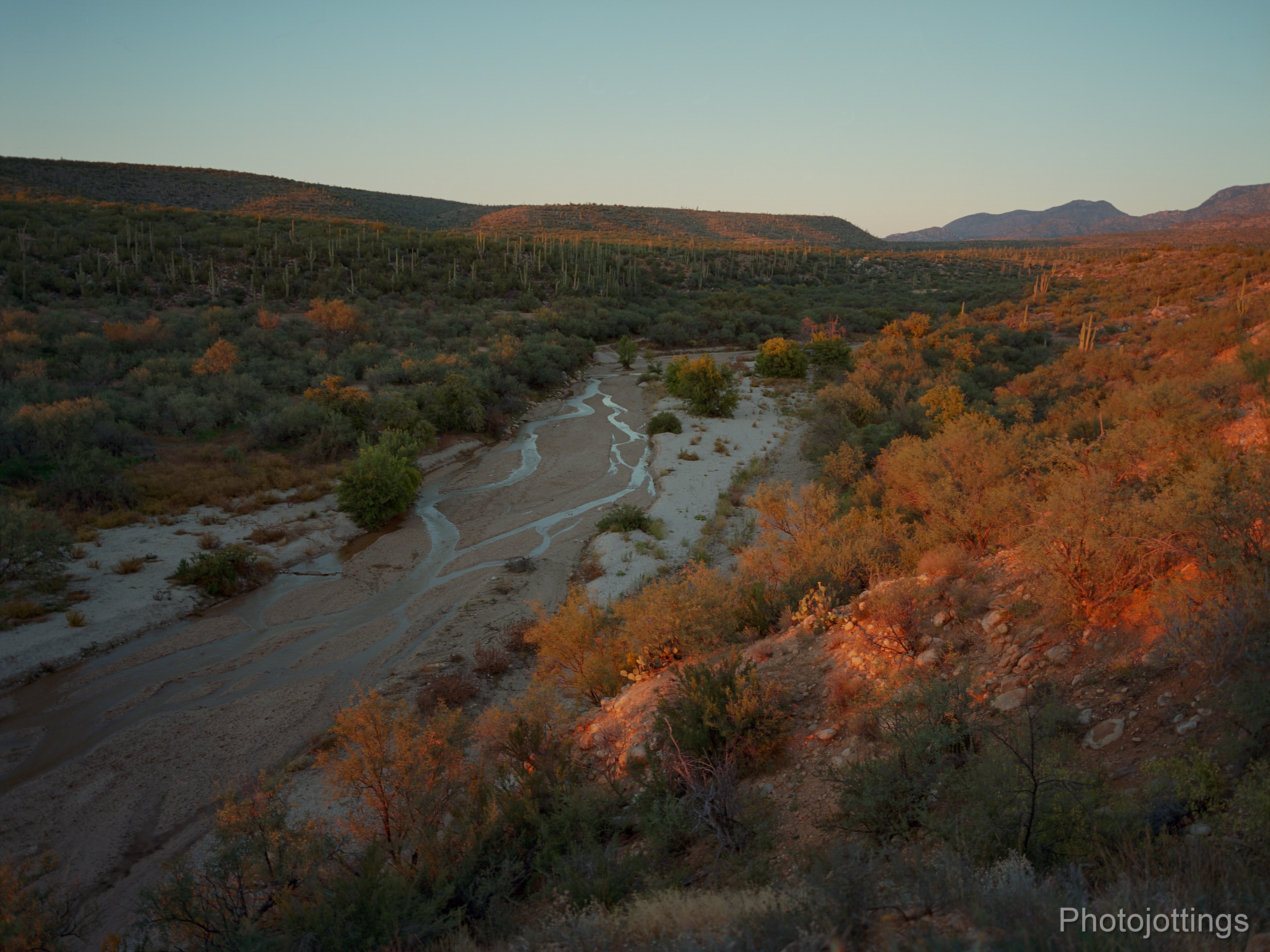
I’ve totally updated the Zeiss Ikon Ikonta review using mostly new pictures, along with the now standard mountain aperture test scene.  I’ve also added more information gained through additional use, and then put the whole review in the same format as the newer camera reviews.

My dad bought this camera new in 1953, and I’ve had it for the last 10 years or so.  Using it was a chore as the shutter speeds were off quite a bit, and the focusing was out of whack so to speak.  After a recent  shutter cleaning and lens calibration by the famed Certo6, it now hums along nicely, and produces much higher technical quality photos than before.

Head to the totally updated review here.

If you’re bored at work, how about checking out a four page B&H Photo ad from a February 1999 Popular Photography magazine?  During the late 1990s the film industry was still going fairly well, but dark clouds were on the horizon.  As I look through the ads, I’m amazed at the prices they were charging, and apparently getting for some of the higher end camera gear.  Keep in mind these prices have been steeply discounted from high volume retailers; your local camera shop probably charged significantly more than what you see here. The swell, (and nearing the end of its life) Nikon 35Ti is $649, the newer Fuji GA645Wi is $1679, and the old, (and nearing the end of their lives) Fuji GW690III series are around $1250, which is actually much less than I would have guessed.

It’s kinda fun looking through the old Photography magazines once in a while, not just for the ads, but the articles and reviews too.  These pages are courtesy of Google Books which scanned the entire magazine.  Enjoy!


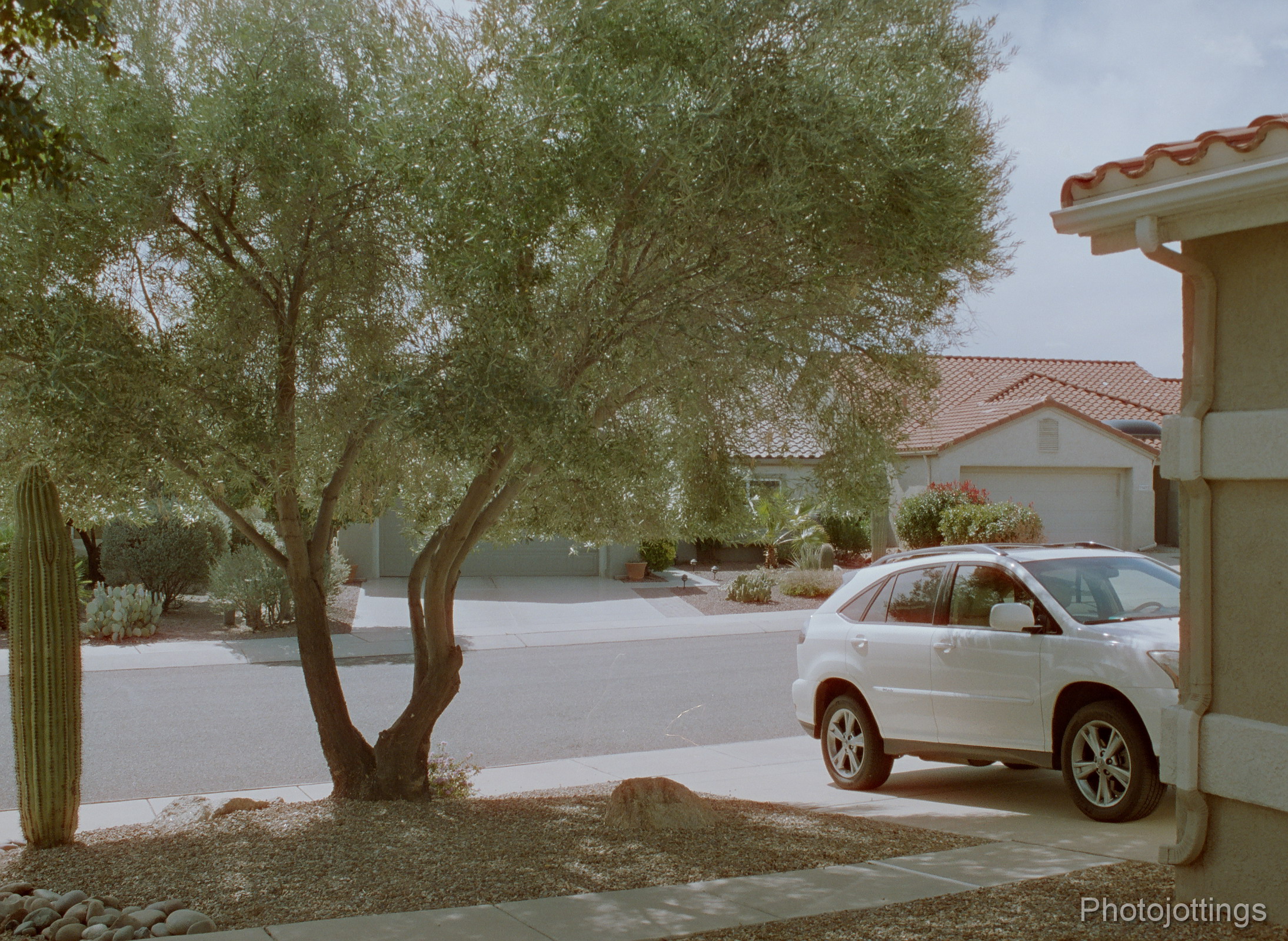
As a follow up to this film, I thought I’d try out a roll of Kodak Vision3 film, sold byCineStill as CineStill 50D when the rem-jet layer is removed.  This removal process adds odd characteristics to the film, like forming red halos and tinged borders around dark to bright transitions; check out the shots below to see what I’m talking about.

CineStill 50D Xpro is actually Kodak Vision3 50D 5203 color negative film, which has a coating called ‘remjet’ for use in motion picture cameras; however, Cinestill has removed the coating so it can be developed in standard color print C-41 chemicals.  Kodak Technical info here.

Kodak touts its Vision3 50D as the worlds finest grain film.  Characteristics include; Fine grain, smooth shadows, (almost like slide film believe it or not), high exposure latitude.  Unfortunately, the CineStill rem-jet removal adds halos and red tinged areas at high contrast edges, although artistic people might actually like/want that look.  Also, the colors are a bit muted, but can be enhanced after scanning.

From the CineStill website for 135mm rolls.

36 exp. 135 rolls. ISO 50/18° speed daylight balanced (5500K) motion picture emulsion. Original fresh stock from Kodak 50D, prepped and rolled for clean safe C-41 standard development as an ISO 50 film. Boasted to be the world’s finest grain film! May also be processed in motion picture ECN-2 chemistry.

Our proprietary “Premoval” process makes motion picture film safe to process in standard C-41 photo lab chemicals or at home. This emulsion is optimized for a hybrid workflow, ideal for scanning, and when processed in C-41 chemistry it can be optically printed on RA-4 paper.


Samples with descriptions.

All images below were taken with an excellent light metering fully auto 35mm camera, so I didn’t have to worry about shutter speeds.  I shot the film at ISO 32 instead of the rated speed of 50.  There is no DX coding, so my camera automatically defaults to ISO 32, which would be 2/3 stop over ISO 50, not a big deal.  No exposure compensation was used.  Scanned on a Nikon Coolscan 9000 ED.  Pictures are sized at 3000×2000.

The roll I purchased late in 2017 is non-DX coded, so you have to dial in your own ISO rating, or your camera may automatically default to 32, 50 or 100, it depends on the camera; mine sets ISO to 32. The information from CineStill is that 135 cassettes are now DX coded, so I’m guessing all new 135 rolls have this.

The film you get has “Eastman 5203” written on the negative edges along with a bunch of other codes.  The film is very flat, and scans well.  CineStill 50D is pricey at close to $11 per 135 roll.

This post is not a review; I’ve only shot one roll of 135, I just thought I’d show how the roll turned out.

With all the incidentals out of the way, let’s move on to some samples.

Click pictures for larger versions.

A course that Jack built.  A typically ‘smooth’ look for this film.

Ridgeline housing project.  See the red tinges along the house roof lines, and smooth shadow areas.


Inside the compound.  See the red tinge around the highlighted wall from the sun.  Notice the smooth under-exposed shadow areas.  This image will respond well to lifting the shadows in post processing.

This image is smaller than the others as I had to crop out the door frame on the left side; which took up about a third of the frame.  Darn, I’ll have to remember to look through the viewfinder more often.  Anyhow, more red tinges at the car windows, among other areas.

Sunvillea.  A nice fit for CineStill 50D; a pink, low contrast subject.  Depth of field is slim here, so not much is in focus.  Shooting info; I think 110mm, F/5.6 and close focus.

At a quick glance, CineStill 50D looks pretty good; I really like the ‘smoothness’ of the film, especially the shadows, and the colors are good too, but I’d add a little more ‘punch’ to the final print.

That’s it for a cursory look at CineStill 50D daylight film.  Help support the site by getting your goodies, and this film here.  B&H, Amazon, ebay.  Note; current Amazon and ebay prices for this film are way too high, get it at B&H photo.

Our next camera up for review is the Spartus Spartaflex, where their famous marketing line is “you see the picture before you take it.”  Of course all cameras have some sort of way to view the picture before you take it, but Jack Galter of the Spartus Camera Corporation was not shy about questionable marketing, and he even tried to register the name “Kodak” for his new line of cigarette lighters with the US Trademark association.

This item was yet another ebay impulse buy, and fortunately I got lucky and ended up with a nice working copy.  The Spartus Spartaflex was made in Chicago Ill, around the late 1940s to early 1950s and priced at $27.50 with flash in 1949.  When looking online for more info, I noticed it looks like there are at least three different iterations of this model through the years; the differences are mostly in the face plate and lens shapes and finishes.

The Spartaflex is a relatively well build plastic “box” type camera, with a waist level viewfinder and a coupled taking and viewing lens, which, by the way, means this is a real twin lens camera, not a pseudo type like this one.   You can actually see the focus change in the finder as you move the lens in and out, but getting perfect focus is another story since there is no magnifier to use on the unusually dim ground glass.  It uses readily available 120 film, and takes 12 6×6 pictures per roll.

Spartus made some pretty dubious claims when marketing this camera.  For instance, in period magazine ads, they claimed the taking lens is coated, the metal parts are chrome, the focal length is 100mm and it focuses down to 5 feet.  Based on my own inspection, none of those claims are true; but oh well, it sounds cool in the ad right, and who’s going to know?  Sneaky those wretched marketers.

Some of these cheap old cameras with simple lenses are capable of producing pretty good large prints.  When I decided to purchase it, I hoped that it would be much better than this similar one.  To find out if it met my expectations, go to the bottom of the review; but first off, let’s take a look at the camera specs.

Name; Spartus Spartaflex

Manufactured by; Spartus Camera Corp, Chicago, Ill, USA.

Date of manufacture; not sure, but most likely in the late 1940s or 50s.

Price; a 1949 magazine ad shows the camera with flash attachment for 27.50, so probably over $20 for the camera body only.  Current eBay prices range anywhere from $10 to $50 for the outfit depending on condition.

Build material; mostly black plastic, with a die-cast front fascia.  All silver items are metal.

Weight and size; camera only, 19.6oz (555g)

Dimensions; camera only, excluding protrusions; 3.0″ (76mm) wide, 4.75″ (120mm) tall, viewfinder hood closed, and 4.0″ (101mm) deep.

Focal length; owner’s manual states 100mm, but really near 90-95mm, which is still very ‘long’ for this format, and in the telephoto range.  A normal focal length for this 6×6 format is 75-80mm.

Aperture; four to choose from, 7.7, 11, 16 and 22, selectable via lever on the side of the taking lens.

Focusing distance; Manual states from 5′, but the lens is marked 8′ (2.5m) to infinity.  Marks at 8, 10, 15, 30, 50 feet and infinity.

Original print size; standard oversize prints 3½” x 3½,” at this size any aperture used will look excellent.  Today you’ll most likely get 4″ x 4″ and they look great too.

Approximate resolution; will make excellent 8″x 10″ prints when the aperture is set to F/22, and sharp 4″x 6″ at the widest aperture.  See Sample images at bottom of page.

Lens; looks like a three element achromat for the taking lens, and probably a one or two element uncoated viewing lens.  Maybe just a hint of blue on the taking lens, otherwise there’s no other effective coating or ‘color correcting’ nonsense present.

Shutter and speed; self-cocking (as you press), spring loaded rotary shutter.  Shutter speed tested, and averaged about 1/45th second.  Time and instant settings, but time acts as bulb, and holds the shutter open for as long as you press down the lever.

Distortion; I didn’t notice much when I took a really bad shot of a straight roof section.  I think it was mild to moderate pincushion.

Color fringing; not much noticeable from looking at one roll.

Features; four apertures to choose from, real twin lens focusing as the two lenses are gear coupled.  side mounted ‘sport finder,’ and uses commonly available 120 film.

Film; 12 6x6cm or 2¼”x2¼” exposures with 120 film, B&H, Amazon, eBay.

Double exposure prevention; no, so don’t forget to advance the film after you take a shot.

Accessories for this model;  flash unit, and carrying case.

Crippling features and omissions; the shutter speed is too slow for me, about half my shots showed signs of jitter, and unfortunately there is no tripod socket.  Viewfinder is dim even in good light.  Additionally; In this price range they should have included a tripod socket and double exposure prevention.

Good features; four apertures to choose from, and it takes widely available 120 film.  It’s reasonably well made with a simple build design, so it should work properly after all the years with zero maintenance or fuss.

Go here for the owner’s manual, and make sure you tip the site owner.

Product shots with descriptions.  Click for larger images.

The Spartus Spartaflex in the ready to shoot position.  On the left side is a mounting screw and connecting pin for the flash unit.  The silver knob on the top is for a neckstrap, which is long gone on this camera.

Here you can see the aperture lever and detents for F/7.7, F/11, F/16 and F/22.  You can get a good view of the synchronized taking and viewing lenses via geared connection.  The pin in the middle/right with the slot is the focus index mark; here it’s set at infinity.  The lower lever on the left side, (right side as you hold it) is the shutter, you push it down and release it for instant 1/45 speed, or ‘time’ for bulb mode, in which you hold it down for a long as you need to for a correct exposure.  Good luck doing this with no tripod socket.  The lever above the shutter selects ‘instant’ or time exposures.

The flip up finder is on the side, just below the film advance knob.  On the back is the red window for seeing the frame number.  The back cover is secured by a knurled metal screw on top, or to the left in this picture.

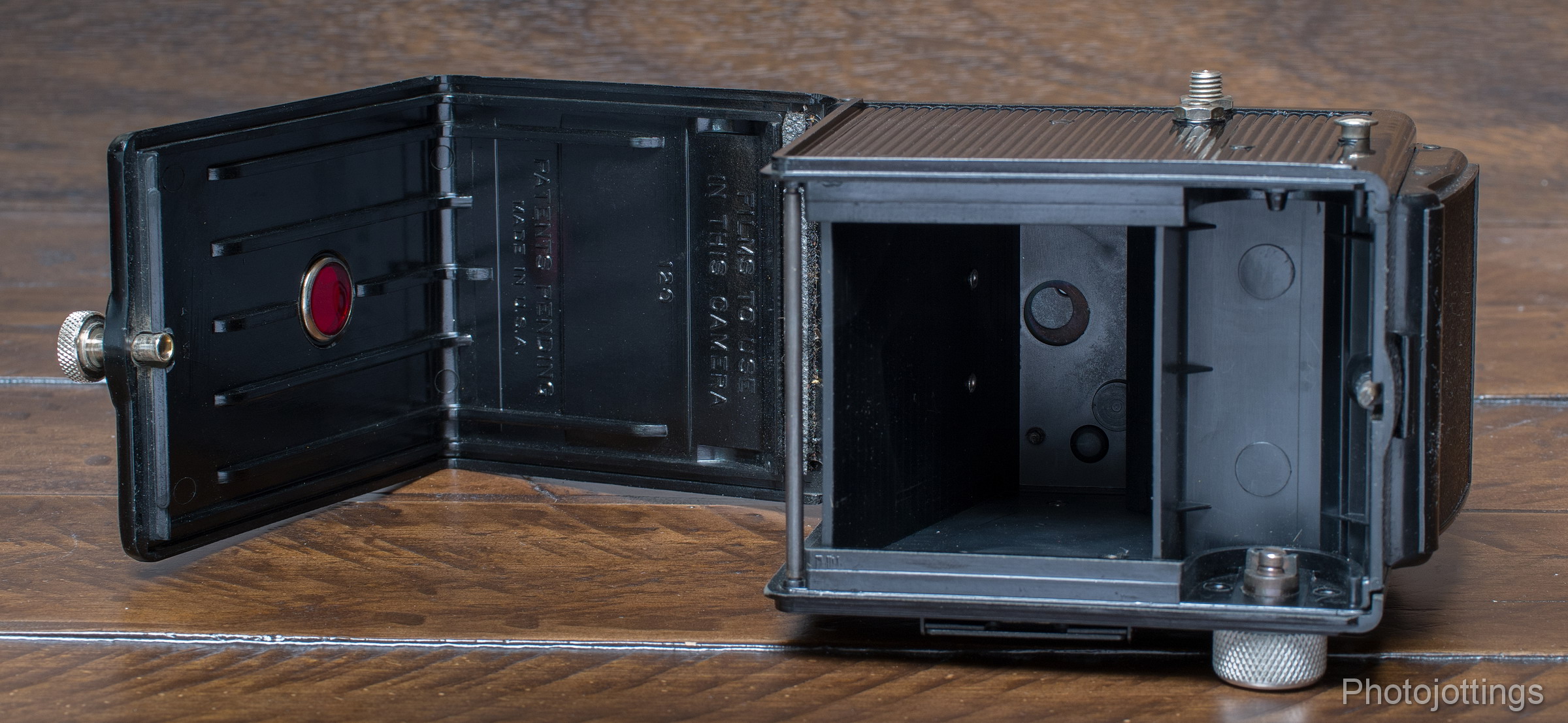
Inside the cover you’ll see the film gate guides, and fake pressure plate.  I didn’t seem to have any problems with film flatness.

The Spartaflex next to a average sized 6×6 TLR or box type camera.  The Spartaflex has the same outside dimensions as a typical 6×9 box camera.

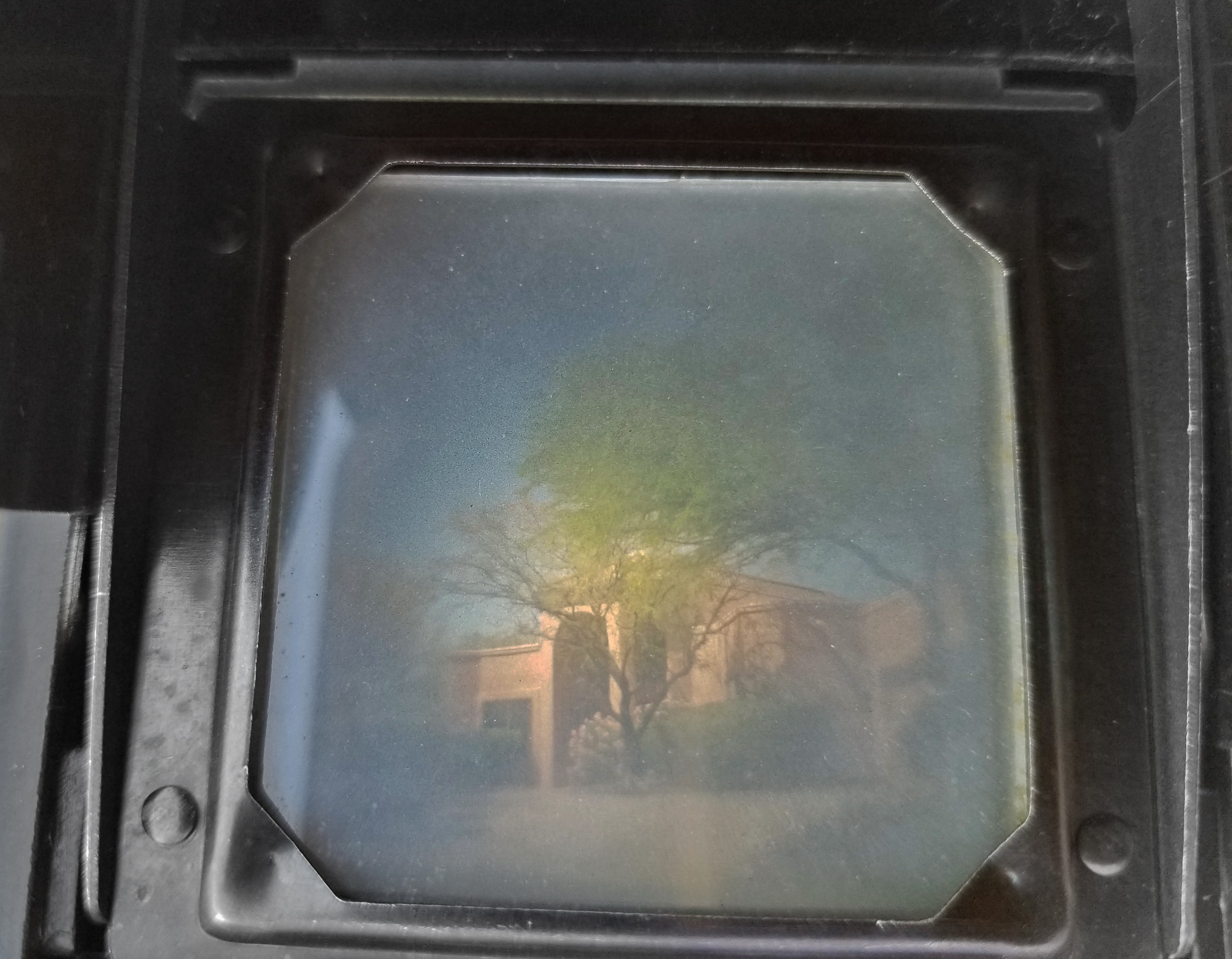
Here’s a view through the dim waist level finder.  The glass is clean, with just a few dust speckles here and there.  This scene is in bright high noon sun lite, so you can imagine what an inside shot or cloudy day would  look like through this.  The viewfinder covers much more area than the taking lens, so beware when composing, you may lose some of your sky like I almost did in the test shots below.


Here are some test images scanned on a Nikon Coolscan 9000 ED.  All are 3000 pixels square; there is no additional resolution from scanning at a higher sample rate.  Click for larger images.

A close focus shot on the Geraniums at F/7.7.  The amount of background blur is quite good due to the ‘long’ lens.  The light band towards the bottom and the bluish spot on the right side appear on the first and last images on the roll.  I suspect the processing lab, but I’m really not sure.

With the sun inside the frame you’ll get a big ring with rainbow flare; a very common problem with this type of lens.

Test samples at each indicated focal length.  Click for larger images.

This shot is at F/7.7.  The centers are pretty sharp for an achromat lens wide open, although I do see a lot of veiling haze.  The soft right side is noticeable here.

Camera shake is noticeable in this image at F/11.  There’s much more contrast at this aperture.

Another picture with camera shake, this one is at F/16.  Now the sides are getting sharper, with even more contrast.

At F/22 the sides are sharp, and the contrast is quite good.  You could make a large print from this picture, but why? it’s just a test shot.


Conclusion.

The Spartus Spartaflex is probably not the best ‘box’ type camera out there.  I do like the image quality when stopped down, it’s really very good for the price range.  It’s nice to be able to select four apertures, and it helps out in low light or when the lens is not centered correctly you can stop it down to F/22 for sharp shots by way of depth of field.  My copy has some issues with a soft right side, but that’s somewhat common with cheaper cameras like this.   The viewfinder is pretty dim, and it’s hard to see the subject in all but the brightest light;  although it seems to be bright enough to show when the focus is close, however, it’s not easy to see dead-on results as there is no magnifier as you would get on a more expensive TLR camera.

Just a thought here: I’d like to point out that it seems the Spartaflex was possibly designed as a 6×9 camera, instead of 6×6.  I’m thinking that because of the size of the camera, and focal length.  The image capture area really falls in the telephoto range, and this is the only 6×6 camera I’ve ever seen with a lens this long; claimed 100mm but more like 90-95mm.   When you consider that, and the viewfinder covers about 75mm, you can easily come to the conclusion that the Sparteflex was initially designed for 6×9 images like their “Press Flash.”  Maybe they ran into some problems along the way, and production costs started going up, so they decided to use parts they already had available for their other 6×6 cameras like the “Full Vue” etc.  Or maybe their other 6×6’s had the same focal length, and I’m full of BS; the Spartaflex is the only one I’ve had a good look at.

My only real complaint with the Spartaflex is the shutter speed is just too slow for me; as I said earlier in the review, over half my shots showed some level of camera shake, and that’s not acceptable, especially when you can’t even mount the camera on a tripod.  Funny, but the Ansco Color Clipper has almost the same shutter speed and weight, and I only had one jittery shot for the roll; but I guess it’s in the position of the shutter button and the way you hold it.

Anyhow, it was fun to shoot a roll of film through this camera, but it’s one and done for the Spartaflex.  For the price range, I’m giving it two thumbs up for image quality, and two thumbs down for shutter speed and viewfinder brightness.  If you really want to screw around with this type of camera, I’d get the Kodak Duaflex with Kodar lens, I reviewed it here, and liked it quite a bit, it has a much wider lens than the Spartaflex, a brighter viewfinder, and seems to produce the same images.  The only thing is it takes 620 film, which is still available fresh, but pricey.

I used Kodak Ektar 100 because I had some that was about to expire and wanted to use it up, however, for best results, I’d use ISO 200-400 speed film, and keep the camera at the F/16-22 setting.

Please consider buying your goodies through my links, doing so helps support the site, thanks!


Just a quick post to show the amazing quality of the lens on a Kodak Autographic Special No. 1 that’s north of a century old.  The lens is a triplet of Zeiss origin, sometimes marketed as a Baush and Lomb Kodak Anastigmat, or Kodak Zeiss Anastigmat.  Click for larger image, 5000 pixels wide.

I have a bunch of these Kodak folding cameras from the turn of the century to the 1930s, and all of them have shutter problems, so plan on getting that fixed if you want to use one for walk around snaps.

The Kodak No. 1 cameras take commonly available 120 film today (6×9 size), as they did way back in the day using wooden spools with metal ends, but they will work just fine with modern film using plastic spools.  Beware of the Kodak No. 1-a, it takes a completely different size film that is no longer available, and it’s often listed alongside the no. 1.

I used Kodak Portra 400 for this image, with the aperture set to F/22, at 1/10 second.  My camera shows some signs of a light leak, see the reddish blotches along the left bottom.  Once I get that, and some other issues fixed, I’ll do a proper review and get it posted.

I see more resolution in this 6×9 negative as I would get with even the most expensive 35mm camera and lens.  Sure, the negative size is much larger with 6×9, but we’re looking at a simple anastigmat lens that was designed almost 110 years ago!!  Talk about future proofing, I wonder how the current Sony Zeiss and GM lenses will compare to top grade lenses in 2128?

I had the chance to shoot another roll of Rollei Digibase CR200 E-6 film, (eBay), and the results are similar to the shots from the first time out.  The difference this time was that I took the shots in a harbor town setting, instead of Arizona desert fall colors.

One thing is for certain, Rollei CR200 has a very large dynamic range, almost like print film.  Unfortunately, I don’t really care for the colors, which are muted warm, with a bluish hue to the shadows.  The colors just don’t “pop” for me.  You can “jack” the colors in photoshop, but it’s really hard to get a more “traditional” look back to the scene.  However, for the artistic type, the native look for this film might be right up your alley.

Below are samples from the second roll.  This day was a little cloudy, with high clouds keeping the bright sun in check, however, the color differences are instantly noticeable from regular color print film, or Fuji Velvia film; see sample and comparison at the very bottom.

These samples were taken with a 1950s 6×9 folder, which has twice the negative size as the camera used for the first roll, (6×4.5), so the grain size and shape that I originally complained about is less intrusive in this set.  The scans below were made by the developing lab, and are pretty close to what you see on the light table.

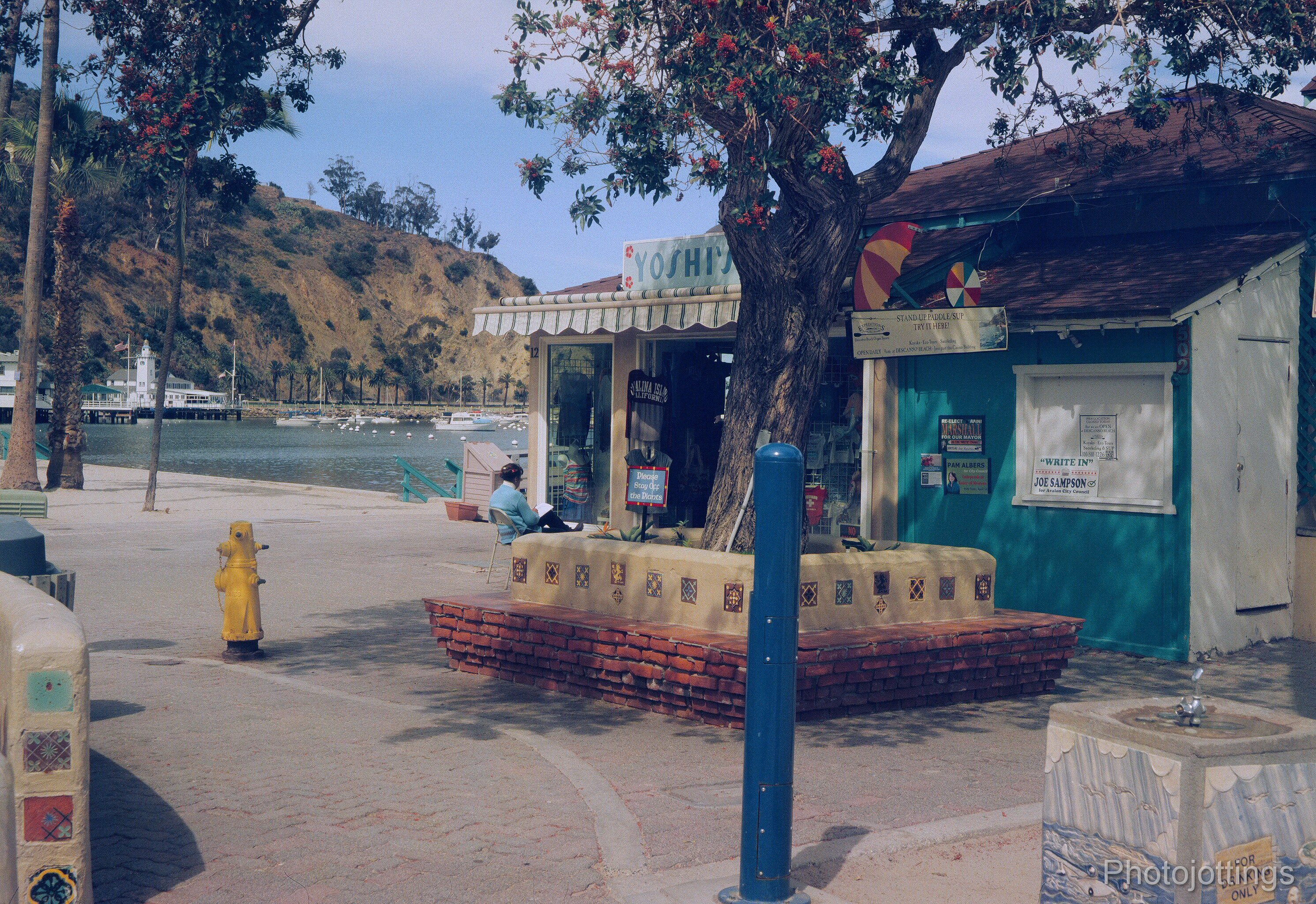
Avalon; slightly filtered sun, but still bright.

Splendour in the Harbor, but it’s reminiscent of ‘film gone bad’ from the 1970s.

Yoshi’s joint; here I “jacked” the colors and white balance for a more “normal” look; I think it looks pretty good.

Info stand using Rollei Digibase CR200 film.

Same scene as above but using Fuji Velvia 100, and three stops less exposure.  The contrast is quite harsh here compared to the Rollei CR200, but the colors are much more to my liking.

Anyhow, I think there’s a lot of potential in this film, especially if they can get the colors in line with Kodak and Fuji’s color reversal films.  It’s one stop faster than most E-6 type film, which can be a pretty big deal when using medium format cameras.  Unfortunately, I doubt I’m going to shoot more rolls of this stuff; It just doesn’t “pop” off the light table like Kodak and Fuji’s film.


Click picture for larger version, (6000×4286).

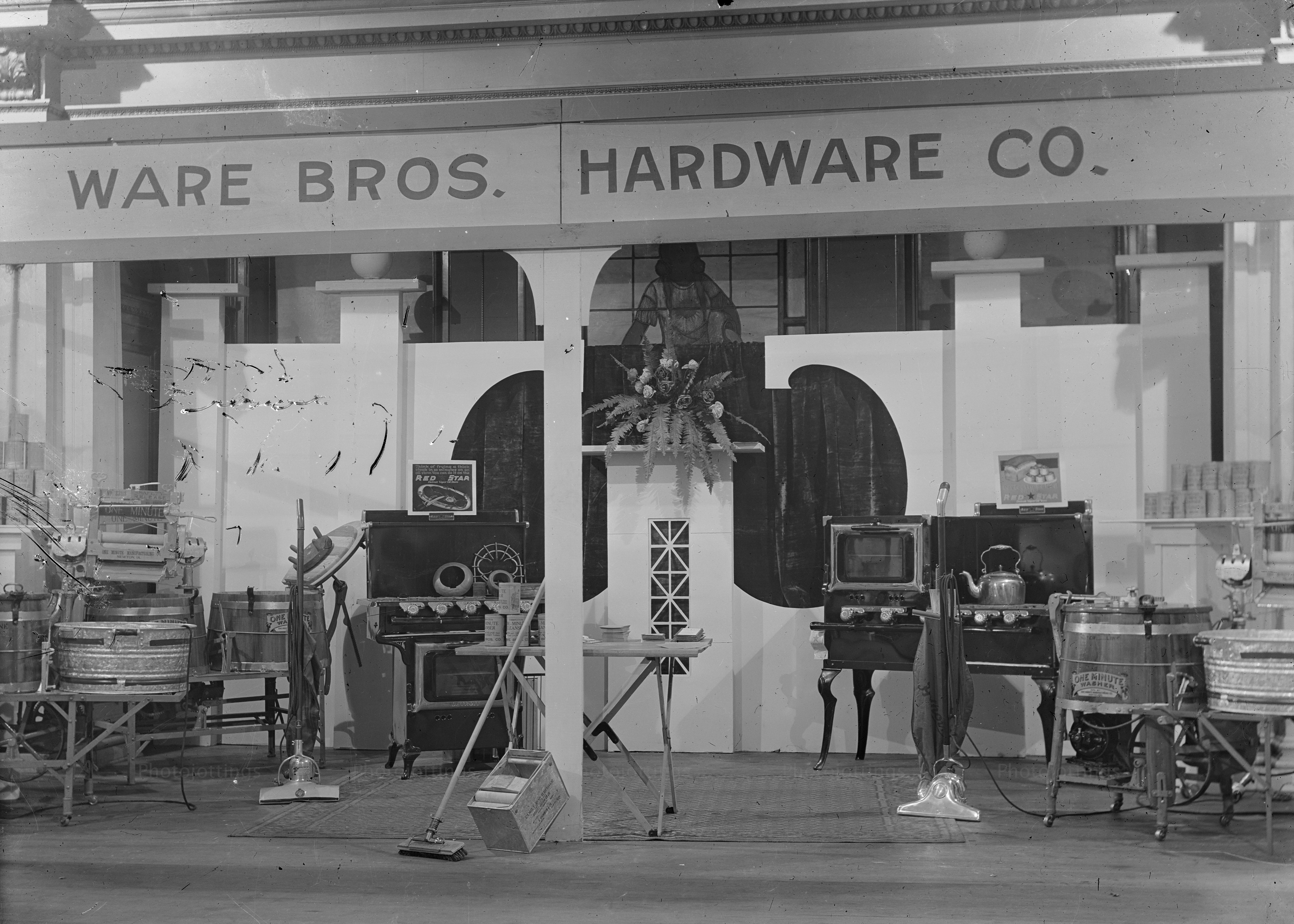
It’s April, (in 1918), and time for some spring cleaning, and maybe to replace your worn out stove with a new Detroit Red Star that can fry a thick steak in just 20 minutes!!  How about a One Minute washing maching, bench or floor model, (see it in color here), and some One Minute Cleanser?  The two electric sweepers brands look to be “America” and maybe “Hoover” although it’s hard to tell.  I see a couple of clothes wringers at the sides of the image, and a floor scrubber too.

Believe it or not, this exposure probably took about half an hour.  I’m guessing (based on depth of field) F/22-32 with an ASA of around 10-20 in what was probably a dimly lit room.  My own exposures with 5×7 film at ASA 100 in similar lighting are about 8 minutes at F/32-45.

This image comes to us as a 5×7 glass plate negative, and one of about fourteen I purchased as a set recently, all from Ware Brothers Sporting Goods and Hardware store in Spokane Washington, and 125 Howard St might be the address of our store at the time of these photographs.  We can date the image to around 1917-1919 as other pictures in this set have a 1917 wartime Marine recruiting poster, with Red Cross blood donation info, and certain items that were only made until 1919.

This picture, and the others were probably taken by an amateur, as many are crooked, along with incorrect exposures, or simply not very sharp, either from missed focus or camera jitter.  This image suffers from soft sides, probably from using an aperture that was too wide, (or from a cheap three element lens), although maybe the photographer got tired of waiting a half hour or more for each exposure; stopping down the aperture for sharper sides and you wind up with hours long exposures(!)

Who took these pictures?  Was it the store owners Son, Daughter or Wife, or friend trying their luck as a photographer?  We’ll probably never know, but that person left us with an interesting ‘window’ into the past!

Check out another image from this set with a golf theme here.

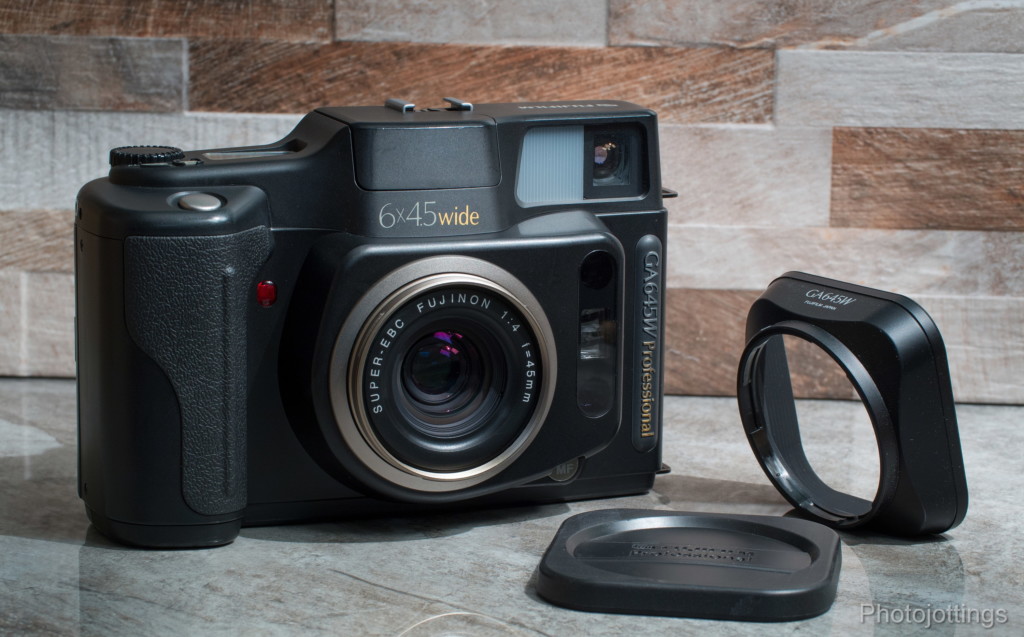
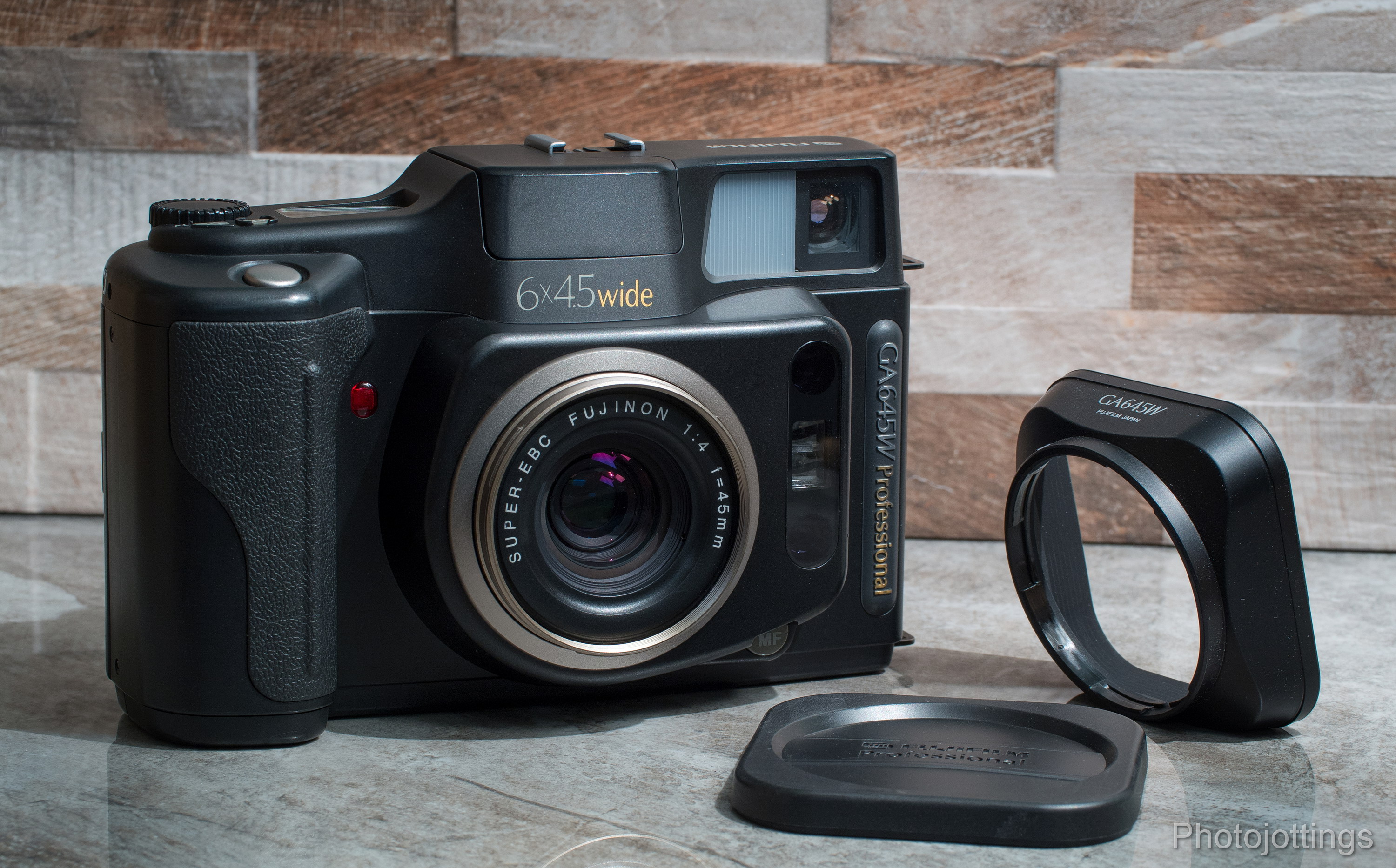
The Fuji GA645W was a very modern and expensive camera for the professional photographer, or rich amateur back in the mid to late 1990s. This particular model has a wide angle lens, and covers about the same as a 28mm lens in 135 format.  There are two versions in this series, a wide angle as we have here, and a slightly longer version of 60mm, (reviewed here), which covers about the same as 37mm in 135 format.  Both are very high quality fixed lens medium format cameras that are feature rich, including full manual operation, and fully automated controls for quick point and shoot snap shots.  And a side note here before I forget; with all the advanced features, I expected a lens cap warning device; but no, if you leave the lens cap on, the camera works fine, but you get no pictures(!)  A couple years later, Fuji introduced a new model (GA645Zi) with a 55-90mm zoom lens, which does have a cap detector.

People looking to step up to medium format from an automated 35mm camera like the Nikon 35Ti will love the simplicities of the Fuji GA645 models, they both function basically the same, of course size being another matter.  So you don’t know how to meter light, no problem, the camera does that for you.  And you don’t know how to focus rangefinder cameras, no problem, its auto focus system is very accurate, and there’s no rangefinder to fiddle with.  Do you like to write down your exposure settings for future use; well, you can keep your pencil in your pocket, the camera records the date and exposure settings along the film margins, not in the picture area!

With the pleasantries out of the way, let’s do a walk around of the Fuji GA645W, and see what the 1990s can deliver to our 5k screens today!


Name; Fuji GA645W Professional  “wide.”

Manufactured by; Fuji Photo Film Co., LTD., Tokyo, Japan.

Made in; Japan.

Date of manufacture; starting in 1995.

Price; hang tags indicate 165,000 yen, so maybe $1500 US in the late 1990s.  A 1999 photo magazine ad shows a price of $1529 from a discount dealer, (B&H Photo).  Current eBay prices range anywhere from $500 to $800 depending on condition and if it comes with the original box or is refurbished etc.

Build material; appears to be a mixture of metal and plastic.  Fit and finish are very good.

Box contents; camera, instruction manual, a softcase, neck strap, hood and cap.

Weight; my measurements ready to shoot; camera with hood and batteries, 30.2oz (854g).

Dimensions; my measurements; 6.5″ (169mm), 4.3″ (110mm) tall, and 2.6″ (67mm) deep.  All dimensions include protrusions.

Focal length; 45mm.  75° diagonal angle of view.

Aperture;  F/4-F/22 auto or manually set in half stop increments.

ISO; 25-1600 manually set in 1/3 stop increments.

Focusing distance; 27″ to infinity, or 0.7m to infinity.  Auto focus sets the shooting distances in 456 steps, but uses 14 steps in the viewfinder.

Viewfinder; ‘portrait’ orientation illuminating window type bright frame finder with automatic parallax correction.  Manual states 90% coverage at infinity, 90% at 1 meter, with a magnification of 0.38x.

Light meter; TTF, through the finder center weighted light metering SPD photocell.

Approximate resolution; good film and technique will make very sharp 16×20″ prints.  See sample images farther down the page.

Distortion; none of my images show any discernible distortion.

Light fall-off; I see  only moderate “corner shading” when shooting at F/4; at other apertures I don’t see any.

Color fringing; none that I notice.

Back ground blur or “bokeh;” looks good when close to the subject at wide apertures, see picture below.

Lens; Fujinon Super-EBC (electron beam coating) 45mm F/4 multi-coated, 7 elements in 5 groups.  Uses 52mm filters, B&H, Amazon, eBay.

Shutter and speed; super quiet electronic auto exposure inter-lens shutter with buzzer so you know when it trips!  Speeds from 2 seconds up to 1/400 from F/4-9.5, and 1/700 from F/11-22, plus bulb mode.

Film; standard 120 or 220 roll, with a picture area of 56mm x 41.5mm.  The “6×4.5” picture area is 2.7x larger than 135 film.

Flash; built-in pop-up type, guide number of 12 at ISO 100, not user adjustable in power.  Fill flash only in aperture priority and manual modes.

Total shots indicator; push in the exposure compensation (+/-) button and hold, then turn the selecting dial from off to ‘ISO.’  It reads in increments of 100, and says it may have up to 200 test shots from the factory.

Power; two CR123a 3V lithium batteries, available at your local grocery/drug store, or these shops; B&HAmazon, eBay.  Fuji claims the batteries will last for 3000 shots with no flash use.

Accessories for this model; Fuji GA flash bracket, Fuji Strobe GA, and a Fuji GA Close up lens kit No. 5.  I’m not sure if the close up lens kit is for use on the ‘Wide’ model, but I’m guessing it is since both cameras are the same outside, as well as close focusing distance.

Crippling features and omissions; nothing really bad, the only minor item would be TTF metering, and that means you have to manually compensate when using filters.

Good features; excellent lens, very accurate metering and focusing, auto parallax adjusting, self timer, auto first frame positioning, film advance and rewind, last shot beep, ±2.0 exposure compensation in half stop increments, and manual focusing via dial setting.  I also like the pop-up flash, which is rare for a medium format camera.

Quirks; you only get 15 shots per roll, not 16 as some information suggests; only the newer “i” models get 16.

Problems; most of these cameras seem to suffer a bit from erratic “jumping” or “skipping” when using the up-down wheel.  For example; when you want to go from F/9.5 to F/11, (which is one click), the settings may jump to F/22, or down to F4 etc.  Apparently, according to several internet posts, some sort of factory lubricant used near the up-down dial has crept about, and is causing the problem.  My camera has this problem too, but it really doesn’t bother me at this point.  It sounds like it’s a fairly straight forward fix even for an amateur.

Other versions; there is a GA645 with a 60mm F/4 lens, but everything else is the same.  There are also versions ending in “i” such as GA645Wi that have (among other things) two shutter buttons and a bar code film reader that automatically sets the film ISO.  There is one with a 55-90mm zoom lens called the GA645Zi.

Go here to see the owners manual for the “i'” version, and make sure you tip the site owner.

Product shots with descriptions.  Click pictures for larger versions.
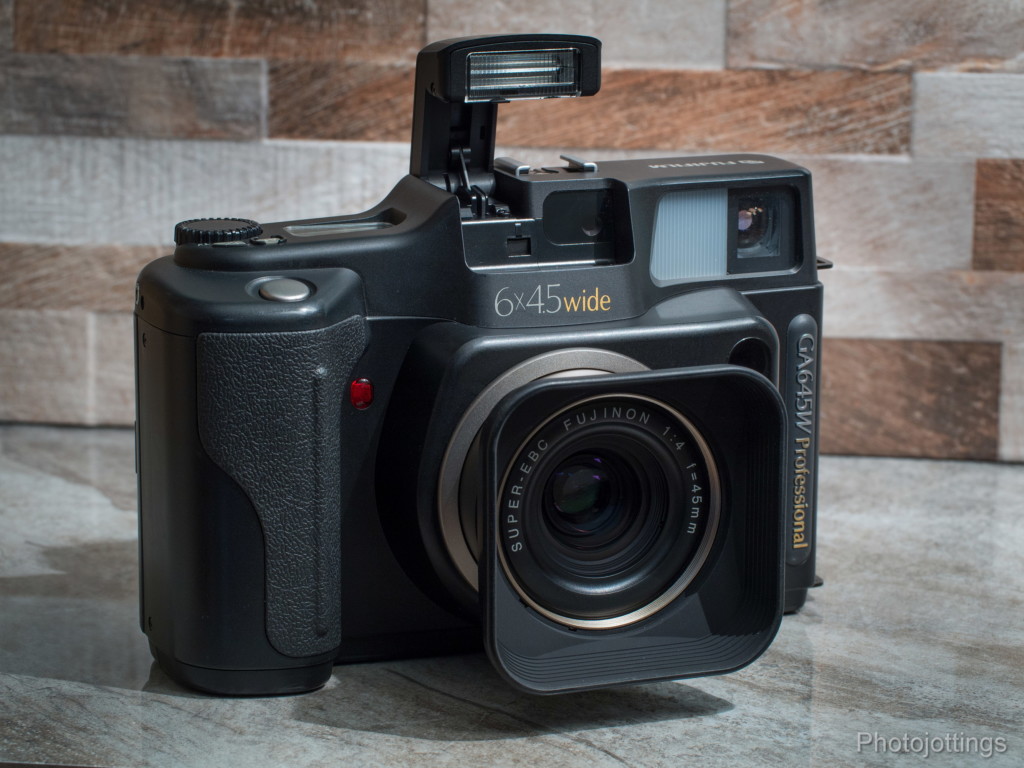
The Fuji GA645W ready to go; the hood doesn’t cause any blockage of the flash.  The red indicator on the left is the self timer lamp.
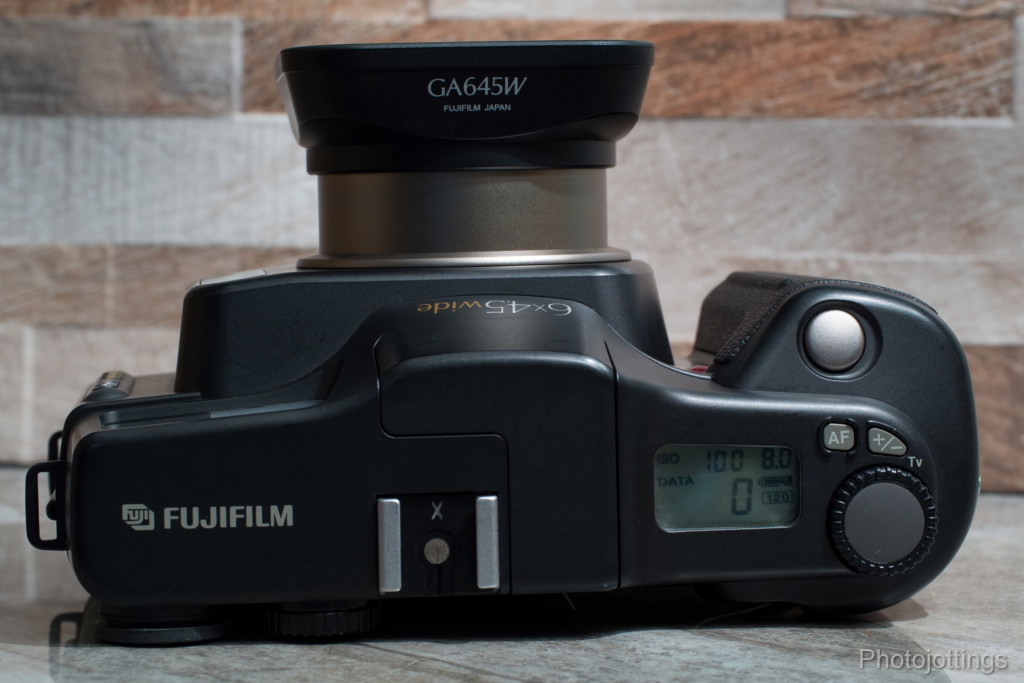
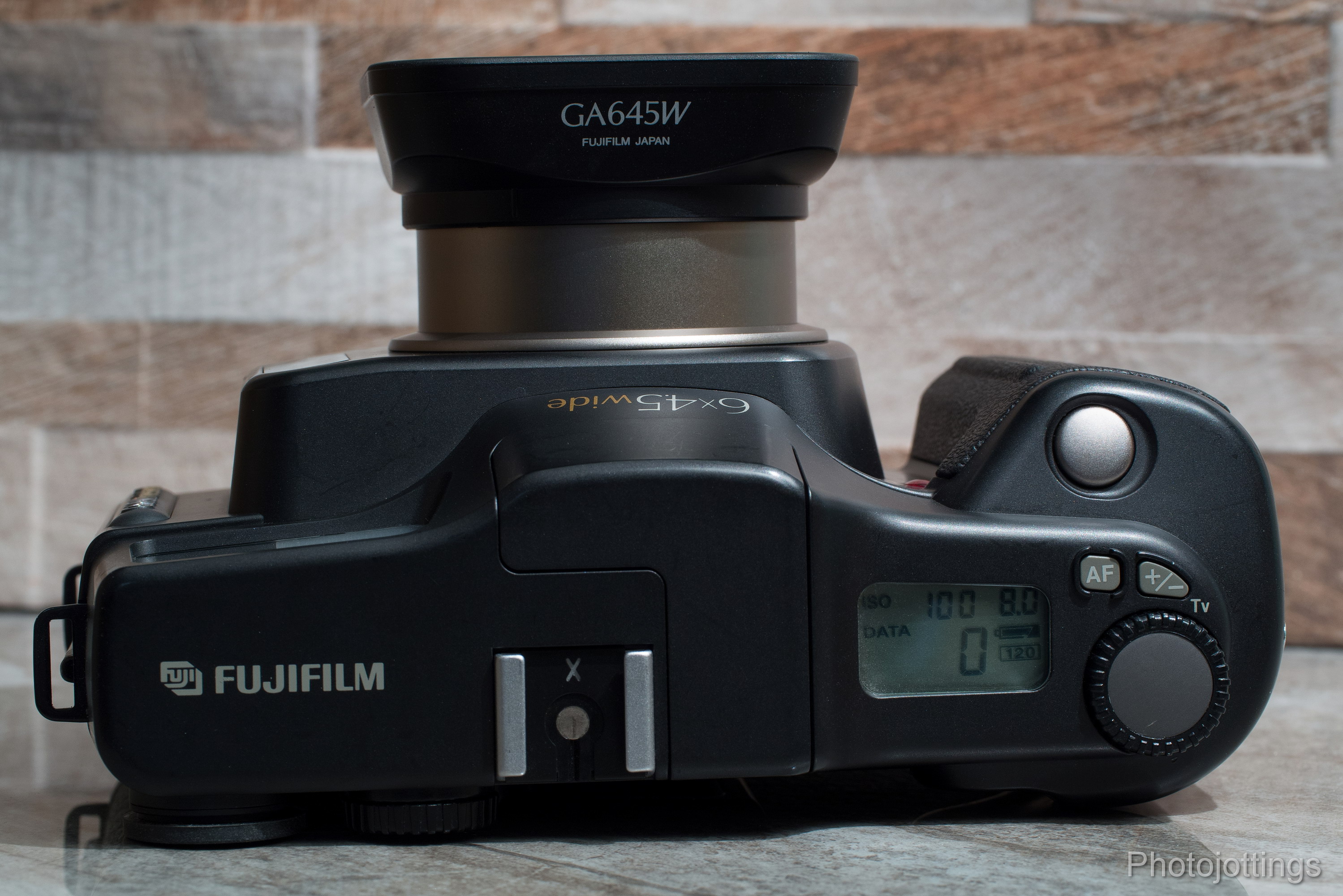
On top we have a hot-shoe in the middle, and LCD panel on the right showing ISO, shutter speed, film type, shot number, aperture, focusing distance, AF or MF, flash ready, battery indicator, and other data.  The large up-down dial wheel is for adjusting settings like aperture, ISO shutter speed etc, oddly, it goes down when turned clock wise, that seems counter-intuitive.  The +- button is for exposure compensation, and holding it down while turning the dial adjusts the shutter speed in manual mode.  The AF dial is for setting either auto focus or manual focus; and last but not least, the large silver button at the top of the grip is for tripping the shutter.
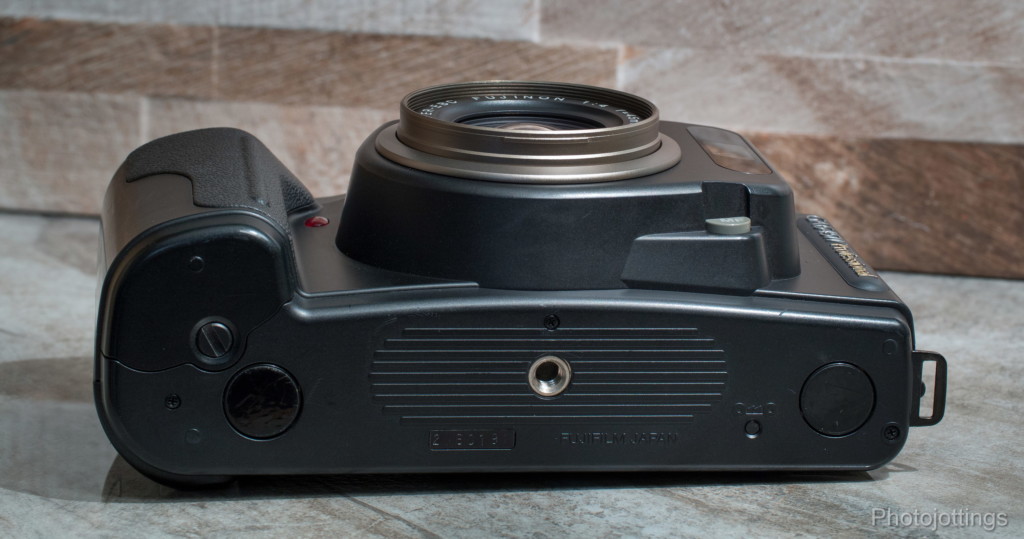
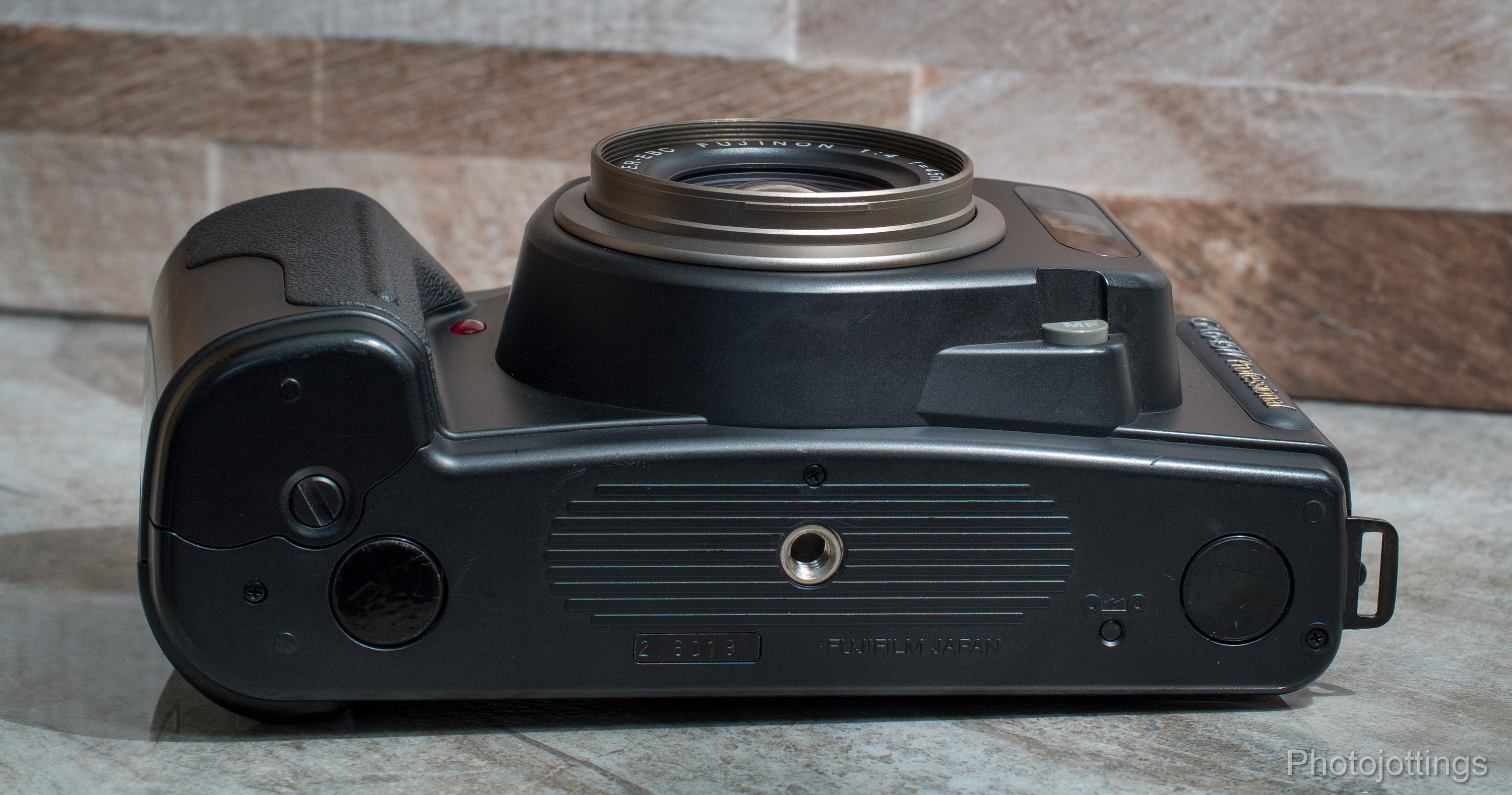
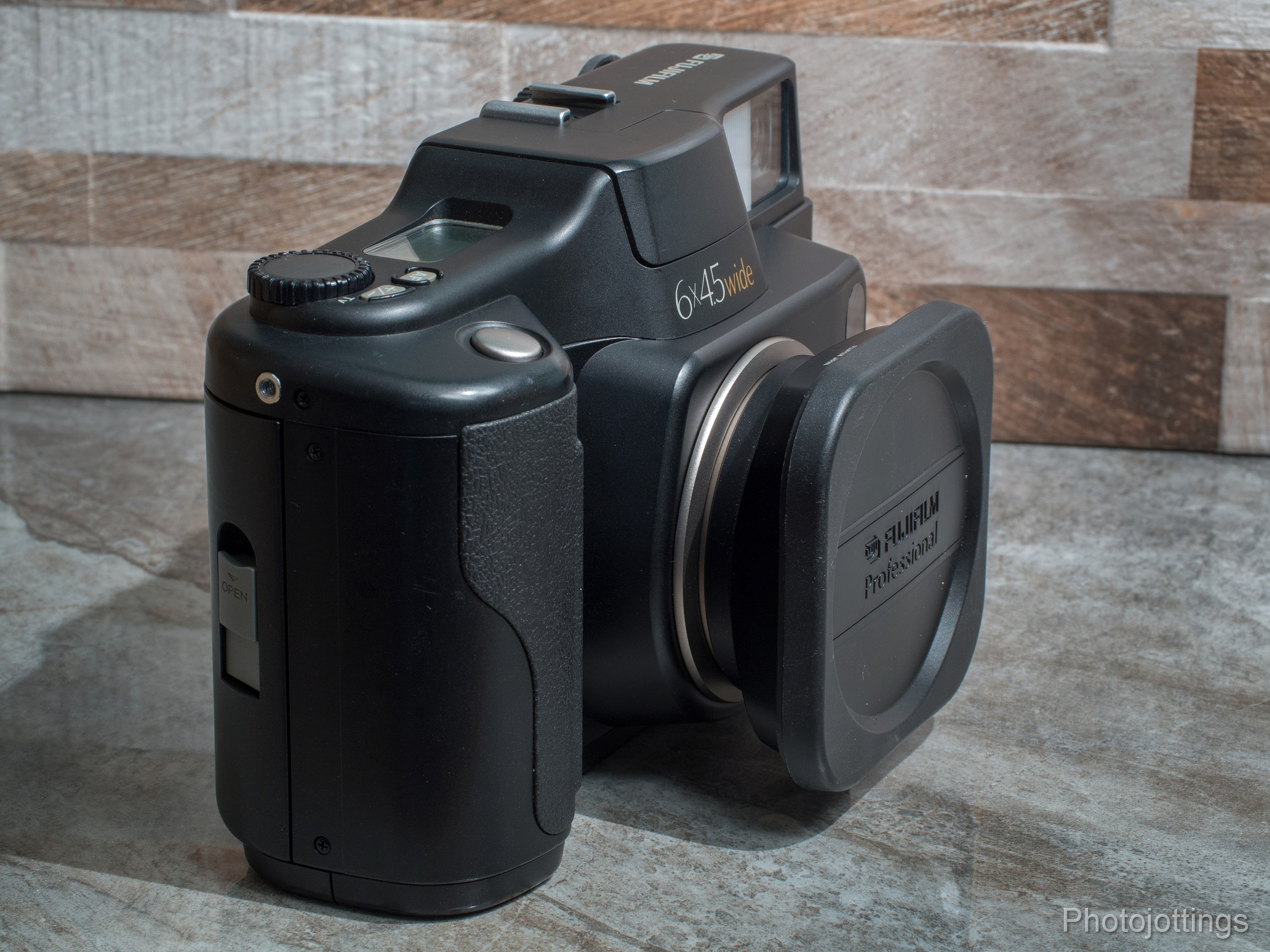
On the left we have the battery cover that holds two CR123a lithium batteries, with access by coin screw .  The ¼-20 tripod socket is centered on the lens.  The small little button to the right bottom is for mid-roll rewind.  The two black circles are film loading knobs that you release via a red button inside the camera.  Just visible is the gray colored MF button located under the lens.  Press and hold while turning the up-down dial sets the focus manually.
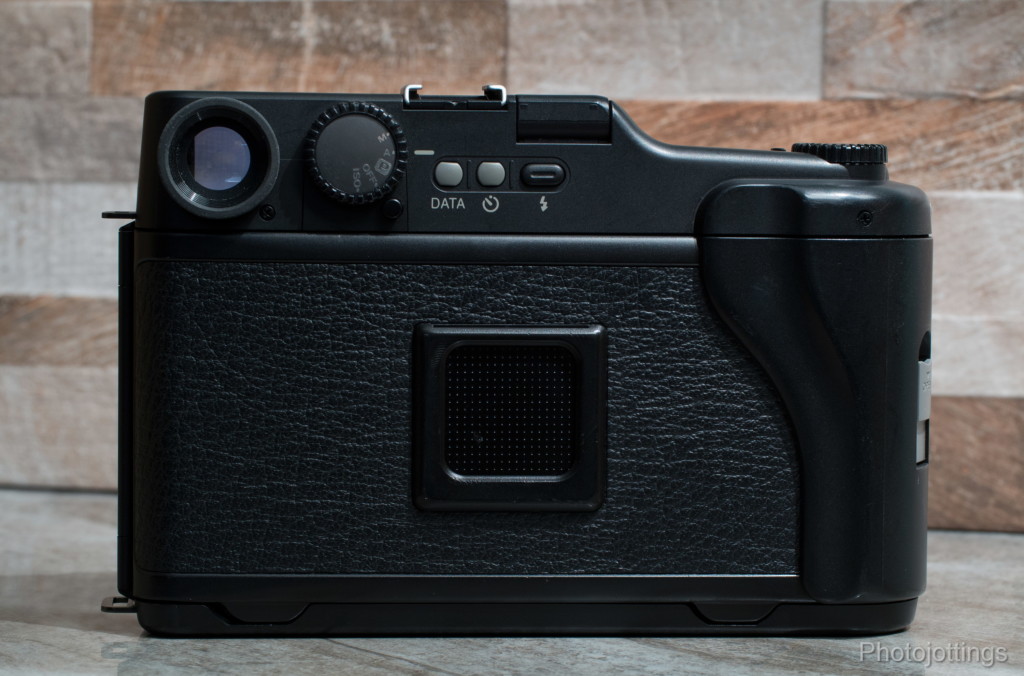
The back of the camera is relatively uncluttered; the big square in the middle is a film reminder slot, the film box end fits nicely in here.  The viewfinder in on the top left.  You can use Nikon “F” style eye-pieces like these  Nikon FM, FE, FA  on this camera, and they’re interchangeable with the larger Fuji GW series.  Go here for the review of the wide angle big brother of this camera.  The next dial is for selecting either ISO, Program mode, aperture priority, and full manual operation.  The left gray button is for setting data such as date and imprinting on the film edges.  The middle button one is for the self timer.  The black button is for popping up the flash.
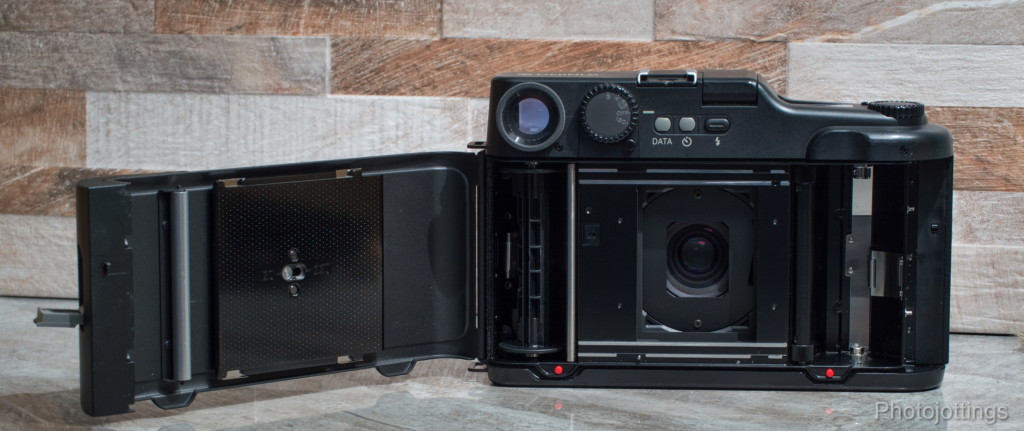
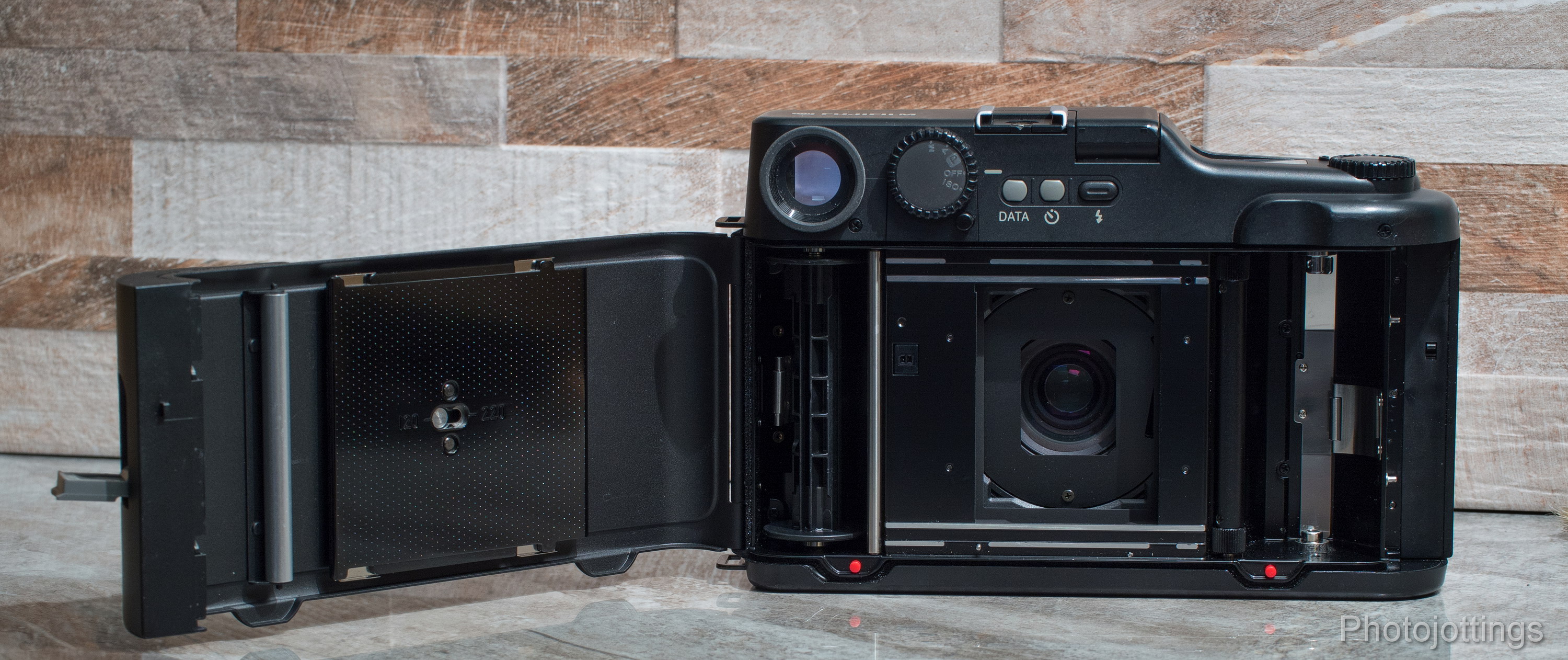
The gray lever type catch on the right side opens the rear cover.  On the inside of the back cover we have the film pressure plate, which can be adjusted from 120 to 220, and after doing so, it will show up on the LCD.  The two red buttons are for popping out the film loading knobs so you can load your film, then press the knobs up until they lock.  While loading the film you can jog the take-up spool for easier flap insertion into the spool slot by turning the up-down dial; the power doesn’t have to be on for it to work.
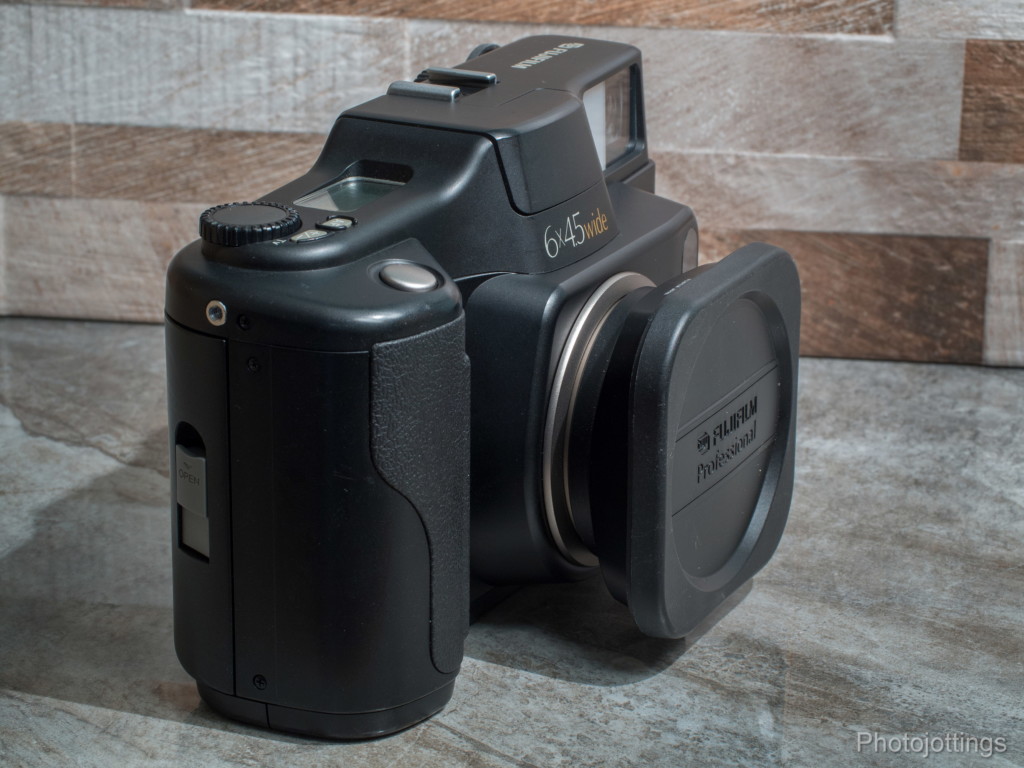
The right side of the camera reveals the back cover opening lever, and the small circular cable release socket; an odd place for that I think.
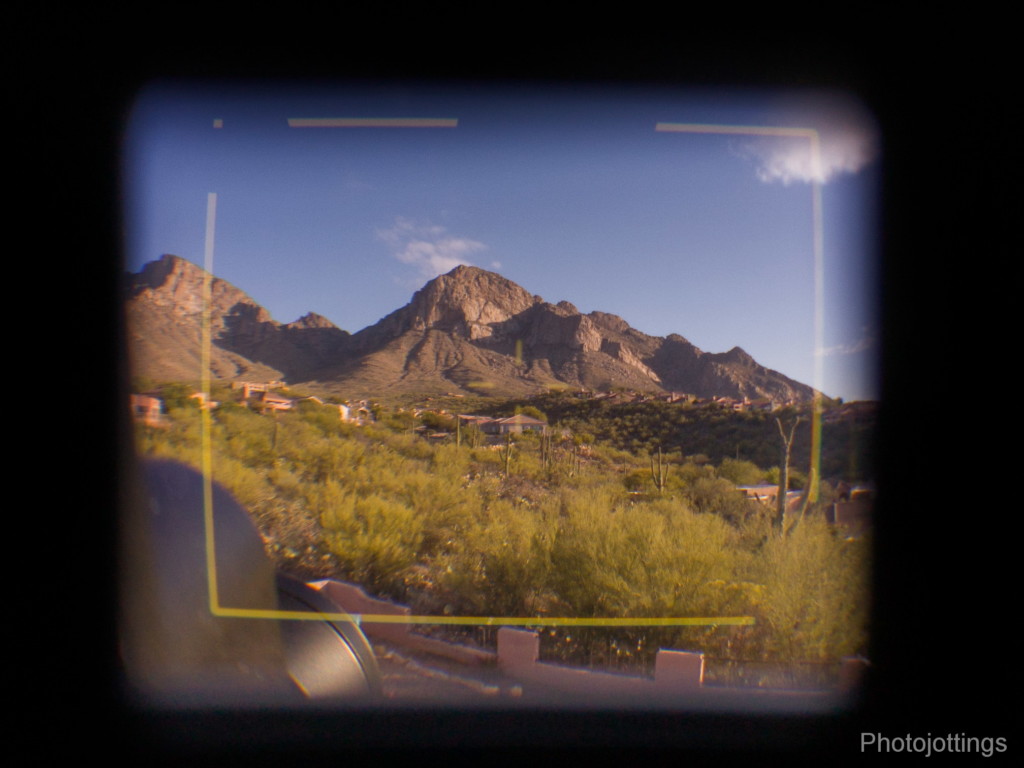
Scene through the viewfinder.  You can see the lens mounting panel and barrel in the viewfinder.   The red numbers are really hard to see in bright light, but you can hold your finger along the bottom of the viewfinder window to black it out, which helps in seeing the information.
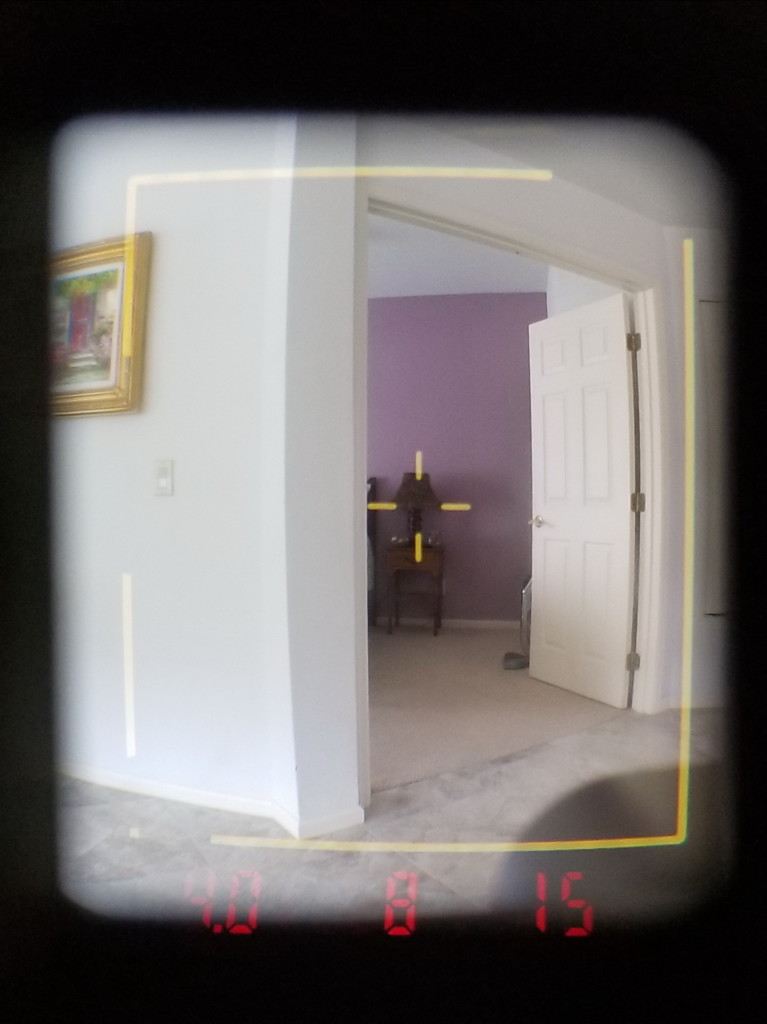
Scene through the viewfinder when holding the camera horizontally; it’s the opposite of a ’35mm’ or 135 format camera.  Red numbers indicate; “4.0” with F/4 being the aperture, “8” or 1/8s is the shutter speed, and “15” is focus distance, in this case I have is set for ‘feet’ but it can be changed to meters in the menu.
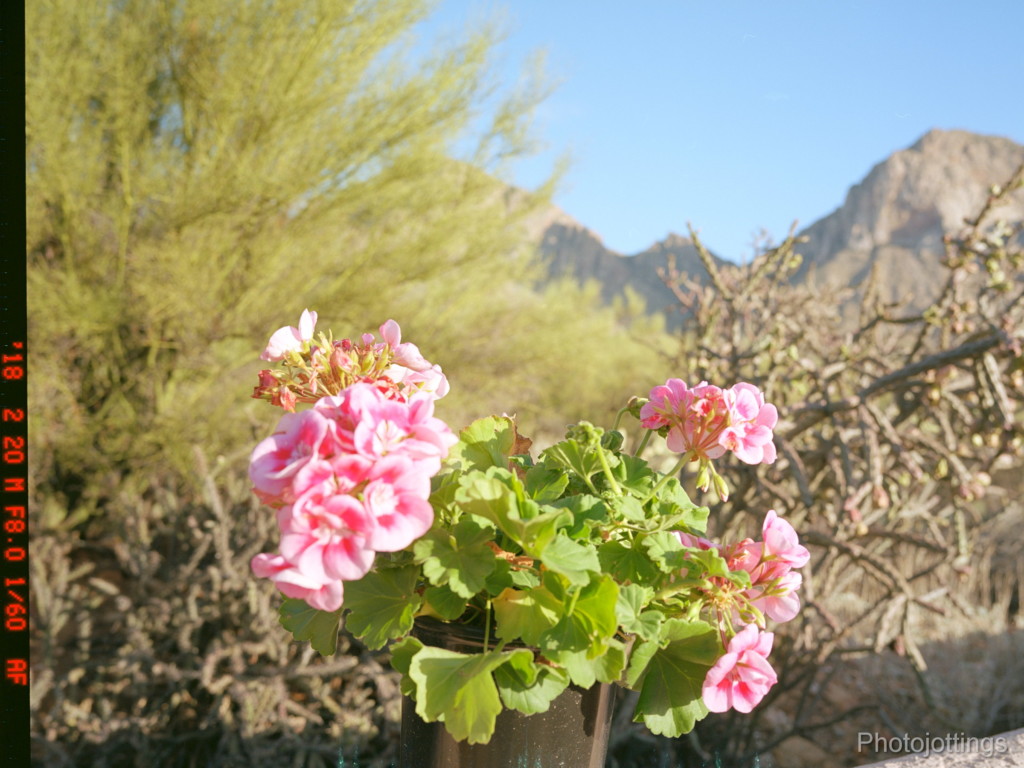
This is the information you get on the margin of the film if you scan outside the picture area; I’m only showing one edge here, and you don’t normally scan beyond the picture area, especially if you’re using masks for flat scanning.  I set the data to show the date and camera settings, but there are other settings to choose from.  Reading from left to right, (or top down here), the date reads 18-2-20, or the 20th of February 2018.  ‘M’ is manual mode, ‘F8.0’ is the aperture, ‘1/60’ is the shutter speed, and ‘AF’ is autofocus.

The data info is red for a positive image, but it will be bluish green when viewed as a negative.  Also, the information is easy to read here, however, when you’re actually looking at the negative, it’s really small, and you’ll need a magnifying glass to read it.
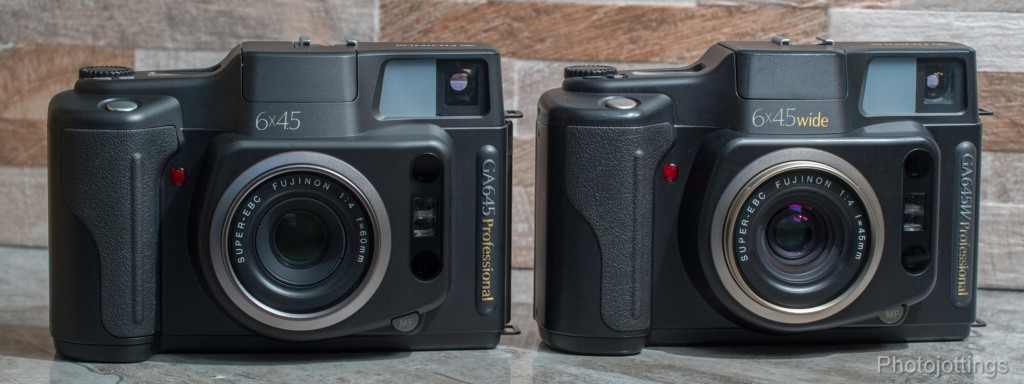
Both prime lens models of the GA645 series.
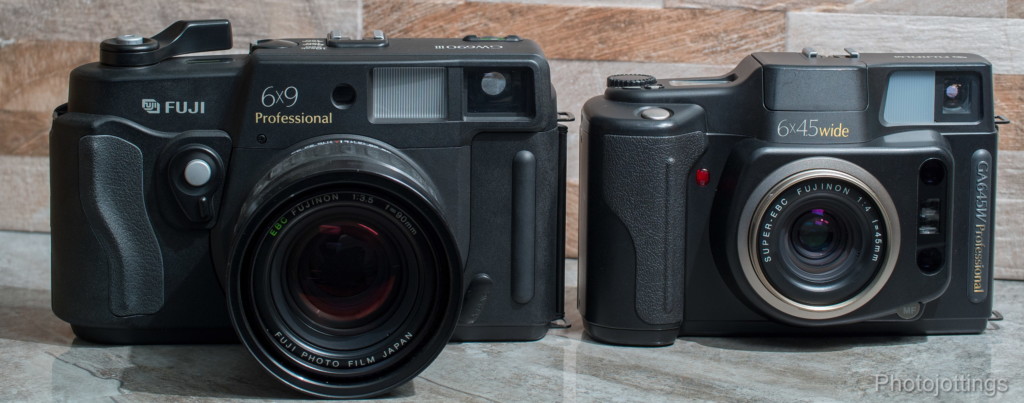
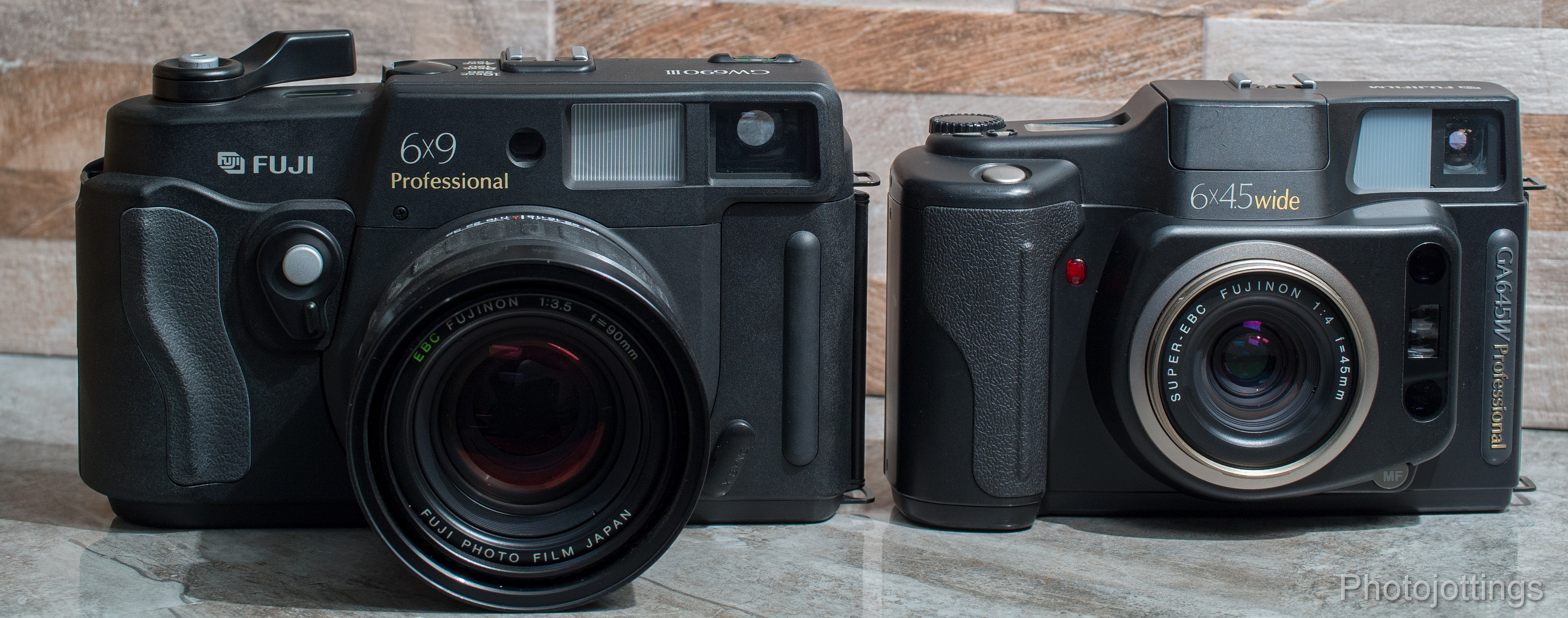
The larger and much heavier Fuji GW series on the left, and our review camera on the right.
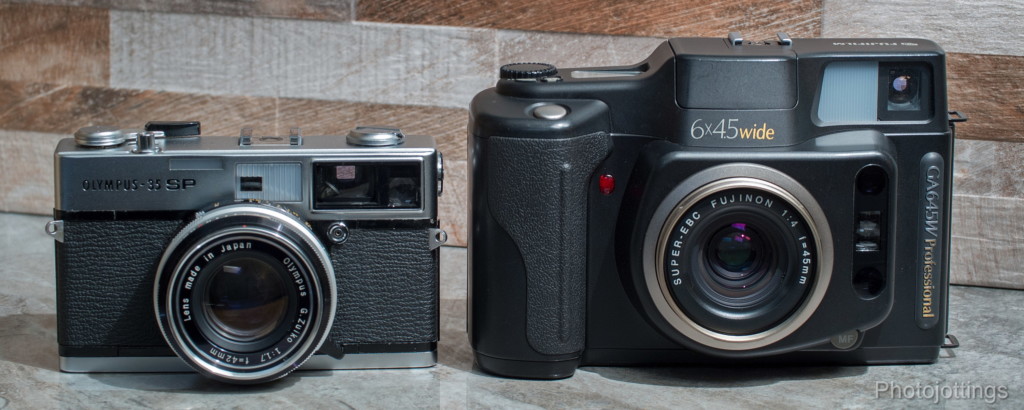
The much smaller Olympus 35 SP on the left.  Both lenses are very high quality, with about the same focal length, using a seven element design.

Sample shots below.

Here are a few samples for your viewing pleasure.  They’re about 5500 pixels wide.  Click images for a larger version.

Anglers hikers paradise, F/11.  Kodak Portra 400.
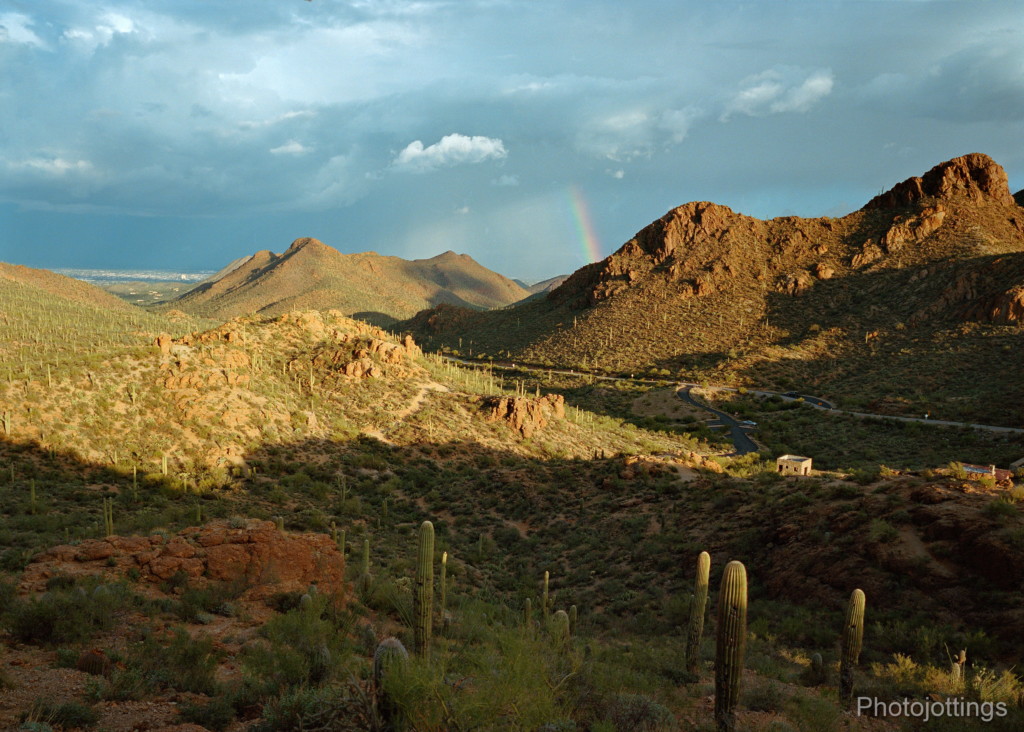
What’s beyond the rainbow?  Mexico, and that pot of gold, or maybe just some bottled water.  F/11, Kodak Portra 400.

Interior scene on a foggy New England morning, F/11 or F/16, about 5-10 seconds.  Kodak Ektar 100.

Sun causing some rainbow flare and acrs, with an arrow.  Kodak Portra 400.
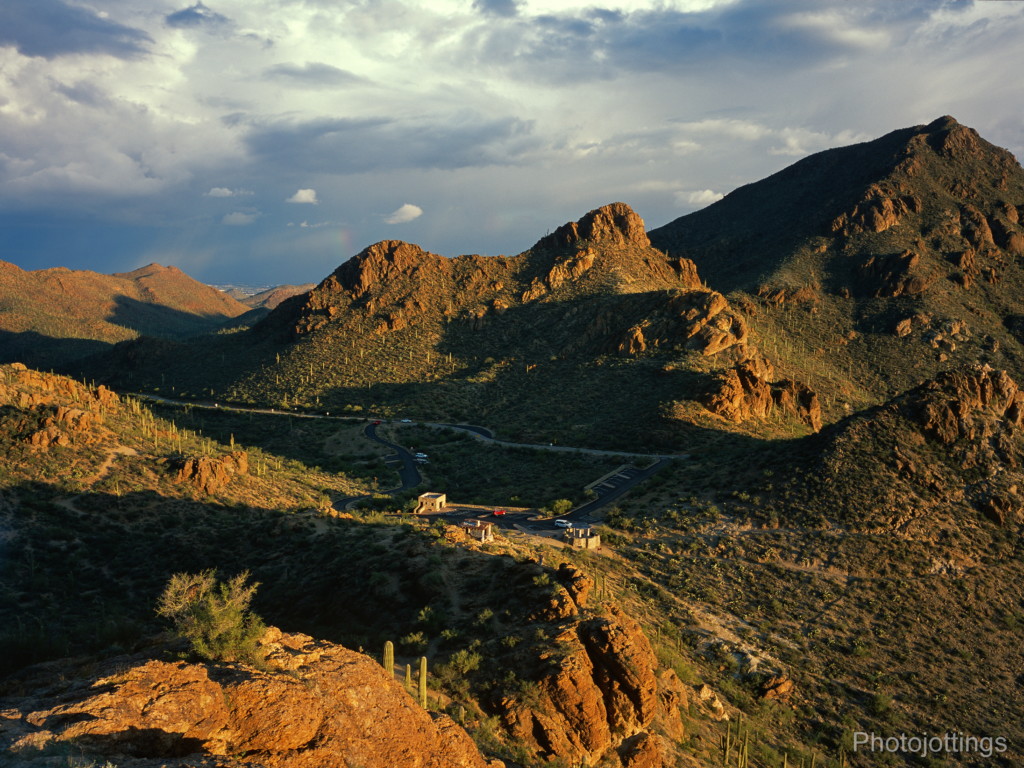
Residential development with storm approaching.  I think this shot was about F/8.   Fuji Provia 100F
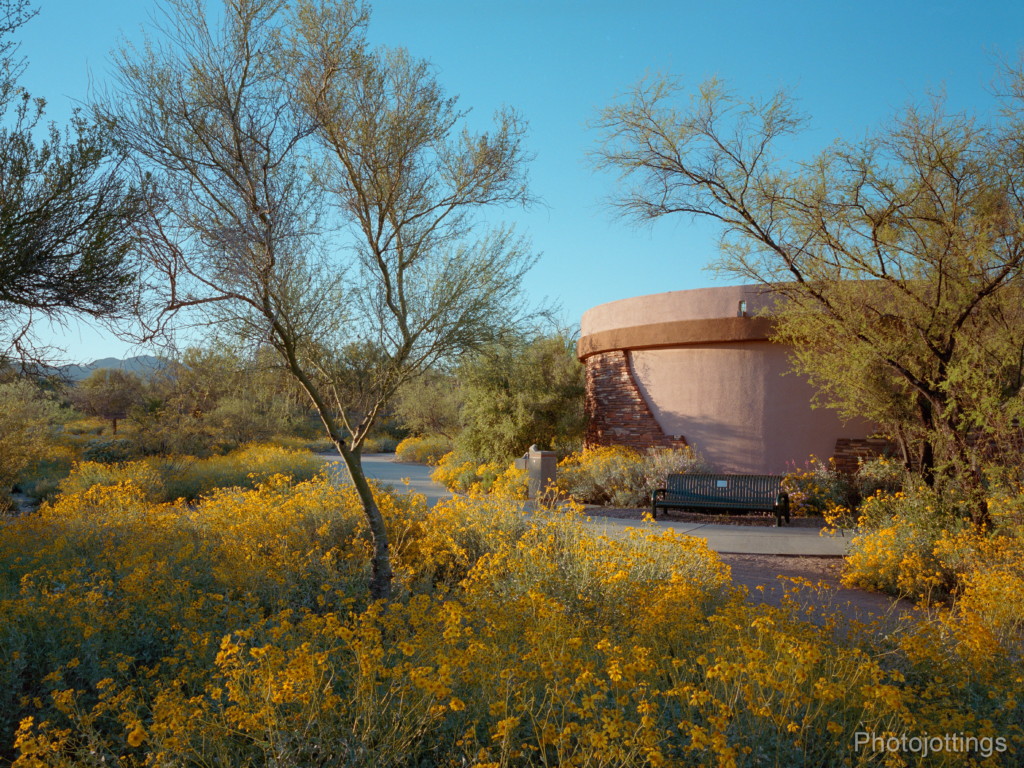
Ancient dwelling in the spring.  F/11, Kodak Portra 400.
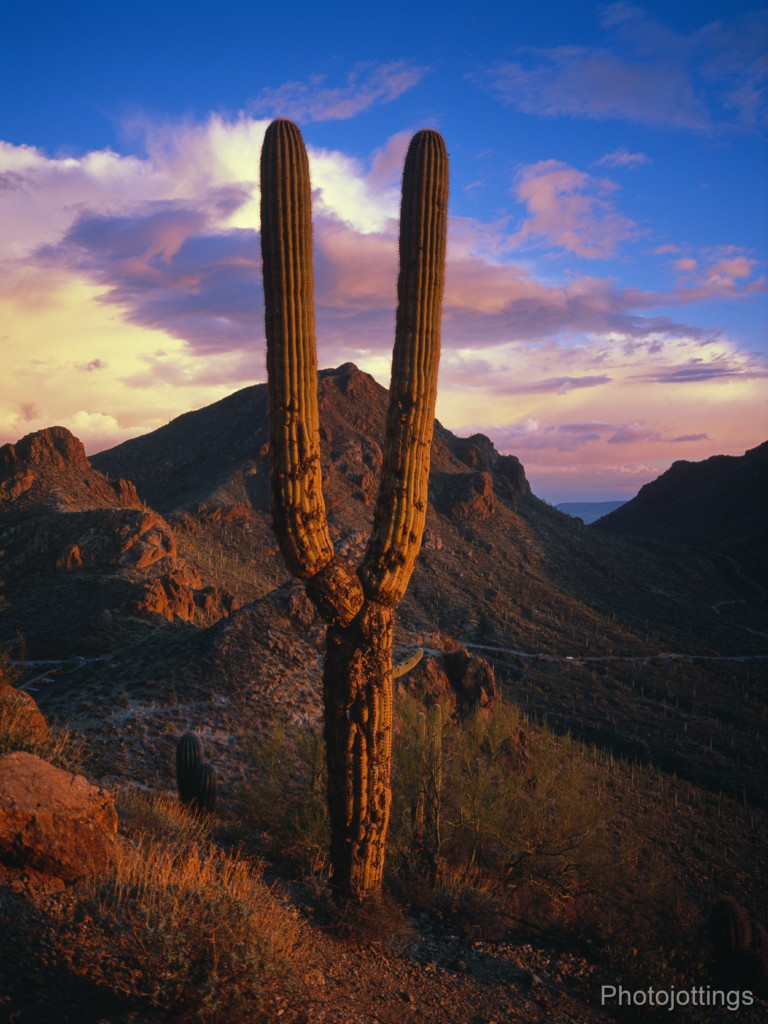
Two trunks at Gates Pass.  Very sharp for wide open use in low light.  F/4 using Fuji Provia 100F.

Little two hearted river.  F/4, Kodak Portra 400.
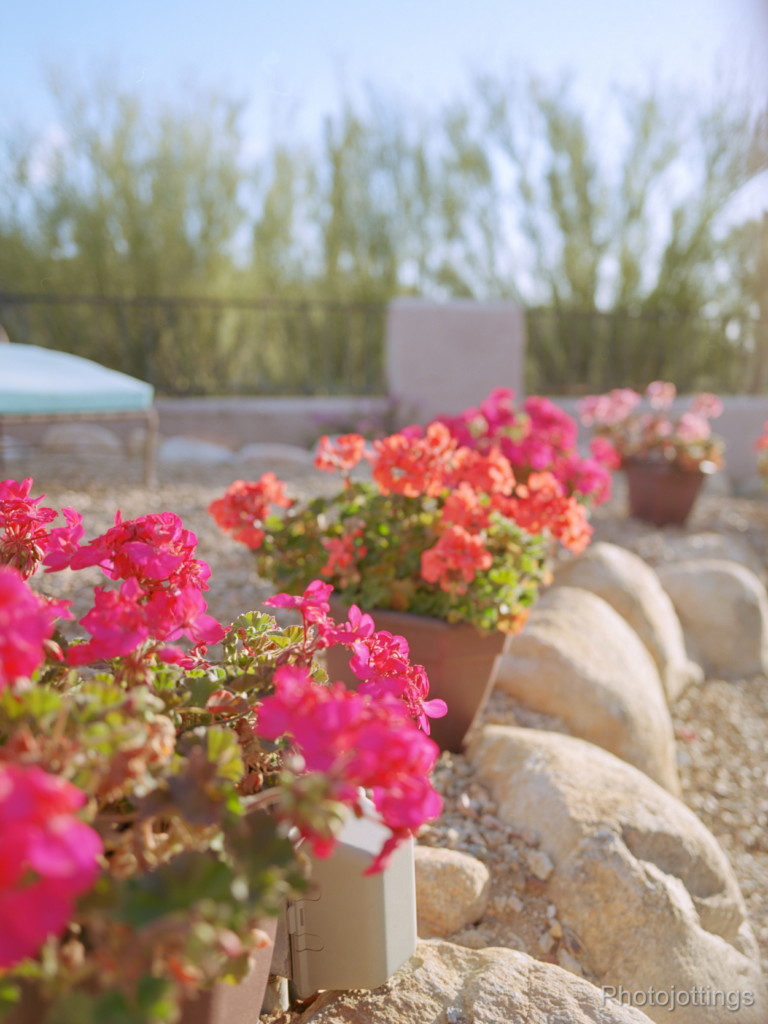
Nice background blur at F/4. Kodak Ektar 100.

Test scene below.

All test shots are displayed at 5500 x 4125 pixels wide when enlarged, and that’s all the resolution included in the film.  Scanned on a Nikon Coolscan 9000 ED.

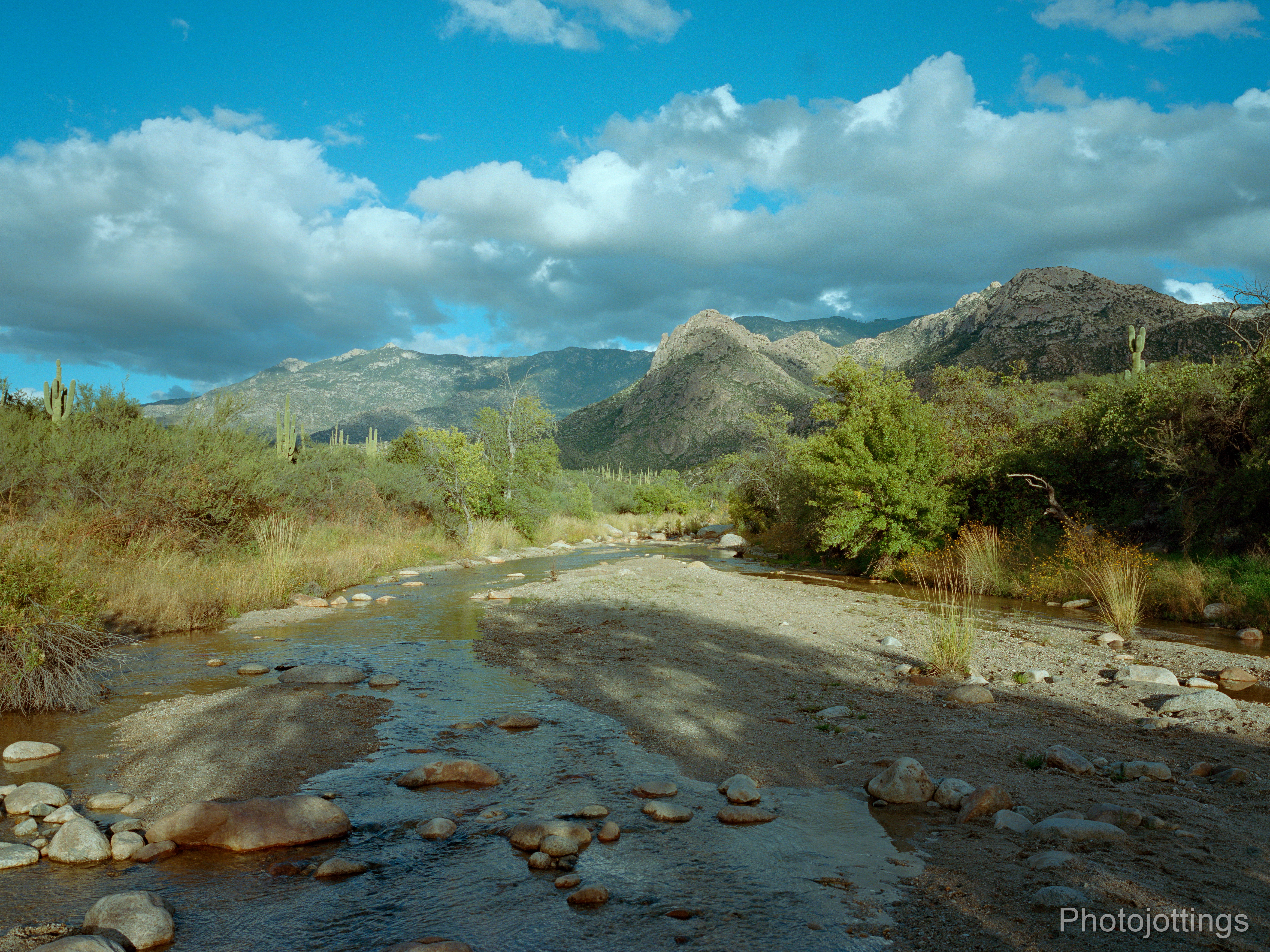
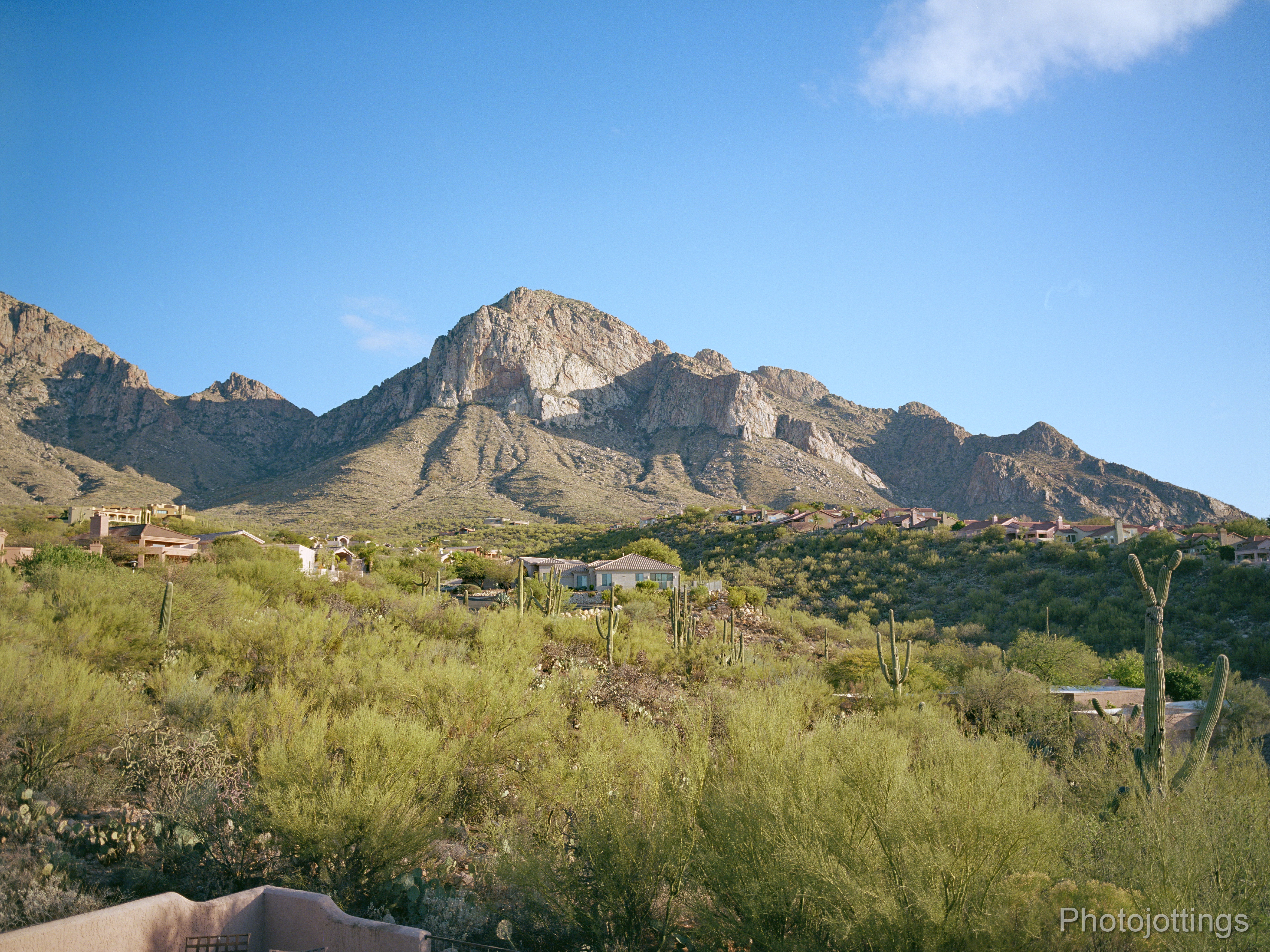
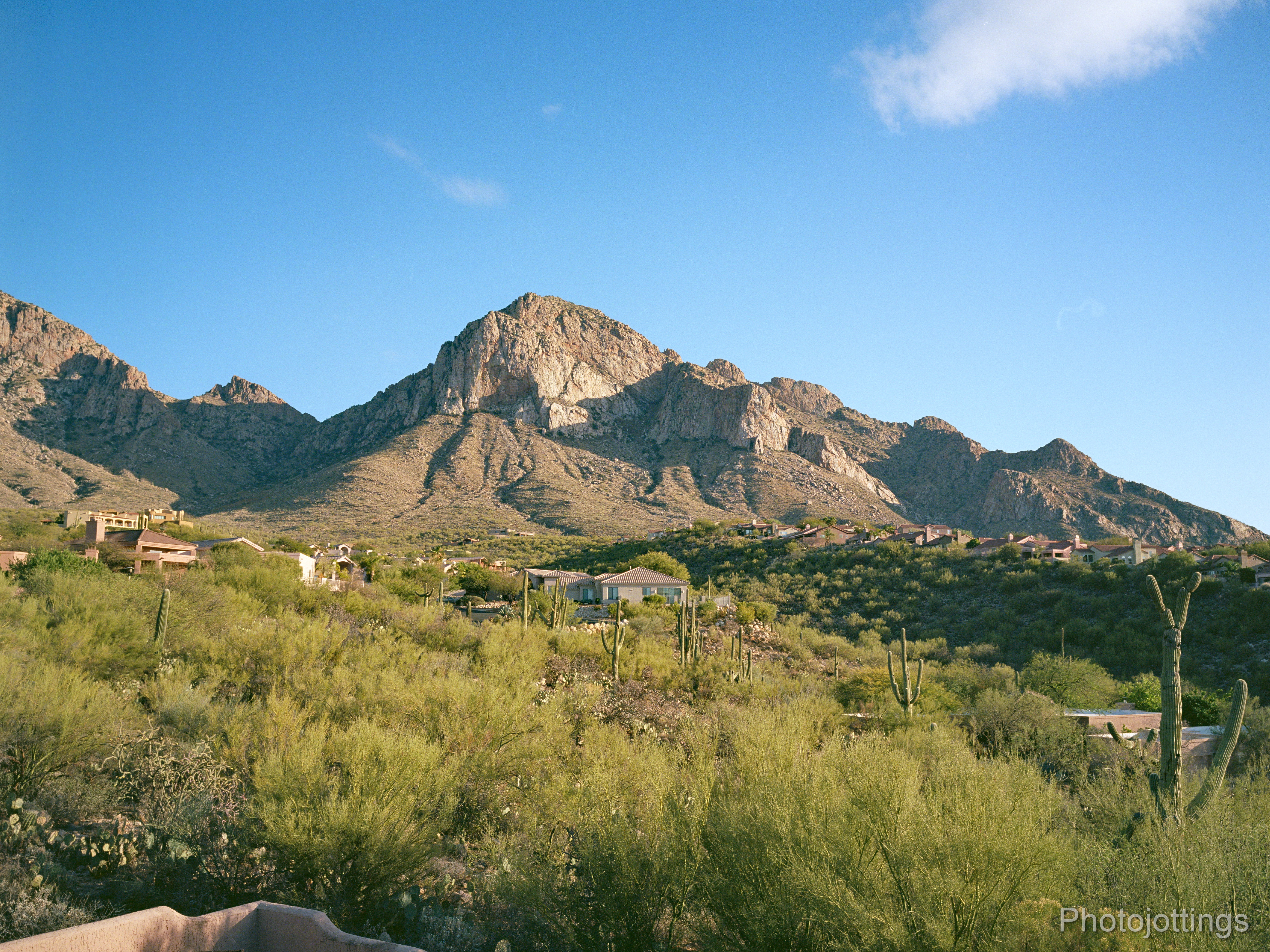
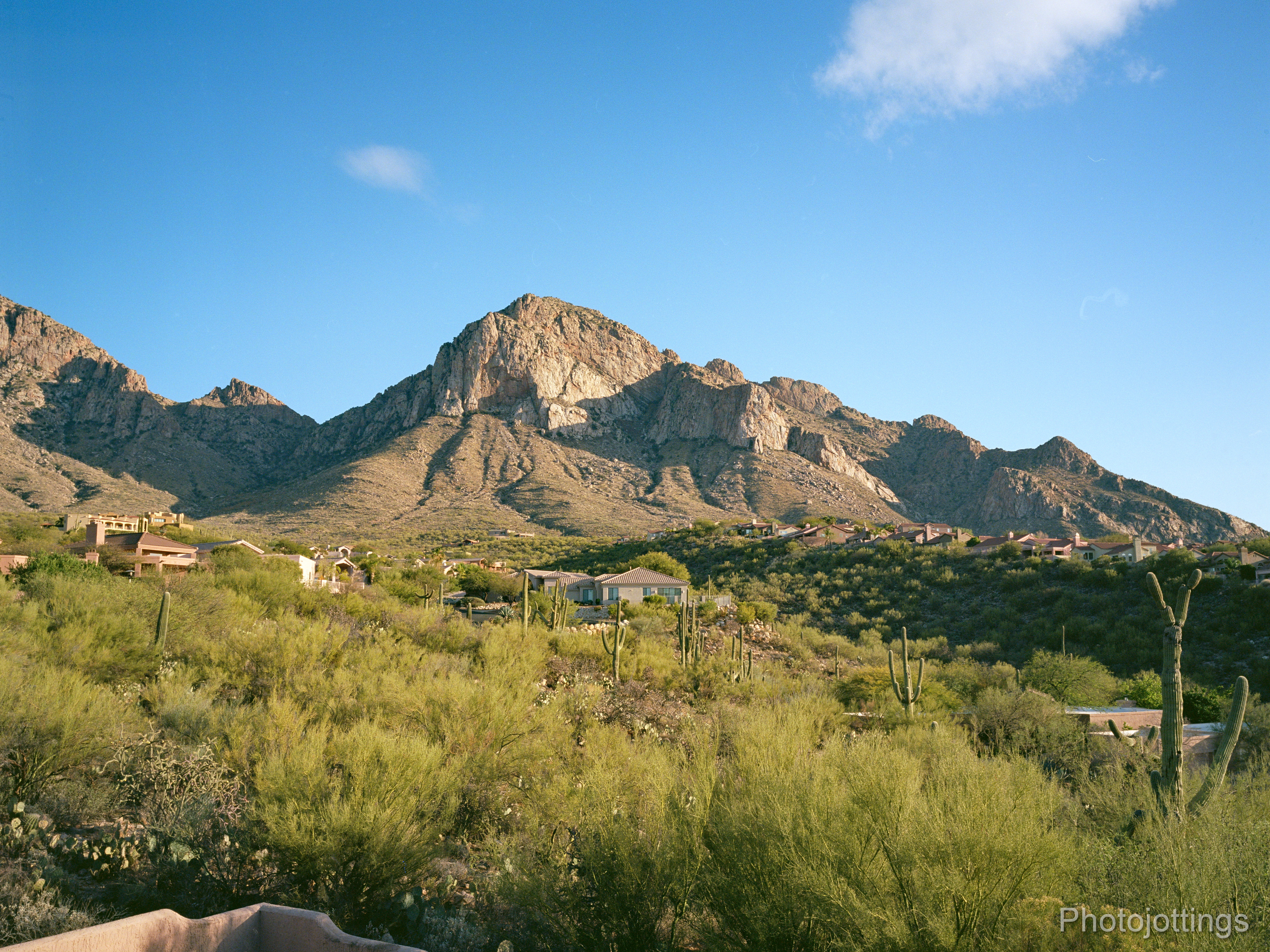
Here is our standard Mountain test scene, this time using Kodak Ektar 100 film.  A tripod was used, but no filters.
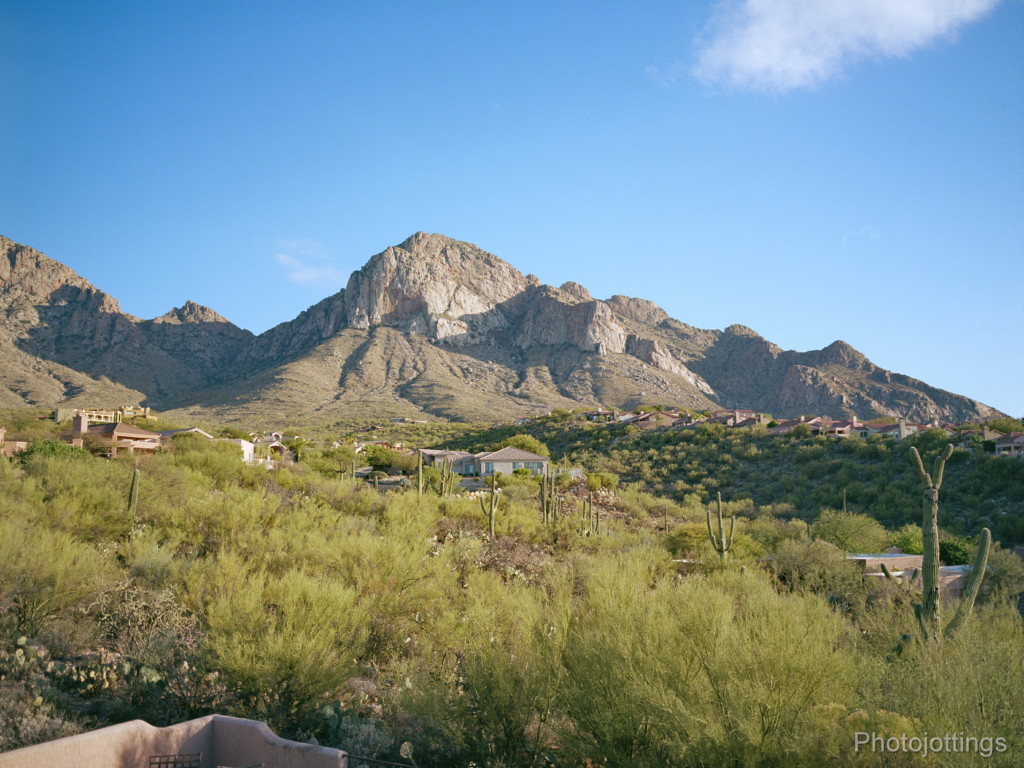
F/4.  Quite sharp with plenty of contrast here, even along the sides. Kodak Ektar 100.

F/5.6.  Contrast is maxed at this aperture, with the sides about the same as F/4.  Kodak Ektar 100.
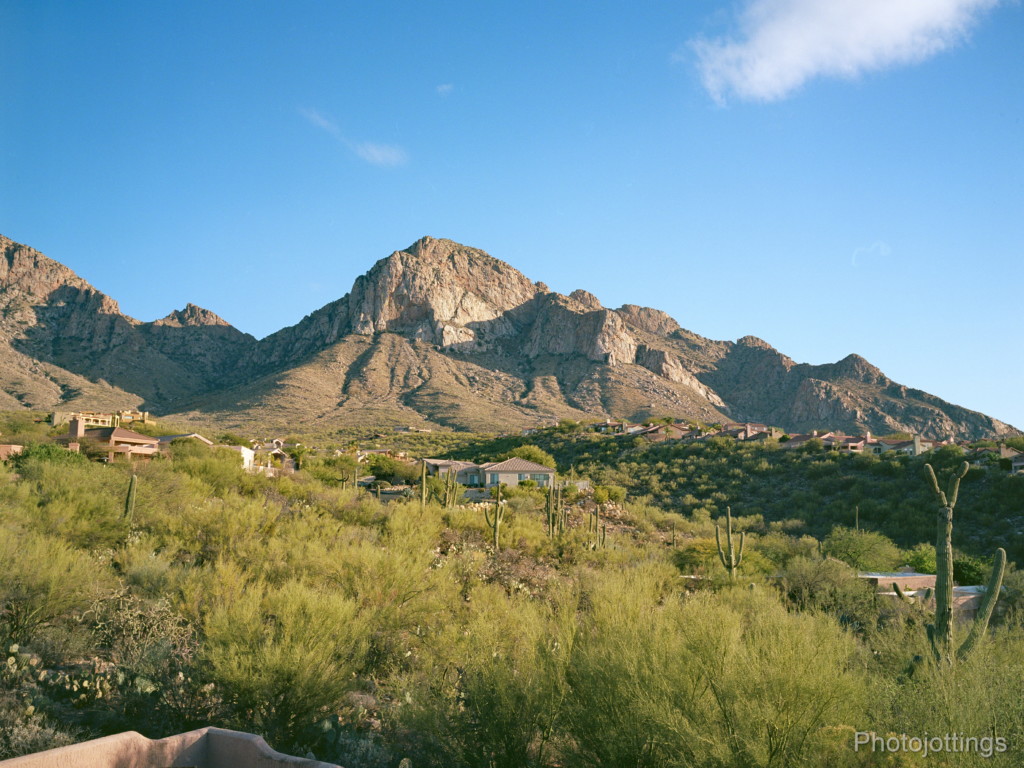
F/8.  About the same as F/5.6. Kodak Ektar 100.
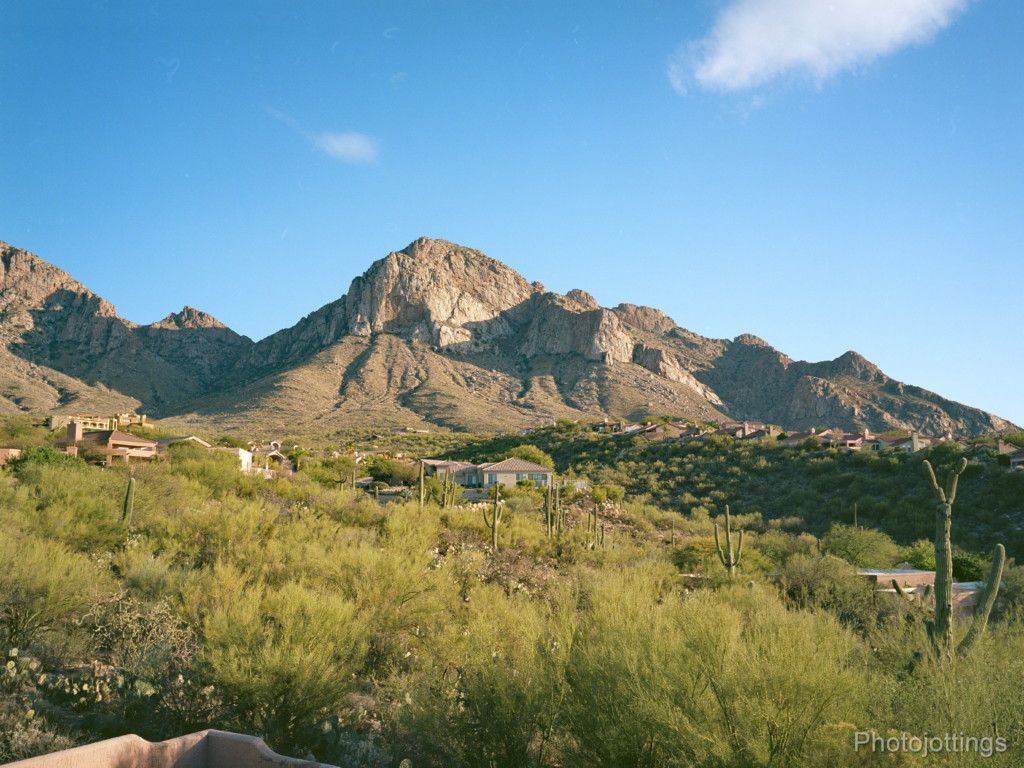
F/11.  The extreme sides are as sharp as the centers; I see no diffraction softening yet. Kodak Ektar 100.
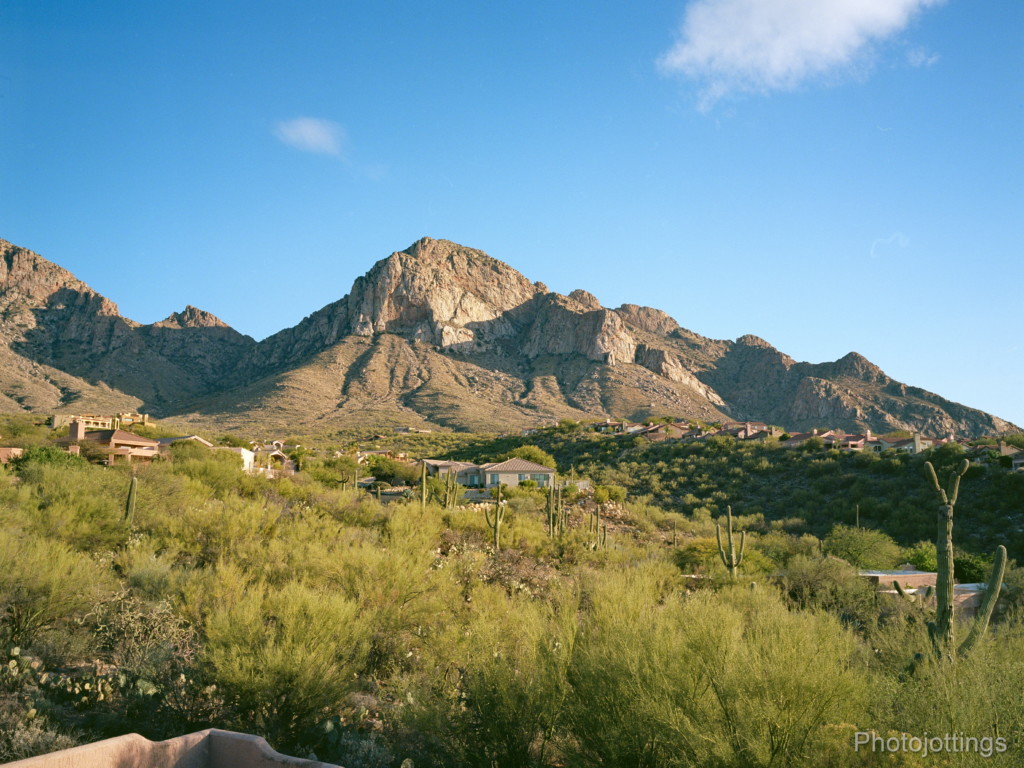
F/16.  Here the image softens very slightly due to diffraction.  Kodak Ektar 100.


Conclusion.

The Fuji GA645W turned in a great review, although I knew it would as I’ve been using this camera for several years now and it never disappoints.  There are a lot of positives to mention for this wide angle camera:  the lens is very sharp with plenty of contrast, even when used wide open; the exposure metering system is excellent, which is a must for color reversal or “slide” film, and the focusing is dead-on in good light.  Having a pop-up flash on a medium format camera is a rarity, and I actually use it quite often for fill when photographing people.  I generally don’t use program mode, but it works just fine if you’re a point and shoot person.  Another real plus is the date and exposure imprinting on the negative margin, that saves me from having to stop and write down my exposure settings after each shot.

I don’t see any real downers for this camera, but just for fun let me mention a few items that could’ve been implemented or improved in the updated model.  Low light focusing is not always spot on, but only noticeable at wide apertures.  It takes two sometimes pricey batteries that may not be available at your vacation destination, so keep a spare set handy.  Filter use requires compensation (really easy to do though) as the metering is through the finder.  Also, don’t forget the camera will work just fine with the lens cap on, so don’t forget to take it off at the start of your picture taking session, other wise, no pictures for you!!  My last complaint is that the camera seems a bit larger than it really needs to be.  Check out the picture above that shows the very large Fuji GW690III next to the GA645W, which is not that much smaller, and has only half the negative size.  However, the GA645 is much lighter, and carrying it around for most of the day is tolerable.

I like the Fuji GA645W, it provides substantially more resolution than 135 format cameras, which will show up when making large prints, or looking at your images on a 5k screen.  The actual picture size on the film is also much larger than 135 format, (2.7x the area), which makes direct viewing of color transparencies more enjoyable.

Sometimes the very wide capture area of this camera can be too much, and quite often I end up using the GA645, which has tighter coverage, about the same as 37mm on a 135 format camera.

Anyhow, when it’s all said and done, the GA645W is a precision tool for the discriminating photographer, and ironically, equally suited for the novice because of the well implemented fully automated features.

Please consider buying through my links and help support the site. Thanks for visiting!
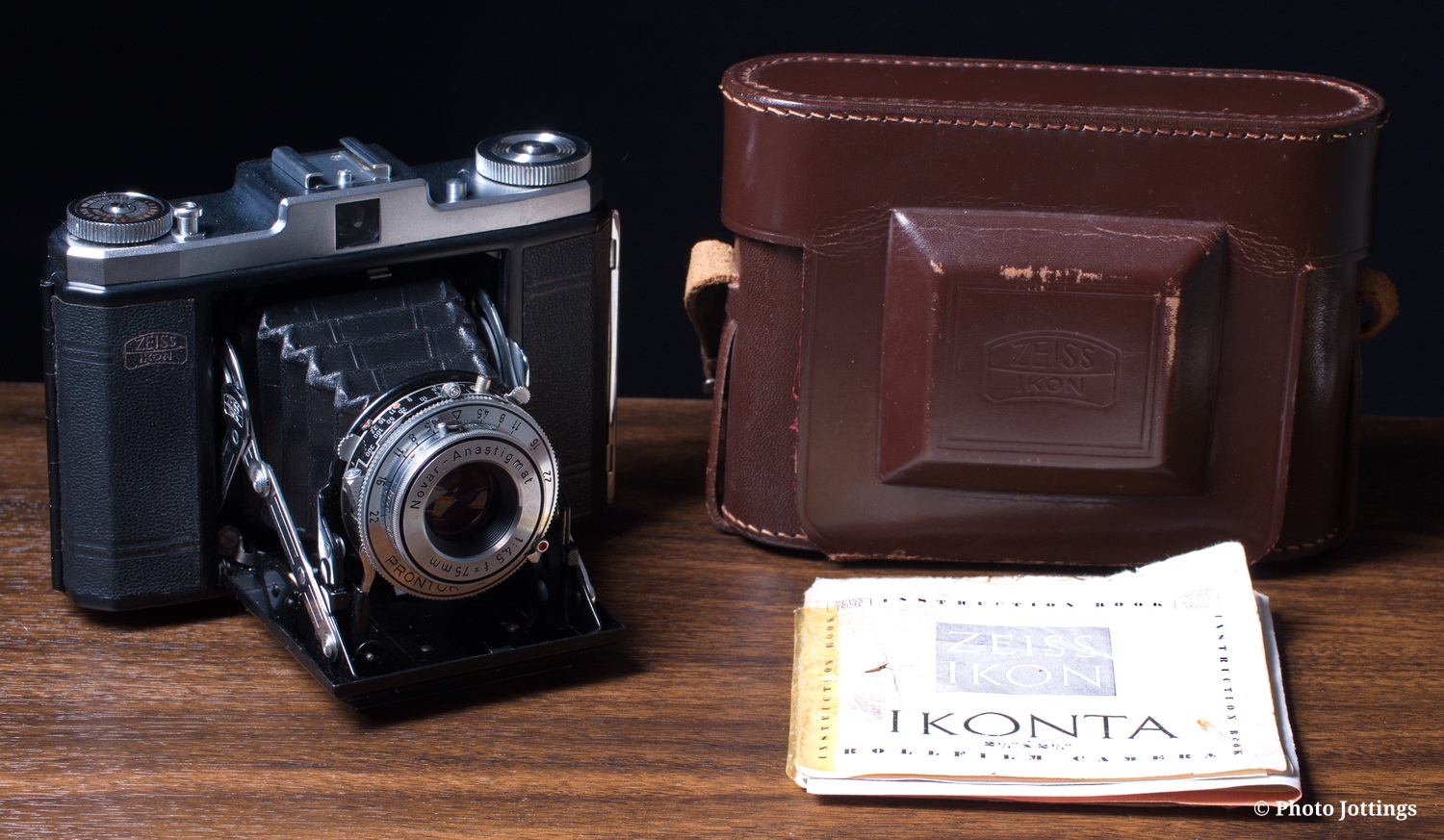
Revisiting the Zeiss Ikon Ikonta

I've totally updated the Zeiss Ikon Ikonta review using mostly new pictures, along with the now standard mountain aperture test scene.  I've also added more information gained through additional use, and then put the whole review in the same format as the newer camera reviews.

My dad bought this camera new in 1953, and I've had it for the last 10 years or so.  Using it was a chore as the shutter speeds were off quite a bit, and the focusing was out of whack so to speak.  After a recent  shutter cleaning and lens calibration by the famed Certo6, it now hums along nicely, and produces much higher technical quality photos than before.

Head to the totally updated review here.

Read more »

Film camera ads and prices from 1999

If you're bored at work, how about checking out a four page B&H Photo ad from a February 1999 Popular Photography magazine?  During the late 1990s the film industry was still going fairly well, but dark clouds were on the horizon.  As I look through the ads, I'm amazed at the prices they were charging, and apparently getting for some of the higher end camera gear.  Keep in mind these prices have been steeply discounted from high volume retailers; your local camera shop probably charged significantly more than what you see here. The swell, (and nearing the end of its life) Nikon 35Ti is $649, the newer Fuji GA645Wi is $1679, and the old, (and nearing the end of their lives) Fuji GW690III series are around $1250, which is actually much less than I would have guessed.

It's kinda fun looking through the old Photography magazines once in a while, not just for the ads, but the articles and reviews too.  These pages...

Read more »

CineStill 50D samples

As a follow up to this film, I thought I'd try out a roll of Kodak Vision3 film, sold byCineStill as CineStill 50D when the rem-jet layer is removed.  This removal process adds odd characteristics to the film, like forming red halos and tinged borders around dark to bright transitions; check out the shots below to see what I'm talking about.

CineStill 50D Xpro is actually Kodak Vision3 50D 5203 color negative film, which has a coating called 'remjet' for use in motion picture cameras; however, Cinestill has removed the coating so it can be developed in standard color print C-41 chemicals.  Kodak Technical info here.

Kodak touts its Vision3 50D as the worlds finest grain film.  Characteristics...

Read more »

Spartus Spartaflex review

Our next camera up for review is the Spartus Spartaflex, where their famous marketing line is "you see the picture before you take it."  Of course all cameras have some sort of way to view the picture before you take it, but Jack Galter of the Spartus Camera Corporation was not shy about questionable marketing, and he even tried to register the name "Kodak" for his new line of cigarette lighters with the US Trademark association.

This item was yet another ebay impulse buy, and fortunately I got lucky and ended up with a nice working copy.  The Spartus Spartaflex was made in Chicago Ill, around the late 1940s to early 1950s and priced at $27.50 with flash in 1949.  When looking online for more info, I noticed it looks like there are at least three different iterations of this model through the years; the differences are mostly in the face plate and lens shapes and finishes.

The Spartaflex is a relatively well build plastic "box" type camera, with a waist level viewfinder and a coupled taking and viewing lens, which, by the way, means this is a real twin lens camera, not a pseudo type like this one.   You can actually see the focus change in the finder as you move the lens in and out, but getting perfect focus is another story since there is no magnifier to use on the unusually dim ground glass.  It uses readily available 120 film, and takes 12 6x6 pictures per roll.

Spartus made some pretty dubious claims...

Read more »

Kodak Autographic Special No. 1 sample

Just a quick post to show the amazing quality of the lens on a Kodak Autographic Special No. 1 that's north of a century old.  The lens is a triplet of Zeiss origin, sometimes marketed as a Baush and Lomb Kodak Anastigmat, or Kodak Zeiss Anastigmat.

I have a bunch of these Kodak folding cameras from the turn of the century to the 1930s, and all of them have shutter problems, so plan on getting that fixed if you want to use one for walk around snaps.

The Kodak No. 1 cameras take commonly available 120 film today (6x9 size), as they did way back in the day using wooden spools with metal ends, but they will work just fine with modern film using plastic spools.  Beware of the Kodak No. 1-a, it takes a completely different size film that is no longer available, and it's often listed alongside the no. 1.

I used Kodak Portra 400 for this image, with the aperture set to F/22, at 1/10 second.  My camera shows some signs of a light leak, see the reddish blotches along the left bottom.  Once I get that, and some other issues fixed, I'll do a proper review and get it posted.

I see more resolution in this 6x9 negative...

Read more »

Re-visiting Rollei CR200 color reversal film

I had the chance to shoot another roll of Rollei Digibase CR200 E-6 film, (B&H, eBay), and the results are similar to the shots from the first time out.  The difference this time was that I took the shots in a harbor town setting, instead of Arizona desert fall colors.

One thing is for certain, Rollei CR200 has a very large dynamic range, almost like print film.  Unfortunately, I don't really care for the colors, which are muted warm, with a bluish hue to the shadows.  The colors just don't "pop" for me.  You can "jack" the colors in photoshop, but it's really hard to get a more "traditional" look back to the scene.  However, for the artistic type, the native look for this film might be right up your alley...

Read more »

HomeGoods, 1918.

It's April, (in 1918), and time for some spring cleaning, and maybe to replace your worn out stove with a new Detroit Red Star that can fry a thick steak in just 20 minutes!!  How about a One Minute washing maching, bench or floor model, (see it in color here), and some One Minute Cleanser?  The two electric sweepers brands look to be "America" and maybe "Hoover" although it's hard to tell.  I see a couple of clothes wringers at the sides of the image, and a floor scrubber too.
Believe it or not, this exposure probably took about half an hour.  I'm guessing (based on depth of field) F/22-32 with an ASA of around 10-20 in what was probably a dimly lit room.  My own exposures with 5x7 film at ASA 100 in similar lighting are about 8 minutes at F/32-45.

This image comes to us as a 5x7 glass plate negative...

Read more »

Fuji GA645W Review

The Fuji GA645W was a very modern and expensive camera for the professional photographer, or rich amateur back in the mid to late 1990s. This particular model has a wide angle lens, and covers about the same as a 28mm lens in 135 format.  There are two versions in this series, a wide angle as we have here, and a slightly longer version of 60mm, which covers about the same as 37mm in 135 format.  Both are very high quality fixed lens medium format cameras that are feature rich, including full manual operation, and fully automated controls for quick point and shoot snap shots.  And a side note here before I forget; with all the advanced features, I expected a lens cap warning device; but no, if you leave the lens cap on, the camera works fine, but you get no pictures(!)  A couple years later, Fuji introduced a new model (GA645Zi) with a 55-90mm zoom lens, which does have a cap detector.

People looking to step up to medium format from an automated 35mm camera like the Nikon 35Ti will love the simplicities of the Fuji GA645 models, they both function basically the same, of course size being another matter.  So you don't know how to meter light, no problem, the camera does that for you.  And you don't know how to focus rangefinder cameras, no problem, its auto focus system is very accurate, and there's no rangefinder to fiddle with.  Do you like to write down your exposure settings for future use; well, you can keep your pencil in your pocket, the camera records the date and exposure settings along the film margins, not in the picture area...

Read more »

Scroll to Top